
FAT-320 · Lesson 3 of 12 · 21 min
Communicators: digital, IP, cellular and radio
Back at the shop, Ravi puts four boxes on the bench: an old digital communicator with two telephone jacks, a modern IP communicator, a cellular communicator with a stub antenna, and a combination unit that carries both IP and cellular. 'Ten years ago nearly everything went over copper phone lines,' he says. 'The phone companies are shutting those down, so every one of those old dialers is a building that will stop reporting one day. Most of our monitoring jobs now are replacements.' This lesson covers the devices that send signals from the building to the signal receiving centre, the paths they use, and how those paths are supervised.
What a communicator does
A communicator takes the fire alarm system's signals and sends them off the premises. It may be built into the control unit or be a separate listed unit wired to the panel's outputs or connected to its data bus. Whatever its form, it must:
- recognise each fire alarm, supervisory and trouble condition and its restoral, and the point or zone it came from;
- format the message in a way the centre's receiver understands;
- send it over one or more communication paths, retrying until the centre acknowledges it;
- supervise those paths, so that a failure is reported both at the premises and at the centre;
- send periodic test signals, so that the centre knows the communicator is alive.
A communicator is listed for fire alarm use and powered from the fire alarm system's primary and secondary supplies, so that it keeps working through a power failure for as long as the panel does. A communicator plugged into a wall outlet, or depending on an internet router with no battery backup, fails exactly when it is most needed.
Digital alarm communicators on telephone lines
The digital alarm communicator transmitter, often called a dialer, seizes a telephone line, dials the centre's receiver, sends a short coded message and hangs up when the receiver acknowledges it. For fire alarm service it traditionally used two telephone lines, with the second used if the first failed. It supervised each line by checking for voltage and by sending regular test calls.
The weakness of the dialer is that it depends on copper telephone service, which carriers in both countries are retiring. A line that has been moved to a voice-over-internet service may still give dial tone but distort the tones the dialer sends, or fail during a power outage when the carrier's equipment loses power. Many authorities no longer accept new dialer installations, and Bramwell replaces them with IP or cellular communicators whenever it can.
IP communicators
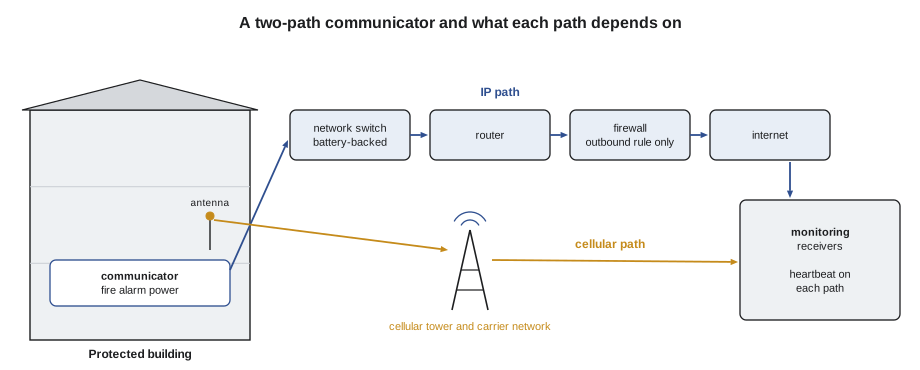
An IP communicator sends its messages over the building's data network and the internet to the centre's IP receiver. It connects to a network switch, gets an address, and holds an encrypted session with the receiver, exchanging short supervision messages, often called heartbeats or polls, at a fixed interval. If the receiver stops hearing from the communicator, it raises a path failure at the centre; if the communicator stops hearing from the receiver, it raises a trouble at the premises.
The IP path depends on equipment that isn't part of the fire alarm system: the owner's switches, routers, firewall and internet service. That equipment must be powered for at least as long as the fire alarm system, which in practice means a dedicated network switch on a battery-backed supply, or the owner's equipment on its own uninterruptible power supply with enough runtime. The firewall must allow the communicator's outbound connection to the receiver's address and port, and nobody may change that without telling the fire alarm company.
Cellular and radio communicators
A cellular communicator sends its messages over a commercial cellular network. It needs no telephone line and no building network, which makes it the fastest way to replace a dialer. It does need adequate signal strength, a carrier network that will remain in service for the life of the unit, and an antenna placed where the signal is good, which is often not in a basement electrical room. Carriers have shut down older 2G and 3G networks, and communicators built only for those networks stopped working. Modern units use LTE, often a low-power version intended for devices, and some can switch between carriers.
Radio communicators send signals over a private radio network owned by the monitoring company or a group of companies, often a mesh network in which each subscriber unit relays signals for others. Some fire departments and campuses run their own radio systems for the same purpose. These systems avoid commercial carriers but need their own planning and maintenance.
# Cellular signal strength: is there margin at the antenna location?
readings = {"basement electrical room": -109, "main floor corridor": -96, "roof antenna kit": -78}
minimum = -100      # the communicator maker's minimum, dBm (illustrative)
margin_wanted = 10  # dB above minimum to allow for weather, load and carrier changes
for place, rssi in readings.items():
    margin = rssi - minimum
    verdict = "good" if margin >= margin_wanted else ("weak" if margin >= 0 else "below minimum")
print(f"{place:26s} {rssi:5d} dBm margin {margin:3d} dB {verdict}")basement electrical room -109 dBm margin -9 dB below minimum main floor corridor -96 dBm margin 4 dB weak roof antenna kit -78 dBm margin 22 dB good
A location that barely meets the maker's minimum today may fail next winter, when snow loads trees, the carrier changes a tower or the building next door adds steel. Bramwell's practice is to want about 10 dB of margin, and to use a remote antenna kit when the communicator's location doesn't give it.
One path or two
CAN/ULC-S561 sets how many communication paths a system needs, how each is supervised and how quickly a failure must be detected, and the requirements depend on the type of transmission and the edition the authority has adopted. Most of Bramwell's installations use two paths, IP and cellular, so that the loss of either one leaves the building connected while the failure is fixed.
Two paths only help if they don't share a weak point. An IP path and a cellular path whose communicator sits on the same unbacked power outlet, or whose network switch and cellular antenna both depend on a router on a wall plug, fail together.
# Path supervision: when would a failure be noticed?
heartbeat_s = {"IP": 180, "cellular": 3600}         # supervision message interval
missed_allowed = {"IP": 2, "cellular": 1}            # misses before the receiver declares failure
for path in heartbeat_s:
    detect = heartbeat_s[path] * (missed_allowed[path] + 1)
print(f"{path:9s} heartbeat every {heartbeat_s[path]/60:4.0f} min -> failure noticed within about {detect/60:4.0f} min")IP heartbeat every 3 min -> failure noticed within about 9 min cellular heartbeat every 60 min -> failure noticed within about 120 min
The figures in the example are settings, not code values. The technician programs the intervals the centre and the authority require, and confirms at the centre's receiver that it really declares a failure when a path is cut.
Test signals and timing
A communicator also sends periodic test signals, sometimes called timer tests, so that the centre can detect a communicator that has stopped working entirely. The centre's automation expects each test within a window and raises a late-test event if one doesn't arrive. The interval is set by the standard the authority has adopted and by the centre; for dialers it was traditionally once a day, and shorter intervals are now common.
When a signal fails on the first path, the communicator retries and then switches to the other path. The retry count and timing affect how long a signal takes to arrive. In the pull station test in the last lesson, the communicator tried the IP path four times at 20-second intervals before switching to cellular, so the alarm took almost two minutes to reach the operator. Shortening the retries and switching paths sooner brought it under 30 seconds.
# How retries and path switching add up
def delivery_time(retries_on_first, retry_gap_s, second_path_s):
    return retries_on_first * retry_gap_s + second_path_s
before = delivery_time(4, 20, 38)
after = delivery_time(1, 10, 18)
print(f"before: {before} s after reprogramming: {after} s")before: 118 s after reprogramming: 28 s
Installing and replacing communicators
Communicator work follows the same steps on most jobs:
- Agree the account, the format, the paths and the receiver addresses or numbers with the centre before arriving.
- Mount the communicator in the fire alarm enclosure or a listed enclosure nearby, powered from the fire alarm system, and connect it to the panel.
- For IP, confirm with the owner's IT staff the switch port, address, firewall rule and the power backup for the network equipment, and get it in writing.
- For cellular, measure signal strength where the antenna will go, and use a remote antenna if needed.
- Program the points, then test every signal type and every point to the centre, confirming time and description on the operator's screen.
- Fail each path in turn and confirm the trouble at the premises and the path failure at the centre.
- Update the record drawings, the account, and the system documentation, including the network details.
Worked problem
Replacing a dialer at Willowbank
Willowbank School's old dialer uses two copper lines. The school board plans to cancel them next month. The board's IT department offers a network port on the school's switch, which is on a battery-backed supply with 30 minutes of runtime. The fire alarm's secondary supply is sized for 24 hours of standby. Cellular signal in the electrical room is -102 dBm. What should Bramwell install?
Show solution
- The network switch's 30 minutes of backup is far less than the fire alarm's 24 hours, so the IP path alone would fail in a long outage. Either the switch gets a supply with matching duration, or the IP path is not relied on alone.
- Cellular at -102 dBm is below a typical -100 dBm minimum, so the cellular unit needs a remote antenna; on the gym roof it reads -80 dBm.
- Install a combination IP and cellular communicator, powered from the fire alarm, with the antenna on the roof, and test both paths.
- Get the board's written agreement that the firewall rule and switch port will not be changed without notice.
Answer: A path is only as reliable as everything it depends on, including power for equipment the fire alarm company doesn't own.
Choosing a communicator for a building
Ravi's checklist for choosing a communicator starts with the building and the requirements, not the product. What does the authority require: the number of paths, the type of service, the supervision interval? Which paths are available and reliable at this address: is there good cellular signal from more than one tower, and does the owner have a network with proper backup power and an IT department willing to document the communicator's needs? Is the communicator compatible with the control unit and listed with it? Will the centre's receivers accept its format? And how long will the chosen paths last: a cellular unit built for a network the carrier plans to retire is a short-term fix.
# Score two communicator options for Willowbank (illustrative weights)
needs = {"two independent paths": 3, "works without owner network": 2, "signal margin on site": 3, "carrier network life": 2}
options = {"cellular only, LTE": {"two independent paths": 0, "works without owner network": 1, "signal margin on site": 1, "carrier network life": 1},
           "IP plus cellular": {"two independent paths": 1, "works without owner network": 1, "signal margin on site": 1, "carrier network life": 1}}
for name, has in options.items():
    score = sum(w * has[k] for k, w in needs.items())
print(f"{name:18s} score {score} of {sum(needs.values())}")cellular only, LTE score 7 of 10 IP plus cellular score 10 of 10
The checklist also covers the installation's documents. A communicator replacement is a change to the fire alarm system, so it needs the same records as any other change: the record drawings updated, the system documents listing the paths and settings, the centre's account updated, and the test results showing every signal reached the centre. Where the authority requires a permit for communicator replacements, Bramwell obtains it first.
Finally, the owner needs to understand what they are responsible for. If the IP path uses the owner's network, the owner must keep that network powered and configured as agreed. If the cellular path depends on a monthly service plan, the owner must keep paying for it. Many monitoring failures start with a well-meant change by someone who didn't know the fire alarm depended on it.
Common mistakes
MistakePlugging a communicator into a wall outlet.
InsteadPower it from the fire alarm system's supplies.
MistakeRelying on a network switch with short battery backup.
InsteadMatch the backup to the fire alarm's duration, or don't rely on that path alone.
MistakePlacing a cellular antenna where the signal is marginal.
InsteadMeasure, and use a remote antenna to get margin.
MistakeLeaving retry and switching settings at defaults.
InsteadSet them so signals arrive well within the limit.
MistakeTesting only one path.
InsteadFail each path and confirm the failure is reported at both ends.
Summary and key terms
- A communicator formats signals, sends them, retries, supervises its paths and sends test signals.
- Dialers depend on copper lines that carriers are retiring.
- IP paths depend on the owner's network, power and firewall.
- Cellular paths need signal margin and a carrier network that will last.
- Each path is supervised, and failures are reported at the premises and at the centre.
- Communicator
- The device that sends fire alarm signals off the premises.
- Dialer
- A digital alarm communicator transmitter that uses telephone lines.
- Heartbeat
- A regular supervision message between an IP or cellular communicator and the receiver.
- Path failure
- Loss of a communication path, reported at the premises and at the centre.
- Timer test
- A periodic test signal that shows the communicator is alive.
Practice problems
Work each problem on paper first, then reveal the answer to check.
Why are dialers being replaced?
Show answer
Carriers are retiring the copper lines they depend on.
What must an IP path's network equipment have?
Show answer
Backup power at least as long as the fire alarm's, and an unchanged firewall rule.
Cellular reads -98 dBm against a -100 dBm minimum. Is it good?
Show answer
No, the margin is too small; use a remote antenna.
How do you prove a path is supervised?
Show answer
Fail it and confirm troubles at the premises and the centre.
What slows a signal that fails on the first path?
Show answer
The retries and the delay before switching to the second path.
Lesson quiz · 5 questions
Score 60% or more to complete this lesson.
Create a free account to save your progress, take quizzes and earn a certificate.