
FAT-320 · Lesson 1 of 12 · 20 min
Why fire alarms are monitored
Sasha Vukovic's fourth year at Bramwell Fire Protection starts with a change of desk. Donna Achebe has moved her from Gerry's inspection crew to the integration group, the people who connect fire alarm systems to everything else: the signal receiving centre that watches them, the networks that join panels together, and the elevators, fans, dampers and doors that a fire alarm controls. Ravi Menon, the designer, runs the group's technical side, and Gerry still signs off the hardest jobs. 'Up to now you have mostly worked inside the panel,' Gerry tells her on the first morning. 'This year you work on the wires that leave it. That is where most of the strange faults live.' This course covers that work, starting with the simplest question: why a fire alarm needs anyone outside the building to hear it.
A fire alarm that only rings inside
A fire alarm system on its own warns the people in the building. Horns sound, strobes flash, voice messages play and, in many buildings, a panel at the entrance shows where the fire is. That is the system's first job, and it does it whether or not anyone outside the building ever finds out. But the system's warnings only help the people who are there to hear them. At three in the morning in a closed warehouse, an office tower on a holiday or a school in August, the horns may sound for an hour before anyone notices, and by then a small fire has become a large one.
Even in an occupied building, people who hear an alarm often assume someone else has called the fire department. Surveys after fires repeatedly find delays of many minutes between the alarm and the first call, and sometimes no call at all. Monitoring removes that gap. A monitored system sends its alarm signal to a staffed facility that acts on it at once, whatever time it is and whoever is or isn't in the building.
What monitoring adds
Monitoring does three things that an unmonitored system cannot:
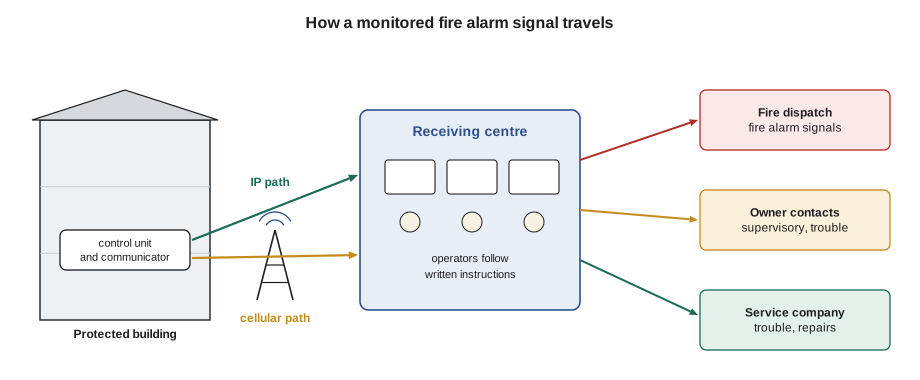
- It summons help for fire alarm signals. The signal receiving centre receives the signal within seconds and passes it to the fire department's dispatch centre, normally within a minute or two of the detector operating.
- It reports supervisory signals. A closed sprinkler valve, a low dry-pipe air pressure or a fire pump that has lost power is not a fire, but it means the building's protection is impaired. Someone has to know, so that the owner can fix it before it matters.
- It reports trouble signals. An open circuit, a ground fault, a failed battery charger or a lost communication path means part of the fire alarm system may not work. Without monitoring, a trouble signal in an empty building can sit unnoticed for weeks.
The second and third points are easy to forget. Most signals a monitoring centre receives are not fires. They are trouble and supervisory signals, and the value of monitoring is as much in getting those fixed as in calling the fire department.
When monitoring is required
In Canada, the National Building Code requires many fire alarm systems to notify the fire department automatically. Where a building is sprinklered, the sprinkler waterflow signal must reach the fire department, and the code describes how. Where the code or the authority having jurisdiction requires a fire alarm system to transmit signals off the premises, the transmission and the monitoring are done to CAN/ULC-S561, the standard for fire signal receiving centres and systems. The certificate of service issued under that standard tells the authority that the building is being monitored by a listed centre, to the standard, under a current agreement.
Even where monitoring is not required, many owners choose it, and their insurers often insist on it. A small retail building or a church may have a monitored system for that reason alone. For the technician, the reason matters less than the result: once a system is monitored, the monitoring is part of the fire alarm system, and everything about it must work and be tested.
Who is involved
A monitored system brings in parties who are not in the building:
- The monitoring company, which runs the signal receiving centre and has a contract with the owner. At Bramwell, most buildings are monitored by Prairie Signal Monitoring, an independent company. Some large owners, like Eastview General Hospital, also monitor their own systems from a security office on site.
- The fire department's dispatch centre, which receives the alarm from the monitoring centre and sends trucks.
- The owner, who receives supervisory and trouble calls and must act on them, and who pays for the service.
- The service company, Bramwell in this course, which installs and programs the communicator, tests the signals, and answers trouble calls.
- The telecommunication carriers whose networks carry the signals: an internet provider, a cellular carrier, or both.
Each of those parties has a piece of the system. The fire alarm technician is often the only person who sees the whole thing, from the detector to the operator's screen, and is the one who has to prove that the whole chain works.
What can go wrong between the building and the centre
A signal that leaves the panel has a long way to go. It has to be formatted by the communicator, sent over a network that belongs to someone else, received by equipment at the centre, matched to the right account, shown to an operator, and acted on correctly. A failure anywhere along that path can mean the fire department isn't called. Sasha's first week in the integration group includes three examples from Bramwell's service files:
- A small office building where the owner cancelled the old copper telephone lines to save money. The communicator still had both of its lines connected to dead jacks, and it had been sending trouble signals for two days. The monitoring centre had called the owner each time and left a voicemail.
- A retail store whose new communicator sent every signal to the centre correctly, but with the wrong zone list: the centre's account still had the old zone descriptions, so a waterflow alarm appeared on the operator's screen as 'zone 3, office smoke'.
- A seniors' residence whose cellular communicator worked perfectly on the day it was installed and then started dropping signals after the carrier changed its network. Nobody had checked the signal strength margin.
None of these was a fire alarm panel problem. All of them were fire alarm system problems.
# Where a signal can be lost: a simple path check
path = [
    ("detector operates", True),
    ("panel processes the alarm", True),
    ("communicator formats the message", True),
    ("network carries it to the centre", False),   # line cancelled by owner
    ("centre receiver decodes it", True),
    ("account and zone list match", True),
    ("operator acts on it", True),
]
for step, ok in path:
    print(f"{step:34s} {'ok' if ok else 'FAILED - signal stops here'}")
    if not ok:
        break
print("the fire department is only called if every step works")detector operates ok panel processes the alarm ok communicator formats the message ok network carries it to the centre FAILED - signal stops here the fire department is only called if every step works
How monitoring and integration fit together
The rest of this course follows the signals outward. The next three lessons look at the monitoring centre, the communicators and paths that reach it, and the signals and priorities it handles. Lessons 5 and 6 cover networks of panels inside a building, and how to keep those networks secure. Lessons 7 to 11 cover the interfaces: what the fire alarm makes other systems do, and what other systems tell the fire alarm. Lesson 12 is a capstone at Eastview General Hospital, where a monitoring failure and an interface fault turn up in the same week.
Some of this work overlaps with other courses. The elevator side of recall belongs to the elevator mechanic and is covered in the elevator program; door hardware and access control belong to the security and door trades; the building automation system belongs to the controls contractor. The fire alarm technician needs to understand enough of each to test the interface and to know when a fault is on the other side of the line.
Worked problem
Is it monitored?
Sasha is sent to a two-storey medical clinic for a trouble call. The panel shows 'communication failure, line 1 and line 2'. The owner says, 'It's fine, we don't need monitoring, the building isn't big.' The panel has a communicator, the building is sprinklered, and the inspection tag lists a monitoring account. What should Sasha do?
Show solution
- Confirm with the monitoring centre whether the account is active and what it has received.
- Check the building's records: a sprinklered building's waterflow signal normally has to reach the fire department, so monitoring is very likely required.
- Find the cause of the communication failure, here two dead telephone jacks, and tell the owner that the system cannot report alarms until it is fixed.
- Write it up as an impairment if it can't be fixed that day, so the owner and the authority know.
Answer: Whether monitoring is required is not the owner's opinion; it is set by the code, the authority and the system's design.
Monitoring and the impairment rules
Because monitoring is part of the system, losing it is an impairment like losing a zone of detectors. When a communicator can't reach the centre, or the account has lapsed, the building can't summon the fire department automatically, even though its detectors and signals still work. The owner must be told, the authority informed where its rules require, and interim measures put in place until the connection is restored. In a staffed building, an interim measure might be a person at the control unit who calls the fire department on any alarm; in an empty building, it may mean a fire watch or keeping the building closed.
The same thinking applies in the other direction. A technician who puts an account on test, disables a communicator to work on it, or disconnects a path to replace equipment has created a temporary impairment. The account must be returned to normal, and the centre's confirmation obtained, before the technician leaves. Bramwell's service reports have a line for it: 'monitoring restored and confirmed with the centre at ...', with the operator's name and the time.
# A simple impairment check for monitoring at the end of a visit
checks = {"account off test": True, "both paths restored at panel": True,
          "centre confirms test signal received": False, "operator name and time recorded": False}
for item, done in checks.items():
    print(f"{item:38s} {'done' if done else 'NOT DONE'}")
print("leave site:", "yes" if all(checks.values()) else "no - finish the monitoring checks first")account off test done both paths restored at panel done centre confirms test signal received NOT DONE operator name and time recorded NOT DONE leave site: no - finish the monitoring checks first
A short history of monitoring
Fire alarm signals have been sent off the premises for well over a century. Early city systems used street boxes wired to a central fire alarm office, where operators read coded signals from a paper tape. Later, private companies ran central stations connected to buildings by dedicated leased lines, and then by ordinary telephone lines using dialers. Each change made monitoring cheaper and more widespread, and each brought new ways for a signal to be lost. The current move from copper lines to IP and cellular paths is the latest of those changes, and it is why so much of a modern fire alarm technician's work happens at the edge of the system, where the fire alarm meets networks it doesn't own.
What hasn't changed is the purpose. Whether the signal travels on a street box circuit or an encrypted internet session, the point is that a fire in an empty building at night is reported in seconds, and that a closed valve or a dead battery is reported before it matters.
Common mistakes
MistakeTreating monitoring as an optional extra.
InsteadTreat it as part of the fire alarm system, tested like any other part.
MistakeThinking a monitoring centre mostly handles fires.
InsteadMost signals are trouble and supervisory signals, and they matter.
MistakeTesting the panel and assuming the signal arrives.
InsteadProve the signal reaches the centre and shows correctly.
MistakeLeaving trouble signals for the owner to sort out.
InsteadFind the cause; a lost path means the building can't report a fire.
MistakeForgetting the other parties.
InsteadThe carrier, the centre and the owner each hold part of the system.
Summary and key terms
- Monitoring sends fire alarm, supervisory and trouble signals to a staffed centre.
- It summons the fire department even when nobody in the building calls.
- Supervisory and trouble signals get impairments fixed before a fire.
- The code and the authority decide when monitoring is required; CAN/ULC-S561 says how it is done.
- The whole path, from detector to operator, is part of the fire alarm system.
- Signal receiving centre
- The staffed facility that receives and acts on signals from monitored fire alarm systems.
- Supervisory signal
- A signal that a fire protection system needs attention, such as a closed valve.
- Trouble signal
- A signal that part of the fire alarm system may not work.
- Communicator
- The device that sends signals from the fire alarm system to the monitoring centre.
- Dispatch centre
- The fire department facility that receives calls and sends trucks.
Practice problems
Work each problem on paper first, then reveal the answer to check.
Name the three kinds of signal a monitored system sends.
Show answer
Fire alarm, supervisory and trouble.
Why do supervisory signals need to reach someone?
Show answer
They mean the fire protection is impaired and must be fixed.
Who usually has a contract for monitoring?
Show answer
The owner, with the monitoring company.
An owner cancels the telephone lines. What happens to monitoring?
Show answer
The communicator can't send signals unless another path exists.
Who proves the whole signal path works?
Show answer
The fire alarm technician, by testing to the centre.
Lesson quiz · 5 questions
Score 60% or more to complete this lesson.
Create a free account to save your progress, take quizzes and earn a certificate.