
FAT-320 · Lesson 11 of 12 · 20 min
Integration with building automation and mass notification
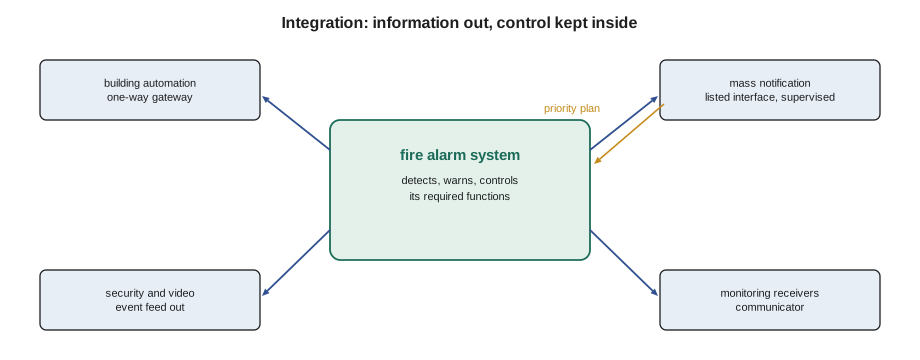
Eastview's facilities department wants the fire alarm system's status on the building automation system's screens, and its emergency management team wants the mass notification system to use the fire alarm's speakers. Ravi chairs the meeting with the controls contractor, the security manager and Tomasz from IT. 'Everyone wants a piece of the fire alarm,' he says afterwards. 'Our job is to give them what helps, and make sure none of it can stop the fire alarm doing its job.' This lesson covers sharing information with building automation and other systems, how mass notification and fire alarm signals share equipment, and the rules that keep life safety functions protected.
What integration is for
Integrating the fire alarm with other systems can help in several ways:
- Facilities staff see alarms, troubles and supervisory signals on the screens they already watch, with floor plans and equipment details.
- The building automation system can respond to fire alarm events in ways that are useful but not required, such as switching lighting or recording conditions.
- Security staff see door states, camera views near an alarm and the fire alarm's events together.
- Emergency managers can use the fire alarm's speakers and visible signals for other emergencies, such as severe weather or a security threat.
Each of those is a convenience or a separate emergency function. None of them may make the fire alarm's own functions depend on another system, and none may let another system interfere with the fire alarm.
Gateways and protocols
Fire alarm systems share information through gateways, which translate the fire alarm's internal events into the protocols other systems use. In buildings, the common protocols are BACnet and Modbus. A fire alarm point, such as a detector or a zone, is mapped to an object in the other protocol, and its state, alarm, trouble, supervisory or normal, is sent whenever it changes.
The safest gateway is one-way: it sends information out and accepts nothing in. Some gateways accept specific commands, such as acknowledge or silence from a workstation, and these must be listed for that purpose and controlled like any other operating point. A gateway that lets a building automation operator reset the fire alarm from an office would bypass every control on who may operate the system, which is why it isn't allowed without the listing and the owner's and authority's acceptance.
# Map fire alarm points to building automation objects (one-way, illustrative)
points = [("N-L1-014", "smoke north wing level 1 corridor", "alarm"),
          ("N-L2-031", "duct AHU-N2", "supervisory"),
          ("N-PS-01", "RPS-3 battery", "trouble"),
          ("N-L3-007", "pull station level 3 stair B", "normal")]
for k, (addr, desc, state) in enumerate(points, start=101):
    print(f"binary value {k}: {addr:9s} {desc:34s} state={state}")
print("gateway mode: send only; commands from the automation side are refused")binary value 101: N-L1-014 smoke north wing level 1 corridor state=alarm binary value 102: N-L2-031 duct AHU-N2 state=supervisory binary value 103: N-PS-01 RPS-3 battery state=trouble binary value 104: N-L3-007 pull station level 3 stair B state=normal gateway mode: send only; commands from the automation side are refused
What building automation may and may not do
Building automation systems run fans, pumps, lights and much more, and they are designed for comfort and efficiency, not life safety. They can take part in fire responses, but the rules are strict:
- A life safety function required by the code, such as fan shutdown on smoke or smoke control, is either controlled directly by the fire alarm system or done through a building automation system listed for that service, with its wiring and programming under the same controls.
- Where a fire alarm relay feeds an automation controller that then stops a fan, the whole path is part of the fire alarm function and is tested as one, and the automation programming for that function is documented and protected from change.
- Information sent to the automation system for convenience, such as displaying alarms, is not relied on for any required function.
At Eastview, the facilities team's request is met with a one-way BACnet gateway that sends every fire alarm point's state to the automation screens. Required fan shutdowns stay hard-wired from fire alarm relays at each air handler, as the last lesson described.
Mass notification and the fire alarm
Mass notification systems deliver messages about emergencies other than fire: severe weather, chemical releases, security threats or shelter-in-place instructions. In buildings with a voice evacuation fire alarm, the same speakers, amplifiers and visible signals can often be used, as Voice Evacuation and Mass Notification describes. When two systems share equipment, the question is which message has priority when both want it.
In Canada, mass notification equipment is covered by CAN/ULC-S576, and the priority between mass notification and fire alarm messages is set by the building's design and emergency plan, accepted by the authority. A fire alarm message normally keeps priority unless the plan deliberately gives a particular mass notification message precedence.
# Message priority when systems share speakers (illustrative plan)
priority = ["live voice from fire command", "security threat: shelter in place", "fire evacuation",
            "severe weather: move to shelter areas", "test and general paging"]
def play(requests):
    return min(requests, key=priority.index)
for req in [("fire evacuation", "test and general paging"),
            ("fire evacuation", "security threat: shelter in place"),
            ("severe weather: move to shelter areas", "fire evacuation")]:
print(f"{' + '.join(req):55s} -> {play(req)}")fire evacuation + test and general paging -> fire evacuation fire evacuation + security threat: shelter in place -> security threat: shelter in place severe weather: move to shelter areas + fire evacuation -> fire evacuation
The plan in the example lets a security threat message override fire evacuation and puts live voice from the fire command position above everything. That is the kind of decision the owner, the designer and the authority make together; the technician programs it and tests it.
Security, video and campus monitoring
Security systems often receive fire alarm events so that officers can see camera views near an alarm, check doors and guide responders. The same rules apply: information flows out to the security system, and no security function may stop the fire alarm. Large campuses like Eastview may run their own monitoring station in a security office, receiving all fire alarm events from the network and forwarding fire alarms to the fire department as the authority and the standard require. That station is part of the monitoring arrangement and must meet the requirements for it, including trained, staffed operation at all times.
Supervision of integrations
Even a one-way gateway can fail, and when it does, the people relying on the automation screens stop seeing alarms. Gateways and interfaces should be supervised so that their failure is reported, at least on the receiving system and preferably as a trouble at the fire alarm where the gateway is listed to do so. Interfaces that carry required functions, such as the connection between the fire alarm and a shared mass notification system, must be supervised by the fire alarm system.
# Is the gateway still talking? (heartbeat age check on the automation side, illustrative)
heartbeat_limit_s = 120
last_seen = {"fire alarm gateway": 35, "mass notification interface": 410, "security event feed": 15}
for link, age in last_seen.items():
print(f"{link:28s} last heard {age:4d} s ago {'ok' if age <= heartbeat_limit_s else 'LINK LOST - report and investigate'}")fire alarm gateway last heard 35 s ago ok mass notification interface last heard 410 s ago LINK LOST - report and investigate security event feed last heard 15 s ago ok
Documenting and testing integrations
Every integration is documented: the gateway or interface, its listing, its direction, the points it carries, the protocol settings, and who owns each side. Tests confirm that each mapped point arrives correctly on the other system, that commands are refused where the gateway is one-way, that disconnecting the gateway causes the expected trouble and affects no fire alarm function, and, for shared mass notification, that the priorities work as the plan says. After any change on either side, the affected points are tested again.
Worked problem
Eastview's integrations
Eastview asks for: (1) fire alarm status on the automation screens; (2) the ability for facilities to silence and reset the fire alarm from the automation workstation; (3) severe weather and lockdown messages over the fire alarm speakers; (4) camera pop-ups at the security desk on any alarm. How should each be handled?
Show solution
- (1) A listed one-way gateway sending every point's state; required fan shutdowns stay hard-wired.
- (2) Declined as asked. Silence and reset stay at the fire alarm's own operating points, available to trained staff with the right access. A listed fire alarm workstation in the facilities office can be added if the owner wants it.
- (3) Through a listed interface between the mass notification system and the voice evacuation system, with priorities set in the emergency plan and accepted by the authority, and the interface supervised.
- (4) An outgoing event feed to the security system, with no path back into the fire alarm.
- Each is documented and tested, including failure of each link.
Answer: Give other systems information; keep control of fire alarm functions inside the fire alarm system.
Graphic workstations and annunciation
Large buildings often have a graphic workstation that shows fire alarm events on floor plans, with the device's location, description and instructions. It is a powerful tool for security staff and firefighters, but it has rules of its own. Where a workstation is used as a required annunciator or as a place where trained staff operate the system, it must be listed for that purpose and supplied from power that lasts as long as the fire alarm's. Where it is only a convenience, the required annunciator at the fire department entrance remains the primary display, and the workstation's failure must not affect it. The floor plans must be kept current: a graphic that shows a detector in a room that was demolished two renovations ago misleads the people who rely on it.
# Check that each device on the graphic floor plan is still in the panel's program (illustrative)
graphic = {"N-L2-014", "N-L2-015", "N-L2-016", "N-L2-019", "N-L2-022"}
panel = {"N-L2-014", "N-L2-015", "N-L2-016", "N-L2-018", "N-L2-019"}
print("on graphic but not in panel:", sorted(graphic - panel))
print("in panel but missing from graphic:", sorted(panel - graphic))on graphic but not in panel: ['N-L2-022'] in panel but missing from graphic: ['N-L2-018']
Data, records and analysis
Integrated systems produce useful data: which detectors cause unwanted alarms, how often troubles occur and on which circuits, how long supervisory conditions last before someone fixes them. Owners like Eastview increasingly want that data in their maintenance systems. Sharing it is fine when it flows out through the same controlled gateways and doesn't open a path back into the fire alarm. For Bramwell, the data helps target maintenance: the detectors with the most unwanted alarms are cleaned or replaced first, and circuits with repeated ground faults are inspected for damage.
The rule for all integration is the same one that runs through this course. The fire alarm system detects, warns, controls its required functions and reports, on its own, whatever happens to the systems around it. Other systems are welcome to watch and to receive information. They are not allowed to stand between the fire alarm and its job.
Who owns each side
Integration projects involve several companies, and confusion about ownership causes many faults. Bramwell's integration documents include a simple table for each connection: which system sends, which receives, who installed and maintains each end, what is carried, and who must be told about changes. When the controls contractor updates the building automation software, the table tells them that the fire alarm gateway's points must be checked afterwards; when Bramwell changes the fire alarm program, it tells Sasha to send the new point list to the controls contractor and the security manager. A connection that nobody owns is the one that breaks without anyone noticing.
At Eastview, the table has eleven rows: the BAS gateway, the mass notification interface, the security event feed, the monitoring communicator, the elevator interfaces for three groups, the smoke control panel, the kitchen hood monitoring and two special hazard releasing panels. Each row has a named contact on both sides.
Common mistakes
MistakeLetting the building automation system reset the fire alarm.
InsteadKeep operation at the fire alarm's own controls.
MistakeRelying on automation screens to notice alarms.
InsteadThey are a convenience, not a required function.
MistakeSharing speakers without a written priority plan.
InsteadSet priorities in the emergency plan with the authority.
MistakeLeaving gateway failures unsupervised.
InsteadReport them, and supervise interfaces that carry required functions.
MistakeChanging mapped points without retesting.
InsteadRetest every affected point after any change.
Summary and key terms
- Integration shares fire alarm information with other systems through gateways.
- One-way gateways send information out and accept nothing in.
- Required functions are controlled by the fire alarm or a listed system, never by convenience links.
- Mass notification may share fire alarm equipment, with priorities set by the emergency plan.
- Integrations are documented, supervised and tested, including their failure.
- Gateway
- A device that translates fire alarm events into another system's protocol.
- BACnet
- A common protocol for building automation systems.
- Mass notification
- A system that delivers messages about emergencies other than fire.
- Priority plan
- The written rules for which message plays when systems share equipment.
- Proprietary station
- A monitoring station run by the property owner on site.
Practice problems
Work each problem on paper first, then reveal the answer to check.
What is the safest kind of gateway?
Show answer
One that sends information out and accepts nothing in.
Can building automation screens replace the fire alarm annunciator?
Show answer
No; they are a convenience.
Who sets mass notification priority?
Show answer
The owner, designer and authority through the emergency plan.
Facilities wants to reset the fire alarm from their workstation. What is the answer?
Show answer
Not through the automation system; use listed fire alarm controls.
What must a test of a gateway include?
Show answer
Point mapping, refused commands and the effect of its failure.
Lesson quiz · 5 questions
Score 60% or more to complete this lesson.
Create a free account to save your progress, take quizzes and earn a certificate.