
FAT-320 · Lesson 10 of 12 · 20 min
Sprinkler, suppression and special hazard interfaces
At Cartwright Distribution Centre, the owner is adding a cold-storage room protected by a preaction sprinkler system and a small server room protected by a clean agent system. Luis, Bramwell's sprinkler foreman, and Ravi meet Sasha in the riser room. 'The sprinkler side is mine,' Luis says. 'But a preaction valve won't open until your panel tells it to, and a clean agent system won't discharge without a releasing panel. That is where our two trades share a wire.' Initiating and Notification Devices covered waterflow switches and valve supervisory switches. This lesson covers the interfaces between fire alarm systems and suppression systems: monitoring, releasing and the signals that travel both ways.
Monitoring sprinkler systems
Every sprinklered building with a fire alarm system sends the sprinkler system's signals to it. Waterflow switches send fire alarm signals; valve supervisory switches, low-air switches on dry systems, low-temperature switches in valve rooms and similar devices send supervisory signals. The fire alarm system's job is to report those signals locally and to the monitoring centre, not to operate the sprinklers, which work on their own when heat opens a head.
Fire pumps are also monitored. The usual signals are pump running, loss of power or phase at the controller, phase reversal, and controller trouble, and for diesel pumps the engine and fuel troubles. The fire pump standard and the fire alarm standard together say which are supervisory signals and which, if any, are troubles; pump running is commonly a supervisory signal, because a running pump means water is moving or pressure has dropped.
# Classify sprinkler and pump signals the way the design requires (illustrative)
signals = {"waterflow riser 2": "alarm", "valve VS-4 closed": "supervisory", "dry valve low air": "supervisory",
           "valve room low temperature": "supervisory", "fire pump running": "supervisory",
           "fire pump power loss": "supervisory", "fire pump phase reversal": "supervisory",
           "pump controller trouble": "trouble"}
from collections import Counter
for name, kind in signals.items():
    print(f"{name:27s} {kind}")
print(dict(Counter(signals.values())))waterflow riser 2 alarm
valve VS-4 closed supervisory
dry valve low air supervisory
valve room low temperature supervisory
fire pump running supervisory
fire pump power loss supervisory
fire pump phase reversal supervisory
pump controller trouble trouble
{'alarm': 1, 'supervisory': 6, 'trouble': 1}Preaction and deluge systems
A preaction sprinkler system has dry pipes held closed by a valve that opens only when a detection system operates. It is used where an accidental leak would be costly, such as cold storage that would freeze a wet pipe, archives and computer rooms. A deluge system has open heads and floods an area when its valve opens. In both cases, the valve is opened electrically by a solenoid controlled by a releasing panel, which is a fire alarm control unit listed for releasing service.
Preaction systems are described by how many conditions must be met before water enters the pipes:
- Non-interlock: the valve opens on detection or on loss of air pressure from an opened head.
- Single interlock: the valve opens on detection; water then flows when a head opens.
- Double interlock: the valve opens only when detection has operated and a head has opened, causing loss of air pressure. This is common in freezers, because water can't enter the pipes on detection alone.
# When does a preaction valve open? (types and conditions)
def valve_opens(kind, detection, air_lost):
    if kind == "non-interlock":
        return detection or air_lost
    if kind == "single interlock":
        return detection
    if kind == "double interlock":
        return detection and air_lost
for kind in ["non-interlock", "single interlock", "double interlock"]:
    row = [valve_opens(kind, d, a) for d, a in [(True, False), (False, True), (True, True)]]
print(f"{kind:16s} detection only: {row[0]!s:5s} head opened only: {row[1]!s:5s} both: {row[2]!s:5s}")non-interlock detection only: True head opened only: True both: True single interlock detection only: True head opened only: False both: True double interlock detection only: False head opened only: False both: True
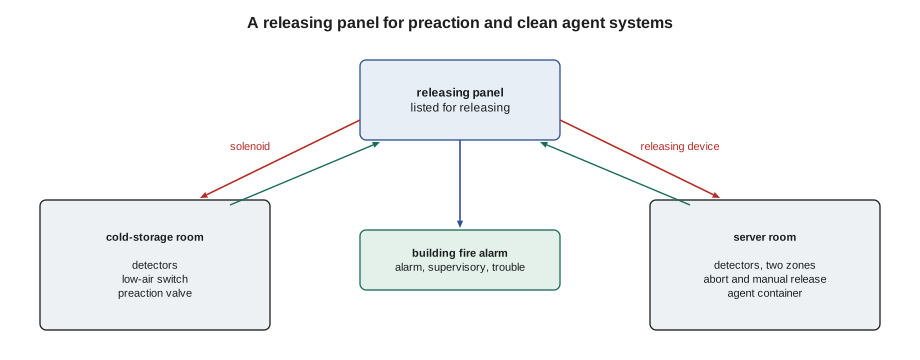
Cartwright's cold-storage room uses a double-interlock system. Its releasing panel receives the room's detectors and the low-air switch, and only when both conditions are met does it energize the solenoid that opens the valve.
Clean agent and other special hazard systems
Clean agent systems flood a room with a gaseous agent that suppresses fire without water, protecting electronics and valuable contents. Other special hazard systems use carbon dioxide, water mist, foam or dry chemical. Most are released by a listed releasing panel, which runs a sequence designed to protect people as well as the equipment:
- Detection, often cross-zoned: two separate detectors must both operate, or two zones must both alarm, so that a single faulty detector doesn't cause a discharge.
- Pre-discharge alarm: signals in the room warn people to leave, and a time delay, commonly about 30 seconds, gives them time to do so.
- Abort station: a switch near the exit that a person can hold to delay the discharge while a false alarm is checked, where the authority allows it.
- Manual release: a station that starts the discharge sequence directly.
- Discharge: the releasing device on the agent container operates, and the panel reports the discharge.
- Auxiliary functions: shutting down the room's air handling, closing dampers and doors, and sometimes cutting power to equipment, so the agent stays in the room.
# A clean agent sequence with cross-zoning and a pre-discharge delay (illustrative times)
events = [(0, "zone 1 detector"), (40, "zone 2 detector"), (52, "abort held"), (75, "abort released")]
delay = 30
cross = {"zone 1 detector", "zone 2 detector"}
seen = set(); start = None; held = 0; held_since = None
for t, e in events:
    seen.add(e)
    if e == "abort held": held_since = t
    if e == "abort released" and held_since is not None: held += t - held_since; held_since = None
    if start is None and cross <= seen:
        start = t; print(f"{t:3d} s both zones in alarm: pre-discharge signals on, countdown {delay} s")
discharge = start + delay + held
print(f"abort held for {held} s, so discharge at {discharge} s")40 s both zones in alarm: pre-discharge signals on, countdown 30 s abort held for 23 s, so discharge at 93 s
In the example the countdown starts when the second zone alarms, at 40 seconds. Someone holds the abort for 23 seconds while they check the room, so the discharge happens at 93 seconds instead of 70. Abort functions vary by system and are set by the authority and the agent standard; some restart the full delay when the abort is released.
Kitchen hood and other monitored systems
Kitchen hood suppression systems and some other special systems work on their own, with their own detection and release. The fire alarm system monitors them: a discharge sends an alarm signal, and a trouble or supervisory condition is reported where the system provides one. The hood system itself shuts off cooking fuel and power, through its own devices, and is tested by its own trade.
Who is responsible for what
These interfaces sit at the boundary between trades, so responsibilities must be clear:
- The sprinkler or special hazard contractor designs and maintains the suppression system, the valve, the agent, the containers and the piping.
- The fire alarm technician maintains the releasing panel and the detection, the releasing circuits and the monitoring connections, where the releasing panel is part of the fire alarm system.
- The releasing circuits must be disabled during fire alarm testing, using the panel's disable function and, where the system allows, physical isolation of the releasing device, so that testing doesn't discharge agent or flood a preaction system. Disabling is recorded, and re-enabling is confirmed before leaving.
# Before and after testing: release outputs disabled, then confirmed enabled
outputs = {"preaction solenoid cold room": "enabled", "agent release server room": "enabled"}
log = []
for o in outputs: outputs[o] = "disabled"; log.append(f"disabled {o}")
# ... testing happens here ...
for o in outputs: outputs[o] = "enabled"; log.append(f"re-enabled {o}")
print("\n".join(log))
print("all release outputs enabled:", all(v == "enabled" for v in outputs.values()))disabled preaction solenoid cold room disabled agent release server room re-enabled preaction solenoid cold room re-enabled agent release server room all release outputs enabled: True
Testing the interfaces
For sprinkler monitoring, each waterflow and supervisory device is operated with the sprinkler trade and its signal confirmed at the panel and the monitoring centre, as Inspection and Testing describes. For releasing systems, the releasing panel's logic is tested with the releasing devices disabled or replaced by test loads: cross-zoning, time delays, abort and manual release, the outputs to auxiliary functions and the signals to the building fire alarm. Actual discharge tests, where required, are planned with the owner, the special hazard contractor and the authority.
Worked problem
Cartwright's new rooms
In the commissioning test at Cartwright, the cold-storage releasing panel opens the preaction valve when a single smoke detector operates, without any loss of air. The design calls for double interlock. The server room panel counts down 30 seconds after the first detector. What is wrong?
Show solution
- The cold-storage panel is programmed as single interlock. It must require both detection and loss of air pressure before it energizes the solenoid.
- The server room panel starts its countdown on one detector, so it isn't cross-zoned as designed. It must wait for both zones.
- Both are programming faults. They are corrected, and the logic is retested with the releasing devices disabled.
- The building fire alarm is checked to confirm it receives the alarm, supervisory, trouble and discharge signals from both panels.
Answer: Releasing logic is life-safety and property-critical; test every condition before enabling discharge.
Releasing panels and the building fire alarm
A releasing panel may be the building's main fire alarm control unit, a separate listed releasing panel that reports to the main system, or a node on the fire alarm network. Whatever the arrangement, the building fire alarm must receive the releasing panel's signals: alarm when detection operates, supervisory for conditions such as a closed agent valve or a disabled release, trouble for faults, and a discharge signal when agent or water is released. The monitoring centre receives them as well, described clearly enough that an operator understands that a suppression system, not just a detector, has operated.
# Signals from a releasing panel to the building fire alarm (illustrative mapping)
mapping = {"server room zone 1 alarm": "alarm", "server room zone 2 alarm": "alarm",
           "agent discharged": "alarm", "abort held": "supervisory", "release disabled": "supervisory",
           "agent low pressure": "supervisory", "releasing circuit open": "trouble"}
for signal, kind in mapping.items():
print(f"{signal:26s} -> building fire alarm and centre as {kind}")server room zone 1 alarm -> building fire alarm and centre as alarm server room zone 2 alarm -> building fire alarm and centre as alarm agent discharged -> building fire alarm and centre as alarm abort held -> building fire alarm and centre as supervisory release disabled -> building fire alarm and centre as supervisory agent low pressure -> building fire alarm and centre as supervisory releasing circuit open -> building fire alarm and centre as trouble
Special hazard safety
Special hazard systems can be dangerous to people. Carbon dioxide systems at extinguishing concentrations can kill, and even clean agents displace air or produce decomposition products in a fire. The design includes warning signals, delays, lockout valves for maintenance, signs and procedures, and the fire alarm technician respects all of them. Before working in a protected room, the technician confirms with the owner and the special hazard contractor that the system is in a safe state for the work, follows the lockout procedure for the agent supply where one exists, and never relies only on a panel's disable switch where the system's procedures require a physical lockout.
Restoring the system is equally important. A releasing panel left disabled, an agent container's releasing device left disconnected, or a preaction valve left in a manual position leaves the protected area without its suppression. The end-of-visit checklist confirms each output is enabled and the system is normal, and the special hazard contractor and the owner are told.
Finally, the records for a suppression interface list the releasing panel, its program version, the release outputs, the auxiliary functions, the signals to the building fire alarm and the special hazard contractor's contact, so the next technician can test it safely.
Common mistakes
MistakeTesting a releasing panel with the releasing devices connected.
InsteadDisable and isolate releases first, and re-enable after.
MistakeTreating a running fire pump as a trouble.
InsteadIt is commonly a supervisory signal; follow the design.
MistakeProgramming double interlock as single interlock.
InsteadCheck the logic against the design for every condition.
MistakeAssuming the fire alarm operates sprinklers.
InsteadSprinklers operate on heat; the fire alarm monitors them.
MistakeTesting a hood system's fuel shutoff as a fire alarm function.
InsteadIt belongs to the hood system's own trade.
Summary and key terms
- Sprinkler systems are monitored: waterflow is an alarm, valves and air are supervisory.
- Fire pumps send running, power and controller signals.
- Releasing panels open preaction and deluge valves and release special agents.
- Clean agent sequences use cross-zoning, pre-discharge delay, abort and manual release.
- Releasing outputs are disabled for testing and confirmed enabled afterwards.
- Releasing panel
- A control unit listed to operate suppression system releases.
- Preaction system
- A dry sprinkler system whose valve opens on detection.
- Double interlock
- A preaction arrangement needing detection and an opened head.
- Cross-zoning
- Requiring two detectors or zones before releasing.
- Abort station
- A switch that delays discharge while held.
Practice problems
Work each problem on paper first, then reveal the answer to check.
Which preaction type needs both detection and loss of air?
Show answer
Double interlock.
What is a pre-discharge delay for?
Show answer
To give people time to leave before agent is released.
A fire pump starts. What kind of signal is that usually?
Show answer
Supervisory.
What must happen to release outputs before testing?
Show answer
They are disabled and isolated, then re-enabled after.
Who maintains the agent containers and piping?
Show answer
The special hazard contractor.
Lesson quiz · 5 questions
Score 60% or more to complete this lesson.
Create a free account to save your progress, take quizzes and earn a certificate.