
FAT-310 · Lesson 8 of 12 · 20 min
Two-way communication for areas of refuge and elevator lobbies
Mrs. Ferrante on Riverlight's 15th floor uses a wheelchair. In an evacuation she can't use the stairs, and the elevators are recalled to the ground floor and taken out of normal service when the fire alarm operates. The building's emergency plan says that she should go to the elevator lobby on her floor and wait for help. 'And then what?' Captain Strand asks during the review. 'How does anyone know she's there?' The answer is two-way communication: a call station where a person waiting for help can talk to someone who can send it. This lesson covers the two-way systems that serve occupants rather than firefighters: area of refuge and elevator landing systems, stairway communication, elevator car communication, and how they connect to the fire alarm system.
Why occupants need two-way communication
Most people leave a building by walking down the stairs. Some can't: people who use wheelchairs, people with heart or lung conditions, people with injuries, and people who can't manage many flights of stairs. Codes protect them in several ways. Some buildings provide areas of refuge, protected spaces where people can wait in relative safety for assistance; some protect elevators so that they can be used for evacuation; some rely on firefighters to carry people down. All of these depend on someone knowing who is waiting and where. A two-way call station tells the responders, and it lets the person waiting know that help is coming, which matters a great deal to someone alone in a lobby while an alarm sounds.
The National Building Code sets out several ways of protecting people who can't use the stairs on floors above or below the entrance level, using fire separations, sprinklers and protected elevators, rather than relying on a single 'area of refuge' system. In Canada, two-way communication for occupants comes mainly from the voice communication system, which must give each floor area access to two-way communication in a high building, and from the elevator code, which requires emergency communication in elevator cars. Some owners and authorities add call stations at elevator lobbies and refuge points, and Riverlight's owner has chosen to, at Captain Strand's request.
How a refuge call system works
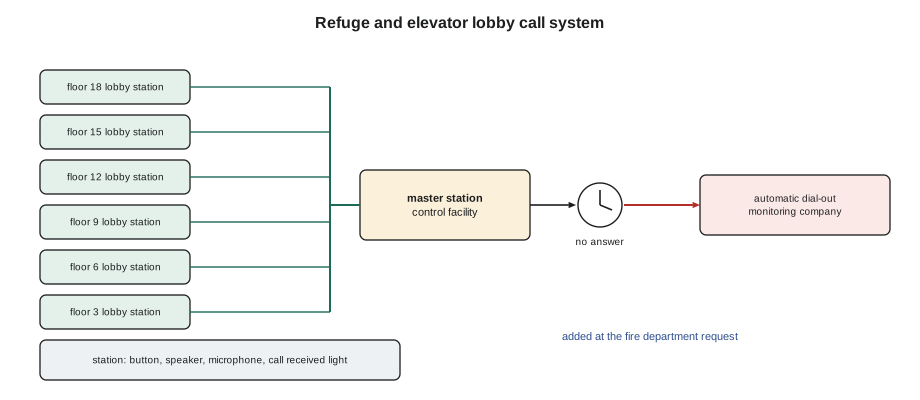
A refuge or elevator landing call system has call stations at the required locations and a master station at the control point. A person at a call station presses a button. The master station sounds and shows which station is calling, and the operator answers and talks to the caller through a hands-free speaker and microphone. The call station shows that the call has been received, with a light or a display, so that someone who can't hear the conversation, or can't speak, still knows help has been told. The operator can then tell the fire department where the person is, or, if the operator is a firefighter, send a crew.
If the control point is not constantly staffed, which is true of most apartment buildings at night, the system must not wait for someone to walk past. After a set time without an answer, it dials out automatically by telephone to a staffed location, such as the building's monitoring company or the emergency services, so that the call reaches a person who can act. Riverlight's master station is in the command center, which is staffed only when the fire department arrives, so its system dials out to Bramwell's monitoring partner after a short delay, and the monitoring operator can talk to the caller through the call station.
Accessibility of the call station
A call station is used by people with disabilities, so it must be accessible itself. Its button must be within reach of a person using a wheelchair, at the height set by the accessibility standard; it must work with one hand and without tight grasping; and it must give both audible and visible feedback, so that a person who is deaf or hard of hearing knows the call has gone through and a person who is blind can hear it. Many stations include a tactile, high-contrast label and instructions in Braille. The posted instructions next to the station explain how to use it, what will happen and where the person is, because a caller may not know what floor they are on.
The installer sets the mounting height to the design and the accessibility standard, checks that nothing will be placed in front of it, and confirms that the instructions sign is the approved one for that location, with the correct floor and lobby identification. A station labelled '12th floor east lobby' on the 13th floor sends rescuers to the wrong place.
Stairway communication
Tall buildings often lock stair doors from the stair side, for security, so that people in the stairs can't enter floors. In a fire, people in a stair that fills with smoke may need to leave it, and firefighters need to move between the stairs and the floors. Codes deal with this in two ways: they require the doors to unlock automatically when the fire alarm operates, and they require a way for someone trapped in a stair to call for help.
In Canada, stair doors in high buildings that are locked from the stair side must generally be released by the fire alarm system, or be arranged so that occupants can re-enter at set floors; the details are in the building code and are coordinated with the fire alarm programming, as FAT-220 described for door releases. Riverlight's stair doors are free to open from the stair side on every floor, so no stairway call stations are needed, but the emergency telephone jacks in the stairs give firefighters a wired link.
Elevator car communication
Every passenger elevator car has an emergency communication device, required by the elevator code, so that a person trapped in a stalled car can call for help. It is not part of the fire alarm system, but it often shares the same monitoring path and the same building, and fire alarm technicians are often asked about it. The elevator code sets how calls are answered and routed: if a call isn't answered within a set time, it is rerouted to another staffed location; newer cars must also provide text or video communication for people who can't use voice, and visible indications that help has been notified. In a fire, the car is recalled and the elevator code's firefighters' service takes over, as the elevator courses cover. The elevator contractor maintains the car's communication device; the fire alarm technician maintains the refuge and lobby call system.
Wiring, power and supervision
Two-way call systems are wired, powered and supervised as part of the fire alarm system or as listed emergency communication equipment connected to it. Each call station's circuit is supervised for opens, shorts and ground faults, and a trouble is reported at the master station and at the fire alarm control unit. The system has secondary power, and its battery calculation includes the call stations and the dial-out equipment. Pathways may need survivability protection, as lesson 7 described for firefighter phones. The dial-out telephone line or communicator is itself supervised, so that a failed line is reported rather than discovered when a call doesn't go through.
# Two-way call system: required locations versus the installed schedule
floors_above = list(range(2, 19))          # floors above the exit discharge level
lobbies = [f"Floor {f} elevator lobby" for f in floors_above]
stair_locked = False                   # stair doors locked from the stair side?
stair_stations = []
if stair_locked:
    for stair in ("A", "B"):
        stair_stations += [f"Stair {stair} floor {f}" for f in range(5, 19, 5)]
required = set(lobbies) | set(stair_stations)
installed = set(lobbies) - {"Floor 13 elevator lobby"} | set(stair_stations)
installed.add("Floor 12 elevator lobby")   # duplicate label found on site
missing = sorted(required - installed)
print(f"Required stations: {len(required)}")
print(f"Installed and labelled correctly: {len(required & installed)}")
print("Missing or mislabelled:", missing if missing else "none")
DIAL_OUT_S = 90
print(f"No answer after {DIAL_OUT_S} s: automatic dial-out to the monitoring centre")Required stations: 17 Installed and labelled correctly: 16 Missing or mislabelled: ['Floor 13 elevator lobby'] No answer after 90 s: automatic dial-out to the monitoring centre
The check is based on the real problem Sasha found during installation: the station in the 13th-floor lobby had been labelled '12th floor', so the schedule showed two 12th-floor stations and none on 13. The dial-out delay shown is the value in Ravi's design; the actual setting is agreed with the authority and the monitoring company.
Testing two-way systems
Every call station is tested at commissioning and at the intervals the standard sets. The technician presses the call button, confirms that the master station sounds and shows the correct location, holds a two-way conversation, confirms the 'call received' indication at the station, and then lets a call go unanswered to confirm that the dial-out works and reaches the right place. The monitoring company is told before testing, so that the dial-out calls aren't treated as real emergencies, and confirms each one it receives. Supervision is checked by opening the circuit at a station.
Worked problem
Planning help for Mrs. Ferrante
Mrs. Ferrante's suite is on the 15th floor. During an alarm on the 9th floor, the 15th floor receives the alert message, and the elevators are recalled. Later the fire department decides to evacuate floors 11 to 18. What should happen, and what does the two-way system add?
Show solution
- Before any emergency, the building's emergency plan lists residents who need help to evacuate, and Mrs. Ferrante has told the property manager she wants to be on it.
- When she hears the evacuation message, she goes to the 15th-floor elevator lobby and presses the call button.
- The master station shows '15th floor elevator lobby'. If no one is there yet, the system dials out after its delay, and the monitoring operator talks to her and tells the fire department.
- The station's light confirms her call was received, and the operator tells her help is coming.
- Firefighters use a recalled elevator under firefighters' service, or carry her down, as the incident commander decides.
Answer: The two-way system turns 'wait in the lobby' into a plan that works: the people who can help know she is there, and she knows they know.
Instructions and signage at call stations
The sign beside a call station has more work to do than most signs. It must tell a person who may be frightened, in pain or confused how to use the station, what will happen when they do, and where they are. Good signs use a few short lines, a picture of the button, and the floor and lobby identification in large characters. They follow the accessibility standard for character size, contrast and tactile characters, and they are mounted where a person using a wheelchair can read them. The sign is part of the system, and it is inspected with the station.
Signs also tell other people what the station is for, which reduces misuse. A call station that is used as an intercom by residents, or pressed by children, causes nuisance dial-outs that the monitoring company must answer. The property manager at Riverlight includes the call stations in the fire safety summary given to residents, so that people know what they are and when to use them.
Maintenance and records
Two-way call systems are inspected and tested periodically, as the standards set, and after any change. The records show every station tested, the result of the call and the dial-out tests, and any repairs. Because the stations are used rarely, faults can go unnoticed for a long time; a station that has been damaged, painted over or blocked by furniture is found only if someone looks. Bramwell's inspection checklist for Riverlight includes a visual check of every station and its sign at each inspection, as well as the functional tests.
The dial-out telephone line or communicator needs particular attention. When a building changes its telephone service, as many have done by moving from copper lines to digital services, the dial-out path can stop working without anyone noticing. The system supervises its communicator, but the test of an unanswered call is the only way to prove that the whole path, from the station to a person at the monitoring company, still works.
Common mistakes
MistakeMounting a call station out of reach.
InsteadMount it at the accessible height and keep the area in front clear.
MistakeLabelling a station with the wrong floor.
InsteadCheck every label against the floor and lobby where it is installed.
MistakeLeaving dial-out untested.
InsteadTest an unanswered call and confirm it reaches the right place.
MistakeConfusing the elevator car phone with the refuge system.
InsteadThey are separate systems maintained by different trades.
MistakeTesting without telling the monitoring company.
InsteadNotify them first and confirm each test call.
Summary and key terms
- Two-way systems let occupants who can't use the stairs call for help and know help is coming.
- Call stations connect to a master station, with automatic dial-out when no one answers.
- Stations must be accessible, with audible and visible feedback and posted instructions.
- Stairs with locked doors may need their own call stations.
- Elevator car communication is a separate system under the elevator code.
- Every station is tested, including unanswered calls and supervision.
- Area of refuge
- A protected space where people can wait for assistance during an emergency.
- Call station
- A two-way communication device that a person uses to call for help.
- Central control point
- The location where two-way calls are answered.
- Dial-out
- An automatic telephone call to a staffed location when a call isn't answered.
- Stairway communication
- Two-way stations in stairs whose doors are locked from the stair side.
Practice problems
Work each problem on paper first, then reveal the answer to check.
Who uses refuge and elevator lobby call stations?
Show answer
People who can't use the stairs, waiting for help.
What happens if a call isn't answered?
Show answer
The system dials out to a staffed location after a set time.
Why must call stations give visible feedback?
Show answer
So a caller who can't hear knows the call was received.
Who maintains the elevator car's emergency phone?
Show answer
The elevator contractor.
What should you do before testing dial-out?
Show answer
Notify the monitoring company.
Lesson quiz · 5 questions
Score 60% or more to complete this lesson.
Create a free account to save your progress, take quizzes and earn a certificate.