
FAT-310 · Lesson 7 of 12 · 20 min
Firefighter telephones and emergency two-way communication
Next to each exit stair door at Riverlight is a small red cabinet with a handset inside. The old firefighter telephones have been there since the building opened, and during the survey Sasha finds that three of them hum, one has a cracked handset, and the one on the 16th floor doesn't ring the master station at all. 'These matter more than people think,' Gerry says. 'When the fire is on the 14th floor and the radios are full of chatter or can't get through the concrete, the crew on the stair can pick up a phone and talk straight to the command post.' This lesson covers firefighter telephones and the other emergency two-way systems that let responders and occupants talk to the control location: what they are for, where they go, how they are wired and supervised, and how they relate to radio coverage systems.
Why responders need wired communication
Firefighters normally communicate by portable radio. But radio signals are weakened by concrete, steel and distance, and in tall buildings, basements and large concrete structures they can fail exactly where crews need them most: in stairwells, deep in a floor, or below grade. The fire command post also needs to talk to the crews operating on the fire floor and the floors around it, to the people controlling the building's systems, and sometimes to the occupants. Wired two-way communication gives a path that doesn't depend on radio, and it is protected and supervised like the rest of the fire alarm system.
There are two main approaches. One is a dedicated wired system: firefighter telephones, also called fire emergency telephones, with handsets or jacks in protected locations throughout the building and a master station at the command location. The other is a radio coverage system that boosts radio signals inside the building so that portable radios work everywhere; these are often called emergency responder radio coverage systems, and they are installed by specialists under their own standards. Many buildings have both, and some jurisdictions now accept radio coverage in place of wired phones. The building code and the fire department decide which is required.
In Canada, the National Building Code requires the voice communication system in a high building to include two-way communication between the central alarm and control facility and the mechanical control centre, accessible from each floor area, and emergency telephones on each floor area near the exit stair shafts. CAN/ULC-S524 sets how they are installed. Saskatoon Fire Department's fire prevention branch also expects radio coverage to be checked in new high buildings, which is a separate system from the telephones.
Telephone stations and jacks
Firefighter telephones come in two forms. A warden station has a handset permanently installed in a cabinet, which the user lifts to call the master station. A phone jack is a socket into which firefighters plug portable handsets that they carry or that are stored at the command location; jacks are cheaper and less likely to be vandalized, and many systems use them in most locations with fixed handsets only in a few. Either way, each station is identified by location, and the master station shows which station is calling.
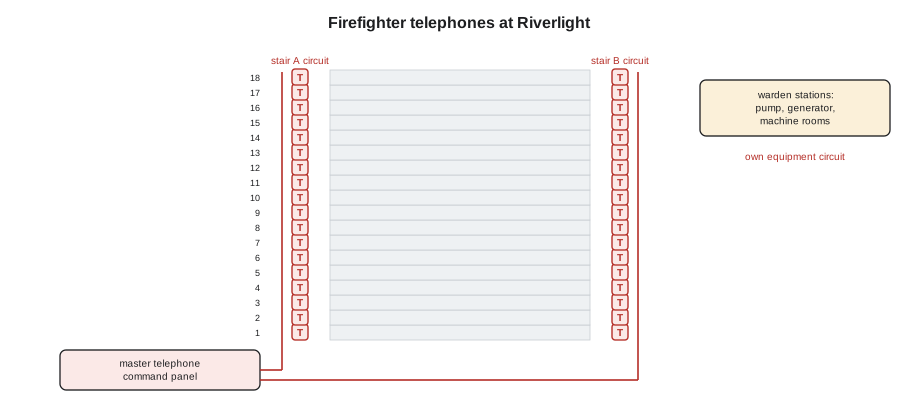
Stations are located where firefighters will be when they need to communicate. The common locations are each floor at each exit stair, often inside the stair or in the vestibule just outside it; each elevator lobby or elevator car in some buildings; the fire pump room; the emergency generator room; the elevator machine rooms; the smoke control equipment rooms; and other places the fire department asks for. At Riverlight, the new design has a jack in each stair at every floor, a warden station in each elevator machine room and the fire pump room, and handsets stored in a cabinet at the command location.
The master station and how calls work
The master station at the command location has a handset and a display or indicator for each telephone circuit or station. When a firefighter plugs into a jack or lifts a warden handset, the master station rings or sounds and shows which station is calling. The operator answers and can connect the caller, and can usually connect several stations at once in a conference, so that the command post can talk to crews on several floors together. Because a crowded conference becomes hard to use and loads the circuit, systems are designed to allow a set number of stations to be connected at the same time. NFPA 72 requires the system to support a minimum number of simultaneous stations, commonly understood as five, and the designer and maker confirm the number for each system.
The audio quality must be good enough to be understood over the noise of a fire and the equipment firefighters wear. Handsets are designed to be used with breathing apparatus masks, and stations in noisy areas such as pump rooms may have louder earpieces or noise-cancelling handsets. Hum on a telephone circuit, as Sasha found on the old system, is usually a sign of induced noise from nearby power wiring or a grounding problem, and it makes conversations harder at exactly the wrong time.
Wiring, supervision and survivability
Telephone circuits are wired and supervised like other fire alarm circuits. Each circuit is monitored for opens, shorts and ground faults, so that a damaged circuit is reported as a trouble. Stations are connected so that removing a handset or a jack faceplate opens the circuit and is reported. Where more than one station shares a circuit, the circuit is often wired so that a fault on one floor doesn't disable the stations on other floors: Class A wiring, or isolation, as FAT-210 described. Telephone circuits are kept apart from speaker circuits and power wiring to avoid induced hum.
Because the telephones are part of the voice communication system, their conductors in a high building are protected in the same way as the voice risers, as lesson 2 described. At Riverlight, each stair's telephone circuit runs in that stair's rated shaft, so that a fire on one floor is unlikely to damage both.
# Firefighter telephone circuit check: stations per circuit and simultaneous use
floors = 18
stairs = 2
stair_jacks = floors * stairs
fixed = {"fire pump room": 1, "elevator machine room": 2, "generator room": 1}
circuits = {"Stair A circuit": floors, "Stair B circuit": floors, "Equipment circuit": sum(fixed.values())}
MAX_PER_CIRCUIT = 20        # maker's limit on stations per circuit
SIMULTANEOUS = 5               # stations the master must connect at once
total = 0
for name, n in circuits.items():
    total += n
    ok = "OK" if n <= MAX_PER_CIRCUIT else "split the circuit"
    print(f"{name:18s} {n:3d} stations  {ok}")
print(f"Total stations: {total} (stair jacks {stair_jacks}, fixed {sum(fixed.values())})")
print(f"Master station must connect at least {SIMULTANEOUS} stations at once")
print("One fault takes out:", "one stair's jacks at most" if stairs > 1 else "all jacks")Stair A circuit 18 stations OK Stair B circuit 18 stations OK Equipment circuit 4 stations OK Total stations: 40 (stair jacks 36, fixed 4) Master station must connect at least 5 stations at once One fault takes out: one stair's jacks at most
The check shows that each stair's 18 jacks fit within the maker's limit on one circuit, and that splitting the jacks by stair means a fault on one circuit leaves the other stair's phones working. Ravi's design also puts the equipment rooms on their own circuit, so that the pump room and machine rooms keep their phones if a stair circuit fails.
Radio coverage systems
Radio coverage systems, also called bi-directional amplifier systems or distributed antenna systems for public safety, amplify the fire department's radio frequencies inside a building, using antennas on the roof and throughout the floors. They are installed and tested by radio specialists and licensed under radio regulations, and the fire alarm technician's involvement is usually limited to monitoring: the radio system's equipment sends signals to the fire alarm control unit for conditions such as loss of power, antenna failure or amplifier failure, and the fire alarm system reports them as supervisory or trouble signals. The LVT-320 course on wireless coverage covers how these systems are designed and tested.
Even where a radio coverage system is installed, many fire departments still want wired phones in tall buildings, because a wired path doesn't depend on radio frequencies, batteries in portable radios or the radio system's own reliability. Captain Strand's preference for Riverlight is both: the new telephone system, and a radio coverage survey to see whether a radio system is also needed.
Testing telephone systems
Every station is tested at commissioning and periodically after: the technician plugs a handset into each jack or lifts each warden handset, confirms that the master station rings and shows the correct location, holds a two-way conversation to check the audio quality, and checks the simultaneous-use capacity by connecting the required number of stations at once. Supervision is checked by opening and shorting the circuit at a station and confirming the trouble at the panel. Results are recorded station by station, so that a station that fails can be found and fixed.
Worked problem
Tracing hum on a telephone circuit
On the old system, the Stair B telephone circuit has a loud hum on every floor from 10 to 18, but not below. The circuit runs in the stair shaft beside a new power feeder installed two years ago for the rooftop equipment. What is the likely cause, and what should the new installation do differently?
Show solution
- Note the pattern: hum on floors 10 to 18 only, where the power feeder runs beside the circuit.
- Identify the likely cause: induced noise from the feeder into the unshielded telephone circuit.
- Check the grounding: a shield or drain grounded at more than one point can also cause hum.
- In the new installation, keep the telephone circuit apart from power wiring, as the design and code require, and use the specified cable.
- Ground any shield at one point only, as the maker instructs, and test for hum on every station.
Answer: The hum came from the feeder run beside the circuit. The new circuit runs in its own conduit on the opposite side of the shaft, and the commissioning test confirms quiet audio at every station.
Firefighter telephone handsets and storage
Where a system uses jacks, the portable handsets are stored in a cabinet at the command location, and the number of handsets is chosen with the fire department, usually enough for the crews that will operate in the building at the same time. Handsets are checked at every inspection: cords for damage, connectors for wear, and each handset for clear audio. A system with good jacks and broken handsets is useless, and handsets are the part most often lost or damaged, because they are carried around the building during incidents and drills.
Warden stations, with fixed handsets in cabinets, are inspected for damage and tampering, and their cabinet doors and signs are checked. In public stairs, cabinets are sometimes vandalized or used to store things; at Riverlight, the old cabinet on the 16th floor held a resident's bicycle lock and a pair of boots, and its handset cord had been cut.
Using the telephones during an incident
During an incident, the master station is usually staffed by a firefighter at the command post, who keeps a log of which crews are on which floors and what they report. Crews plug in at the stair door on the floor where they are working, report their position and conditions, and receive instructions. Because the telephones are wired and supervised, the command post knows exactly where each call comes from, which a radio call doesn't always tell them. Fire departments train their members on the telephone systems in their area, and some ask building owners for a familiarization visit after a new system is installed. Captain Strand has asked Bramwell to arrange one at Riverlight for the crews from the nearest station, after commissioning.
The telephone system also serves the voice system's own needs. A firefighter at the command panel can use the telephone to ask a crew on the 9th floor whether the message there can be heard, and adjust the announcements accordingly. In some systems the operator can connect a telephone station to the speakers on a floor, so that a crew leader can make an announcement directly to the occupants around them.
Common mistakes
MistakeAssuming portable radios work everywhere.
InsteadCheck radio coverage and provide wired phones where required.
MistakePutting all stair jacks on one circuit.
InsteadSplit circuits so that one fault doesn't disable every station.
MistakeRunning telephone circuits beside power feeders.
InsteadSeparate them to avoid hum.
MistakeTesting only that the master station rings.
InsteadHold a conversation and test simultaneous use.
MistakeTreating the radio coverage system as part of the phones.
InsteadIt is a separate system; the fire alarm system monitors it.
Summary and key terms
- Wired two-way communication gives responders a path that doesn't depend on radio.
- Firefighter telephones use warden stations or jacks at stairs, elevator rooms, pump rooms and other locations.
- The master station identifies callers and connects several stations at once.
- Telephone circuits are supervised, separated from power wiring and protected like voice pathways.
- Radio coverage systems are separate, and the fire alarm system monitors their trouble signals.
- Every station is tested for ringing, location, audio quality and simultaneous use.
- Firefighter telephone
- A wired telephone station for responders, connected to a master station.
- Warden station
- A telephone station with a permanently installed handset.
- Phone jack
- A socket for a portable firefighter handset.
- Master station
- The control location equipment that answers and connects telephone calls.
- Radio coverage system
- A system that amplifies responders' radio signals inside a building.
Practice problems
Work each problem on paper first, then reveal the answer to check.
Why do tall buildings need wired communication for firefighters?
Show answer
Radio signals can fail in stairs, deep floors and basements.
What is the difference between a warden station and a jack?
Show answer
A warden station has a fixed handset; a jack takes a portable handset.
Where are firefighter phones usually located?
Show answer
At each exit stair on each floor, and in pump, generator and elevator machine rooms.
What usually causes hum on a telephone circuit?
Show answer
Induced noise from nearby power wiring or a grounding problem.
What does the fire alarm system do for a radio coverage system?
Show answer
It monitors the radio system's trouble and supervisory signals.
Lesson quiz · 5 questions
Score 60% or more to complete this lesson.
Create a free account to save your progress, take quizzes and earn a certificate.