
FAT-310 · Lesson 10 of 12 · 21 min
Integration of mass notification with fire alarm: priority
During the Willowbank design meeting, the principal asks the question that every mass notification design has to answer. 'Suppose we're in lockdown because someone with a weapon is in the building, and then somebody pulls a fire alarm. What happens? Do the kids leave the classrooms?' The room goes quiet. A pulled fire alarm during a lockdown is not hypothetical: it has been used to draw people out of rooms. But a real fire during a lockdown is possible too. 'That's what the priority matrix is for,' Ravi says. 'We decide now, with the school board and the fire department, what the system does, so that nobody has to decide in the moment.' This lesson covers how mass notification and fire alarm systems share equipment and signals, how priority between them is decided and programmed, and how the combination is tested.
Why priority matters
When a fire alarm system and a mass notification system share speakers, appliances or a building, they can both want to deliver a message at the same time. Without a rule, the result can be dangerous: two messages playing over each other so that neither can be understood, a fire evacuation message drawing people out of locked classrooms into danger, or a lockdown message keeping people in a burning building. A priority scheme decides in advance which message plays, where, and what happens to the other one.
Traditionally, fire alarm signals have had the highest priority in any building system: nothing was allowed to override them. Mass notification changed that. For some events, such as a violent intruder, the right instruction is the opposite of a fire evacuation, and the people managing the event may need to override the fire alarm's notification in some areas. Modern codes allow this, but only on the basis of a risk analysis and the building's emergency plan, and only in ways that keep the fire alarm system's other functions working.
In Canada, mass notification isn't required by the National Building Code, and the fire alarm system must continue to meet the code and CAN/ULC-S524 whatever else is connected to it. Any arrangement that lets a mass notification message take priority over fire alarm notification must be accepted by the authority having jurisdiction, and the equipment must be listed for the combination, with mass notification equipment listed to CAN/ULC-S576. At Willowbank, Captain Strand's office has agreed to a limited override for lockdown, described below, with conditions.
The priority matrix
A priority matrix is a table that lists every source of messages and signals and sets their order. A typical order, from highest to lowest, might be: live voice from the fire department's command panel; live voice from an authorized mass notification console; recorded mass notification messages for the highest-risk events, if the risk analysis gives them priority; fire alarm evacuation and alert signals; other recorded mass notification messages; and non-emergency uses such as paging, bells and background music, which are muted by any emergency message. Every system's matrix is different, because it comes from that site's risk analysis and plan.
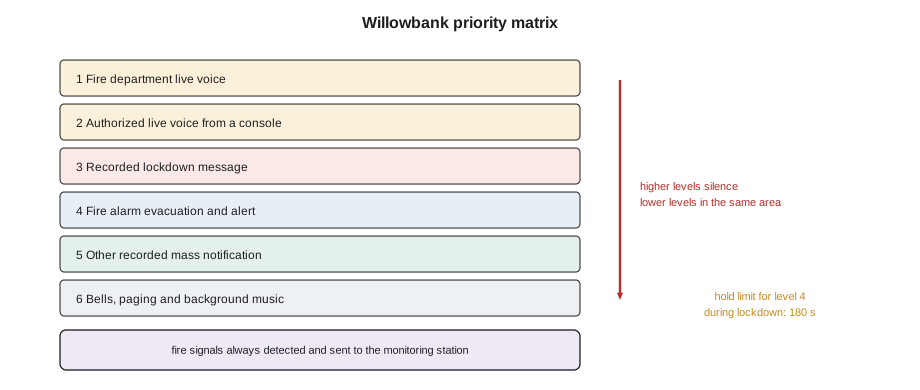
The matrix also says what happens to a lower-priority message when a higher one takes over. It can be interrupted and resume when the higher message ends, it can be cancelled, or it can continue in areas the higher message doesn't cover. And it says what happens to visible signals: a fire alarm strobe might keep flashing during a lockdown message, or it might be stopped so that it doesn't draw people out of hiding, depending on the plan.
The Willowbank decision
After two meetings, the school board, the fire department and Ravi agree on the following. When a lockdown is in progress and the fire alarm system operates, the fire alarm signal is not delayed or blocked: it still goes to the monitoring station and the fire department is dispatched. In the school's corridors, the fire alarm's horns and strobes are held off for up to three minutes while a recorded message tells staff that the fire alarm has activated during a lockdown and that they should stay in their locked rooms unless they see smoke or fire or are told to leave by a staff member or a police officer. During those three minutes, the principal or a police officer can use the console to tell the building what to do. If no one does, the fire alarm notification starts automatically at the end of the three minutes.
The decision balances two risks. Holding the fire alarm notification for a short time reduces the risk that a malicious alarm draws children into a corridor; starting it automatically after a limit means that if there really is a fire and nobody intervenes, the building still evacuates. The fire department is dispatched in every case, so firefighters and police are on the way while the decision is made. Every part of the decision is written into the sequence of operations and the emergency plan, and staff are trained on it.
# Priority arbitration: which message plays in the corridors?
PRIORITY = {"fd_live": 1, "console_live": 2, "lockdown": 3, "fire_evac": 4, "mns_other": 5, "bells": 6}
HOLD_LIMIT = 180     # seconds the fire alarm notification may be held during lockdown
def corridor_audio(active, t_fire=None, now=0, override=None):
    if override:
        return override
    if "lockdown" in active and "fire_evac" in active:
        held = now - t_fire
        if held < HOLD_LIMIT:
            return f"lockdown-fire message (fire alarm held, {HOLD_LIMIT - held} s left)"
        return "fire_evac (hold limit reached, automatic restart)"
    return min(active, key=lambda a: PRIORITY[a]) if active else "silent"
events = [
    ("normal day", {"bells"}, None, 0, None),
    ("lockdown only", {"lockdown", "bells"}, None, 0, None),
    ("pull station during lockdown, 40 s", {"lockdown", "fire_evac"}, 0, 40, None),
    ("same, principal sends live message", {"lockdown", "fire_evac"}, 0, 70, "console_live"),
    ("same, nobody intervenes, 180 s", {"lockdown", "fire_evac"}, 0, 180, None),
    ("fire alarm only", {"fire_evac", "bells"}, None, 0, None),
]
for name, active, t_fire, now, override in events:
    print(f"{name:38s} -> {corridor_audio(active, t_fire, now, override)}")
print("Fire signal to the monitoring station: sent immediately in every case")normal day -> bells lockdown only -> lockdown pull station during lockdown, 40 s -> lockdown-fire message (fire alarm held, 140 s left) same, principal sends live message -> console_live same, nobody intervenes, 180 s -> fire_evac (hold limit reached, automatic restart) fire alarm only -> fire_evac Fire signal to the monitoring station: sent immediately in every case
The simulation shows every case the sequence of operations has to cover, and it is the basis for the test plan: each line becomes a test, with the expected result written down before the test is run.
Interfaces between the systems
Where the mass notification system is separate from the fire alarm system, as at Willowbank, the two are connected by interfaces: relays, supervised circuits or a listed data link. The fire alarm control unit tells the MNS when the fire alarm is active, so that the MNS can respond according to the matrix, and the MNS tells the fire alarm control unit when a lockdown is active and when it has a trouble. These interface circuits are supervised, so that a broken link is reported rather than silently changing how the systems behave. The fire alarm system must never depend on the MNS to do its own job: if the MNS fails completely, the fire alarm must still detect, notify and report as the code requires.
Where the systems share equipment, the interface is inside the combined control equipment, and the priority is set in its programming. The equipment must be listed for both functions. Shared speakers and amplifiers must be sized for the larger of the two loads, and the battery calculation must include the mass notification functions as well as the fire alarm functions, for the durations the risk analysis and the standard require.
Non-emergency audio and paging
Paging systems, bell systems and background music share many buildings with fire alarm and mass notification systems, and sometimes share speakers with them. The rule is simple: any emergency message mutes non-emergency audio in the areas it covers, and the mute is controlled by the emergency system, not the other way round. At Willowbank, the bell system and the intercom are muted by a relay from the MNS and the fire alarm control unit. The LVT-310 course on AV systems describes how the mute is connected on the AV side; the fire alarm technician tests it from the fire alarm side, by confirming that every non-emergency source goes quiet when each emergency message plays.
Testing integrated systems
Integrated systems are tested as a whole, following the priority matrix and the sequence of operations. Each case in the matrix is set up and the result checked in every area: which message plays, which visible signals operate, what the fire alarm control unit shows, and what is sent to the monitoring station. The cases include the combinations, such as a fire alarm during a lockdown, and the failures, such as a broken interface circuit or an MNS amplifier failure. The fire department and the owner often want to witness these tests, and the results are recorded in the commissioning report. Any later change to either system, including a change to the emergency plan, is followed by retesting of the cases it affects.
Worked problem
Writing the test for a fire alarm during lockdown
Sasha is asked to write the test steps for the case 'pull station during lockdown, nobody intervenes'. What should the steps include, and what should each one check?
Show solution
- Notify the monitoring station, the fire department and the school, and confirm the building is empty or that occupants know a test is running.
- Start a lockdown from the main office console and confirm the lockdown message, text displays and amber appliances in every area.
- Activate a pull station in the east corridor and start a timer. Confirm that the monitoring station receives the fire alarm signal immediately.
- Confirm that the corridors play the lockdown-fire message and that the fire alarm horns and strobes stay off.
- At three minutes, confirm that the fire alarm notification starts automatically throughout the building and that the lockdown message stops.
- Restore the system and record each result with the time it occurred.
Answer: The test proves each part of the agreed decision, including the automatic restart, and the record shows the fire department exactly how the system will behave.
Training the people who send messages
A priority matrix and a sequence of operations only work if the people at the consoles understand them. Staff who may send mass notification messages need training: which messages exist, when to use each one, how to choose areas, how to make a live announcement, and what the system does when the fire alarm operates during a lockdown. They also need practice, because a person who has never used the console will be slow and uncertain in a real event. At Willowbank, the principal, the vice-principal, the office staff and the custodians are trained by Bramwell when the system is handed over, with refresher sessions at the start of each school year and during the lockdown drills.
Training includes what not to do. Staff are told not to send a fire evacuation message from the console during a lockdown unless they have confirmed a fire, and not to cancel a fire alarm notification without the fire department's agreement. The scripts for live announcements are kept beside each console, so that a person under stress has the words in front of them.
Documenting the integration
The integration between the fire alarm system and the MNS is documented in the sequence of operations, the priority matrix, the interface wiring diagrams and the risk analysis. These documents are part of the fire alarm documentation and are kept with it, so that any technician who later services either system can see how they interact. When Bramwell's service technician changes a fire alarm program at Willowbank, the checklist includes a step to check whether the change affects the MNS interface, and if it does, to retest the cases in the matrix that use it.
Changes to the emergency plan are the most common cause of integration problems. If the school decides to change its lockdown procedure, for example to add a 'hold and secure' level for threats outside the building, the risk analysis, the messages, the matrix, the programming and the training all have to change together, and the combination has to be tested again.
Common mistakes
MistakeLetting two messages play over each other.
InsteadSet a priority matrix so that one message plays in each area.
MistakeLetting mass notification block fire signals to the monitoring station.
InsteadFire signals are always transmitted, whatever has priority.
MistakeHolding fire notification without a time limit.
InsteadRestart it automatically unless an authorized person decides otherwise.
MistakeMaking the fire alarm depend on the MNS.
InsteadThe fire alarm must work fully if the MNS fails.
MistakeTesting only the single-event cases.
InsteadTest the combinations and the failures in the matrix.
Summary and key terms
- When fire alarm and mass notification both want to speak, a priority matrix decides.
- Mass notification may take priority over fire notification only where the risk analysis, plan and authority allow.
- Fire signals are always processed and transmitted, whatever has priority.
- Interfaces between separate systems are supervised, and the fire alarm never depends on the MNS.
- Emergency messages mute paging, bells and background music.
- Integrated systems are tested case by case from the matrix.
- Priority matrix
- A table setting the order in which messages and signals take precedence.
- Override
- A higher-priority message taking the place of a lower one.
- Hold limit
- The maximum time a lower-priority notification may be held before it restarts.
- Interface circuit
- A supervised connection that carries signals between two systems.
- Mute
- Silencing non-emergency audio during an emergency message.
Practice problems
Work each problem on paper first, then reveal the answer to check.
Why is a priority matrix needed?
Show answer
So that only one message plays in each area and the right one wins.
What must the fire alarm system keep doing when mass notification has priority?
Show answer
Detect, process and transmit fire signals.
Why does the Willowbank design restart the fire alarm automatically after three minutes?
Show answer
So that the building still evacuates if there is a real fire and nobody intervenes.
Which system controls the mute of background music?
Show answer
The emergency system.
What kinds of cases must the integrated test include?
Show answer
Single events, combinations and failures.
Lesson quiz · 5 questions
Score 60% or more to complete this lesson.
Create a free account to save your progress, take quizzes and earn a certificate.