
FAT-310 · Lesson 12 of 12 · 20 min
Capstone: commissioning the voice system for Riverlight Tower
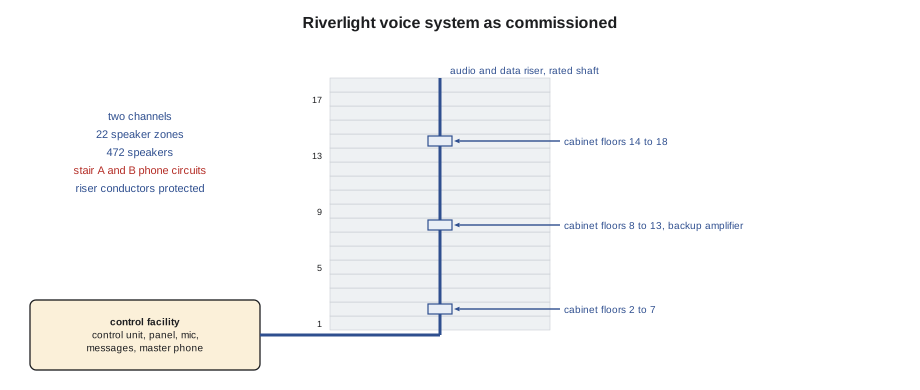
Six months after the first site visit, the new Riverlight voice system is installed. The three amplifier cabinets are on floors 2, 8 and 14, 472 speakers are mounted and tapped, the new messages are recorded and loaded, the telephone jacks and refuge call stations are in, and the programming is complete. What remains is commissioning: proving that everything works, putting the results on paper, and showing Captain Strand that the system does what the design says. Gerry has given Sasha the job of running the commissioning plan, with himself as the second technician and Ravi on call. 'You've done every part of this in the last eleven lessons,' he tells her. 'Now you do them all, in order, and you don't skip one because the last one went well.' This lesson follows the commissioning from the plan to the witness test, using everything the course has covered.
The plan
Sasha's plan has seven stages. First, the pre-commissioning checks: the installation complete, every speaker tap recorded, every circuit's insulation resistance tested and every message file checked against the approved script. Second, functional tests of the equipment: amplifiers at full load, backup amplifier switching, the message generator, the microphone and the command panel. Third, supervision of every speaker circuit, telephone circuit and call station circuit. Fourth, the programming: every phased evacuation case, the stair and lobby zones and the edge cases. Fifth, the audibility and intelligibility measurements. Sixth, the two-way systems: telephones and refuge stations, including dial-out. Seventh, the integrated tests with the building's other systems and the fire department's witness test.
The plan also deals with the building's 400 or so residents. The property manager sends notices a week ahead and again the day before each stage, listing the times when alarms and messages will sound. Testing that sounds alarms is done between 10:00 and 15:00 on weekdays. Bedroom measurements need access to suites, so Sasha's crew samples one suite of each layout on each of six representative floors, arranged with residents who have agreed, rather than every suite. The monitoring company is told before each session and the system is placed on test, so that alarms aren't dispatched.
Stage 1 and 2: pre-checks and equipment
The pre-checks find two problems. On the 6th floor, one corridor speaker's tap is recorded as 1 W but is set at 2 W, and it is corrected. And the French version of the relocation message has been loaded in place of the French evacuation message, so that a fire on the 5th floor would have played 'move to the lobby of your floor and wait for instructions' in French after the English 'leave the building now'. Sasha catches it by listening to every message file against the script, which is why the step is in the plan. The files are reassigned and checked again.
The equipment tests go well, with one exception. When Sasha fails the floor 8 cabinet's channel 1 amplifier, the backup amplifier takes over in two seconds, and the panel reports the failure and the backup in use, as the design requires. But when she fails channel 2 with the backup already in use, the panel reports the second failure correctly but the floors served by channel 2 go silent, which is expected: one backup covers one failure. Ravi confirms that the design accepts this, and Sasha records it so that the fire department knows the system's limits.
# Commissioning summary: tests planned, passed, failed and retested
stages = [
    ("1 Pre-checks", 520, 2),
    ("2 Equipment", 46, 0),
    ("3 Supervision", 96, 1),
    ("4 Programming cases", 64, 1),
    ("5 Audibility points", 84, 2),
    ("6 Intelligibility points", 118, 3),
    ("7 Two-way stations", 53, 1),
]
total = sum(n for _, n, _ in stages)
failed = sum(f for _, _, f in stages)
print(f"{'Stage':28s}{'Tests':>7s}{'Failed first time':>19s}")
for name, n, f in stages:
    print(f"{name:28s}{n:7d}{f:19d}")
print(f"Total tests: {total}, first-time failures: {failed} ({failed / total:.1%})")
print("All failures corrected and retested before the witness test: yes")Stage Tests Failed first time 1 Pre-checks 520 2 2 Equipment 46 0 3 Supervision 96 1 4 Programming cases 64 1 5 Audibility points 84 2 6 Intelligibility points 118 3 7 Two-way stations 53 1 Total tests: 981, first-time failures: 10 (1.0%) All failures corrected and retested before the witness test: yes
Sasha keeps a running summary like this one through the commissioning, so that at any time she, Gerry and the property manager can see how far the work has come and what is still open. Every failure on the list has its own record with the reading, the cause, the correction and the retest.
Stage 3 and 4: supervision and programming
Supervision testing finds one problem: on the 17th floor, opening the corridor speaker circuit at its last speaker gives a trouble, but shorting it there doesn't. The cause is a second end-of-line resistor left on the circuit at an earlier speaker, from the old system's wiring, which hides a short beyond it. It is removed, and the circuit is tested again from the end.
The programming tests run through the cause-and-effect matrix, case by case. For an alarm on each floor from 1 to 18, Sasha confirms which zones get the evacuation message, which the alert, what the stairs and lobbies get, and what the command panel shows. The edge cases from lesson 5 are included: an alarm on the 18th floor, one on the 1st, alarms on two floors at once, and alarms in each stair. One case fails: an alarm from the duct detector in the 12th-floor corridor air handler evacuates floors 11 to 13, as it should, but also sends the alert message to the stair zones instead of the stair message. Ravi corrects the programming rule for duct detector inputs, and every case that uses that rule is retested.
Stage 5: audibility and intelligibility
The sound level and intelligibility measurements follow the plan from lesson 11: calibrated meters, ambient noise measured with the building in normal use, tone levels at listener height and at the pillow in the sample bedrooms, and STIPA measurements on a grid in each acoustically distinguishable space on the six representative floors, plus every stair landing on those floors and the ground floor lobby. Two audibility points fail at first: the bedroom in suite 912, where the speaker was moved, and a corner of the amenity room behind a folding partition. Three intelligibility points fail at first: two in the ground floor lobby near the mailboxes, which pass after the added speaker, and one at the bottom landing of stair A, which the authority accepts as discussed in lesson 11.
Sasha also checks the measurements against the design calculations. The corridors and suites come out close to the predictions. The stairs come out slightly better than the simplified model predicted, because the speakers aimed along the flights put more direct sound on the landings than the model assumed. The lobby comes out worse, until the added speaker, because its stone floor and glass wall are more reflective than the finishes shown on the drawings. Ravi records the differences for future designs.
Stage 6: two-way systems
The telephone tests take a full day: 36 stair jacks, the warden stations in the fire pump room, the generator room and both elevator machine rooms, and the simultaneous-use test with five stations connected at once to the master. All pass, and the hum that troubled the old Stair B circuit is gone. The refuge call stations in the elevator lobbies are tested one by one, including an unanswered call from each of three floors to prove that the dial-out reaches the monitoring company, which confirms each call. One station fails: its 'call received' light doesn't come on, because a connector in the back box has worked loose. It is reseated and retested.
Riverlight's stair doors are free to open from the stair side, so there are no stairway call stations to test.
Stage 7: integrated tests and the witness test
The integrated tests check that the voice system works with the building's other fire and life safety systems: the elevators recall when they should, the stair pressurization fans start, the fire pump's signals reach the panel, the door holders release, and the monitoring company receives every signal. Many of these were tested when the original fire alarm system was installed, but the new voice system's programming changes some of the outputs, so they are tested again. The building's integrated testing record is updated.
The witness test is Captain Strand's. She chooses the cases she wants to see, not the ones the crew suggests: an alarm on the 14th floor, the floor where the amplifier cabinet is; an alarm in stair B; and a live announcement to floors 15 to 18 from the command panel, which she makes herself, without help. She walks to the 16th floor to listen to her own announcement in a corridor and a stair. She asks Sasha to show her the record for the bottom landing of stair A, and the reason it was accepted. And she operates the firefighter telephone from the 14th floor to the command center. At the end she has one comment: the command panel's zone labels are clear, but the button for the stair zones is at the bottom of the panel and easy to miss; she asks for it to be moved to the top row, next to 'all call'. Ravi agrees, and the change is made and retested before the system is accepted.
The records
The commissioning ends with the verification report under CAN/ULC-S537, which FAT-330 covers in detail: the device-by-device results, the speaker tap schedule, the message scripts and file list, the sound level and intelligibility measurements with their plans, the telephone and call station results, the integrated test results, and the list of deficiencies and their corrections. A copy goes in the documentation cabinet beside the control unit, with the site-specific software and the message files.
The records also feed the building's future. The tap schedule tells the next technician what each speaker was set to. The intelligibility results are the baseline that later inspections compare against. The message scripts tell the next owner what the system says, and when the emergency plan changes, which messages need to change too. Sasha files the summary of lessons learned that Bramwell keeps for each major project: listen to every message file, test supervision from the end of each circuit, and check the amplifier backup's limits with the designer before the witness test.
Worked problem
Deciding whether the system is ready for the witness test
Two days before Captain Strand's visit, Sasha's summary shows two open items: the stair B zone button relabel requested by the property manager, and a retest of suite 912's bedroom after the speaker was moved, which can't be done until the resident is home. Should the witness test go ahead?
Show solution
- Sort the open items by whether they affect life safety: the suite 912 retest does, because a failed audibility point means a resident might not wake.
- Check whether the item can be closed in time: the property manager arranges access for the next morning.
- Check the other item: the relabel is cosmetic, but it should be done before the witness test so that the panel matches the records.
- Confirm that every other failure has been corrected and retested, and that the records are complete.
- If any life safety item can't be closed, tell Ravi and Captain Strand before the visit and agree whether to postpone.
Answer: The suite 912 retest passes the next morning and the relabel is done, so the witness test goes ahead with nothing open. Had the retest not been possible, the honest answer would have been to say so before the visit.
Handover and training
Commissioning ends with handover: the system is formally given to the owner, with the records, the operating instructions and training for the building's staff. At Riverlight, Sasha trains the property manager and the two building superintendents on what the command panel shows, how to recognize a trouble, how to silence and reset after an authorized test, and who to call. She also explains what they must not do: make announcements during a real fire unless the fire department asks, or change any setting. The fire department's familiarization visit follows a week later.
Common mistakes
MistakeSkipping a stage because the previous one went well.
InsteadFollow the plan in full.
MistakeTesting only the programming cases the crew suggests.
InsteadExpect the authority to choose its own cases.
MistakeLeaving out the integrated tests for a voice-only upgrade.
InsteadRetest the outputs the new programming affects.
MistakeClosing a failure without a retest.
InsteadRecord the correction and retest every failure.
MistakeGoing into a witness test with life safety items open.
InsteadClose them, or tell the authority beforehand.
Summary and key terms
- Commissioning follows a written plan: pre-checks, equipment, supervision, programming, measurements, two-way systems and integrated tests.
- Occupants, the monitoring company and the authority are notified and coordinated throughout.
- Pre-checks such as listening to every message file catch errors that later tests might miss.
- Every failure is recorded with its cause, correction and retest.
- The authority chooses its own witness cases and may operate the system itself.
- The records become the baseline for the building's future inspections and changes.
- Commissioning
- Proving and documenting that a new system works as designed.
- Witness test
- Testing observed and directed by the authority having jurisdiction.
- Pre-commissioning checks
- Checks of installation completeness, taps, wiring and messages before functional testing.
- Deficiency list
- The record of failures found and their corrections.
- Integrated testing
- Testing the fire alarm system together with the other fire and life safety systems it controls.
Practice problems
Work each problem on paper first, then reveal the answer to check.
What are the seven stages of Sasha's commissioning plan?
Show answer
Pre-checks, equipment, supervision, programming, audibility and intelligibility, two-way systems, and integrated and witness tests.
How was the wrong French message found?
Show answer
By listening to every message file against the approved script.
Why did shorting the 17th-floor circuit at its end not give a trouble?
Show answer
A leftover end-of-line resistor at an earlier speaker hid the short.
Why did the stair results beat the model?
Show answer
The aimed speakers put more direct sound on the landings than the model assumed.
What did Captain Strand ask to change?
Show answer
Move the stair zone button to the top row of the command panel.
Lesson quiz · 5 questions
Score 60% or more to complete this lesson.
Create a free account to save your progress, take quizzes and earn a certificate.