
FAT-310 · Lesson 6 of 12 · 20 min
Intelligibility: STI, acoustics and design for speech
In the old Riverlight system, the stairwells were the worst places in the building. The message played loudly enough, but standing in the concrete stair on the 12th floor, Sasha could barely make out a word. 'Loud and clear are two different things,' Gerry says. 'In here, every word bounces off the concrete and walls for two seconds. By the time the third word arrives, the first one is still ringing.' The new design adds speakers in the stairs and changes how they are aimed and tapped, and the commissioning will include measurements to prove that people can understand the messages. This lesson covers what makes speech intelligible, how intelligibility is measured with the Speech Transmission Index, how the space affects it, and how voice systems are designed to achieve it.
What intelligibility means
Speech is a stream of sounds that change quickly. Vowels are relatively loud and long, and carry most of the energy; consonants are quieter and shorter, and carry most of the meaning. 'Leave', 'leaf' and 'least' differ only in their final consonants. For speech to be understood, the listener must hear the rapid changes in level that separate one sound from the next. Anything that blurs those changes, by filling in the quiet gaps between sounds, reduces intelligibility.
Three things blur speech in buildings. Background noise fills the gaps with sound that has nothing to do with the speech: ventilation, traffic, machinery, people talking. Reverberation fills the gaps with the speech's own reflections, arriving late from walls, floors and ceilings. And distortion in the equipment, such as an overloaded amplifier or a damaged speaker, changes the speech itself. A system can be loud enough to be heard in every part of the building and still fail if any of these is bad enough.
Audibility and intelligibility are therefore measured differently. Audibility, for tones, is a matter of sound level above the background, measured in dBA, and FAT-120 covered the rules. Intelligibility is a matter of how well the system preserves the rapid changes in speech, and it is measured with a different scale.
The Speech Transmission Index
The Speech Transmission Index, or STI, is a number between 0 and 1 that describes how well a sound system and a space together transmit speech. It works by measuring how much the space and the system reduce the modulation of a test signal: a signal whose level rises and falls at the rates speech does, from less than one cycle a second to more than ten. A perfect path keeps the full depth of modulation, giving an STI of 1; noise and reverberation flatten the modulation, lowering the STI. The method is set out in the international standard IEC 60268-16, and fire alarm standards refer to it.
STI values are often described with qualitative bands. An STI below about 0.3 is bad; most speech can't be understood. Between about 0.3 and 0.45 is poor. Between about 0.45 and 0.6 is fair, enough for familiar messages to be understood by most listeners. Between about 0.6 and 0.75 is good, and above 0.75 is excellent. Emergency messages are short, simple and repeated, which helps listeners, so emergency voice systems are usually designed for the fair to good range rather than for excellent.
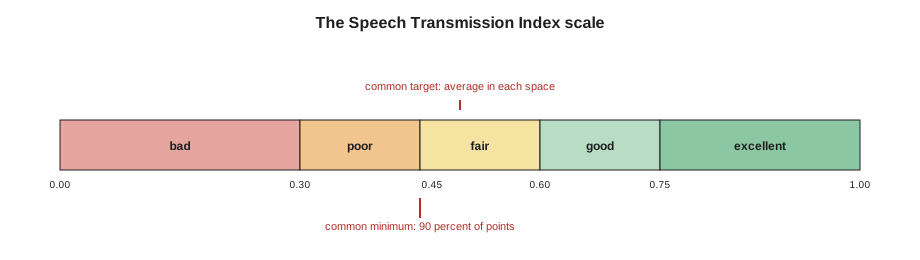
CAN/ULC-S524 requires voice messages to be intelligible throughout the areas they serve, and the National Building Code requires them to be heard and understood throughout the building, except inside elevator cars. Canadian designs commonly use STI targets similar to those in NFPA 72's annex, applied by acoustically distinguishable space, and the verification report records the method and results. Ravi's specification for Riverlight sets the targets out explicitly, so that there is no argument at commissioning about what 'intelligible' means.
Acoustically distinguishable spaces
Intelligibility depends so much on the space that voice systems are designed and tested space by space. An acoustically distinguishable space, or ADS, is an area that differs from its neighbours in its acoustics, its noise or its use: a corridor, a stairwell, an apartment, a lobby, a parking level, a mechanical room. Each ADS gets its own design and its own measurements. Two rooms of the same size and finish can be one ADS; a carpeted corridor and the concrete stair at its end are two.
The designer lists the ADSs and decides for each whether voice intelligibility is required, or whether audible tones or other signals are enough. Spaces where people are not expected to need instructions, such as small mechanical rooms, may need only audibility. Spaces where intelligibility is very hard to achieve, such as a parking garage or a large concrete stair, may need many more speakers, or the design may accept tone signals there with voice messages at the stair doors. These decisions are recorded in the design documents, so that the commissioning team knows which spaces to measure and what targets apply.
# Riverlight acoustically distinguishable spaces (ADS) and their requirements
ads = [
    ("Suite living area", "carpet or wood, furniture", "voice", 0.50),
    ("Suite bedroom", "soft finishes, door closed", "voice", 0.50),
    ("Corridor", "carpet, acoustic ceiling", "voice", 0.50),
    ("Exit stair", "concrete, painted block", "voice", 0.45),
    ("Elevator lobby", "tile floor, gypsum walls", "voice", 0.50),
    ("Ground floor lobby", "stone floor, glass, high ceiling", "voice", 0.50),
    ("Mechanical room", "concrete, equipment noise", "tone only", None),
    ("Electrical room", "concrete, small", "tone only", None),
]
for name, finish, need, target in ads:
    t = f"STI average {target:.2f}" if target else "audibility only"
    print(f"{name:20s} {need:9s} {t:22s} ({finish})")
print("Spaces to measure for intelligibility:", sum(1 for a in ads if a[3]))Suite living area voice STI average 0.50 (carpet or wood, furniture) Suite bedroom voice STI average 0.50 (soft finishes, door closed) Corridor voice STI average 0.50 (carpet, acoustic ceiling) Exit stair voice STI average 0.45 (concrete, painted block) Elevator lobby voice STI average 0.50 (tile floor, gypsum walls) Ground floor lobby voice STI average 0.50 (stone floor, glass, high ceiling) Mechanical room tone only audibility only (concrete, equipment noise) Electrical room tone only audibility only (concrete, small) Spaces to measure for intelligibility: 6
Ravi's list gives the stairs a slightly lower design target than the other spaces, which the authority has accepted, because the stairs' hard surfaces make it very hard to reach the full target and because the stair message is short and repeated. The list goes into the specification and the commissioning plan.
How noise and reverberation affect STI
The two main enemies of intelligibility can be estimated before a system is installed. Background noise lowers the STI according to the speech-to-noise ratio: the louder the speech is above the noise, the better, up to a point. Reverberation lowers the STI according to the space's reverberation time, the time it takes for a sound to fade by 60 dB after it stops. A carpeted bedroom may have a reverberation time of 0.4 s; a concrete stair, 2 to 4 s; a large parking garage, more.
# Estimating STI from speech-to-noise ratio and effective reverberation time (simplified, single band)
# Closer speakers give more direct sound, which this model treats as a shorter effective reverberation time.
import math
mod_freqs = [0.63, 0.8, 1.0, 1.25, 1.6, 2.0, 2.5, 3.15, 4.0, 5.0, 6.3, 8.0, 10.0, 12.5]
def sti(snr_db, rt60):
    tis = []
    for F in mod_freqs:
        m_rev = 1 / math.sqrt(1 + (2 * math.pi * F * rt60 / 13.8) ** 2)
        m_noise = 1 / (1 + 10 ** (-snr_db / 10))
        m = m_rev * m_noise
        snr_app = 10 * math.log10(m / (1 - m))
        snr_app = max(-15, min(15, snr_app))
        tis.append((snr_app + 15) / 30)
    return sum(tis) / len(tis)
cases = [("Suite bedroom", 15, 0.4), ("Corridor", 12, 0.7), ("Lobby", 10, 1.6),
         ("Stair, old design", 6, 3.0), ("Stair, new design", 12, 1.5), ("Garage, loud fans", 3, 3.5)]
for name, snr, rt in cases:
print(f"{name:20s} S/N {snr:3d} dB, RT {rt:3.1f} s -> STI about {sti(snr, rt):.2f}")Suite bedroom S/N 15 dB, RT 0.4 s -> STI about 0.74 Corridor S/N 12 dB, RT 0.7 s -> STI about 0.61 Lobby S/N 10 dB, RT 1.6 s -> STI about 0.45 Stair, old design S/N 6 dB, RT 3.0 s -> STI about 0.31 Stair, new design S/N 12 dB, RT 1.5 s -> STI about 0.47 Garage, loud fans S/N 3 dB, RT 3.5 s -> STI about 0.25
The estimate is simplified: a full STI calculation works across seven octave bands and includes the hearing threshold and masking effects. But it shows the pattern that matters. In the bedroom and the corridor, with modest noise and little reverberation, the STI is good. In the stair, putting a speaker close to every few landings, instead of relying on two loud speakers, does two things: it raises the speech-to-noise ratio, and it gives each listener more direct sound, which the simple model represents as a shorter effective reverberation time. Together they lift the STI from poor to fair, although the stair's hard surfaces still keep it below the corridor. And in a noisy, reverberant garage, even a loud system struggles. The estimate also shows that once the speech is well above the noise, making it louder does little; reverberation sets the ceiling.
Designing for intelligibility
Designers improve intelligibility in a few main ways. They put speakers close to listeners, so that each listener hears mostly direct sound from one speaker rather than reflected sound and the sound of distant speakers. They use more speakers at lower taps rather than fewer at higher taps, as lesson 3 explained. They choose speakers whose sound is aimed at the listeners and away from hard surfaces: in a stair, a speaker on every second or third landing, aimed along the flight, works better than one large speaker at the top. In very reverberant spaces, they may use speakers with narrow, controlled dispersion. And where they can, they work with the architect to add sound-absorbing finishes, such as acoustic ceiling tiles in corridors and lobbies.
They also avoid things that make intelligibility worse. Speakers that are far apart but heard together, such as two speakers at opposite ends of a long lobby, cause the same speech to arrive at a listener at two different times, which smears it like reverberation. Turning the system up to beat noise can overload amplifiers and speakers and distort the speech. And messages recorded with too much low-frequency content, or with music behind them, waste energy on sounds that don't carry meaning.
Intelligibility is a property of the whole system, so it is affected by things the fire alarm technician controls. A speaker on the wrong tap, a reversed speaker, a damaged cone, or a message loaded at the wrong level all lower the STI. That is why commissioning measures intelligibility in the finished building, after the taps are set and the messages loaded, rather than relying on the design calculation alone.
Worked problem
Improving intelligibility in the Riverlight stairs
The old system had one 2 W speaker at the top of each stair and one at the bottom, about 60 m (200 ft) apart. Measurements at the 12th floor landing gave an STI of 0.31. The new design must reach an average of 0.45 in the stairs. What changes would help, and why?
Show solution
- Note the cause: listeners in the middle of the stair are far from both speakers, so the speech-to-noise ratio is low and most of what they hear is reverberant sound.
- Add speakers so that every listener is close to one: the new design puts a speaker on every third landing.
- Lower the taps: with speakers close together, each can be tapped at 1 W instead of 2 W, which reduces the reverberant build-up.
- Aim the speakers along the flights rather than at the concrete walls.
- Confirm the result by measuring at several landings during commissioning, not just the 12th.
Answer: With six speakers per stair at lower taps, the design calculation predicts an STI of about 0.47 on the landings, and the commissioning measurements will confirm whether it is reached.
Intelligibility and hearing loss
Many occupants have some hearing loss, especially older residents, and hearing loss affects the high frequencies that carry consonants first. A message that most people find fair can be poor for someone with moderate hearing loss. Designers can't fix this completely, but clear speech, a calm pace, short messages and visible signals all help, and in buildings with many older occupants some designers aim for a higher STI than the minimum.
Common mistakes
MistakeTreating loudness as intelligibility.
InsteadMeasure intelligibility with STI as well as level in dBA.
MistakeDesigning one speaker layout for the whole building.
InsteadDesign and test each acoustically distinguishable space.
MistakeUsing a few loud speakers in a reverberant space.
InsteadUse more speakers, closer to listeners, at lower taps.
MistakeTurning the system up to beat noise.
InsteadToo much level distorts; reverberation limits the gain from louder speech.
MistakeRelying on the design calculation alone.
InsteadMeasure intelligibility in the finished building.
Summary and key terms
- Speech is understood through its rapid changes in level, which noise, reverberation and distortion blur.
- The Speech Transmission Index measures intelligibility from 0 to 1.
- A common criterion is an average STI of at least 0.50 in each space, with most points at 0.45 or more.
- Intelligibility is designed and tested by acoustically distinguishable space.
- Speakers close to listeners at low taps give the best intelligibility.
- Installation errors such as wrong taps or reversed speakers lower intelligibility.
- Speech Transmission Index (STI)
- A measure from 0 to 1 of how well speech is transmitted.
- Acoustically distinguishable space (ADS)
- An area whose acoustics, noise or use differs from its neighbours.
- Reverberation time
- The time for sound to fade by 60 dB after the source stops.
- Speech-to-noise ratio
- How much louder the speech is than the background noise.
- Direct sound
- Sound that reaches the listener straight from the speaker.
- STIPA
- A shortened STI test method used for public address systems.
Practice problems
Work each problem on paper first, then reveal the answer to check.
What three things blur speech in buildings?
Show answer
Background noise, reverberation and distortion.
What STI range is described as 'fair'?
Show answer
About 0.45 to 0.60.
What is an acoustically distinguishable space?
Show answer
An area whose acoustics, noise or use differs from its neighbours.
Why does making speech louder stop helping beyond a point?
Show answer
Reverberation limits the STI regardless of level.
Name one installation error that lowers intelligibility.
Show answer
A speaker on the wrong tap, a reversed speaker or a damaged cone.
Lesson quiz · 5 questions
Score 60% or more to complete this lesson.
Create a free account to save your progress, take quizzes and earn a certificate.