
ELEC-430 · Lesson 7 of 12 · 24 min
Wiring methods, boxes and raceways
Wiring methods are the physical means of carrying conductors through a building: cables, raceways, cable trays and busways, together with the boxes and fittings that join them. Exam questions on wiring methods test where each method may and may not be used, how it must be supported and protected, how many conductors fit in a box or raceway, how many bends are allowed between pull points, and how methods change in wet, corrosive, buried and fire-rated locations. Calculation questions on box fill and conduit fill are common and reward a careful counting method. This lesson reviews the main wiring methods and their uses, support and protection, boxes and box fill, raceway fill and bends, underground installations, and fire separations.
Choosing a wiring method
Every wiring method has a defined scope: the occupancies, locations and conditions where it is permitted, and those where it is prohibited. Non-metallic sheathed cable is the standard method in houses but is restricted in other building types and prohibited in some locations; armoured and metal-clad cables are flexible and widely used in commercial work; rigid metal conduit gives the best mechanical protection; electrical metallic tubing (EMT) is the common commercial raceway in dry indoor locations; rigid PVC conduit resists corrosion and is common underground and in wet locations; and flexible conduits connect vibrating equipment. Exam questions often describe a location, such as a parking garage, a farm building, a hazardous area or a wet location, and ask which method is permitted.
| Wiring method | Typical uses | Typical restrictions |
|---|---|---|
| NMD90 non-metallic sheathed cable | Dwellings and buildings of combustible construction | Not in wet locations; limited in non-combustible buildings |
| AC90 and ACWU90 armoured cable | Commercial and residential branch circuits | ACWU90 required for wet or underground use |
| TECK90 cable | Industrial feeders and motors, cable trays | Connectors must suit the location |
| Rigid metal conduit | Maximum mechanical protection, hazardous locations | Corrosion protection needed in some soils |
| EMT | Commercial dry locations, exposed and concealed | Not where subject to severe damage; wet-location fittings outdoors |
| Rigid PVC conduit | Underground, wet and corrosive locations | Expansion fittings; limits where subject to damage and heat |
| Liquid-tight flexible conduit | Connections to motors and vibrating equipment | Length and bonding limits |
Support and protection
Cables and raceways must be secured and supported at intervals and near boxes, so that they do not sag, pull out of connectors or transfer strain to terminations. Cables run through framing must be protected from nails and screws, typically by keeping them back from the edge of studs and joists or by installing steel plates. Cables and raceways exposed to physical damage need extra protection or a more robust method. Conductors entering boxes and enclosures through openings must be protected from sharp edges with bushings or connectors.
For example, NMD90 cable is generally secured within 300 mm of every box or fitting and at intervals not exceeding 1.5 m, and cable run through holes in framing within 32 mm of the edge must be protected. Each raceway type in Section 12 has its own support spacing rules, and the exam may ask for them.
Boxes and box fill
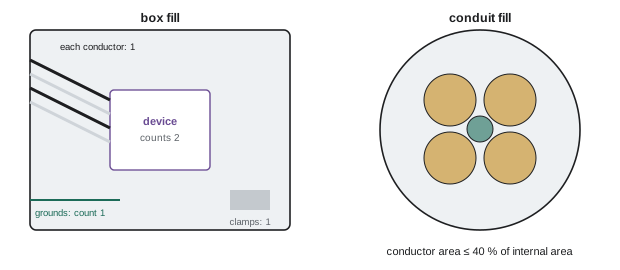
Every splice, switch, receptacle and luminaire connection must be in a box or enclosure that remains accessible, and the box must be large enough for the conductors and devices it contains. Overfilled boxes cause damaged insulation, loose connections and overheating. Box fill rules assign a volume to each conductor according to its size, and count devices, clamps and other items as equivalent conductors.
In the CEC, Rule 12-3034 and Tables 22 and 23 set box fill. Table 23 gives the maximum number of conductors of each size for standard boxes, and Table 22 gives the usable volume per conductor for calculating other boxes. Insulated conductors entering the box are counted, bare bonding conductors are not, and each wiring device reduces the number of conductors permitted, as the rule specifies. Because the counting conventions differ from those used in the United States, use only Canadian practice questions for box fill.
Worked problem
Conduit fill for a feeder
Four 3 AWG T90 Nylon conductors and one 8 AWG T90 Nylon bonding conductor are to be installed in EMT. Using conductor areas of 62.8 mm² for 3 AWG and 23.6 mm² for 8 AWG, and internal areas of 557 mm² for 27 mm EMT and 965 mm² for 35 mm EMT, find the smallest EMT size. (Conductor dimensions come from Table 6 and raceway areas from Table 9.)
Show solution
- Total conductor area: 4 × 62.8 + 23.6 = 274.8 mm².
- Maximum fill for more than two conductors (Table 8): 40 %.
- 27 mm EMT: 0.40 × 557 = 223 mm², less than 274.8 mm², too small.
- 35 mm EMT: 0.40 × 965 = 386 mm², more than 274.8 mm², acceptable.
Answer: Trade size 35 mm EMT. A 27 mm conduit would be filled to about 49 %, above the 40 % limit.
Raceway fill
Raceway fill limits make conductors possible to pull without damaging insulation and allow heat to escape. For conductors of different sizes, the total cross-sectional area of the conductors, including insulation, is compared with a percentage of the raceway's internal area: 53 % for one conductor, 31 % for two and 40 % for three or more. For conductors all of the same size, tables in the code give the maximum number of conductors per raceway size directly, which is faster on exams. Conductor areas depend on insulation type and thickness, so a raceway that holds four conductors of one type may not hold four of another type with thicker insulation.
In the CEC, Table 8 gives the maximum fill percentages, Table 6 series give conductor dimensions by insulation type, Table 9 series give internal areas of raceways, and Table 6 includes counts for conductors of the same size in common raceways.
Bends and pull points
Pulling conductors through conduit becomes harder with every bend, because tension multiplies at each change of direction. Codes therefore limit the bends between pull points, such as boxes, conduit bodies and fittings, to the equivalent of four quarter bends, a total of 360°, including offsets and kicks. Exam questions may describe a run with a 90° bend, two 45° offsets and a 30° kick, and ask whether a pull point is needed. Bends must be made without kinking or reducing the internal diameter, within minimum radius limits, and conductors must not be installed in a raceway until it is complete between pull points.
Underground installations
Underground wiring must be buried deep enough to avoid damage from digging and traffic, with depth depending on the wiring method, the voltage, the location (such as under a driveway, a road, a building slab or a lawn) and whether additional protection such as concrete encasement or a protective board is provided. Direct-buried cables need a cover of sand or screened fill to avoid sharp stones, and many installations require warning tape above the cable. Where conductors leave the ground and rise up a building or pole, they must be protected against damage to a specified height. Raceways entering buildings from underground must be sealed to prevent water and gas from entering, and allowance must be made for frost heave and settlement with expansion fittings.
In the CEC, Rule 12-012 and Table 53 give minimum cover depths for direct-buried conductors and cables and for raceways, according to the voltage and location, with reduced depths permitted where mechanical protection is provided.
Fire separations and plenums
Wiring that passes through fire-rated walls, floors and ceilings must not reduce the fire resistance of the assembly. Penetrations are sealed with listed firestop systems that match the wiring method and the assembly rating. Spaces used for environmental air, such as ceiling plenums and air-handling spaces, are restricted to wiring methods that will not spread fire or produce excessive smoke, such as metal raceways or cables with low-smoke, flame-resistant jackets rated for plenum use. These requirements link the electrical code with the building code, and exam questions may ask which cable types are permitted in a return-air plenum or how penetrations must be treated.
Cable trays and busways
Cable trays support cables in industrial and large commercial installations, allowing large numbers of cables to be installed and changed easily. Only cables rated for tray use may be installed, and fill rules depend on cable sizes and tray type. Ampacities of cables in trays have their own rules because heat dissipation depends on spacing and covers. Busways, prefabricated assemblies of bus bars in an enclosure, carry large currents along buildings with plug-in or bolt-on taps for loads; they have rules about where they may run, how they are supported and how taps are protected.
Conductors in parallel raceways and cables
Large feeders often use several raceways in parallel, each carrying a complete set of phase and neutral conductors. Each raceway is sized for its own set, and the grouping factors apply to the conductors within each raceway. Using one raceway per phase is not permitted for AC circuits in metal raceways, because the unbalanced magnetic field heats the raceway by induction. The same principle requires all conductors of a circuit to be in the same cable, raceway or trench, so that their magnetic fields cancel.
Expansion, drainage and corrosion
Raceways must allow for thermal expansion, particularly rigid PVC conduit, which expands about five times as much as steel for the same temperature change; long outdoor runs need expansion fittings. Raceways that may collect condensation, such as those passing from warm to cold spaces, must be arranged to drain, sealed against air movement, or both. Metal raceways in corrosive locations, such as farm buildings, swimming pool equipment rooms and chemical plants, need corrosion-resistant materials or coatings. Questions may describe a situation and ask which material or fitting is required.
Boxes for luminaires and fans
Boxes that support luminaires and ceiling fans must be rated for the load. Boxes for ceiling fans must be listed for fan support, because fans produce vibration and dynamic loads, and the box must be supported directly by the building structure. Heavy luminaires above a stated weight must be supported independently of the box. Boxes in walls must be set flush with or slightly behind combustible and non-combustible finishes, within limits, and gaps around boxes in drywall must be repaired. Exam questions on these points often test the weight thresholds and the setback distances.
Raceway seals and pulling
Conductors must be pulled into raceways without exceeding their allowable pulling tension and sidewall pressure, using lubricants approved for the insulation. Long or complex pulls are planned using calculations of pulling tension, which grows exponentially with each bend. Raceways are cleaned and inspected before pulling, and conductors are protected from abrasion at the raceway entrance. These practices are examined as common occupational skills.
Exam strategy for wiring method questions
Wiring method questions are often answered fastest by going to the article or rules for the specific method mentioned, which typically list permitted uses, prohibited uses, support, bending and fill in a consistent order. Learn this common structure, because it lets you jump to the right part of any wiring method's rules without reading from the start. When a question asks which method is permitted for a location, check both the method's own rules and any rules for the location itself, such as hazardous, wet, corrosive or fire-rated areas, since either can exclude a method.
Common mistakes
MistakeUsing a wiring method outside its permitted scope.
InsteadCheck uses permitted and not permitted for the location.
MistakeCounting bare bonding conductors the US way in a Canadian question.
InsteadUse the counting rules of the code you are examined on.
MistakeUsing 53 % or 31 % fill for three or more conductors.
InsteadUse 40 % for three or more.
MistakeForgetting offsets and kicks in the 360° total.
InsteadAdd every bend between pull points.
MistakeIgnoring driveway or roadway burial depths.
InsteadUse the depth for the actual location.
Summary and key terms
- Each wiring method has defined permitted and prohibited uses.
- Support intervals and protection from nails and damage are specified.
- Box fill assigns volumes to conductors and counts devices and fittings.
- Raceway fill is 53 %, 31 % or 40 % of internal area for 1, 2 or 3+ conductors.
- Bends between pull points are limited to 360°.
- Burial depths depend on method, voltage and location.
- Firestopping and plenum rules link electrical and building codes.
- Wiring method
- System of cables or raceways carrying conductors.
- Raceway
- Enclosed channel for conductors.
- EMT
- Electrical metallic tubing.
- Box fill
- Allowed volume of conductors and devices in a box.
- Conduit fill
- Percentage of raceway area occupied by conductors.
- Pull point
- Box or fitting where conductors can be pulled.
- Quarter bend
- A 90° bend.
- Cover depth
- Distance from finished grade to the top of buried wiring.
- Firestop
- System sealing penetrations in fire-rated assemblies.
- Plenum
- Space used for environmental air.
Practice problems
Work each problem on paper first, then reveal the answer to check.
Maximum fill for two conductors?
Show answer
31 %.
Maximum fill for five conductors?
Show answer
40 %.
Total area of three 62.8 mm² conductors; does 27 mm EMT (557 mm²) suffice?
Show answer
188.4 mm² ≤ 222.8 mm²; yes.
Maximum bends between pull points?
Show answer
360°, four quarter bends.
A run has two 90° bends and two 45° offsets (four 45° bends). Total?
Show answer
360°, at the limit.
Support spacing for NMD90?
Show answer
Within 300 mm of boxes; every 1.5 m.
Which tables govern box fill?
Show answer
Tables 22 and 23 with Rule 12-3034.
Which table gives burial depths?
Show answer
Table 53.
Why are fill limits needed?
Show answer
For pulling without damage and heat dissipation.
What wiring is permitted in plenums?
Show answer
Metal raceways or plenum-rated cables.
Lesson quiz · 5 questions
Score 60% or more to complete this lesson.
Create a free account to save your progress, take quizzes and earn a certificate.