
ELEC-430 · Lesson 1 of 12 · 25 min
How the Red Seal exam works and building a study plan
The interprovincial Red Seal examination is the final step in becoming a certified construction electrician in most of Canada. Passing it earns a provincial or territorial certificate of qualification with the Red Seal endorsement, which is recognized in every participating province and territory and tells employers that you meet a national standard. The exam tests the whole trade: code knowledge, calculations, theory, installation practice, motors and controls, and communication systems, all in a few hours. Many apprentices who are competent on the job find the exam difficult, not because they lack knowledge, but because they are unfamiliar with the format, slow at finding rules in the Canadian Electrical Code (CEC) and rusty on calculations they rarely do by hand. This course is a structured review of the trade designed around the exam. This first lesson explains how the exam is built and scored, what it covers, and how to build a study plan that uses the remaining weeks well.
Who sets the exam
The Red Seal Program is a partnership between the federal government and the provinces and territories, coordinated by the Canadian Council of Directors of Apprenticeship (CCDA). For each Red Seal trade, industry experts from across the country develop a Red Seal Occupational Standard (RSOS), which lists the major work activities, tasks and sub-tasks of the trade and the knowledge and skills each requires. Exam questions are written and validated by tradespeople and instructors to match the standard, and each province or territory administers the exam through its apprenticeship authority, such as Skilled Trades Ontario, SkilledTradesBC or the Saskatchewan Apprenticeship and Trade Certification Commission. In Ontario the construction electrician trade is known as 309A, Construction and Maintenance Electrician. Apprentices normally write the exam after completing their hours and technical training; experienced tradespeople without an apprenticeship may also qualify to challenge it after documenting their experience.
The format
The current construction electrician exam has 100 multiple-choice questions, each with four answer options and a single correct answer, and the pass mark is 70 %. Candidates are given a copy of the Canadian Electrical Code and a reference material booklet containing formulas, acronyms and figures, and may use a non-programmable calculator; phones and other electronic devices are not allowed. The edition of the code provided depends on the exam date: for example, Saskatchewan advised that the 2021 CEC would be provided until August 2026 and the 2024 CEC thereafter. Candidates usually have about four hours, which is plenty for well-prepared candidates but tight for those who look up every rule. Check the current details with your own apprenticeship authority before you write, because formats and editions change.
| Major work activity | Share of exam | Questions |
|---|---|---|
| A. Common occupational skills | 11 % | 11 |
| B. Generating, distribution and service systems | 28 % | 28 |
| C. Wiring systems | 30 % | 30 |
| D. Motors and control systems | 21 % | 21 |
| E. Signalling and communication systems | 10 % | 10 |
What the questions test
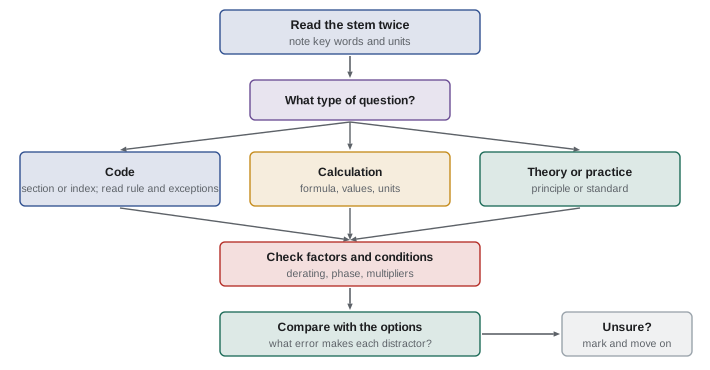
Exam questions fall into a few broad types. Code questions ask what a rule requires: a minimum size, a maximum distance, where protection is needed. Calculation questions ask you to size a conductor, find a load, calculate voltage drop or work out a motor circuit. Theory questions test understanding of electrical principles: series and parallel circuits, AC behaviour, transformers, motors, controls and electronics. Practice and safety questions describe a job situation and ask what to do. Many questions combine these, for example asking for the minimum conductor size for a motor, which requires a table lookup, a multiplier and a correction factor.
Questions are written to discriminate between candidates who know the material and those who do not. Wrong answers, called distractors, are usually the results of common mistakes: forgetting a correction factor, using the wrong table column, applying the wrong multiplier, or confusing two similar rules. If your answer matches one of the options, that does not prove it is right; an answer that matches is just as likely to be a well-designed trap.
How your score works
Every question is worth the same, and there is normally no penalty for a wrong answer, so you should answer every question even when unsure. Because the pass mark applies to the whole exam rather than to each section, strength in one area can make up for weakness in another, but large weaknesses are dangerous: an area worth 30 % of the exam cannot be skipped. After an unsuccessful attempt, most authorities provide a breakdown of your performance by area, which is valuable for planning the next attempt, and set a waiting period before you can rewrite.
Worked problem
Working out the margin
On a 100-question exam with a 70 % pass mark, a candidate is confident about 62 answers and has narrowed 20 more to two options each. The remaining 18 are guesses among four options. What is the expected score?
Show solution
- Confident answers: 62 (assume all correct).
- Two-way guesses: 20 × 0.5 = 10 expected correct.
- Four-way guesses: 18 × 0.25 = 4.5 expected correct.
- Expected total: 62 + 10 + 4.5 = 76.5, or about 76 %.
Answer: About 76 to 77 %, above the pass mark, but with little margin if some "confident" answers are wrong. Turning guesses into known answers in the weeks before the exam is the most reliable way to add margin.
The code book as a tool
Because the CEC is provided, the exam does not reward memorizing rule numbers; it rewards knowing how the code is organized and finding the right rule quickly. A candidate who knows that conductor ampacities are in Section 4 and Tables 1 to 4, that circuit loading and dwelling calculations are in Section 8, that bonding is in Section 10 and that motors are in Section 28 can find most answers in under a minute. Since you cannot bring your own marked-up copy, practise with a clean book of the same edition, using the index and table of contents rather than your own tabs. Lesson 2 covers code navigation in detail.
Building a study plan
A good study plan starts with an honest assessment. Take a full-length practice exam under exam conditions before you begin reviewing, mark it, and sort your errors by topic and by cause: not knowing the material, not finding the rule, misreading the question, or making a calculation error. This diagnosis shows where study time will pay off most. A typical plan then runs over eight to twelve weeks:
- Weeks 1–2: code navigation, definitions and the general rules; daily lookup drills.
- Weeks 3–5: conductors, branch circuits and feeders, load calculations, services, grounding and bonding.
- Weeks 6–7: wiring methods, boxes and raceways, motors, transformers and controls.
- Week 8: special locations and systems, such as hazardous locations, pools, emergency systems, fire alarm and renewables.
- Weeks 9–10: calculations and theory review; timed mixed practice.
- Final weeks: full practice exams under timed conditions, reviewing every error.
Short daily sessions of an hour or so are more effective than occasional long ones, because spaced practice strengthens memory. Active practice, answering questions and working calculations, beats rereading notes. Keep an error log: for every question you get wrong, write down why and the correct reasoning, and review the log weekly.
Resources
Useful resources include the RSOS for the construction electrician trade, available free on the Red Seal website, which lists everything the exam can test; the Red Seal sample questions and self-assessment tools; your apprenticeship training notes; exam preparation books and practice question banks; and study groups with other apprentices. Use the same CEC edition as your exam. Be cautious with free online question banks, which may be based on old code editions or contain errors; check any doubtful answer against the code itself.
Preparing for exam day
Practical preparation reduces stress. Confirm the date, location and identification required; check the calculator rules and bring an approved calculator with fresh batteries; and plan to arrive early. Sleep well the night before rather than cramming. During the exam, read every question completely, answer the ones you know first, mark the ones that need time, and return to them. Lesson 12 covers exam technique and timing in detail, with full practice exams.
Anatomy of a good exam question
It helps to see an exam question from the writer's side. A well-written question has a stem that describes a realistic situation and asks one clear thing, a correct answer (the key) that can be justified from the code, the standard or accepted trade theory, and three distractors that are plausible to someone who has not mastered the topic. Writers build distractors from the errors they see apprentices make: forgetting a multiplier, using a line-to-neutral voltage, reading the wrong column, applying a rule from a different section, or confusing a minimum with a maximum. Knowing this changes how you read options. Instead of asking "which looks right?", ask "what mistake would produce each of these?" When you can explain every distractor, you can be confident of the key.
Studying by question type
Each type of question rewards a different kind of practice. For code questions, practise finding rules quickly and reading them completely; flash cards with a topic on one side and the governing rule on the other are useful for drilling. For calculation questions, practise the same type repeatedly until the steps become automatic, then mix types so that you learn to recognize which method applies. For theory questions, explain concepts aloud or to a study partner, because explaining exposes gaps that rereading hides. For practice and safety questions, relate each one to situations you have seen on the job, and check your habits against the standards, since some site habits are not what the code or safety standard requires.
Fitting study around work
Most candidates prepare while working full time, often with long days and family commitments. Realistic plans account for this. Short, regular sessions, such as 45 minutes on weekday evenings and a longer session at the weekend, are more sustainable than ambitious plans that collapse after a week. Some candidates study during breaks with question apps or flash cards, or listen to recorded explanations while commuting. Telling family and employers about the exam date helps protect study time in the final weeks, and some employers offer time off or paid preparation courses.
Study groups
Studying with others has real benefits: explaining a concept to someone else is one of the most effective ways to learn it, other people catch errors you miss, and a group keeps members on schedule. Effective groups meet regularly, set a topic for each session, work through questions individually first and then compare reasoning, and keep discussion focused. Groups work less well when one person does all the explaining or sessions drift into general conversation. A group of three to five candidates with similar exam dates is usually ideal.
Tracking progress
Keep a simple progress chart: the date, the practice set or exam taken, the score, the time used and the main error causes. Seeing scores rise over several weeks builds confidence, and a plateau shows when a change of approach is needed, for example moving from reading to more timed practice, or from mixed questions back to focused work on one weak topic. Aim for practice scores comfortably above the pass mark, around 80 % or more, before the real exam, because nerves and unfamiliar questions usually cost a few marks on the day.
Common mistakes
MistakeStudying without first taking a diagnostic practice exam.
InsteadDiagnose weak areas and plan around them.
MistakeMemorizing rule numbers.
InsteadLearn how the code is organized and practise finding rules.
MistakeStudying a different code edition from the exam.
InsteadUse the edition named for your exam date.
MistakeRereading notes instead of practising.
InsteadAnswer questions and work calculations daily.
MistakeLeaving questions blank.
InsteadAnswer every question; there is no penalty for guessing.
Summary and key terms
- The Red Seal exam leads to a certificate recognized across participating provinces and territories.
- The construction electrician exam has 100 questions with a 70 % pass mark.
- Questions are weighted by the major work activities of the RSOS.
- Questions test code, calculations, theory and practice; distractors reflect common errors.
- Every question counts equally; answer them all.
- Code navigation skill matters more than memorization.
- A diagnostic exam, a written plan, daily practice and an error log make study effective.
- Certificate of qualification
- Credential certifying a journeyperson.
- Red Seal endorsement
- Interprovincial recognition of qualification.
- RSOS
- Red Seal Occupational Standard for a trade.
- Journeyperson
- A fully qualified tradesperson (journeyman in US usage).
- Candidate bulletin
- Document describing exam rules and content.
- Stem
- The question part of a multiple-choice item.
- Distractor
- A plausible wrong answer option.
- Pass mark
- Minimum score required to pass.
- Error log
- Record of mistakes and correct reasoning.
- Spaced practice
- Short, repeated study sessions over time.
Practice problems
Work each problem on paper first, then reveal the answer to check.
How many questions are on the construction electrician Red Seal exam?
Show answer
100.
What pass mark is most common?
Show answer
70 %.
Which major work activity carries the most questions?
Show answer
C, wiring systems (30 %).
Name four types of exam question.
Show answer
Code, calculation, theory, practice and safety.
What is a distractor?
Show answer
A wrong answer built from a common mistake.
Should you leave hard questions blank?
Show answer
No; there is normally no penalty for guessing.
Expected correct answers from 12 four-way guesses?
Show answer
3.
What should a diagnostic exam sort your errors by?
Show answer
Topic and cause.
Why are short daily sessions better than long occasional ones?
Show answer
Spaced practice strengthens memory.
What goes in an error log?
Show answer
Each wrong question, why it was wrong and the correct reasoning.
Lesson quiz · 5 questions
Score 60% or more to complete this lesson.
Create a free account to save your progress, take quizzes and earn a certificate.