
ELEC-410 · Lesson 3 of 12 · 27 min
Flow and temperature measurement
Flow and temperature are, with pressure and level, the four core process variables. Flow measurement controls how much of each ingredient enters a process, bills customers for water, gas and steam, and protects pumps and burners. Temperature measurement controls heating and cooling, protects equipment and ensures product quality and safety. This lesson covers the main flowmeter technologies and their installation requirements, then thermocouples, resistance temperature detectors (RTDs) and temperature transmitters, including the wiring details that cause most temperature measurement errors in the field.
Flow basics
Volumetric flow rate is the volume passing a point per unit time, in units such as m³/h, litres per second or US gallons per minute; mass flow rate is mass per unit time, such as kg/h. Volumetric flow equals the cross-sectional area of the pipe times the average velocity. Flow profiles matter: in a long straight pipe the velocity profile is fully developed and symmetrical, but elbows, valves and pumps distort it, which is why most flowmeters need straight pipe runs upstream and downstream. Manufacturers specify these runs as multiples of pipe diameter, for example 10 diameters upstream and 5 downstream, and flow conditioners can shorten them.
Differential pressure flowmeters
The oldest and still very common method places a restriction, usually an orifice plate, in the pipe. Fluid accelerates through the restriction and its pressure drops; a differential pressure transmitter measures the drop. Bernoulli's principle shows that flow is proportional to the square root of the differential pressure:
So doubling the flow quadruples the differential pressure. At 10 % of maximum flow the DP is only 1 % of maximum, which limits useful turndown to roughly 4:1 or 5:1 for a single orifice and transmitter. Modern DP transmitters perform the square root extraction internally, or the control system does it; the critical rule is that it must be done exactly once. Doing it twice, or not at all, produces large errors at low flows. Other DP elements include venturi tubes, which recover most of the pressure loss, flow nozzles, and averaging pitot tubes. DP meters are well understood, have no moving parts and suit liquids, gases and steam, but they cause permanent pressure loss and require long straight runs.
Worked problem
Square root relationship
An orifice meter is sized so that 200 m³/h gives 25 kPa differential pressure. What flow corresponds to 9 kPa? If the transmitter outputs a linear-in-DP signal with 0 to 25 kPa = 4 to 20 mA, what current is measured at that flow?
Show solution
- Q = 200 × √(9 / 25) = 200 × 0.6 = 120 m³/h.
- DP fraction = 9 / 25 = 0.36.
- Current = 4 + 0.36 × 16 = 9.76 mA.
- If the transmitter extracted the square root, the output would be 4 + 0.6 × 16 = 13.6 mA instead.
- The control system must know which form it receives so the square root is applied once.
Answer: 120 m³/h; 9.76 mA if the signal is linear in DP, 13.6 mA if it is linear in flow.
Magnetic flowmeters
A magnetic flowmeter, or magmeter, applies a magnetic field across a pipe lined with non-conductive material. A conductive liquid moving through the field generates a voltage proportional to its velocity (Faraday's law), picked up by electrodes. Magmeters have no obstruction and no pressure loss, measure in both directions, and are standard in water, wastewater, slurries and chemicals. Requirements: the liquid must be conductive (typically above 5 µS/cm, so not hydrocarbons or pure water), the pipe must be full, and the meter and liquid must be at the same electrical potential. In plastic or lined pipe, grounding rings or electrodes are required on both sides, bonded to the meter body, so that stray currents and static do not swamp the millivolt-level signal. Mount magmeters where the pipe stays full, such as in a vertical line with upward flow, and away from the suction side of pumps.
Other flowmeter technologies
- Coriolis meters vibrate one or two tubes; flowing mass twists the tubes in proportion to mass flow, and the vibration frequency gives density. They measure mass flow directly with high accuracy for liquids and gases, at higher cost and with size limits.
- Vortex meters place a bluff body in the stream; vortices shed alternately at a frequency proportional to velocity. Suitable for steam, gas and clean liquids, with no moving parts, but they cut off at low velocities.
- Ultrasonic meters measure the difference in transit time of sound pulses travelling with and against the flow. Clamp-on versions mount outside the pipe, useful for checking other meters and for retrofits.
- Turbine and positive displacement meters count rotations of a rotor or chambers; accurate for clean fluids and custody transfer, but have moving parts that wear.
- Thermal mass flowmeters measure the heat carried away from a heated sensor, common for gas and compressed air.
| Meter | Measures | Best for | Limitations |
|---|---|---|---|
| Orifice / DP | Volumetric (from √ΔP) | Liquids, gas, steam | Pressure loss, 4:1 turndown, straight runs |
| Magnetic | Volumetric | Conductive liquids, slurries | Needs conductivity, full pipe, grounding |
| Coriolis | Mass and density | High accuracy liquids and gases | Cost, size, vibration |
| Vortex | Volumetric | Steam, gas, clean liquids | Low-flow cutoff |
| Ultrasonic | Volumetric | Large pipes, clamp-on checks | Bubbles, solids, pipe condition |
| Thermal mass | Mass (gas) | Compressed air, gas | Calibration to gas composition |
Thermocouples
A thermocouple is two dissimilar metal wires joined at a measuring (hot) junction. A voltage, the Seebeck voltage, appears at the open ends that depends on the temperature difference between the hot junction and the point where the wires connect to copper, the reference or cold junction. The voltage is small: a type K thermocouple produces about 41 µV per degree Celsius. Because the measurement depends on the reference junction, instruments measure the terminal temperature and add the corresponding voltage, called cold junction compensation.
Common types include type K (chromel–alumel, −200 to about 1,250 °C, general purpose), type J (iron–constantan, narrower range, reducing atmospheres), type T (copper–constantan, cryogenic to 350 °C, good accuracy), and types R, S and B (platinum–rhodium, up to about 1,700 °C for furnaces). Thermocouples are rugged, fast, inexpensive and cover very high temperatures, but are less accurate and stable than RTDs.
Wiring rules are strict. Any junction of dissimilar metals creates a new thermocouple, so the circuit must be run in matching thermocouple extension wire, with matching connectors, all the way to the instrument or transmitter. Using copper wire from the head to the controller moves the reference junction to the head, where the temperature is unknown, causing errors that change with the weather. Thermocouple wire is colour coded, but codes differ: in North America, the negative lead is red, while other standards use different colours, so always verify with the tag or a meter. Reversed polarity produces readings that move in the wrong direction as temperature changes.
Resistance temperature detectors
An RTD uses the predictable increase of a metal's resistance with temperature. The standard Pt100 platinum RTD has 100 Ω at 0 °C and, with the common coefficient \(\alpha = 0.00385\), about 138.5 Ω at 100 °C. A simplified linear relation is adequate for many checks:
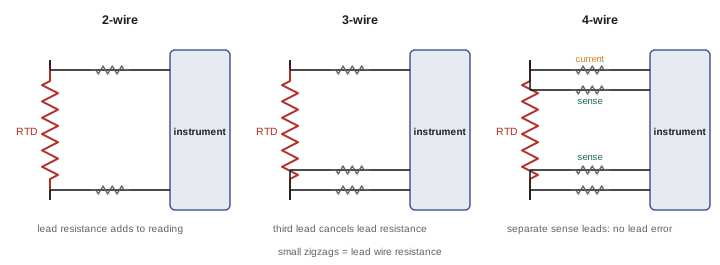
RTDs are more accurate, stable and linear than thermocouples, from about −200 to 600 °C, but slower and more fragile. Because the signal is a resistance, lead wire resistance adds error: each ohm of lead resistance on a Pt100 reads as about 2.6 °C. Two-wire connections include both leads in the measurement and are only acceptable for short runs. Three-wire connections, the industrial standard, use the third lead to measure and cancel lead resistance, provided all three leads are the same length and gauge. Four-wire connections measure voltage on separate leads from the current, eliminating lead effects, and are used for laboratory and high-accuracy work.
Worked problem
Lead resistance error
A Pt100 is connected with two wires of 18 AWG copper, 60 m each way (resistance about 21 Ω/km). Estimate the temperature error.
Show solution
- Total lead length = 120 m = 0.12 km.
- Lead resistance = 0.12 × 21 = 2.5 Ω.
- Sensitivity of a Pt100 ≈ 100 × 0.00385 = 0.385 Ω/°C.
- Error = 2.5 / 0.385 ≈ 6.5 °C reading high.
- A three-wire connection or a head-mounted transmitter would remove most of this error.
Answer: About 6.5 °C high; use three-wire wiring or a transmitter at the sensor.
Thermowells, transmitters and installation
Sensors are usually installed in thermowells, closed-end tubes welded or threaded into the process so that sensors can be removed without shutting down. The well must be long enough to reach the representative fluid, typically with the tip in the middle third of the pipe, and be designed to withstand vortex-induced vibration at high velocities, which has broken wells. Response is slower in a well, and spring-loaded sensors that press against the bottom of the well improve contact.
Temperature transmitters, mounted in the sensor head or on a DIN rail nearby, convert the sensor signal into 4–20 mA or a digital signal. Mounting the transmitter near the sensor keeps low-level millivolt or resistance signals short and sends a robust current signal back to the control room. Transmitters also provide sensor diagnostics, such as detecting an open thermocouple and driving the output to a configured failure value, typically below 3.6 mA or above 21 mA under the NAMUR NE 43 convention, so the control system can recognize a failed sensor instead of acting on a false reading.
Choosing a flowmeter
Choosing a flowmeter means matching technology to the fluid, the required accuracy, the available straight run and the budget. Questions to ask include whether the fluid is liquid, gas or steam; whether it is clean or carries solids; whether it is conductive; what the minimum, normal and maximum flows are; what pressure loss is acceptable; whether mass or volume is needed; and whether the measurement is for control, for monitoring or for billing (custody transfer), which demands the highest accuracy and often regulatory approval. A magmeter is the usual first choice for conductive liquids; Coriolis for high-accuracy mass flow in smaller lines; vortex or DP for steam; and thermal mass for compressed air. Clamp-on ultrasonic meters are valuable diagnostic tools, because they can verify the readings of an installed meter without breaking into the pipe.
Troubleshooting flow and temperature loops
Flow readings that are noisy at low flow often reflect the square root relationship of DP meters or the low-flow cutoff of vortex meters. A magmeter that reads erratically may have a partially empty pipe, entrained air, coated electrodes, or missing grounding rings. A temperature reading that is too low with a thermowell may indicate the sensor is not touching the bottom of the well or that the well is too short. A thermocouple reading that jumps or reads ambient temperature may have an open junction, which a transmitter's burnout detection should flag. Comparing a suspect reading with a portable reference, such as a calibrated thermometer in a test well or a clamp-on flowmeter, quickly shows whether the problem is in the measurement or in the process.
Flow totalization, the accumulation of total volume or mass over time, is used for billing, batch dosing and reporting. Totals can be calculated in the transmitter and sent as a pulse output, where each pulse represents a fixed quantity such as 10 litres, or calculated in the control system from the analog flow signal. Pulse outputs avoid analog conversion errors but must be wired and scaled correctly; a mismatch between the pulse value configured in the meter and in the counter produces totals that are wrong by a constant factor, a common commissioning error that is easily caught by comparing the total with the rate over a known time.
Common mistakes
MistakeApplying square root extraction twice.
InsteadConfirm where square root extraction is done and do it once.
MistakeInstalling a magmeter in plastic pipe without grounding rings.
InsteadBond grounding rings or electrodes to the meter.
MistakeRunning copper wire for a thermocouple circuit.
InsteadUse matching extension wire to the instrument.
MistakeUsing two-wire RTDs on long runs.
InsteadUse three-wire connections or a local transmitter.
MistakeIgnoring straight-run requirements.
InsteadProvide upstream and downstream diameters or a conditioner.
Summary and key terms
- Flow is volumetric or mass; flowmeters need developed flow profiles.
- DP flow is proportional to the square root of differential pressure.
- Magmeters need conductive liquid, full pipes and proper grounding.
- Coriolis measures mass and density; vortex suits steam and gas.
- Thermocouples need matching extension wire and cold junction compensation.
- RTDs are accurate; three- and four-wire connections cancel lead resistance.
- Head-mounted transmitters shorten low-level signal runs and add diagnostics.
- Volumetric flow
- Volume per unit time.
- Mass flow
- Mass per unit time.
- Orifice plate
- Restriction creating a flow-dependent pressure drop.
- Square root extraction
- Converting DP to a signal linear in flow.
- Magmeter
- Flowmeter using Faraday's law in conductive liquids.
- Coriolis meter
- Mass flowmeter using vibrating tubes.
- Seebeck voltage
- Voltage produced by a thermocouple junction.
- Cold junction compensation
- Correction for the reference junction temperature.
- Pt100
- Platinum RTD with 100 Ω at 0 °C.
- Thermowell
- Protective tube holding a temperature sensor.
Practice problems
Work each problem on paper first, then reveal the answer to check.
A pipe has 0.02 m² area and 1.5 m/s velocity. Find Q.
Show answer
0.03 m³/s = 108 m³/h.
If flow halves, what happens to orifice DP?
Show answer
It falls to one quarter.
Why is orifice turndown limited?
Show answer
DP becomes tiny at low flow.
Name two requirements for a magmeter.
Show answer
Conductive liquid, full pipe, grounding.
What does a Coriolis meter measure directly?
Show answer
Mass flow and density.
About how many µV per °C does type K produce?
Show answer
About 41 µV/°C.
What happens if copper wire replaces extension wire?
Show answer
The reference junction moves, causing errors.
Resistance of a Pt100 at 50 °C?
Show answer
About 119.3 Ω.
Why use three-wire RTD connections?
Show answer
To cancel lead resistance.
What does NAMUR NE 43 define?
Show answer
Failure current levels below 3.6 or above 21 mA.
Lesson quiz · 5 questions
Score 60% or more to complete this lesson.
Create a free account to save your progress, take quizzes and earn a certificate.