
ELEC-310 · Lesson 10 of 12 · 30 min
Reduced-voltage starting and soft starters
A motor started across the line, at full voltage, draws six to eight times its full-load current and produces a sharp jolt of starting torque. For small motors on a stiff supply this is not a problem, and across-the-line starting is the simplest and most common method. For large motors, or motors on weak supplies such as long rural lines and standby generators, the inrush current causes a voltage dip that can flicker lights, drop out contactors and trip sensitive equipment elsewhere in the plant, and the torque shock can break couplings, slip belts and cause water hammer in pipes. Reduced-voltage starting lowers the voltage applied to the motor during acceleration, reducing both the starting current and the starting torque. This lesson explains why and when reduced-voltage starting is needed, the electromechanical methods (primary resistor or reactor, autotransformer, wye-delta and part-winding), solid-state soft starters, and how to choose among them, with variable frequency drives as the final alternative covered in Lesson 11.
Why reduce starting current?
There are three main reasons for reduced-voltage starting:
- Voltage dip: a large inrush through the impedance of the utility supply and the plant transformer lowers the voltage for everything on the same system. Utilities often set limits on motor starting current or on voltage flicker at the point of connection, particularly for large motors on rural lines.
- Mechanical stress: full-voltage starting torque accelerates the load abruptly, which can damage gearboxes, couplings and belts, spill product on conveyors, and cause water hammer when pumps start and stop.
- Source capacity: standby generators have much higher impedance than a utility supply, and a large motor started across the line may stall the generator or drop its voltage so far that other loads fail.
The trade-off is that reducing the voltage reduces the starting torque even more than it reduces the current, because torque is proportional to the square of voltage (Lesson 2). A reduced-voltage starter must still provide enough torque to accelerate the load. Loads with low starting torque, such as centrifugal pumps and fans, suit reduced-voltage starting well; loads that need high torque from standstill, such as loaded conveyors and positive-displacement compressors, may not start at all.
Estimating voltage dip
A simple estimate of the voltage dip at the motor terminals when starting a motor fed from a transformer treats the transformer as the main impedance. The available short-circuit kVA of the transformer is its rating divided by its per-unit impedance; the dip is then approximately:
Worked problem
Voltage dip from starting a large motor
A 200 hp, 460 V motor with code letter G (up to 6.29 kVA/hp) is supplied from a 1,000 kVA transformer with 5.75 % impedance. Estimate the voltage dip at the transformer secondary for an across-the-line start and for a start at one-third the locked-rotor kVA, as with a wye-delta starter.
Show solution
- Locked-rotor kVA = 6.29 × 200 = 1,258 kVA.
- Short-circuit kVA = 1,000 ÷ 0.0575 = 17,390 kVA.
- Across the line: dip ≈ 1,258 ÷ (1,258 + 17,390) × 100 = 6.7 %.
- At one-third: 419 kVA; dip ≈ 419 ÷ (419 + 17,390) × 100 = 2.4 %.
Answer: About 6.7 % dip across the line, reduced to about 2.4 % with one-third starting kVA. Voltage drop in the feeder and the utility source impedance add to these figures, so a full study uses the whole system impedance. Dips above about 10 % to 15 % commonly cause problems with contactors and electronics.
Primary resistor and reactor starters
The oldest reduced-voltage method inserts resistors or reactors in series with each line during starting. The voltage drop across them reduces the voltage at the motor, typically to 65 % to 80 % of line voltage. As the motor accelerates, its current falls, the drop across the resistors decreases, and the motor voltage rises gradually, giving a smooth start. After a set time, a run contactor shorts out the resistors and the motor runs at full voltage. Because the motor stays connected throughout, the transition is closed (no interruption of current), avoiding the current spike of open transition.
With a series impedance, line current and motor current are the same and both fall in proportion to the voltage, while torque falls with its square: at 65 % voltage, current is 65 % of locked-rotor current and torque 42 % of locked-rotor torque. Resistors waste energy as heat during starting and limit the number of starts per hour; reactors, used mostly on medium-voltage motors, waste less. Primary resistor starters are robust and simple but have largely been replaced by soft starters.
Autotransformer starters
An autotransformer starter uses a three-phase autotransformer (or two in open delta) with taps, usually at 50 %, 65 % and 80 % of line voltage, to supply the motor at reduced voltage. Because the autotransformer transforms current as well as voltage, the line current is lower than the motor current:
- Motor voltage = tap fraction × line voltage.
- Motor current = tap × locked-rotor current at full voltage.
- Line current = tap² × locked-rotor current (plus a small magnetizing current).
- Starting torque = tap² × locked-rotor torque.
So for the same starting torque, an autotransformer draws less line current than any other electromechanical method: at the 65 % tap, line current and torque are both about 42 % of their full-voltage values. The Korndorfer connection gives a closed transition: during starting, the autotransformer is connected in wye; at transition, the wye point is opened so part of the winding acts as a series reactor, and then the run contactor applies full voltage. Autotransformer starters are bulky and expensive but give the best torque per ampere, and are used for large pumps, fans and compressors, particularly where a utility limits starting current.
Worked problem
Comparing autotransformer taps
A motor has locked-rotor current of 600 % and locked-rotor torque of 150 % of full-load values. The load needs at least 50 % of full-load torque to start. Compare the 50 %, 65 % and 80 % autotransformer taps.
Show solution
- 50 % tap: torque = 0.25 × 150 = 37.5 %; line current = 0.25 × 600 = 150 %. Torque is too low.
- 65 % tap: torque = 0.4225 × 150 = 63 %; line current = 0.4225 × 600 = 254 %; motor current = 0.65 × 600 = 390 %.
- 80 % tap: torque = 0.64 × 150 = 96 %; line current = 0.64 × 600 = 384 %.
Answer: The 65 % tap gives 63 % torque, enough margin over the 50 % required, with line current of about 254 % of full load instead of 600 %. The 80 % tap is the fallback if acceleration is too slow.
Wye-delta starters
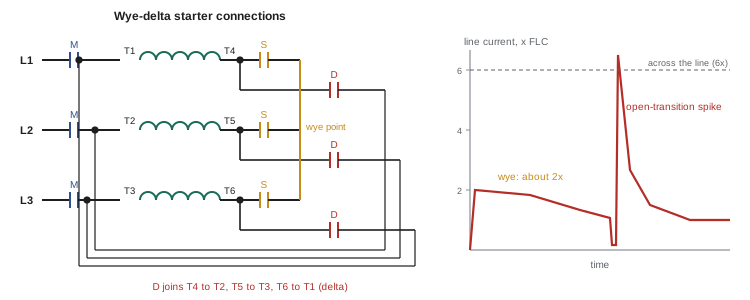
A wye-delta (star-delta) starter is used with motors designed to run in delta, with both ends of each winding brought out (six or twelve leads). During starting, the windings are connected in wye, so each winding receives line voltage divided by √3, 58 % of its rated voltage. Winding current and torque are each reduced to one-third of their delta values (58 % voltage squared is 33 %), and the line current is also one-third of the across-the-line value. After the motor accelerates, typically to 80 % to 90 % of full speed, the starter reconnects the windings in delta for full voltage. A wye-delta starter uses three contactors: main (M), star (S) and delta (D), with S and D electrically and mechanically interlocked, and an on-delay timer to make the transition.
In an open-transition wye-delta starter, the motor is briefly disconnected during the change from wye to delta. When it is reconnected, the rotor field has drifted out of phase with the supply, and the result can be a current spike as large as or larger than across-the-line starting, together with a torque transient. A closed-transition starter adds a fourth contactor and a set of resistors that keep the motor connected through the transition, greatly reducing the spike. Wye-delta starting suits loads with low starting torque, such as fans, centrifugal pumps and unloaded compressors; with only one-third of the locked-rotor torque available, loaded starts will fail. The motor must be rated for delta running at the supply voltage, and the overload relay, connected in the motor leads, is set at the phase current, 58 % of line full-load current.
Worked problem
Setting the overload on a wye-delta starter
A 50 hp, 575 V motor with nameplate full-load current 50 A (line, in delta) is started wye-delta with the overload relay in the motor leads. What is the overload setting?
Show solution
- In delta, phase (winding) current = line current ÷ √3 = 50 ÷ 1.732 = 28.9 A.
- The overload relay in the motor leads carries winding current, so set it at 28.9 A (or as directed by the manufacturer).
Answer: About 28.9 A. Setting it at 50 A, the line current, would leave the motor effectively without overload protection, a common error on wye-delta starters.
Part-winding starters
A part-winding starter uses a motor with two parallel windings, such as a dual-voltage motor connected for its lower voltage. During starting, only one winding is energized, giving roughly 65 % of locked-rotor current and about 45 % to 50 % of locked-rotor torque; after one to two seconds, the second winding is connected. Part-winding starting is not truly reduced-voltage starting, because full voltage is applied to the part winding, and the acceleration can be uneven, with some motors not accelerating beyond half speed on the first winding. It is inexpensive and used mainly for refrigeration compressors and some pumps and fans on 208 V to 230 V systems. The motor must be designed for part-winding starting, and each winding has its own overload relay.
Soft starters
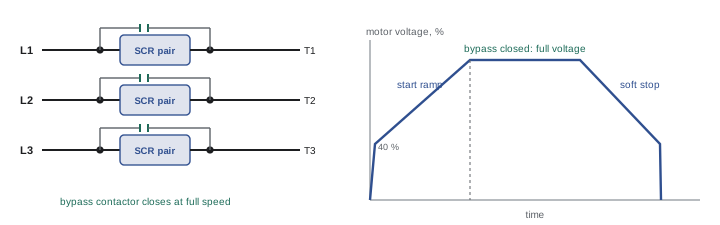
A solid-state soft starter controls the voltage to the motor with pairs of thyristors (SCRs) connected back to back in each phase. By delaying the point in each half cycle at which the SCRs switch on (phase-angle control), the soft starter applies a reduced effective voltage that rises smoothly during starting, according to a set ramp time, initial voltage or torque, and current limit. Because the voltage can be adjusted continuously, the soft starter can match the motor torque closely to the load, giving a smooth, shock-free start. Common features include:
- Voltage ramp or current-limit starting, with adjustable initial torque and ramp time.
- Torque control starting that shapes acceleration for pumps, limiting pressure surges.
- Soft stop: a decelerating voltage ramp that prevents water hammer in pumping systems by slowing the flow gradually instead of letting the check valve slam.
- Kick start: a short burst of high torque to break away loads with high static friction.
- Built-in electronic overload protection, phase loss, phase reversal, underload and jam detection.
- An internal or external bypass contactor that closes when the motor is at full speed, removing the SCRs from the circuit to eliminate their heat loss (about 1 W per ampere per phase) and harmonics during running.
A soft starter reduces voltage, not frequency, so it shares the basic limitation of other reduced-voltage methods: torque falls with the square of voltage, and the motor runs at full speed once started. It cannot control speed. For a given starting current, it does not produce more torque than an autotransformer. Its advantages are smoothness, adjustability, compact size, built-in protection and soft stopping. While ramping, the SCRs draw non-sinusoidal current, producing harmonics, but only for the duration of the start. Some soft starters are inside-delta rated, connected inside the motor delta like a wye-delta starter, so that they carry only 58 % of the line current and can be smaller.
Choosing a starting method
| Method | Starting current (% of across-the-line) | Starting torque (% of across-the-line) | Typical uses |
|---|---|---|---|
| Across the line | 100 % | 100 % | Most motors on adequate supplies |
| Primary resistor (65 %) | 65 % | 42 % | Smooth starts, older installations |
| Autotransformer (65 % tap) | 42 % | 42 % | Large pumps and fans with current limits |
| Wye-delta | 33 % | 33 % | Fans, centrifugal pumps, unloaded compressors |
| Part winding | About 65 % | About 45 % to 50 % | Refrigeration compressors |
| Soft starter | Adjustable, typically 250 % to 400 % of FLC | Adjustable, falls with voltage squared | Pumps, fans, conveyors needing smooth starts |
| VFD | About 100 % to 150 % of FLC | Up to 150 % of full-load torque | Any load needing low-current starts or speed control |
The choice depends on the load's torque requirements, the supply's ability to absorb the inrush, any utility limits, the need for soft stopping or speed control, cost and space. A centrifugal pump that only needs to start smoothly and stop without water hammer suits a soft starter. A loaded conveyor needing high torque from standstill with low current needs a VFD, which can produce full-load torque at standstill with roughly full-load current, because it reduces frequency as well as voltage. If the process would benefit from speed control as well, the VFD usually wins outright.
Common mistakes
MistakeUsing reduced-voltage starting on a load that needs high breakaway torque.
InsteadCheck that torque at reduced voltage exceeds the load torque, or use a VFD.
MistakeSetting a wye-delta overload at line current when it is in the motor leads.
InsteadSet it at phase current, 58 % of line full-load current.
MistakeIgnoring the open-transition current spike.
InsteadUse closed transition where the spike causes problems.
MistakeExpecting a soft starter to control running speed.
InsteadUse a VFD for speed control; a soft starter only ramps voltage.
MistakeOmitting the bypass contactor on a soft starter in a hot enclosure.
InsteadUse bypass to remove SCR heat during running.
Summary and key terms
- Reduced-voltage starting limits inrush, voltage dip and torque shock, at the cost of starting torque.
- Voltage dip can be estimated from locked-rotor kVA and source short-circuit kVA.
- Primary resistor starters reduce current in proportion to voltage and torque with its square.
- Autotransformers reduce line current and torque with the square of the tap: best torque per ampere.
- Wye-delta gives one-third current and torque; overloads are set at phase current.
- Part-winding starters energize one winding first, for compressors and some pumps.
- Soft starters ramp voltage with SCRs, offer soft stop and protection, but do not control speed.
- Across-the-line starting
- Starting a motor at full voltage.
- Reduced-voltage starting
- Applying lower voltage during acceleration to limit current.
- Voltage dip
- A temporary fall in system voltage caused by inrush current.
- Autotransformer starter
- A starter using autotransformer taps to reduce voltage.
- Closed transition
- Changing from start to run without disconnecting the motor.
- Open transition
- Briefly disconnecting the motor during the change to run.
- Wye-delta starter
- A starter that connects windings in wye to start and delta to run.
- Part-winding starter
- A starter that energizes one of two parallel windings first.
- Soft starter
- A solid-state starter that ramps voltage using SCRs.
- Soft stop
- A controlled voltage ramp-down to prevent water hammer.
Practice problems
Work each problem on paper first, then reveal the answer to check.
Name three reasons for reduced-voltage starting.
Show answer
Limiting voltage dip, reducing mechanical stress, and starting on a weak source such as a generator.
At 70 % voltage, what fraction of locked-rotor torque is available?
Show answer
0.7² = 49 %.
A 500 kVA, 5 % impedance transformer supplies a motor with 600 kVA locked-rotor kVA. Estimate the dip.
Show answer
SC kVA = 10,000; dip ≈ 600 ÷ 10,600 = 5.7 %.
At the 80 % tap, what is the line current as a fraction of across-the-line current?
Show answer
64 %.
What advantage does the Korndorfer connection give?
Show answer
Closed transition from start to run.
What fraction of current and torque does wye-delta starting give?
Show answer
One-third of each.
Why can open-transition wye-delta starting cause a large current spike?
Show answer
The motor is reconnected out of phase with the supply after a brief disconnection.
A delta motor has line full-load current 80 A. What is the wye-delta overload setting in the motor leads?
Show answer
80 ÷ 1.732 = 46 A.
How does a soft starter reduce voltage?
Show answer
By phase-angle control of back-to-back SCRs.
Why does a VFD give more torque per ampere at start than a soft starter?
Show answer
It reduces frequency as well as voltage, keeping flux and torque per ampere high.
Lesson quiz · 5 questions
Score 60% or more to complete this lesson.
Create a free account to save your progress, take quizzes and earn a certificate.