
ELEC-310 · Lesson 1 of 12 · 32 min
Motor principles and nameplates
Electric motors drive most of the machinery in industry and commerce: pumps, fans, compressors, conveyors, mixers, elevators and machine tools. They use roughly half of all electricity generated, and in a typical industrial plant they account for most of the electrical load. For an electrician, motors and their controls are a large part of the work at Level 3 and beyond: selecting and installing motors, sizing their conductors and protection, wiring starters and control circuits, setting up drives, and finding faults when something stops. This course covers that work from the motor itself to the control panel. This first lesson reviews how motors produce torque, defines the quantities used to describe motor performance, explains every item on a motor nameplate, and introduces the standards that govern motor ratings and installations.
The lessons that follow build on this one. Lesson 2 looks in detail at the three-phase induction motor, the workhorse of industry. Lesson 3 covers single-phase, DC and special motors. Lesson 4 deals with installation, connections and alignment, and Lesson 5 with motor branch circuits under the electrical code. Lessons 6 to 9 cover starters, control devices, ladder diagrams and standard control circuits; Lessons 10 and 11 cover reduced-voltage starting and variable frequency drives; and Lesson 12 brings everything together in troubleshooting, maintenance and a capstone project.
How a motor produces torque
Every electric motor works on the same principle: a conductor carrying current in a magnetic field experiences a force. The force on a straight conductor of length L carrying current I at right angles to a magnetic field of flux density B is:
In a motor, conductors are arranged around a rotor so that these forces act at a distance from the shaft, producing torque, the turning effort. The rest of motor design is about arranging the magnetic field and the currents so that the torque keeps acting in the same direction as the rotor turns. In a DC motor, a commutator reverses the current in each rotor coil as it passes from one pole to the next. In an AC induction motor, the stator windings produce a magnetic field that rotates, and the rotor is dragged along by currents induced in it. In a synchronous motor, the rotor has its own fixed magnetic poles that lock onto the rotating field.
The same machine can also work as a generator: turn the shaft, and a voltage is induced in the conductors as they cut the magnetic field. Even while running as a motor, every machine generates a back EMF (counter-voltage) opposing the supply. At standstill there is no back EMF, which is why motors draw a large inrush current when started across the line, often six to eight times their full-load current. Much of motor control is about managing that starting current and the torque that goes with it.
Torque, speed and power
Torque is force times radius, measured in newton-metres (N·m) or pound-feet (lb·ft). Mechanical power is the rate of doing work, the product of torque and rotational speed. In practical units:
One horsepower is 746 W, so a 10 hp motor delivers 7.46 kW at its rated load. Motors are rated in horsepower in North America and in kilowatts elsewhere, and many nameplates show both. The formula shows an important trade-off: for the same power, a slower motor must produce more torque. A 4-pole motor running at 1,780 rpm and an 8-pole motor at 880 rpm can both be rated 20 hp, but the slower one produces about twice the torque, and it is larger, heavier and more expensive as a result.
Worked problem
Torque from power and speed
A 20 hp, 1,770 rpm motor drives a conveyor. What is its full-load torque in lb·ft and N·m?
Show solution
- T = 5,252 × P ÷ n = 5,252 × 20 ÷ 1,770 = 59.3 lb·ft.
- In SI: P = 20 × 0.746 = 14.92 kW; T = 9,549 × 14.92 ÷ 1,770 = 80.5 N·m.
- Check: 1 lb·ft = 1.356 N·m, and 59.3 × 1.356 = 80.4 N·m.
Answer: The motor produces about 59 lb·ft (80 N·m) at full load. The starting and breakdown torques of a typical general-purpose motor are two to three times this value (Lesson 2).
Electrical input, efficiency and power factor
A motor converts electrical power into mechanical power, with losses in the windings (I²R losses), the iron core (hysteresis and eddy currents), friction and windage, and stray losses. Efficiency is output divided by input. For a three-phase motor, the electrical input is:
where V_L is the line voltage, I_L the line current and PF the power factor. Induction motors draw magnetizing current that lags the voltage, so their power factor is typically 0.80 to 0.90 at full load and falls sharply at light load: a motor running at a quarter of its rating may have a power factor near 0.5. Efficiency also falls at light load, which is one reason oversized motors waste energy. Rearranging the formula gives the current a motor draws for a given output:
Worked problem
Line current from output power
A 15 kW motor on a 575 V three-phase supply has a full-load efficiency of 92.4 % and power factor of 0.85. Estimate its full-load line current.
Show solution
- Input power = 15,000 ÷ 0.924 = 16,230 W.
- I = 16,230 ÷ (1.732 × 575 × 0.85) = 16,230 ÷ 846.5 = 19.2 A.
- Compare with the nameplate full-load current; the calculated value should be close to it, and any large difference suggests the efficiency or power factor values are wrong.
Answer: About 19 A. For code calculations, use the nameplate or code table full-load current (Lesson 5), not a calculated value.
The nameplate
Every motor carries a nameplate, and reading it correctly is the starting point for installing, protecting, controlling and replacing the motor. Standards in North America are set by NEMA MG 1 (Motors and Generators) and, for Canada, CSA C22.2 No. 100 and the CSA energy efficiency standard C390; IEC 60034 is used internationally and for many imported motors. A NEMA nameplate typically shows:
- Manufacturer, model, serial number and catalogue number, needed to order parts or an exact replacement.
- Rated power in hp (and often kW).
- Rated voltage or voltages, for example 230/460 V for a dual-voltage motor or 575 V; and the connection diagram for each voltage.
- Full-load amperes (FLA) at each voltage.
- Rated speed in rpm at full load, for example 1,765 rpm, which tells you the number of poles (Lesson 2).
- Frequency (60 Hz in North America) and number of phases.
- Service factor (SF), for example 1.15.
- Insulation class (B, F or H) and the ambient temperature rating, usually 40 °C.
- Time rating or duty: continuous for most motors, or a short-time rating such as 30 minutes.
- NEMA design letter (A, B, C or D), which describes the torque and current characteristics.
- Locked-rotor kVA code letter.
- Nominal efficiency, and often "NEMA Premium" or an IE efficiency class.
- Frame size, for example 256T, and enclosure type, for example TEFC.
- Bearing types, and sometimes power factor, maximum ambient, altitude and inverter-duty information.
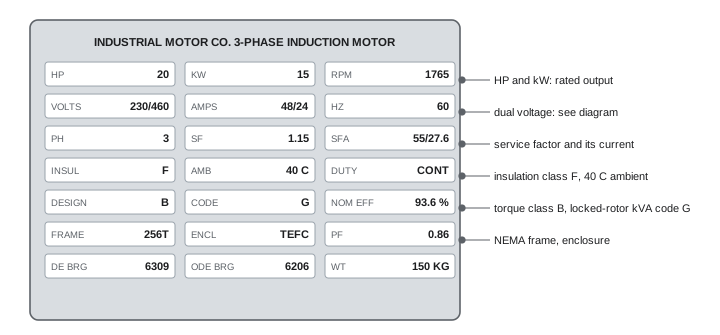
Service factor
The service factor is a multiplier indicating how much overload the motor can carry continuously at rated voltage and frequency without damage, though at the cost of higher temperature and shorter insulation life. A 10 hp motor with SF 1.15 can deliver 11.5 hp continuously. Many nameplates also show a service factor amperes value (SFA), the current at that load. Service factor is a margin for occasional overloads, voltage variations and unknown conditions, not extra capacity to be used routinely: running continuously into the service factor raises winding temperature by about 10 °C and roughly halves insulation life. Motors operated on variable frequency drives are often treated as having a service factor of 1.0, because the drive adds heating (Lesson 11). Service factor also affects overload protection settings (Lesson 6).
Insulation class and temperature
The life of a motor is mostly the life of its winding insulation, and insulation life depends on temperature. Insulation is classified by the maximum temperature it can withstand for its expected life: Class B 130 °C, Class F 155 °C and Class H 180 °C. The total temperature is the ambient (40 °C standard) plus the temperature rise from losses plus a hot-spot allowance. A common rule of thumb is that every 10 °C above the rated temperature halves insulation life, and every 10 °C below doubles it. Many modern motors use Class F insulation but are designed for a Class B temperature rise, giving a thermal margin that extends life considerably. High ambient temperatures, high altitude (thinner air cools less effectively, usually above 1,000 m or 3,300 ft), blocked ventilation, frequent starting and voltage unbalance all raise winding temperature and shorten life.
Design letters and code letters
The NEMA design letter describes the shape of the torque-speed curve and the starting current:
- Design A: normal starting torque, higher starting current than B; used where high breakdown torque is needed.
- Design B: normal starting torque, normal starting current, low slip; the general-purpose motor for pumps, fans and most loads.
- Design C: high starting torque, normal starting current; for loads that are hard to start, such as loaded conveyors and compressors.
- Design D: very high starting torque and high slip; for high-inertia loads with intermittent motion, such as punch presses and hoists.
The locked-rotor code letter indicates the starting current, as kilovolt-amperes per horsepower drawn with the rotor locked at full voltage. For example, code G means 5.6 to 6.29 kVA/hp and code J means 7.1 to 7.99 kVA/hp. Multiplying by horsepower gives the locked-rotor kVA, from which the locked-rotor current can be calculated. Premium-efficiency motors often have higher locked-rotor current than older designs, which can cause nuisance tripping of instantaneous-trip breakers set close to the limit, and the code letter allows this to be checked.
Worked problem
Locked-rotor current from the code letter
A 50 hp, 460 V motor has code letter G (5.6 to 6.29 kVA/hp). Estimate its maximum locked-rotor current.
Show solution
- Maximum locked-rotor kVA = 6.29 × 50 = 314.5 kVA.
- I_LR = 314,500 ÷ (1.732 × 460) = 314,500 ÷ 796.7 = 395 A.
- The full-load current of a 50 hp, 460 V motor is about 65 A, so starting current is about six times full load.
Answer: About 395 A at the moment of starting. The supply, protective devices and any generator must handle this inrush, and the voltage dip it causes may affect other equipment (Lesson 10).
Frames, enclosures and mounting
NEMA frame numbers standardize the mounting dimensions of motors so that a motor from one manufacturer can replace another's. In a frame such as 256T, the first two digits relate to the shaft height (for frames 143T and larger, the shaft height in inches is the first two digits divided by four, so 6.25 in for a 256T frame), the third digit to the spacing of the mounting feet, and the suffix letter to features such as T for the current standard dimensions, C for a C-face mounting flange, and D for a D-flange. IEC motors use frame numbers that give the shaft height in millimetres directly, for example IEC 132 for a 132 mm shaft height.
The enclosure protects the motor from its environment and determines how it is cooled:
- ODP (open drip-proof): openings allow ventilating air through the motor; drops falling at up to 15° from vertical are kept out. For clean, dry indoor locations.
- TEFC (totally enclosed fan-cooled): the motor is closed, with an external fan blowing air over a finned frame. The most common industrial enclosure, suitable for dusty and damp locations.
- TENV (totally enclosed non-ventilated): closed, without a fan, cooled by convection; used in small sizes and for low-speed drive operation.
- TEAO (totally enclosed air-over): cooled by the airflow of the fan it drives.
- Explosion-proof and dust-ignition-proof motors for hazardous locations, which must be marked for the class, division or zone, and gas or dust group.
- Washdown and severe-duty motors for food processing, chemical plants and outdoors.
IEC motors use IP codes, such as IP55, where the first digit describes protection against solids and the second against water.
Efficiency standards
Because motors use so much electricity, governments regulate their minimum efficiency. Efficiency classes are set out in IEC 60034-30-1 as IE1 (standard) through IE4 (super premium), with IE5 emerging; NEMA Premium corresponds approximately to IE3.
In Canada, Natural Resources Canada sets minimum efficiency levels for electric motors under the Energy Efficiency Regulations, generally requiring NEMA Premium (IE3) efficiency for most general-purpose motors from 1 to 500 hp, with testing to CSA C390. Replacement motors bought for existing equipment must normally meet these levels, and higher efficiency often pays for itself quickly in continuously running applications.
A small difference in efficiency has a large effect over a motor's life. Electricity typically accounts for over 95 % of the lifetime cost of a continuously running motor; the purchase price is a small fraction. A 50 hp motor running 6,000 hours a year at 75 % load uses about 180,000 kWh a year; raising efficiency from 93 % to 95 % saves about 3,800 kWh a year.
Motor standards and codes
Several kinds of rules apply to motor work:
- Product standards: NEMA MG 1, CSA C22.2 No. 100 and IEC 60034 define ratings, performance, testing and nameplate markings, and certification marks show that a motor meets the applicable safety standard.
- Installation code: the Canadian Electrical Code, Part I, Section 28 (Motors and generators), governs conductors, overcurrent and overload protection, disconnecting means and control for motors, with Tables 44 and 45 giving full-load currents for three-phase and single-phase motors. Provincial adoptions and amendments apply.
- Workplace safety: lockout and energy isolation procedures (covered throughout the course) and arc flash requirements apply whenever motor circuits are worked on.
- Machinery standards: NFPA 79 and CSA C22.2 No. 301 cover the electrical equipment of industrial machines, including emergency stop functions, and ISO 13849 and IEC 62061 cover the safety-related parts of control systems.
Safety with motors
Motors combine electrical and mechanical hazards. A motor that has stopped may restart automatically when a pressure switch, float or timer calls for it, or when a process controller is reset. Rotating shafts, couplings and belts can catch clothing and hair. Capacitors in single-phase motors and drives can hold a dangerous charge after power is removed (ELEC-210). Before working on any motor or driven equipment, follow the lockout procedure: identify all energy sources, including stored mechanical energy (gravity, springs, pressure), isolate and lock them, verify the absence of voltage with a tested meter, and try to start the equipment from its normal controls before beginning work. Never rely on a stop button, a control circuit or a drive's stop command for isolation: these can fail or be overridden.
Common mistakes
MistakeSizing conductors and protection from a calculated current.
InsteadUse the nameplate or code table full-load current as the code requires.
MistakeTreating service factor as spare capacity for routine use.
InsteadSize the motor for the load; the service factor is a margin that costs insulation life.
MistakeIgnoring altitude and ambient temperature.
InsteadDerate or select a larger motor above 1,000 m (3,300 ft) or 40 °C.
MistakeReplacing a motor by horsepower only.
InsteadMatch voltage, speed, frame, enclosure, design letter, mounting and shaft.
MistakeRelying on a stop button for safety.
InsteadLock out, verify absence of voltage and test the controls before work.
Summary and key terms
- Motors produce torque from the force on current-carrying conductors in a magnetic field.
- Power equals torque times speed: hp = lb·ft × rpm ÷ 5,252, kW = N·m × rpm ÷ 9,549.
- Line current depends on output, voltage, efficiency and power factor.
- The nameplate gives ratings, connections, service factor, insulation class, design and code letters, frame and enclosure.
- Insulation life roughly halves for every 10 °C of excess temperature.
- Design letters describe torque and current characteristics; code letters give locked-rotor kVA per hp.
- Product standards, installation codes, efficiency rules and lockout procedures all govern motor work.
- Torque
- Turning effort, force times radius.
- Back EMF
- Voltage generated in a running motor that opposes the supply.
- Full-load amperes (FLA)
- Current drawn at rated output, voltage and frequency.
- Service factor
- Multiplier showing permissible continuous overload.
- Insulation class
- Temperature rating of winding insulation: B, F or H.
- Design letter
- NEMA classification of torque and starting current characteristics.
- Code letter
- Letter indicating locked-rotor kVA per horsepower.
- Locked-rotor current
- Current drawn with the rotor stationary at full voltage.
- TEFC
- Totally enclosed fan-cooled motor enclosure.
- NEMA Premium
- High efficiency level, roughly equivalent to IE3.
Practice problems
Work each problem on paper first, then reveal the answer to check.
What is the full-load torque of a 30 hp motor at 1,760 rpm?
Show answer
5,252 × 30 ÷ 1,760 = 89.5 lb·ft (about 121 N·m).
Why do motors draw high current when starting?
Show answer
At standstill there is no back EMF to oppose the supply.
How much power does a 10 hp motor deliver at its rated load, in kW?
Show answer
7.46 kW.
A 25 hp motor has SF 1.15. What load can it carry continuously?
Show answer
28.75 hp, with higher temperature and reduced insulation life.
What is the temperature limit of Class F insulation?
Show answer
155 °C.
What happens to insulation life if a winding runs 10 °C hotter than rated?
Show answer
It roughly halves.
Which NEMA design is the general-purpose motor?
Show answer
Design B.
A 20 hp, 460 V motor has code letter H (6.3 to 7.09 kVA/hp). What is its maximum locked-rotor current?
Show answer
7.09 × 20 = 141.8 kVA; 141,800 ÷ (1.732 × 460) = 178 A.
What is the shaft height of a 286T frame motor?
Show answer
28 ÷ 4 = 7 in.
Which enclosure suits a dusty sawmill: ODP or TEFC?
Show answer
TEFC, because it is closed against dust.
Lesson quiz · 5 questions
Score 60% or more to complete this lesson.
Create a free account to save your progress, take quizzes and earn a certificate.