
ELE-203 · Lesson 1 of 12 · 37 min
RC and RL transients
In ELE-202, every circuit was resistive or at DC steady state, so voltages and currents were constants found with algebra. Capacitors and inductors change that. Because they store energy, they cannot respond instantly when a switch closes or a source changes: a capacitor's voltage and an inductor's current move gradually from their old values to their new ones. The interval in which they do so is the transient, and the shape of that change, an exponential for circuits with one storage element, appears everywhere in engineering, from the time a camera flash takes to recharge to the voltage spike when a relay coil is switched off.
This lesson reviews the capacitor and inductor laws, solves source-free and step-driven first-order circuits, develops a general method that solves any first-order circuit by inspection, and introduces second-order RLC circuits. Lesson 2 develops second-order circuits fully, and the section at the end of this lesson shows how the rest of the course builds on them.
Capacitors and inductors
A capacitor stores energy in an electric field. Its charge is proportional to its voltage, \(q = Cv\), so its current is proportional to the rate of change of voltage:
An inductor stores energy in a magnetic field. Its voltage is proportional to the rate of change of its current:
Two consequences drive everything in this lesson:
- A capacitor's voltage cannot change instantaneously, because a jump would require infinite current. Its current can jump.
- An inductor's current cannot change instantaneously, because a jump would require infinite voltage. Its voltage can jump.
So if a switch operates at \(t = 0\), \(v_C(0^+) = v_C(0^-)\) and \(i_L(0^+) = i_L(0^-)\), where \(0^-\) is the instant just before switching and \(0^+\) just after. At DC steady state, nothing changes, so \(i_C = 0\) (a capacitor acts as an open circuit) and \(v_L = 0\) (an inductor acts as a short circuit). These two facts give the initial and final conditions of every transient problem.
Capacitors and inductors combine like conductances and resistances respectively: capacitors in parallel add (\(C_{eq} = C_1 + C_2\)) and in series combine reciprocally; inductors in series add and in parallel combine reciprocally.
The source-free RC circuit
Suppose a capacitor charged to \(V_0\) is connected across a resistor at \(t = 0\). KCL at the top node gives \(C\,dv/dt + v/R = 0\), a first-order linear differential equation whose solution is an exponential decay:
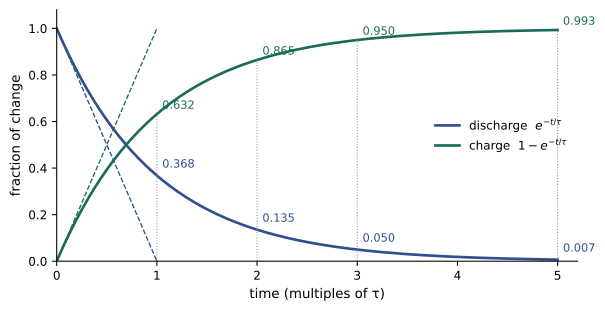
The time constant \(\tau\) (in seconds when R is in ohms and C in farads) sets the speed. After one time constant the voltage has fallen to \(e^{-1} = 36.8\%\) of its initial value; after \(2\tau\), 13.5%; after \(3\tau\), 5.0%; after \(5\tau\), 0.67%. Engineers usually treat a transient as finished after about five time constants. The current \(v/R\) decays with the same time constant, and the energy initially stored in the capacitor is dissipated in the resistor.
Worked problem
Discharging a capacitor
A 100 µF capacitor charged to 12 V is connected across a 10 kΩ resistor at t = 0. Find the time constant, the voltage at t = 2 s, the time for the voltage to fall to 1 V, and the energy dissipated in the resistor.
Show solution
- \(\tau = RC = 10{,}000 \times 100 \times 10^{-6} = 1.0\) s.
- \(v(2) = 12\,e^{-2} = 1.62\) V.
- Setting \(12\,e^{-t/1} = 1\): \(t = \ln 12 = 2.48\) s.
- Energy initially stored: \(\tfrac{1}{2} \times 100 \times 10^{-6} \times 12^2 = 7.2\) mJ, all dissipated in the resistor as \(t \to \infty\).
Answer: τ = 1.0 s; v(2 s) = 1.62 V; the voltage reaches 1 V at 2.48 s; 7.2 mJ is dissipated. In general, the time to fall from \(V_0\) to \(V\) is \(\tau \ln(V_0/V)\).
The source-free RL circuit
Similarly, if an inductor carrying current \(I_0\) is connected across a resistor at \(t = 0\), KVL gives \(L\,di/dt + Ri = 0\), and
Note the difference: a larger resistance makes an RC circuit slower but an RL circuit faster. In both cases, if the circuit contains more than one resistor, \(R\) is the Thévenin resistance seen by the storage element with all independent sources turned off.
Worked problem
Inductive kick
A relay coil (L = 0.5 H, resistance 60 Ω) carries 0.2 A from a 12 V supply. The switch controlling it opens, and the only path left for the coil current is through a 10 kΩ leakage resistance across the switch contacts. What voltage appears across the coil at the instant the switch opens, and how quickly does the current decay?
Show solution
- The coil current cannot change instantly: \(i(0^+) = 0.2\) A.
- That current now flows through 10 kΩ + 60 Ω, so the coil voltage is \(0.2 \times 10{,}060 = 2012\) V (with polarity reversed from normal operation).
- Time constant: \(\tau = L/R = 0.5/10{,}060 = 50\) µs.
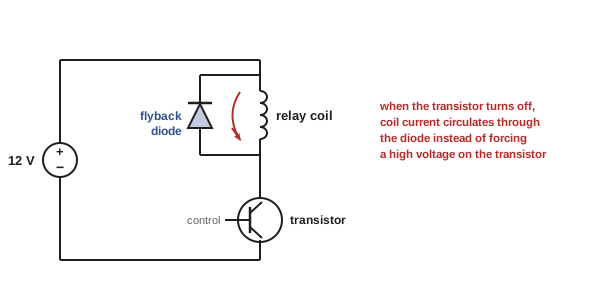
Answer: About 2000 V for a few tens of microseconds: enough to arc across the switch contacts or destroy a transistor driving the coil. This is why inductive loads are fitted with a flyback (freewheeling) diode across the coil, which gives the current a low-resistance path and clamps the voltage to about 0.7 V above the supply, at the cost of a slower decay (τ = 0.5/60 ≈ 8 ms).
Step response and the general method
When a first-order circuit contains DC sources, the capacitor voltage or inductor current moves exponentially from its initial value toward a new final value. Every such response has the same form:
where \(x\) is any voltage or current in the circuit. This gives a general method that avoids writing a differential equation:
- Find the initial value \(x(0^+)\): use the circuit before switching (at DC steady state, capacitors open, inductors shorted) to find \(v_C(0^-)\) or \(i_L(0^-)\), which carry over to \(0^+\). If \(x\) is some other quantity, solve the \(t = 0^+\) circuit with the capacitor replaced by a voltage source of value \(v_C(0^+)\) or the inductor by a current source of value \(i_L(0^+)\).
- Find the final value \(x(\infty)\): solve the circuit after switching at DC steady state.
- Find the time constant: turn off independent sources in the circuit after switching, find the Thévenin resistance \(R_{th}\) seen by the capacitor or inductor, and use \(\tau = R_{th}C\) or \(\tau = L/R_{th}\).
- Write the response from the formula.
Worked problem
Charging through a divider
A 24 V source feeds a divider of R₁ = 6 kΩ (top) and R₂ = 3 kΩ (bottom). An uncharged 50 µF capacitor is connected across R₂ by a switch that closes at t = 0. Find \(v_C(t)\) and the time at which it reaches 6 V.
Show solution
- Initial value: \(v_C(0^+) = v_C(0^-) = 0\).
- Final value: capacitor open, so \(v_C(\infty) = 24 \times 3/(6 + 3) = 8\) V.
- Thévenin resistance seen by the capacitor (source shorted): \(6 \parallel 3 = 2\) kΩ, so \(\tau = 2000 \times 50 \times 10^{-6} = 0.1\) s.
- \(v_C(t) = 8 + (0 - 8)e^{-t/0.1} = 8(1 - e^{-10t})\) V.
- For 6 V: \(e^{-10t} = 0.25\), \(t = 0.1 \ln 4 = 0.139\) s.
Answer: \(v_C(t) = 8(1 - e^{-10t})\) V, reaching 6 V at 139 ms. Notice that the capacitor charges toward the Thévenin voltage (8 V), not the source voltage (24 V).
Worked problem
Capacitor with an initial charge
A 10 µF capacitor charged to 5 V is switched at t = 0 to a 20 V source through 2 kΩ. Find \(v_C(t)\), the current at \(t = 0^+\) and the voltage at t = 30 ms.
Show solution
- \(v_C(0^+) = 5\) V; \(v_C(\infty) = 20\) V; \(\tau = 2000 \times 10 \times 10^{-6} = 20\) ms.
- \(v_C(t) = 20 + (5 - 20)e^{-t/0.02} = 20 - 15e^{-50t}\) V.
- At \(0^+\) the resistor sees \(20 - 5 = 15\) V, so \(i(0^+) = 15/2000 = 7.5\) mA (the current jumps from zero, which is allowed).
- \(v_C(0.03) = 20 - 15e^{-1.5} = 20 - 3.35 = 16.65\) V.
Answer: \(v_C(t) = 20 - 15e^{-50t}\) V; the current starts at 7.5 mA and decays with the same 20 ms time constant; at 30 ms the voltage is 16.65 V.
Worked problem
RL step response
A 12 V source is connected at t = 0 to a series circuit of 4 Ω and 0.2 H, initially de-energized. Find \(i(t)\), the inductor voltage at \(t = 0^+\) and the current at 100 ms.
Show solution
- \(i(0^+) = 0\); \(i(\infty) = 12/4 = 3\) A; \(\tau = 0.2/4 = 0.05\) s.
- \(i(t) = 3(1 - e^{-20t})\) A.
- At \(0^+\), no current flows, so the resistor voltage is zero and the full 12 V appears across the inductor.
- \(i(0.1) = 3(1 - e^{-2}) = 2.59\) A.
Answer: \(i(t) = 3(1 - e^{-20t})\) A; the inductor voltage jumps to 12 V and then decays as \(12e^{-20t}\) V; the current is 2.59 A at 100 ms.
Pulses and switching sequences
When a circuit is switched more than once, solve each interval in turn: the value of \(v_C\) or \(i_L\) at the end of one interval is the initial value for the next. For example, a square wave driving an RC circuit charges the capacitor during each high interval and discharges it during each low interval; if the pulse width is much longer than \(\tau\) the output follows the input closely with rounded edges, and if much shorter the capacitor voltage barely moves and settles near the average of the input. This is the basis of RC smoothing and of the timing in many oscillator circuits.
Second-order circuits
A circuit with one capacitor and one inductor (that cannot be combined) is second order: it is described by a second-order differential equation, and energy can slosh back and forth between the electric and magnetic fields. For a series RLC circuit, the source-free equation is
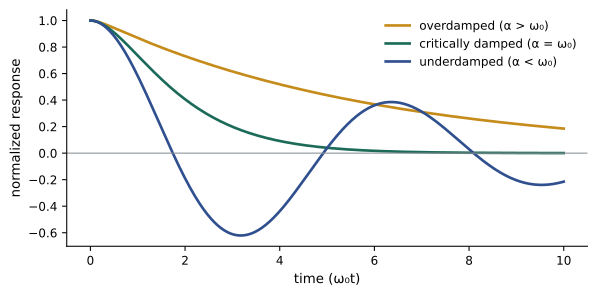
where \(\alpha\) is the damping coefficient (neper frequency) and \(\omega_0\) the undamped natural (resonant) frequency. For a parallel RLC circuit, \(\alpha = 1/(2RC)\) with the same \(\omega_0\). Comparing them gives three kinds of response:
- Overdamped (\(\alpha > \omega_0\)): the sum of two decaying exponentials, with no oscillation.
- Critically damped (\(\alpha = \omega_0\)): the fastest return to zero without oscillation, of the form \((A_1 + A_2 t)e^{-\alpha t}\).
- Underdamped (\(\alpha < \omega_0\)): a decaying oscillation \(e^{-\alpha t}(B_1\cos\omega_d t + B_2\sin\omega_d t)\), with damped frequency \(\omega_d = \sqrt{\omega_0^2 - \alpha^2}\).
Worked problem
Classifying an RLC circuit
A series RLC circuit has R = 10 Ω, L = 10 mH and C = 100 µF. Classify its response, and find the damped frequency if it oscillates. What resistance would make it critically damped?
Show solution
- \(\alpha = R/(2L) = 10/(2 \times 0.01) = 500\) s⁻¹.
- \(\omega_0 = 1/\sqrt{0.01 \times 100 \times 10^{-6}} = 1/\sqrt{10^{-6}} = 1000\) rad/s.
- \(\alpha < \omega_0\), so the response is underdamped: \(\omega_d = \sqrt{1000^2 - 500^2} = 866\) rad/s (138 Hz).
- Critical damping needs \(R = 2L\omega_0 = 2 \times 0.01 \times 1000 = 20\) Ω.
Answer: Underdamped, ringing at 866 rad/s while decaying with time constant 1/α = 2 ms; 20 Ω would make it critically damped. Ringing of this kind appears whenever a fast edge excites stray inductance and capacitance, such as on circuit board traces and long cables.
Lesson 2 develops second-order circuits fully, with initial conditions, step responses and measures such as overshoot and settling time; Lesson 10 solves them with the Laplace transform, and Lesson 9 studies their resonance in the frequency domain.
How this course is organized
The course moves from time-domain transients to the frequency domain and back. Lessons 1 and 2 cover first- and second-order transients. Lessons 3 and 4 introduce phasors and impedance and apply every analysis method to AC circuits. Lesson 5 covers AC power and Lesson 6 magnetically coupled circuits and transformers. Lessons 7 and 8 treat balanced and unbalanced three-phase systems, including symmetrical components. Lesson 9 covers frequency response and filters, Lesson 10 the Laplace transform, and Lesson 11 Fourier series and non-sinusoidal waveforms. Lesson 12 introduces two-port networks and circuit simulation and ends with a filter design project.
Common mistakes
MistakeAssuming a capacitor's current or an inductor's voltage is continuous at a switching instant.
InsteadOnly capacitor voltage and inductor current are continuous; currents through capacitors and voltages across inductors can jump.
MistakeUsing the source resistance alone in the time constant.
InsteadUse the Thévenin resistance seen by the capacitor or inductor in the circuit after switching, with independent sources turned off.
MistakeAssuming the capacitor charges to the source voltage.
InsteadIt charges to the final DC value in the circuit, which is often the Thévenin voltage at its terminals.
MistakeWriting τ = R/L or τ = L·R for an RL circuit.
Insteadτ = L/R: larger resistance makes an RL transient faster.
MistakeSwitching inductive loads off without a suppression path.
InsteadFit a flyback diode, snubber or surge suppressor so the inductor current has somewhere to go.
Summary and key terms
- Capacitor: \(i = C\,dv/dt\), energy \(\tfrac12 Cv^2\); inductor: \(v = L\,di/dt\), energy \(\tfrac12 Li^2\).
- Capacitor voltage and inductor current cannot jump; at DC steady state capacitors are open and inductors shorted.
- Source-free responses decay as \(e^{-t/\tau}\): τ = RC or τ = L/R, using the Thévenin resistance seen by the element.
- After τ the response has completed 63.2% of its change; after about 5τ it is finished.
- General first-order response: \(x(t) = x(\infty) + [x(0^+) - x(\infty)]e^{-t/\tau}\); time to reach a value is \(\tau\ln\) of the ratio of remaining changes.
- Interrupting inductor current produces large voltages; flyback diodes and snubbers prevent damage.
- Series RLC: α = R/2L, ω₀ = 1/√(LC); overdamped, critically damped or underdamped as α is greater than, equal to or less than ω₀.
- Transient
- The interval in which a circuit moves from one steady state to another.
- Time constant
- The time τ in which a first-order response completes 63.2% of its change.
- First-order circuit
- A circuit with one equivalent energy storage element, described by a first-order differential equation.
- Natural response
- The response of a circuit with no independent sources, due to stored energy.
- Step response
- The response of a circuit to a sudden application of a DC source.
- Initial condition
- The value of a capacitor voltage or inductor current at the start of an interval.
- Flyback diode
- A diode across an inductive load that provides a path for its current when the supply is interrupted.
- Second-order circuit
- A circuit described by a second-order differential equation, typically containing both L and C.
- Damping coefficient
- α, the rate of exponential decay of a second-order response.
- Undamped natural frequency
- ω₀ = 1/√(LC), the frequency of oscillation with no resistance.
- Underdamped
- A second-order response that oscillates as it decays (α < ω₀).
- Critically damped
- The boundary case α = ω₀, the fastest response without oscillation.
Practice problems
Work each problem on paper first, then reveal the answer to check.
Find the time constant of 47 µF with 22 kΩ, and of 50 mH with 25 Ω.
Show answer
RC = 22,000 × 47 × 10⁻⁶ = 1.034 s; L/R = 0.05/25 = 2 ms.
A capacitor discharges from 100 V with τ = 5 ms. What is the voltage at 12 ms?
Show answer
100 e^(−2.4) = 9.07 V.
How long does an RC circuit take to charge from 0 to 90% of its final value?
Show answer
e^(−t/τ) = 0.1, so t = τ ln 10 = 2.30τ.
A 470 µF capacitor at 400 V is a hazard. Through what resistance must it discharge to fall below 50 V within 60 s?
Show answer
τ ≤ 60/ln(400/50) = 60/2.079 = 28.9 s; R ≤ 28.9/470×10⁻⁶ = 61.4 kΩ.
An inductor of 2 H carries 3 A. How much energy is stored?
Show answer
½ × 2 × 3² = 9 J.
A 9 V source, 3 kΩ and 1 µF are in series, with the capacitor initially at 3 V. Find v_C(t).
Show answer
v_C(∞) = 9 V, τ = 3 ms: v_C(t) = 9 − 6e^(−t/0.003) V.
In the previous question, what is the current at t = 0⁺ and at t = 6 ms?
Show answer
i(0⁺) = (9 − 3)/3000 = 2 mA; i(6 ms) = 2e^(−2) = 0.271 mA.
A 24 V source in series with 8 Ω supplies an inductor of 0.4 H through a switch closed at t = 0. When does the current reach 2.5 A?
Show answer
i(∞) = 3 A, τ = 0.05 s: 2.5 = 3(1 − e^(−t/0.05)), e^(−t/0.05) = 1/6, t = 0.05 ln 6 = 89.6 ms.
A series RLC circuit has L = 1 mH and C = 10 nF. Find ω₀ and the resistance for critical damping.
Show answer
ω₀ = 1/√(10⁻¹¹) = 316,228 rad/s (50.3 kHz); R = 2Lω₀ = 632 Ω.
A parallel RLC circuit has R = 1 kΩ, L = 10 mH and C = 1 µF. Classify its natural response.
Show answer
α = 1/(2RC) = 500 s⁻¹; ω₀ = 1/√(10⁻⁸) = 10,000 rad/s; α < ω₀, so underdamped, with ω_d ≈ 9987 rad/s.
Lesson quiz · 5 questions
Score 60% or more to complete this lesson.
Create a free account to save your progress, take quizzes and earn a certificate.