
DCE-420 · Lesson 9 of 12 · 30 min
Electric service agreements, large-load tariffs and PPA terms
The commercial terms of power supply are set in contracts that can run to hundreds of pages and last for decades: the electric service agreement with the utility, the large-load tariff that governs it, power purchase agreements with generators, and gas and transportation contracts. The headline price is only one term among many. Minimum payments, ramp schedules, curtailment rights, credit support, change-in-law clauses and termination provisions often decide how much a contract really costs and who bears the risks. This lesson explains the structure of electric service agreements and the large-load tariffs that regulators have adopted as data centre demand has surged, and the key terms of PPAs, with worked examples of the exposures they create and the points worth negotiating.
The electric service agreement
A large data centre is connected under an electric service agreement (ESA), sometimes called a contract for electric service or connection agreement, which supplements the utility's tariff. Typical provisions:
- Contract capacity: the maximum demand the utility commits to serve, in MW, and how it ramps over time (for example 50 MW in year one rising to 300 MW in year five).
- Facilities and cost responsibility: the substation, lines and network upgrades the utility will build, and how much the customer pays upfront (contribution in aid of construction) versus through rates.
- Term: often 10 to 20 years for large loads, with renewal options.
- Minimum bill or minimum demand: the customer pays for at least a set percentage of contract capacity whether it uses it or not.
- Credit support: letters of credit, parent guarantees or cash deposits securing the customer's obligations, often sized to the cost of facilities or several years of minimum bills.
- Exit and termination: fees if the customer terminates early or reduces contract capacity, covering stranded costs of facilities built for it.
- Curtailment and interruptibility: any rights of the utility to reduce service, and the terms of flexible connections (Lesson 4).
- Technical requirements: power quality, ride-through behaviour, power factor, protection settings and telemetry.
In Canadian provinces, connection costs for large customers on transmission systems are set by regulatory codes and utility tariffs. In Ontario, the Transmission System Code governs connection cost responsibility: transmitters perform an economic evaluation, and customers make capital contributions for connection facilities not justified by expected revenues, with true-ups if forecast load does not materialize. Hydro-Québec allocates power for new large loads above 5 MW through ministerial approval under rules adopted in 2023, giving priority to projects judged to bring the greatest economic and environmental benefit. Other provinces have their own tariffs and allocation processes.
Large-load tariffs: why and how
Utilities are being asked to plan and build generation and transmission for unprecedented load growth, much of it from a small number of very large customers whose forecasts are uncertain: many requests are speculative, duplicated across utilities, or slower to materialize than projected. If the utility builds for load that never arrives, other customers can end up paying. Large-load tariffs try to ensure that the customers who cause the costs bear them, through:
- Long minimum terms, typically 10 to 20 years.
- Minimum demand charges of 60% to 90% of contracted capacity.
- Collateral scaled to the customer's credit rating and the utility's investment.
- Exit fees covering the remaining cost of dedicated facilities and a share of generation built for the customer.
- Load ramp schedules agreed in advance, with penalties or re-queuing for slipping more than a set margin.
- Study deposits and milestones to discourage speculative requests (Lesson 3).
For credit-worthy hyperscale operators these terms are manageable; for smaller developers they can be decisive, because collateral ties up capital before revenues begin.
Worked problem
Minimum bill exposure during a slow ramp
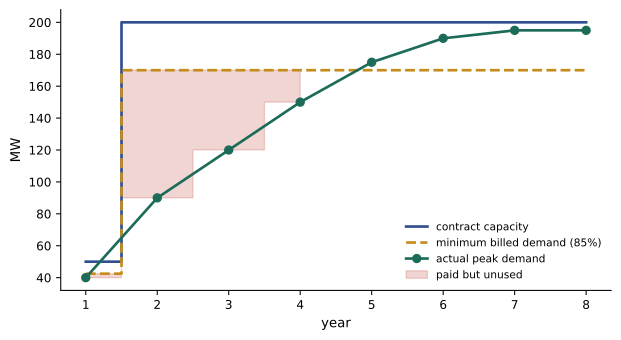
An ESA has a contract capacity of 200 MW from year two, a minimum demand charge of 85% of contract capacity, and a demand rate of $12 per kW-month. The data centre's actual peak demand in year two is only 90 MW because leasing is slower than planned. What does the minimum bill cost compared with paying for actual demand?
Show solution
- Billed demand: the greater of actual (90 MW) and \(0.85 \times 200 = 170\) MW, so 170 MW.
- Monthly demand charge: \(170{,}000 \times 12 = \$2.04\) million; for actual demand it would be \(90{,}000 \times 12 = \$1.08\) million.
- Annual difference: \((2.04 - 1.08) \times 12 = \$11.5\) million.
Answer: The minimum bill costs about $11.5 million a year more than actual demand would. Negotiating a ramp schedule that matches realistic leasing, and staging contract capacity in phases with options, is worth more than a small reduction in the energy rate.
Worked problem
Collateral requirement
A utility requires collateral equal to the greater of the cost of dedicated facilities ($90 million) and 24 months of minimum bills. The minimum bill is 170 MW at $12/kW-month plus a minimum energy charge equivalent to $3 million a month. How much collateral is needed, and what does a letter of credit cost at 1.5% a year?
Show solution
- Monthly minimum: \(170{,}000 \times 12 + 3{,}000{,}000 = \$5.04\) million; 24 months = $121 million.
- Collateral: the greater of $90 million and $121 million = $121 million.
- Letter of credit cost: \(0.015 \times 121 = \$1.8\) million a year.
Answer: About $121 million of collateral, costing about $1.8 million a year if provided by a letter of credit, or tying up the full amount if posted as cash. Collateral often steps down as load ramps and the customer establishes a payment history; negotiating that schedule is valuable.
Key terms of power purchase agreements
Lesson 5 described physical and virtual PPAs. Beyond price, the terms that matter most are:
- Term and price structure: fixed price, escalating price (for example 2% a year), or a price with collars; terms are typically 10 to 20 years.
- Settlement point: the node or hub where energy is priced and settled; settling at the project node gives the buyer basis risk exposure to congestion between the project and its load or hub (Lesson 2), while settling at a hub shifts basis risk to the seller.
- Shape: as-generated (the buyer takes whatever the project produces), or shaped/firm products in which the seller delivers a fixed block, taking the shape risk at a higher price.
- Curtailment and negative prices: who bears the cost when the grid operator curtails the project or prices go negative; many PPAs exclude payment for energy produced during negative-price hours.
- Commercial operation date and delay damages: the date the project must start delivering, and liquidated damages if it is late, important when the data centre needs the energy (or attributes) for a target year.
- Performance guarantees: minimum annual output or availability, with damages for shortfalls.
- Environmental attributes: transfer of renewable energy certificates or equivalent, with hourly data where required for 24/7 accounting (Lesson 6).
- Change in law: how new taxes, tariffs (for example on imported solar panels), carbon rules or market changes are shared.
- Credit support and default: collateral from both parties, events of default, termination payments based on the mark-to-market value of the remaining contract.
Worked problem
Negative price hours in a virtual PPA
A 200 MW solar virtual PPA settles at the project node at a strike price of $45/MWh. In a year, the project produces 60,000 MWh during hours when the nodal price is negative, averaging −$15/MWh. Compare the buyer's settlement cost for those hours with and without a clause excluding negative-price hours.
Show solution
- Without the clause: the buyer pays strike minus market for each MWh, \(45 - (-15) = \$60\)/MWh, so \(60{,}000 \times 60 = \$3.6\) million.
- With the clause: no settlement for those hours, so $0 (the project is expected to curtail when prices are negative).
Answer: The negative-price provision saves the buyer about $3.6 million a year in this case. As negative prices become common in solar-heavy grids, this clause has become one of the most negotiated terms in PPAs.
Negotiating well
Good contract outcomes come from understanding the counterparty's constraints and allocating each risk to the party best able to manage it:
- Utilities need protection against stranded costs and must treat customers consistently under regulation; customers gain more by proposing realistic ramps, phased commitments and appropriate credit than by fighting minimum terms outright.
- Developers of generation need bankable contracts to finance projects; buyers can obtain lower prices by accepting risks they can manage (for example, taking basis risk at a node near their own load).
- Model each contract under scenarios (slow ramp, early exit, low and high market prices, project delays) to understand the real exposures rather than relying on the headline price.
- Coordinate across contracts: the ESA ramp, PPA delivery dates, gas supply for bridging generation and data centre construction all need to line up; a mismatch can leave the owner paying for power it cannot use, or without power when the building is ready.
- Involve legal, finance, energy and engineering staff early, and keep a register of obligations, notice dates and milestones across all contracts.
Gas supply and transportation contracts
A data centre with on-site generation also signs gas contracts (Lesson 8), whose terms parallel those of electricity contracts. A gas supply agreement with a producer or marketer specifies the daily and annual quantities, the price (fixed, index plus a margin, or a mix), the delivery point, and whether supply is firm or interruptible; many use a standard master agreement, such as the NAESB base contract in North America, with negotiated special provisions. Take-or-pay clauses require the buyer to pay for a minimum annual quantity even if it uses less, the gas equivalent of a minimum bill, which matters for a bridging plant whose use will fall once the grid connection arrives. A transportation agreement with the pipeline sets the contracted daily capacity, reservation charges, receipt and delivery points, the term (often 10 to 20 years for new capacity, backed by credit support) and balancing obligations that penalize large differences between scheduled and actual consumption. Rights to release or resell unused capacity reduce the cost of over-commitment.
Worked problem
Take-or-pay exposure
A bridging plant contracts 6 million MMBtu a year with a 90% take-or-pay at a fixed $4.00/MMBtu. In year 4, after the grid connection arrives, the plant runs as backup and burns only 0.5 million MMBtu. What does it pay for gas it does not use?
Show solution
- Minimum quantity: \(0.9 \times 6 = 5.4\) million MMBtu.
- Shortfall: \(5.4 - 0.5 = 4.9\) million MMBtu at $4.00 = $19.6 million.
Answer: About $19.6 million for gas not taken, unless the contract allows resale, carry-forward of make-up gas, or a step-down in quantities. Gas contract terms must match the planned transition of the plant from prime to backup duty.
Common mistakes
MistakeNegotiating only the energy price.
InsteadMinimum bills, ramps, collateral, exit fees and curtailment often matter more.
MistakeCommitting to a ramp based on optimistic leasing forecasts.
InsteadMatch contract capacity to realistic ramps, with phases and options.
MistakeIgnoring the cost of collateral.
InsteadInclude letter of credit fees or the opportunity cost of cash, and negotiate step-downs.
MistakeAccepting node settlement without analysing basis.
InsteadStudy historical nodal prices and negotiate hub settlement or price adjustments.
MistakeOverlooking negative-price and curtailment provisions.
InsteadSpecify who bears costs when prices are negative or output is curtailed.
Summary and key terms
- Electric service agreements set contract capacity, ramps, cost responsibility, minimum bills, collateral, exit terms and technical requirements.
- Large-load tariffs with long terms, minimum demand and collateral protect other customers from stranded costs.
- Slow load ramps under minimum demand provisions can cost millions a year.
- PPA value depends on settlement point, shape, curtailment, negative prices, delay damages, attributes and change in law.
- Credit support and termination terms allocate counterparty risk on both sides.
- Good negotiation allocates risks to those best able to manage them and coordinates all supply contracts.
- Electric service agreement
- The contract between a utility and a large customer for service.
- Contract capacity
- The maximum demand the utility commits to serve.
- Contribution in aid of construction
- An upfront payment by a customer toward utility facilities.
- Minimum demand charge
- A charge for a percentage of contract capacity regardless of use.
- Exit fee
- A payment due if a customer terminates or reduces service early.
- Collateral
- Security such as a letter of credit backing contractual obligations.
- Settlement point
- The location at which energy is priced in a contract.
- As-generated
- A PPA in which the buyer takes all of a project's variable output.
- Liquidated damages
- Pre-agreed payments for specific breaches, such as delay.
- Change in law
- A clause allocating the effects of new laws or regulations.
Practice problems
Work each problem on paper first, then reveal the answer to check.
Billed demand under an 80% minimum with 150 MW contract capacity and 100 MW actual?
Show answer
120 MW.
Extra annual cost of that at $10/kW-month?
Show answer
\(20{,}000 \times 10 \times 12 = \$2.4\)M.
Why do utilities require collateral from large loads?
Show answer
To protect other customers if the load fails to materialize or leaves.
Letter of credit cost for $50M at 1.25%?
Show answer
$625,000 a year.
Who bears basis risk in a PPA settled at the project node?
Show answer
The buyer.
What is an as-generated PPA?
Show answer
The buyer takes the project's variable output as produced.
Settlement for 1,000 MWh at strike $40 and market −$10 without a negative-price clause?
Show answer
Buyer pays $50,000.
What do delay damages protect against?
Show answer
Late commercial operation of the project.
Name two typical features of large-load tariffs.
Show answer
Long terms, minimum demand, collateral, exit fees, ramp schedules.
Why coordinate the ESA ramp with construction and PPAs?
Show answer
To avoid paying for unused power or lacking power when ready.
Lesson quiz · 5 questions
Score 60% or more to complete this lesson.
Create a free account to save your progress, take quizzes and earn a certificate.