
DCE-330 · Lesson 2 of 12 · 28 min
Psychrometrics: moist air in the data centre
The air that cools a data centre is not dry. It carries water vapour, and the amount matters: too much and water condenses on cold surfaces or corrodes electronics; too little and the risk of static discharge rises; and the moisture in outdoor air decides how much free cooling an economizer or an evaporative cooler can deliver. Psychrometrics is the study of moist air, and its quantities, dry-bulb temperature, humidity ratio, relative humidity, dew point, wet-bulb temperature and enthalpy, appear in every cooling specification, from the ASHRAE thermal guidelines of Lesson 1 to the economizer and evaporative cooling design of Lesson 7. This lesson defines them, shows how to calculate them, and applies them to heating, cooling, mixing and evaporative processes.
Describing moist air
Moist air is a mixture of dry air and water vapour. At the pressures and temperatures in a data centre both behave as ideal gases, and the total pressure is the sum of the partial pressures of dry air and vapour (Dalton's law). The key properties are:
- Dry-bulb temperature \(t\): the ordinary air temperature.
- Humidity ratio \(W\): the mass of water vapour per unit mass of dry air, in kg/kg or g/kg. It changes only when water is added or removed, not when air is heated or cooled without condensation.
- Relative humidity (RH): the partial pressure of vapour as a percentage of the saturation pressure at the same temperature. It changes with temperature even when \(W\) does not.
- Dew point \(t_{dp}\): the temperature at which the air becomes saturated if cooled at constant \(W\). Any surface colder than the dew point collects condensation.
- Wet-bulb temperature \(t_{wb}\): the temperature reached by evaporating water into the air until it is saturated, measured by a thermometer with a wet wick in moving air. It is the lower limit for evaporative cooling.
- Specific enthalpy \(h\): the energy content per kilogram of dry air, including the latent heat of the vapour, in kJ/kg.
They are related by
where \(p_w\) is the vapour partial pressure, \(p\) the total pressure, \(p_{ws}(t)\) the saturation pressure at temperature \(t\), and \(t\) is in °C. The saturation pressure rises steeply with temperature, roughly doubling every 11 °C, which is why warm air can hold much more moisture than cold air.
import math

P = 101.325  # kPa, sea-level atmospheric pressure

def p_ws(t):
    # saturation vapour pressure over water, kPa (Magnus formula)
    return 0.6112 * math.exp(17.62 * t / (243.12 + t))

def state(t, rh):
    pw = rh / 100 * p_ws(t)
    W = 0.622 * pw / (P - pw)                      # kg water per kg dry air
    a = math.log(pw / 0.6112)
    dew = 243.12 * a / (17.62 - a)
    h = 1.006 * t + W * (2501 + 1.86 * t)          # kJ per kg dry air
    return W, dew, h

for name, t, rh in (("cold aisle", 24.0, 45.0), ("hot aisle", 38.0, 21.0),
                    ("outdoor summer", 30.0, 60.0), ("outdoor winter", -10.0, 70.0)):
    W, dew, h = state(t, rh)
    print(f"{name:15s} {t:5.1f} C {rh:4.0f}% RH  W = {1000 * W:5.2f} g/kg  dew point {dew:5.1f} C  h = {h:6.1f} kJ/kg")

# The hot aisle holds the same moisture as the cold aisle: heating raises temperature, not W
W_cold = state(24.0, 45.0)[0]
pw = W_cold * P / (0.622 + W_cold)
print(f"RH of cold-aisle air heated to 38 C: {100 * pw / p_ws(38.0):.0f}%")cold aisle 24.0 C 45% RH W = 8.33 g/kg dew point 11.3 C h = 45.4 kJ/kg hot aisle 38.0 C 21% RH W = 8.65 g/kg dew point 11.9 C h = 60.5 kJ/kg outdoor summer 30.0 C 60% RH W = 15.99 g/kg dew point 21.4 C h = 71.1 kJ/kg outdoor winter -10.0 C 70% RH W = 1.24 g/kg dew point -14.4 C h = -7.0 kJ/kg RH of cold-aisle air heated to 38 C: 20%
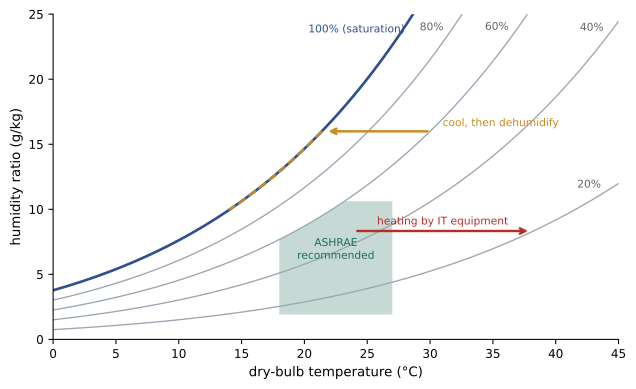
The output illustrates a point that confuses many operators: the hot aisle has the same moisture content as the cold aisle (the small difference is rounding of the chosen RH), but its relative humidity is far lower, because the air is warmer. Relative humidity alone does not tell whether moisture was added or removed; humidity ratio or dew point does. That is one reason the ASHRAE guidelines specify humidity limits as dew points as well as relative humidity.
The psychrometric chart
The psychrometric chart plots these properties for a given pressure: dry-bulb temperature along the horizontal axis, humidity ratio up the vertical axis, curves of constant relative humidity rising to the saturation curve, and sloping lines of constant wet-bulb temperature and enthalpy. Every state of moist air is a point, and every process is a path between points.
Processes
Sensible heating and cooling
When air passes through IT equipment, or through a cooling coil whose surface is above the air's dew point, its temperature changes but its humidity ratio does not: the path on the chart is horizontal. The heat transferred is the sensible heat:
This is the relationship from Lesson 1 between airflow, temperature rise and heat load.
Cooling with dehumidification
If a coil surface is colder than the entering air's dew point, water vapour condenses on it. The air leaves cooler and drier, and the coil removes latent heat (the heat of condensation, about 2,450 kJ per kg of water) as well as sensible heat. The total is the change in enthalpy:
The sensible heat ratio (SHR) is the sensible share of the total. Data centres have SHRs close to 1, because IT equipment adds heat but almost no moisture. Cooling units designed for offices, with SHRs around 0.7, waste energy in data centres by dehumidifying air that does not need it and then, sometimes, rehumidifying it. Data centre cooling units are selected for high SHR, and chilled water is supplied warm enough (often 15 °C and above) that coils stay above the room's dew point and run dry.
Worked problem
Is the coil wet?
Return air enters a cooling coil at 36 °C with a dew point of 11.3 °C. Chilled water enters the coil at 18 °C and leaves at 26 °C. Will the coil condense moisture?
Show solution
- The coldest coil surface is near the chilled-water inlet, a little above 18 °C.
- 18 °C is well above the 11.3 °C dew point.
Answer: No. The coil runs dry and all its capacity is sensible. With 7 °C chilled water, as in older designs, the coil surface would be below the dew point and the coil would dehumidify the room, wasting energy and requiring humidifiers to replace the moisture.
Mixing
When two airstreams mix adiabatically, the mixed state lies on the straight line between them on the chart, at a position given by their mass flow fractions; humidity ratio and enthalpy are mass-weighted averages, and temperature very nearly so. Air-side economizers mix hot return air with cold outdoor air to reach a target supply temperature.
Evaporative cooling
Spraying or wicking water into air cools it at nearly constant enthalpy: the heat to evaporate the water comes from the air itself, so the dry-bulb temperature falls while the humidity ratio rises, along a line of constant wet-bulb temperature. The lowest temperature reachable is the wet-bulb temperature; real evaporative media achieve 80% to 90% of the difference between dry-bulb and wet-bulb (the saturation effectiveness).
import math

P = 101.325

def p_ws(t):
    return 0.6112 * math.exp(17.62 * t / (243.12 + t))

def W_of(t, rh):
    pw = rh / 100 * p_ws(t)
    return 0.622 * pw / (P - pw)

def rh_of(t, W):
    pw = W * P / (0.622 + W)
    return 100 * pw / p_ws(t)

def wet_bulb(t, W):
    # ASHRAE psychrometric relation, solved by bisection
    lo, hi = -20.0, t
    for _ in range(60):
        twb = (lo + hi) / 2
        ws = W_of(twb, 100.0)
        w_calc = ((2501 - 2.326 * twb) * ws - 1.006 * (t - twb)) / (2501 + 1.86 * t - 4.186 * twb)
        if w_calc > W:
            hi = twb
        else:
            lo = twb
    return twb

# Air-side economizer: mix hot-aisle return air with cold outdoor air to reach 22 C supply
t_ret, W_ret = 36.0, W_of(24.0, 45.0)
t_out, W_out = 2.0, W_of(2.0, 80.0)
x = (t_ret - 22.0) / (t_ret - t_out)            # outdoor air fraction (approximately, by temperature)
W_mix = x * W_out + (1 - x) * W_ret
print(f"outdoor air fraction {x:.2f}; mixed air 22.0 C, W {1000 * W_mix:.2f} g/kg, RH {rh_of(22.0, W_mix):.0f}%")

# Direct evaporative cooling: air approaches its wet-bulb temperature
for t, rh in ((35.0, 20.0), (35.0, 50.0), (28.0, 70.0)):
    W = W_of(t, rh)
    twb = wet_bulb(t, W)
    t_out_evap = t - 0.85 * (t - twb)            # 85% effective evaporative media
print(f"{t:4.1f} C, {rh:3.0f}% RH: wet bulb {twb:4.1f} C, evaporative supply {t_out_evap:4.1f} C")outdoor air fraction 0.41; mixed air 22.0 C, W 6.34 g/kg, RH 39% 35.0 C, 20% RH: wet bulb 18.9 C, evaporative supply 21.3 C 35.0 C, 50% RH: wet bulb 26.2 C, evaporative supply 27.5 C 28.0 C, 70% RH: wet bulb 23.7 C, evaporative supply 24.3 C
In a dry climate, an evaporative cooler turns 35 °C air into 21 °C supply air, inside the ASHRAE recommended range; in a humid climate the same cooler barely helps. This is why evaporative cooling is so effective in places like Alberta, Arizona and the interior of British Columbia, and much less so in humid coastal or tropical climates. Design uses local climate data of wet-bulb temperatures, such as the ASHRAE design conditions or hourly weather files (Lesson 12).
Humidity limits and their reasons
The ASHRAE thermal guidelines (Lesson 1) recommend a dew point between −9 °C and 15 °C and relative humidity no higher than 60% at the IT inlet, with wider allowable ranges for each equipment class. The limits have physical reasons:
- High humidity: above about 60% RH, especially with gaseous pollutants such as sulphur compounds and chlorine, corrosion of copper and silver on circuit boards accelerates. Where air quality is poor, ASHRAE recommends staying below 50% RH, or filtering the air with chemical media and measuring corrosion rates with copper and silver coupons.
- Condensation: any surface below the dew point, such as a cold pipe, an uninsulated chilled-water valve, or equipment brought in from a cold truck, collects water.
- Low humidity: very dry air increases the risk of electrostatic discharge. Research sponsored by ASHRAE found that with proper grounding of floors, people and equipment, the risk remains low down to about 8% RH, which allowed the lower limits to be relaxed, saving the energy and water of humidification.
Worked problem
Bringing in new equipment
A server delivered by truck in winter is at −5 °C when it is wheeled into a hall at 24 °C with a dew point of 11 °C. What happens, and what is the practice?
Show solution
- The server's surfaces, at −5 °C, are far below the room's 11 °C dew point.
- Moisture from the room air condenses (or freezes, then melts) on and inside the server.
Answer: Condensation forms inside the equipment. Practice is to leave new equipment in its packaging in a staging area until it reaches room temperature, typically several hours to a day, before unpacking and powering it.
Measuring humidity
Humidity is measured with capacitive sensors that report relative humidity, combined with a temperature sensor to calculate dew point and humidity ratio. Their accuracy is typically ±2% to ±3% RH and they drift with time and contamination, so they need regular calibration. Because RH depends so strongly on temperature, a sensor reading must be paired with the temperature at the same point: an RH sensor in the hot aisle will always read low compared with one in the cold aisle, even though the moisture content is the same. Control systems for humidity should therefore use dew point, measured or calculated, at the IT inlets or in the supply air.
Common mistakes
MistakeComparing relative humidity readings taken at different temperatures.
InsteadCompare dew point or humidity ratio, which do not change with sensible heating.
MistakeSupplying chilled water below the room dew point.
InsteadKeep coil surfaces above the dew point so coils run dry and SHR stays near 1.
MistakeExpecting evaporative cooling to work equally everywhere.
InsteadIts limit is the wet-bulb temperature, which is high in humid climates.
MistakeHumidifying to 40–50% RH by habit.
InsteadFollow current ASHRAE limits; with good grounding, much lower humidity is acceptable.
MistakeUnpacking cold equipment immediately in the hall.
InsteadAcclimatize it until it reaches room temperature to avoid condensation.
Summary and key terms
- Moist air is described by dry-bulb, humidity ratio, RH, dew point, wet-bulb and enthalpy.
- Heating and cooling without condensation change temperature and RH but not humidity ratio.
- Coils colder than the dew point dehumidify; data centres want dry coils and SHR near 1.
- Mixed air lies on the line between the two states; evaporative cooling follows constant wet-bulb.
- ASHRAE humidity limits reflect corrosion, condensation and static discharge risks.
- Control and compare humidity by dew point, not relative humidity.
- Psychrometrics
- The study of the properties of moist air.
- Humidity ratio
- Mass of water vapour per mass of dry air.
- Relative humidity
- Vapour pressure as a percentage of saturation pressure at the same temperature.
- Dew point
- The temperature at which air becomes saturated when cooled at constant moisture.
- Wet-bulb temperature
- The temperature reached by evaporative saturation; the limit of evaporative cooling.
- Enthalpy
- Energy content of moist air per kilogram of dry air.
- Sensible heat
- Heat that changes temperature.
- Latent heat
- Heat absorbed or released by evaporation or condensation.
- Sensible heat ratio
- The sensible share of total cooling.
- Saturation effectiveness
- How closely an evaporative cooler approaches the wet-bulb temperature.
Practice problems
Work each problem on paper first, then reveal the answer to check.
Does humidity ratio change when air passes through a server?
Show answer
No; only temperature and RH change.
Air at 24 °C has a dew point of 12 °C. Will a pipe at 14 °C sweat?
Show answer
No; it is above the dew point.
Sensible heat for 10 m³/s of air heated by 12 °C?
Show answer
1.2 × 10 × 12 = 144 kW.
Latent heat to condense 1 g/kg from 5 kg/s of air?
Show answer
5 × 0.001 × 2,450 = 12.3 kW.
Why is SHR near 1 in data centres?
Show answer
IT equipment adds heat but almost no moisture.
Mixing equal masses at W = 4 and 10 g/kg gives?
Show answer
7 g/kg.
Evaporative supply at 40 °C dry-bulb, 20 °C wet-bulb, 85% effectiveness?
Show answer
23 °C.
What is the lowest temperature evaporative cooling can reach?
Show answer
The wet-bulb temperature.
Why limit RH where gaseous pollutants are present?
Show answer
Humidity accelerates corrosion of copper and silver.
Which humidity quantity should controls use?
Show answer
Dew point (or humidity ratio).
Lesson quiz · 5 questions
Score 60% or more to complete this lesson.
Create a free account to save your progress, take quizzes and earn a certificate.