
CSCO-122 · Lesson 6 of 12 · 23 min
Risk management frameworks
▶ Video coming soon A video version of this lesson is on the way.
Kettle & Crumb Bakery's owner, Anneliese Vogt, had a question that Owen Larkin passed to Keisha in early November. Her insurer had sent a cyber insurance renewal form with forty questions, and her bank had asked whether the bakery's card terminals met the payment card industry's security standard. She wanted to know, in plain words, how much risk the bakery was carrying and what it would cost to reduce it. Keisha asked Jordan to help her build the bakery's first risk register. Risk management, she told him, is how security stops being a list of scary technical things and becomes a set of business decisions that an owner can actually make.
This lesson explains what risk is and how it is measured, the choices an organization has for dealing with each risk, and the frameworks that help organizations of every size manage risk in a consistent way. It ends with the register Keisha and Jordan built.
What risk is
Lesson 4 defined risk as the combination of a threat exploiting a vulnerability and the impact that follows. Risk management turns that idea into a repeatable process: identify what you need to protect, identify what could go wrong, estimate how likely and how harmful each event would be, decide what to do about it, and keep checking as things change. The assets involved are not only devices. For the bakery they included card payments, the online ordering site, the recipes and supplier pricing in the office laptop, employee payroll records and the bakery's reputation in a small city.
Two terms describe how much risk an organization is willing to carry. Risk appetite is the broad amount of risk an organization is willing to accept in pursuit of its goals. Risk tolerance is the acceptable variation around a particular objective, often expressed as a limit, such as the longest time the shops can operate without card payments. Owners set appetite and tolerance; technicians help them understand what those choices mean.
Qualitative risk assessment
Most small organizations assess risk qualitatively, using ratings rather than dollar figures. Each risk is rated for likelihood and impact on a simple scale, often 1 to 5, and the two ratings are multiplied to give a risk score. The scores can then be plotted on a risk matrix, sometimes called a heat map, where the top-right corner holds the risks that need attention first.
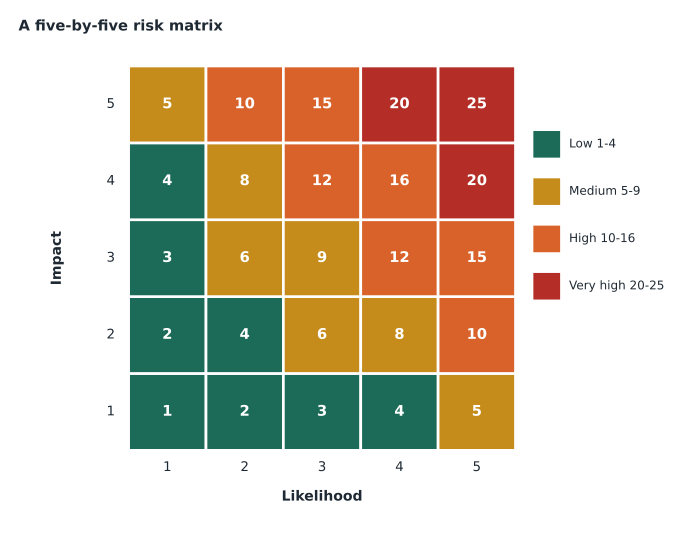
Qualitative ratings are quick and easy to discuss, but they depend on judgment. Two people may rate the same risk differently. Keisha reduced that problem by writing down what each rating meant for the bakery. An impact of 5 meant losing the ability to take payments in all three shops for more than a day or a breach of customer card data. An impact of 1 meant a nuisance fixed in under an hour. A likelihood of 5 meant it was expected within the year; a likelihood of 1 meant it was unlikely in the next five years.
Quantitative risk assessment
Quantitative assessment puts numbers on risk in money. It is used where good data exist, such as insurance, and it is a favourite of exam questions because the formulas are simple.
- Asset value (AV) is what the asset is worth, including the cost of replacing it and the income it supports.
- Exposure factor (EF) is the fraction of the asset's value lost in one event.
- Single loss expectancy (SLE) is the expected loss from one event: SLE = AV × EF.
- Annualized rate of occurrence (ARO) is how many times the event is expected per year. Once every four years is an ARO of 0.25.
- Annualized loss expectancy (ALE) is the expected loss per year: ALE = SLE × ARO.
The ALE gives a rough ceiling on what it makes sense to spend each year to reduce a risk. If a control costs more per year than the loss it prevents, it may not be worth buying, although reputation and legal duties can change that calculation.
Worked problem
Annualized loss for a point-of-sale outage
Kettle & Crumb's three shops together take about 6,000 dollars in card sales on a typical day. A ransomware attack on the point-of-sale system is estimated to stop card payments for two days, and about half of those sales would be lost because customers would go elsewhere or pay less in cash. Recovery costs are estimated at 4,000 dollars. Such an attack is estimated to happen once every five years. What are the SLE and ALE?
Show solution
- Lost sales: 6,000 dollars per day × 2 days × 0.5 = 6,000 dollars.
- Add recovery costs: 6,000 + 4,000 = 10,000 dollars. This is the single loss expectancy.
- Once every five years is an ARO of 1 ÷ 5 = 0.2.
- ALE = 10,000 × 0.2 = 2,000 dollars per year.
Answer: The SLE is 10,000 dollars and the ALE is 2,000 dollars per year. A control costing much less than that per year, such as better backups and segmentation, is easily justified.
Treating risk
Once a risk is understood, there are four standard ways to treat it, and the exam expects you to know them.
- Mitigate, also called reduce: apply controls that lower the likelihood or impact, such as patching, multi-factor authentication or backups.
- Transfer, also called share: shift some of the financial impact to someone else, usually through insurance or a contract with a supplier.
- Avoid: stop the activity that creates the risk, such as no longer storing card numbers at all.
- Accept: knowingly live with the risk because it is low or the cost of treating it is too high. Acceptance must be approved by someone with authority and reviewed regularly.
Most risks are treated with a combination. The bakery reduced the risk of card data theft by moving to point-of-sale terminals that encrypt card data from the moment a card is tapped, transferred part of the remaining financial risk through cyber insurance and accepted the small leftover risk in writing. The risk that remains after treatment is called residual risk, and it is the residual risk that the owner accepts. Insurance transfers money, not responsibility: if customer data is stolen, the bakery still has to notify people and deal with its reputation.
Frameworks that guide the work
A framework is a structured set of practices that helps an organization manage cybersecurity risk consistently and explain its approach to others. The CCST exam expects familiarity with the main ones and with how compliance frameworks shape what an organization must do.
| Framework | Who publishes it | What it is used for |
|---|---|---|
| NIST Cybersecurity Framework (CSF) 2.0 | US National Institute of Standards and Technology, 2024 | Organizing a whole security program around six functions: Govern, Identify, Protect, Detect, Respond and Recover |
| NIST Risk Management Framework (SP 800-37) | NIST | A detailed process for selecting, implementing and authorizing controls, widely used by US government systems |
| ISO/IEC 27001 and 27005 | International Organization for Standardization and International Electrotechnical Commission | An information security management system that can be certified, and guidance on risk management |
| CIS Critical Security Controls | Center for Internet Security | A prioritized list of practical safeguards, grouped into implementation groups for organizations of different sizes |
| Baseline Cyber Security Controls and CyberSecure Canada | Canadian Centre for Cyber Security; certification program run by Innovation, Science and Economic Development Canada | Short, practical starting points written for small and medium organizations |
| PCI DSS | PCI Security Standards Council | Mandatory security requirements for any organization that stores, processes or transmits payment card data |
The NIST CSF is the one most often discussed in small and medium organizations, including in Canada. Version 2.0, released in February 2024, added the Govern function to stress that cybersecurity is a leadership responsibility, not just a technical one. Each function breaks down into categories and subcategories that an organization can use to describe its current state, set a target state and plan the gap between them. The CIS Controls are more concrete: they say what to do first, such as keeping an inventory of devices and software, which is exactly where Lesson 4 started.
Compliance frameworks
Some frameworks are voluntary. Others are required by law, regulation or contract, and those are called compliance frameworks. Their requirements shape how an organization protects data and how it must respond to incidents, which Lesson 9 covers.
- PCI DSS applies to anyone who handles payment card data. Small merchants like the bakery usually prove compliance with a self-assessment questionnaire each year. Version 4.0 became the only active version in 2024, and its newer requirements took effect on March 31, 2025.
- Privacy laws such as the federal Personal Information Protection and Electronic Documents Act (PIPEDA), Quebec's private-sector privacy law and provincial health information acts require reasonable safeguards for personal information and set breach-reporting duties.
- Professional rules can also apply. Riverside Family Law's lawyers have a professional duty to protect client confidentiality, set by their provincial law society, which includes taking reasonable care with technology.
- The European Union's General Data Protection Regulation can apply to North American businesses that offer goods or services to people in the EU.
The risk register
A risk register is the document where risks are recorded, rated, assigned and tracked. It is the working tool that turns frameworks into action. Each entry names the risk, the affected asset, the likelihood and impact ratings, the score, the planned treatment, the owner, the due date and the residual risk after treatment.
| Risk | L | I | Score | Treatment | Owner |
|---|---|---|---|---|---|
| Ransomware stops point-of-sale and ordering | 3 | 5 | 15 | Mitigate: offline backups, segmentation, EDR; transfer: insurance | Owner, with Brightline |
| Card data theft from terminals | 2 | 5 | 10 | Mitigate: encrypting terminals, PCI self-assessment; transfer: insurance | Owner |
| Phishing steals the bookkeeper's email password | 4 | 3 | 12 | Mitigate: MFA, awareness training | Brightline |
| Office laptop stolen from the shop | 2 | 3 | 6 | Mitigate: full-disk encryption; accept residual | Owner |
| Internet outage at one shop | 3 | 2 | 6 | Mitigate: terminals with cellular backup and offline mode | Brightline |
| Supplier price list leaked | 1 | 2 | 2 | Accept | Owner |
The register made the conversation with Anneliese short and productive. She could see the three highest risks at a glance, what each fix would cost and who was responsible. She approved the backups and segmentation immediately, asked Brightline to price multi-factor authentication for the bookkeeper's account, and signed acceptance of the two lowest risks. The register would be reviewed every six months and after any incident.
Two kinds of risk are easy to leave out of a first register. The first is third-party risk: the bakery depends on its point-of-sale vendor, its payment processor, its online ordering platform and Brightline itself, and a failure or breach at any of them becomes the bakery's problem. Keisha added a line for each critical supplier, with a note on what their contract said about security and how quickly they had to report incidents. The second is the risk of doing nothing about known weaknesses, such as the end-of-support PCs from Lesson 2. Writing those down, with an owner and a decision, is what turns a vague worry into a managed risk.
Worked problem
Choosing a treatment from scores
A risk is rated likelihood 4 and impact 4 before treatment. Adding multi-factor authentication would lower the likelihood to 2 and leave the impact at 4. The owner's tolerance is that no risk should score above 9 without a plan. What is the score before and after, and is the residual risk within tolerance?
Show solution
- Before: 4 × 4 = 16, well above the tolerance of 9.
- After MFA: 2 × 4 = 8.
- 8 is below 9, so the residual risk is within tolerance and can be accepted in writing.
Answer: The score falls from 16 to 8, within the tolerance of 9, so MFA is approved and the residual risk is accepted.
Common mistakes
MistakeTreating risk as purely technical.
InsteadOwners set appetite and tolerance and make the final decisions.
MistakeUsing ratings without written definitions.
InsteadDefine what each likelihood and impact rating means for the organization.
MistakeAssuming insurance removes the risk.
InsteadInsurance transfers money; notification and reputation duties remain.
MistakeAccepting risk informally.
InsteadRecord acceptance with an approver, a reason and a review date.
MistakeConfusing voluntary and compliance frameworks.
InsteadPCI DSS and privacy laws are requirements; the NIST CSF and CIS Controls are guidance.
Summary and key terms
- Risk management identifies assets and threats, rates likelihood and impact, chooses a treatment and repeats regularly.
- Appetite is the broad willingness to accept risk; tolerance is the acceptable limit for a particular objective.
- Qualitative assessment multiplies likelihood and impact ratings; quantitative assessment uses SLE = AV × EF and ALE = SLE × ARO.
- Risks are mitigated, transferred, avoided or accepted, and the remaining residual risk is accepted by an authorized person.
- The NIST CSF 2.0, NIST RMF, ISO/IEC 27001, CIS Controls and small-business baselines guide programs; PCI DSS and privacy laws are compliance requirements.
- A risk register records each risk's rating, treatment, owner and residual risk.
- Risk appetite
- The amount of risk an organization is willing to accept to reach its goals.
- Risk tolerance
- The acceptable limit of risk for a particular objective.
- Single loss expectancy (SLE)
- The expected loss from one event: asset value times exposure factor.
- Annualized loss expectancy (ALE)
- The expected yearly loss: SLE times annualized rate of occurrence.
- Residual risk
- The risk that remains after treatment.
- Risk transfer
- Shifting part of the financial impact, usually through insurance or contracts.
- Compliance framework
- A set of security requirements imposed by law, regulation or contract.
- Risk register
- The record of identified risks, their ratings, treatments and owners.
Practice problems
Work each problem on paper first, then reveal the answer to check.
What is the difference between risk appetite and risk tolerance?
Show answer
Appetite is the overall willingness to accept risk; tolerance is the specific acceptable limit for one objective.
An asset worth 50,000 dollars would lose a fifth of its value in one event. What is the SLE?
Show answer
50,000 × 0.2 = 10,000 dollars.
An event is expected once every ten years with an SLE of 30,000 dollars. What is the ALE?
Show answer
30,000 × 0.1 = 3,000 dollars per year.
Name the four risk treatment options.
Show answer
Mitigate, transfer, avoid and accept.
Which function did NIST CSF 2.0 add?
Show answer
Govern.
Why is PCI DSS called a compliance framework?
Show answer
Its requirements are mandatory for organizations that handle payment card data.
Lesson quiz · 5 questions
Score 60% or more to complete this lesson.
Create a free account to save your progress, take quizzes and earn a certificate.