
CSCO-121 · Lesson 1 of 12 · 23 min
The CCST Cybersecurity exam and security roles
▶ Video coming soon A video version of this lesson is on the way.
Jordan Pelletier had been at Brightline IT Services in Saskatoon for just over two months when Owen Larkin, the owner, called him into the small meeting room with the whiteboard that never quite erases. Jordan had spent September and October on the help desk with Marisol Tran, resetting passwords, swapping failed drives and learning to write tickets that someone else could understand. He had booked his CCST IT Support exam for early in the new year. Owen wanted to talk about what came next. Brightline's clients were asking more security questions every month, and the company's one security analyst, Keisha Moreau, could not answer them all.
Owen's plan was simple. Jordan would keep his help desk shifts, but two afternoons a week he would shadow Keisha. Along the way he would prepare for the Cisco Certified Support Technician Cybersecurity exam, known by its code 100-160. Keisha would be his mentor for the security side, the way Marisol had been for support. This course follows those afternoons. It covers the first half of the exam: security principles, threats and the basic ideas of protecting a network. CSCO-122 covers the second half: endpoints, vulnerability management, risk and incident handling.
What the CCST Cybersecurity certification is
The CCST certifications are Cisco's entry-level credentials. They sit below the CCNA and are aimed at people starting out: students, career changers and technicians who support networks and users but are not yet network engineers. There are CCST exams for IT support, networking and cybersecurity. Each is a single exam, and passing it earns the certification. Cisco positions the cybersecurity exam as a way to show that a candidate understands core security concepts well enough to work in an entry-level role such as a security operations centre analyst, a help desk technician with security duties, or a junior security administrator at a small organization.
Cisco's exam page describes the exam as testing knowledge of security principles, network security and endpoint security concepts, vulnerability assessment and risk management, and incident handling. When this course was written, that page gave the duration as 50 minutes and the price as 125 US dollars, and listed several languages, including English, French and Spanish. Prices, languages and policies change, so check the current page before you book. Training providers commonly describe the exam in five domains, and that grouping is a useful study map even though Cisco's own exam topics document is the authority.
| Commonly listed domain | Main ideas | Where this program covers it |
|---|---|---|
| Essential security principles | Confidentiality, integrity and availability; threats and vulnerabilities; access management; encryption basics | CSCO-121, lessons 2 to 5, 10 and 11 |
| Basic network security concepts | Protocol weaknesses, firewalls, access control lists, VPNs, wireless security, secure remote access | CSCO-121, lessons 6 to 9 and 12 |
| Endpoint security concepts | Operating system hardening, updates, anti-malware and detection tools, logs | CSCO-122, lessons 1 to 3 and 8 |
| Vulnerability assessment and risk management | Vulnerability management process, scan results, risk and frameworks, continuity planning | CSCO-122, lessons 4 to 7 and 11 |
| Incident handling | Monitoring, incident response phases, evidence handling, compliance | CSCO-122, lessons 8 to 10 and 12 |
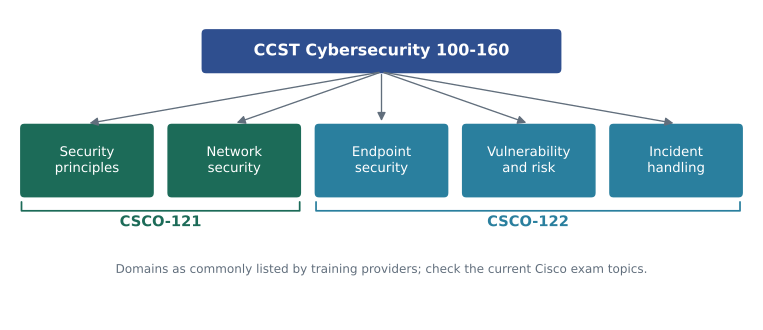
The number of questions and the passing score are not stated on Cisco's exam page. Secondary sources commonly report 40 to 50 questions and say that Cisco does not publish a pass mark; score reports show pass or fail with feedback by section. Treat any precise figure you read elsewhere with caution. The CCST Exam Readiness course, CSCO-190, covers booking, item types and time management in detail. For now, the useful fact is that 50 minutes for roughly 40 to 50 items leaves about a minute per question, so recognition and clear understanding matter more than slow working-out.
Who works in security
Keisha started her first afternoon with Jordan by drawing the people who do security work. At the top of her drawing was the board and senior management, who own risk and decide how much of it the organization will accept. Below them was a security leader, often called a chief information security officer in large organizations and simply "whoever does security" in small ones. Then came the people who build and run defences, the people who watch for attacks, and the people who check that everything is working. In a company of 14 people like Brightline, one person may wear four of those hats, which is exactly why Keisha needed help.
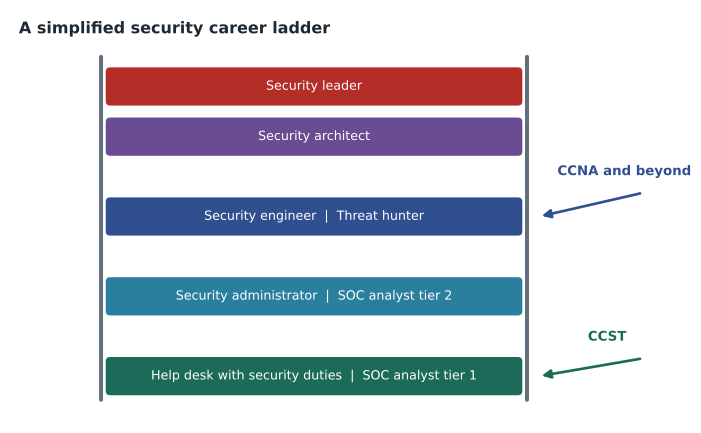
Entry-level roles are where most people start. A security operations centre, or SOC, analyst watches alerts from monitoring tools, decides which are real, and escalates the serious ones. SOCs often describe analysts in tiers: tier 1 triages alerts, tier 2 investigates incidents in depth, and tier 3 hunts for threats that tools have missed. A security administrator configures firewalls, accounts, permissions and security tools. A help desk technician with security duties resets accounts safely, spots phishing, and handles lost devices. Other roles include vulnerability analyst, governance and compliance analyst, penetration tester, and security engineer. The CCST is aimed at the first rungs of this ladder.
| Role | Typical tasks | Skills this course builds |
|---|---|---|
| SOC analyst, tier 1 | Watch alerts, triage, open and escalate incidents | Recognizing attack types, reading log entries, knowing when to escalate |
| Security administrator | Manage accounts, firewall rules, VPN access, wireless settings | Access control, firewall and ACL logic, secure protocols, AAA |
| Help desk with security duties | Verify callers, reset credentials, handle phishing reports and lost devices | Social engineering awareness, authentication, least privilege |
| Junior compliance analyst | Collect evidence for audits, track policies and exceptions | Security principles, privacy law basics, documentation |
| Network technician | Configure switches, VLANs and wireless securely | Zones and segmentation, wireless security, secure management |
The defender's mindset
Keisha told Jordan that the most important thing she could teach him was not a tool but a habit of mind. Attackers look for the easiest way in. Defenders have to think about every way in, so they rely on layers, so that one failure does not mean total failure. This idea is called defence in depth. A small business might have a firewall at the edge, separate networks for different kinds of devices, strong sign-in for every account, up-to-date software, backups, and staff who know how to report a suspicious email. No single layer is perfect. Together they make an attack slower, noisier and more likely to fail.
The second habit is skepticism about trust. Older network designs assumed that anything inside the office was safe. Modern guidance, often summed up as zero trust, assumes that a device or user is not trusted just because of where it sits on the network. Every request is checked: who is asking, from what device, for what resource, and whether that makes sense right now. Zero trust is a direction rather than a product, and most small organizations move toward it gradually, starting with strong sign-in and separating their networks.
The third habit is writing things down. Marisol's favourite phrase on the help desk, "write it down", matters even more in security. Changes to firewall rules, exceptions to policy, the reason an account was given extra access, and every step taken during an incident all need a record. When something goes wrong, the record is how the team reconstructs what happened. When an auditor or insurer asks, the record is the evidence that controls exist.
Ethics and the law
Security work gives people access and knowledge that could cause harm. A technician who can reset passwords can also read mail. An analyst who studies attacks can, in principle, carry one out. For that reason security has strong professional ethics. The core rules are simple: act only within your authorization, protect the privacy of the people whose data you see, report problems honestly, and never test or probe systems you do not have written permission to test. Many certification bodies, including Cisco, require candidates to agree to a code of conduct, and breaking exam rules or misusing knowledge can cost a certification.
The law matters too. In Canada, the Criminal Code makes unauthorized use of a computer an offence, and privacy laws such as the federal Personal Information Protection and Electronic Documents Act (PIPEDA), Quebec's private-sector law and provincial health information laws such as Saskatchewan's Health Information Protection Act set rules for handling personal information and reporting breaches. Jordan did not need to be a lawyer, Keisha said, but he did need to know that these rules exist, that Brightline's clients are bound by them, and that the right response to a possible breach is to escalate quickly rather than quietly fix it.
National cyber security agencies
Each country has public agencies that publish free guidance, alerts and advice for small organizations. In Canada the Canadian Centre for Cyber Security, part of the Communications Security Establishment, publishes advisories, baseline controls for small and medium organizations and awareness material. Police services and the Canadian Anti-Fraud Centre take reports of cybercrime and fraud. Keisha subscribes to the agency's alerts and reads them each morning with her coffee. She told Jordan to do the same; it is the cheapest threat intelligence available.
Frameworks give structure to all of this. The NIST Cybersecurity Framework, published in the United States and widely used in Canada as well, organizes security work into functions: govern, identify, protect, detect, respond and recover. Brightline uses those functions to explain its services to clients. Lessons in this course mostly sit in the identify and protect functions; CSCO-122 spends more time on detect, respond and recover.
Worked problem
Planning a study timetable
Jordan has about 16 weeks before his planned exam and can study for five hours a week outside his shadowing afternoons. He wants to split his time in proportion to the five domains, giving the two CSCO-121 domains a combined 40 of every 100 hours. How many hours should he plan for this course's material?
Show solution
- Total study time is 16 weeks × 5 hours = 80 hours.
- The CSCO-121 share is 40 of every 100 hours, or 0.40.
- 0.40 × 80 hours = 32 hours.
Answer: Jordan should plan about 32 hours for the material in this course, and the remaining 48 for CSCO-122, CSCO-190 and practice.
Worked problem
Choosing the right first response
During his first shadowing afternoon, Jordan sees a Brightline Desk ticket from Riverside Family Law: a lawyer says her mailbox sent messages she did not write. Jordan knows how to reset a password. What should he do first, and why?
Show solution
- Recognize that this may be a security incident, not just a support request, because an account may be compromised.
- Follow Brightline's procedure: escalate to Keisha, the security analyst, and record what the lawyer reported and when.
- Do not delete the sent messages or change mailbox rules yet; they may be evidence of what happened.
- Resetting the password and ending active sessions is likely, but it should be done as part of the incident response, in the order Keisha decides.
Answer: Escalate and record first. A quiet fix could destroy evidence and miss a breach that the firm must assess under privacy law.
Common mistakes
MistakeTreating the CCST as a networking exam with a security chapter.
InsteadThe 100-160 exam covers security principles, network and endpoint security, risk and incident handling as its whole scope.
MistakeMemorizing a question count or pass mark from a forum.
InsteadCisco does not publish a pass mark; check the official exam page for the duration, price and topics.
MistakeAssuming a firewall makes a network secure.
InsteadSecurity relies on layers: defence in depth.
MistakeTrusting anything inside the office network.
InsteadZero trust checks every request regardless of network location.
MistakeTesting a system to "see if it is secure" without permission.
InsteadOnly test with written authorization; unauthorized access is an offence.
Summary and key terms
- The 100-160 CCST Cybersecurity exam is an entry-level Cisco certification covering security principles, network and endpoint security, vulnerability and risk management, and incident handling.
- Cisco's page lists a 50-minute exam; the question count and pass mark are not published there, so treat outside figures with caution.
- CSCO-121 covers principles and network security; CSCO-122 covers endpoints, risk and incidents.
- Entry-level roles include SOC tier 1 analyst, security administrator and help desk technician with security duties.
- Defence in depth, zero trust and good records are the defender's core habits.
- Ethics and law limit what a security worker may do: act within authorization and protect privacy.
- CCST
- Cisco Certified Support Technician, an entry-level Cisco certification.
- SOC
- Security operations centre, the team that monitors and responds to security alerts.
- Defence in depth
- Using several layers of protection so that one failure does not lead to total compromise.
- Zero trust
- An approach that does not trust a user or device because of its network location and checks every request.
- NIST Cybersecurity Framework
- A widely used framework that groups security work into govern, identify, protect, detect, respond and recover.
- Authorization (ethical sense)
- Written permission to access or test a system, which defines the limits of legitimate security work.
Practice problems
Work each problem on paper first, then reveal the answer to check.
Which four topic areas does Cisco's exam page name for 100-160?
Show answer
Security principles; network and endpoint security concepts; vulnerability assessment and risk management; incident handling.
What does a tier 1 SOC analyst do?
Show answer
Watches and triages alerts, opens incidents and escalates serious ones.
What is defence in depth?
Show answer
Layered protection, so one failed control does not mean total compromise.
What is the core idea of zero trust?
Show answer
Network location alone does not earn trust; every request is checked.
Why should a possible account compromise be escalated rather than quietly fixed?
Show answer
It may be an incident with evidence and legal reporting duties.
Name the six functions of the NIST Cybersecurity Framework.
Show answer
Govern, identify, protect, detect, respond and recover.
Lesson quiz · 5 questions
Score 60% or more to complete this lesson.
Create a free account to save your progress, take quizzes and earn a certificate.