
CON-350 · Lesson 7 of 12 · 26 min
Construction insurance I: builder's risk and property
Insurance is the main way the construction industry transfers risks that no party to the contract could reasonably carry alone: a fire that destroys a half-finished building, a flood that fills the excavation, a crane collapse that injures people on the street. This lesson covers the basic principles of insurance and the property side of a construction insurance program, centred on builder's risk insurance. Lesson 8 covers liability insurance, professional and pollution coverage, and wrap-up programs. Insurance policies vary widely, and the wording of the actual policy always governs; nothing here replaces advice from a licensed broker.
How insurance works
An insurance policy is a contract in which the insurer agrees to pay for specified losses in return for a premium. A few principles explain most of how construction insurance behaves.
| Principle | Meaning | Construction example |
|---|---|---|
| Insurable interest | The insured must stand to lose financially if the loss occurs | Owner, contractor and subcontractors all have an interest in the work in progress |
| Indemnity | The insured is restored to its position before the loss, not enriched | Payment for the cost to rebuild damaged work, less the deductible |
| Deductible | The part of each loss the insured pays itself | $25,000 per occurrence, larger for flood or earthquake |
| Limit and sublimit | The most the insurer will pay overall or for a type of loss | Full project value for fire; a lower sublimit for flood |
| Exclusion | A loss or cause the policy does not cover | Wear and tear, design defects, mechanical breakdown |
| Subrogation | After paying, the insurer takes over the insured's rights against whoever caused the loss | Insurer sues the subcontractor whose torch started the fire |
| Waiver of subrogation | The parties agree that insurers will not pursue each other | All project parties waive claims against each other for insured losses |
| Duty of disclosure and conditions | The insured must disclose material facts and meet policy conditions | Hot work permits, fire watch, security, notice of loss |
Subrogation and its waiver are central to construction. Without a waiver, a fire caused by a subcontractor would be paid by the builder's risk insurer, which would then sue the subcontractor to recover its payment, defeating the purpose of a project-wide policy and setting the parties against each other. Standard contracts therefore require the property insurance to include all parties as insureds and require the parties to waive subrogation against each other for insured losses.
Insurance in Canada is regulated provincially, and brokers and insurers must be licensed in the province where they operate. The Insurance Bureau of Canada represents property and casualty insurers, and the Canadian Construction Documents Committee publishes CCDC 41, CCDC Insurance Requirements, which sets the insurance that CCDC contracts require. The 2020 edition of CCDC 41 accompanies CCDC 2-2020.
Builder's risk insurance
Builder's risk insurance, also called course of construction or construction all risks insurance, covers physical loss or damage to the work while it is being built: materials on site, materials in transit and stored off site, temporary works and the permanent work as it is installed. It is usually written on an all risks basis, meaning it covers every cause of physical loss except those specifically excluded.
Under CCDC 2-2020 and CCDC 41, the contractor normally provides a broad form property policy for the work, with the owner, contractor and subcontractors as insureds, in an amount not less than the value of the work, and keeps it in force until the work is complete. Owners may choose to buy it themselves, for example when they have a master property program.
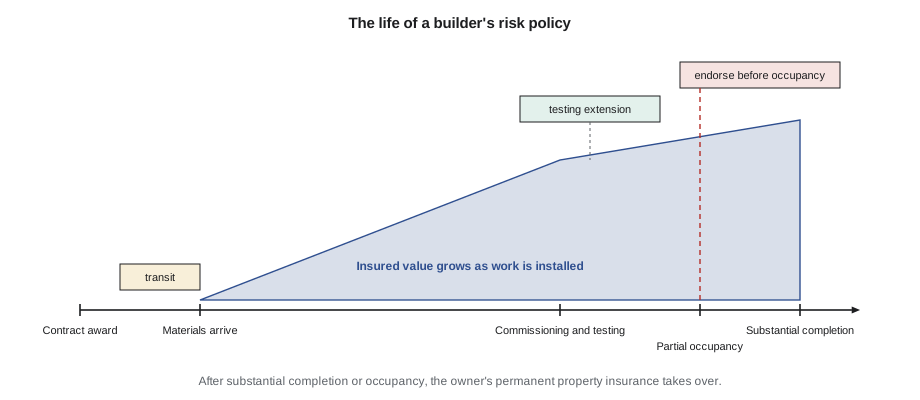
Coverage typically ends at the earliest of substantial completion, occupancy or use by the owner, or the policy expiry date. Partial occupancy is a common trap: if the city moves library staff into part of Kingfisher Wharf before the pool is finished, the policy may require the insurer's consent or end for the occupied part. Owners and contractors should agree in advance who insures what during partial occupancy and obtain the endorsement before anyone moves in.
Common exclusions and extensions
The exclusions in a builder's risk policy matter as much as the coverage. Several are almost universal; others can be removed or limited by paying for an extension.
| Item | Usual position | Comment |
|---|---|---|
| Faulty workmanship, materials or design | Excluded, but resulting damage usually covered | The defective part is not paid, damage it causes to other work may be; LEG clauses define the line |
| Wear and tear, gradual deterioration, corrosion | Excluded | Not sudden and accidental |
| Mechanical or electrical breakdown | Often excluded; covered during testing by extension | Commissioning of the pool plant needs testing coverage |
| Flood and earthquake | Covered with a sublimit and higher deductible, or excluded | Waterfront sites need careful review |
| Theft from an unsecured site | Restricted; security conditions apply | Fencing, lighting and locked storage may be conditions |
| Delay in start-up (soft costs) | Not covered unless added | Covers owner losses from delay caused by an insured loss |
| Contractor's tools and equipment | Excluded; insured under the contractor's equipment floater | Separate policy |
| Existing structures | Excluded unless added | Renovations need existing building coverage |
The defects exclusion is the source of many disputes. Insurers in many markets use standard clauses from the London Engineering Group, known as LEG 1, LEG 2 and LEG 3, to define how much of a loss caused by a defect is covered. LEG 1 excludes all loss caused by a defect, LEG 2 covers resulting damage but excludes the cost of what would have been needed to fix the defect before the loss, and LEG 3 excludes only the cost of improving the original defective design or workmanship. Owners and contractors on complex projects, especially those with innovative designs, usually negotiate for LEG 2 or LEG 3 wording.
Worked problem
Applying a defects exclusion
At Kingfisher Wharf a poorly welded joint in a pool water main fails during commissioning, flooding the mechanical room. Repairing the weld would have cost $3,000 if it had been caught. The flood damages pumps, controls and drywall costing $186,000. The deductible is $25,000. Roughly what is recovered under LEG 1, LEG 2 and LEG 3 wording?
Show solution
- LEG 1: all loss caused by the defect is excluded, so nothing is recovered.
- LEG 2: the resulting damage is covered, but the cost of fixing the weld itself is excluded: 186,000 − 25,000 deductible = $161,000 recovered; the $3,000 weld repair is not.
- LEG 3: similar here, because the only excluded cost is improving the defective weld; recovery is about $161,000.
Answer: The wording decides whether a $186,000 loss is insured. Under LEG 1, the subcontractor and contractor would bear it, subject to their own liability insurance and contract terms.
Valuing the policy and paying the premium
The limit is normally set at the completed value of the project, including materials and labour but often excluding land, site preparation that cannot be damaged, and fees. Premiums are expressed as a rate per $100 (or per $1,000) of completed value for the project term, and depend on the type of construction, the location, the duration, the deductibles and the loss history of the contractor. Wood-frame residential projects pay much higher rates than concrete buildings because of fire risk; projects in flood or earthquake zones pay more for those perils.
Market conditions also move rates. Broker reports for 2026 described the construction insurance market as competitive for contractors with good loss records, with project builder's risk rates for non-high-hazard projects expected to move only slightly in 2027, while wood-frame and catastrophe-exposed projects faced closer underwriting. Rates quoted in this lesson are illustrative only.
Choosing a deductible
A higher deductible lowers the premium but leaves more of each loss with the insured. The right choice depends on the expected number and size of losses and on how much retained loss the project can absorb. Water damage, the most frequent builder's risk loss in many markets, typically produces many small and medium losses, so the deductible choice matters.
# Choosing a builder's risk deductible by expected annual cost (illustrative, seeded)
import numpy as np
rng = np.random.default_rng(41)
value = 48_000_000
options = {10_000: 0.150, 25_000: 0.128, 50_000: 0.112, 100_000: 0.098}   # deductible: rate per $100
YEARS = 20_000
total = {d: [] for d in options}
for _ in range(YEARS):
    n = rng.poisson(1.6)                          # expected losses over the project
    losses = rng.lognormal(mean=10.4, sigma=1.3, size=n)
    for d, rate in options.items():
        retained = np.minimum(losses, d).sum()
        total[d].append(value / 100 * rate + retained)
for d, rate in options.items():
    t = np.array(total[d])
print(f"Deductible {d:>7,}: premium {value / 100 * rate:>8,.0f} mean total cost {t.mean():>8,.0f} P90 {np.percentile(t, 90):>8,.0f}")Deductible 10,000: premium 72,000 mean total cost 86,829 P90 102,000 Deductible 25,000: premium 61,440 mean total cost 92,902 P90 131,616 Deductible 50,000: premium 53,760 mean total cost 103,842 P90 164,460 Deductible 100,000: premium 47,040 mean total cost 118,662 P90 219,818
In this illustration each step up in deductible saves less premium than it adds in expected retained losses, so the lowest deductible has the lowest mean total cost, and the 90th percentile shows how much worse a bad project can be with a high deductible. With a different loss pattern, for example fewer and smaller losses or larger premium discounts, the balance can tip the other way; the point of the exercise is to compare premium savings with expected retained losses rather than to choose the cheapest premium. The project team should choose a deductible it can afford to pay several times over, not just once, and should make clear in the contract who pays the deductible on each loss. Many contracts make the party responsible for the loss pay the deductible, which gives subcontractors an incentive to prevent losses.
Loss prevention and claims
Insurers expect insured parties to prevent losses, and many policies make specific measures conditions of coverage. On construction sites the most important are hot work controls (permits, fire watch and extinguishers for welding and cutting), water damage prevention (leak detection, staged testing of piping, shut-off procedures), fire protection during construction (standpipes, temporary heat safety, combustible waste removal), and site security. Wood-frame mid-rise projects have suffered many large fires during construction in both countries, and insurers now often require fire prevention plans, security patrols and camera monitoring as conditions.
When a loss occurs, the insured must give prompt notice, protect the property from further damage, document the loss with photographs and records, and cooperate with the insurer's adjuster. Repairs should not be completed before the adjuster has had a chance to inspect, unless delay would cause further damage. Under most contracts the contractor carries out the repairs as a change to the work, and the insurance proceeds flow to the owner or are held in trust for the parties according to the contract.
| Step after a loss | Who | Why |
|---|---|---|
| Make safe and stop further damage | Contractor | Policies require mitigation; unmitigated damage may be excluded |
| Notify broker and insurer | Named insured (owner or contractor) | Late notice can jeopardize coverage |
| Photograph and record | Contractor | Evidence of cause, extent and value |
| Meet the adjuster | Contractor and owner | Agree scope and method of repair |
| Notify contract parties | Contractor | Contract notice requirements for changes and time |
| Track costs separately | Contractor | Proof of loss and recovery of deductible |
Common mistakes
MistakeAssuming builder's risk covers the cost of fixing defective work.
InsteadExpect the defective part to be excluded; check which LEG wording applies to resulting damage.
MistakeLetting the owner occupy part of the building without telling the insurer.
InsteadObtain an occupancy endorsement or arrange the owner's property cover first.
MistakeChoosing the highest deductible to minimize premium.
InsteadCompare premium plus expected retained losses, and check the project can absorb several deductibles.
MistakeOmitting a waiver of subrogation.
InsteadRequire all parties to waive subrogation for insured losses so the policy works as a project policy.
MistakeTreating fire prevention as optional.
InsteadFollow hot work, temporary heat and security conditions; breaches can void coverage.
Summary and key terms
- Insurance transfers financial loss to an insurer for a premium, governed by insurable interest, indemnity, deductibles, limits and exclusions.
- Waivers of subrogation stop insurers suing other project parties and make a project property policy work.
- Builder's risk covers physical loss to the work during construction on an all risks basis, subject to exclusions.
- Under CCDC contracts the contractor usually provides it; under AIA A201 the owner usually does.
- Defects are excluded but resulting damage is often covered; LEG clauses define the line.
- Premiums are a rate on completed value; deductible choice balances premium against retained losses.
- Loss prevention conditions, especially hot work, water damage and fire controls, are essential to coverage.
- Builder's risk insurance
- Property insurance covering the work during construction.
- All risks
- Coverage of all causes of physical loss except those excluded.
- Deductible
- The part of each loss paid by the insured.
- Sublimit
- A lower limit applying to a particular type of loss within the policy.
- Subrogation
- An insurer's right, after paying a loss, to recover from the party that caused it.
- Waiver of subrogation
- An agreement that insurers will not pursue specified parties for insured losses.
- LEG clause
- A standard London Engineering Group clause defining cover for losses caused by defects.
- Soft costs
- Non-physical costs such as interest, fees and lost revenue arising from a delay.
- Delay in start-up
- Coverage for the owner's losses from delayed completion caused by an insured loss.
- Hot work
- Welding, cutting, torch-applied roofing and other work producing flame or sparks.
Practice problems
Work each problem on paper first, then reveal the answer to check.
What does insurable interest mean?
Show answer
The insured must stand to lose financially if the loss occurs.
Why do construction contracts require a waiver of subrogation?
Show answer
To stop insurers suing other project parties after paying an insured loss.
Who normally provides builder's risk under CCDC 2-2020?
Show answer
The contractor.
A $30 million project has a rate of $0.14 per $100. What is the premium?
Show answer
300,000 × 0.14 = $42,000.
What is excluded under LEG 2 wording?
Show answer
The cost that would have been needed to correct the defect before the loss; resulting damage is covered.
Name two typical builder's risk exclusions.
Show answer
Any two of: faulty workmanship or design, wear and tear, mechanical breakdown, unsecured theft, contractor's equipment.
Why is partial occupancy a risk for builder's risk coverage?
Show answer
Coverage may end or need consent when the owner occupies or uses the building.
What should the contract say about deductibles?
Show answer
Who pays them, often the party responsible for the loss.
Give three loss prevention measures insurers often require.
Show answer
Hot work permits and fire watch, water damage controls, fire protection, security.
Why should repairs usually wait for the adjuster?
Show answer
So the insurer can inspect and agree the scope; unless delay would cause further damage.
Lesson quiz · 5 questions
Score 60% or more to complete this lesson.
Create a free account to save your progress, take quizzes and earn a certificate.