
CON-350 · Lesson 12 of 12 · 25 min
Monitoring and reporting risk, and capstone: a risk management plan
Risk management fails most often not in identification or analysis but in follow-through. A well-built register at the start of the project is worth little if nobody checks whether responses were carried out, whether new risks have appeared, or whether contingency is draining faster than risks are expiring. This final lesson covers how risks are monitored and reported during a project and across a contractor's business, and then brings the whole course together in a capstone: a risk management plan for the Kingfisher Wharf Community Centre.
What to monitor
Monitoring has three parts: tracking the risks already in the register, watching for new risks, and checking that the risk process itself is working. Each part has its own measures.
| Area | What to track | Typical measure |
|---|---|---|
| Exposure | Total expected value of open risks, and the top risks | Total EMV; P80 contingency need from an updated model |
| Contingency | Remaining contingency against remaining exposure | Contingency remaining ÷ exposure remaining; burn against plan |
| Responses | Actions due, completed and overdue | Percentage of actions overdue |
| Register health | New, closed and occurred risks; last review dates | Risks not reviewed in 60 days |
| Triggers | Early warning signs for key risks | Supplier delivery status, groundwater readings, subcontractor payment complaints |
| Occurred risks | Which risks became issues and at what cost | Actual cost versus estimate at identification |
Triggers deserve attention because they turn monitoring from a monthly ritual into early warning. For the late dehumidifier risk at Kingfisher Wharf the triggers might be a missed factory test date or a request to change shipping method; for subcontractor default, slow payment of the subcontractor's own suppliers, reduced crews or requests for advance payment (CON-330 lesson 11). Assigning each trigger to someone who will actually see it, such as the expediter or the superintendent, is what makes it useful.
Risk dashboards and reports
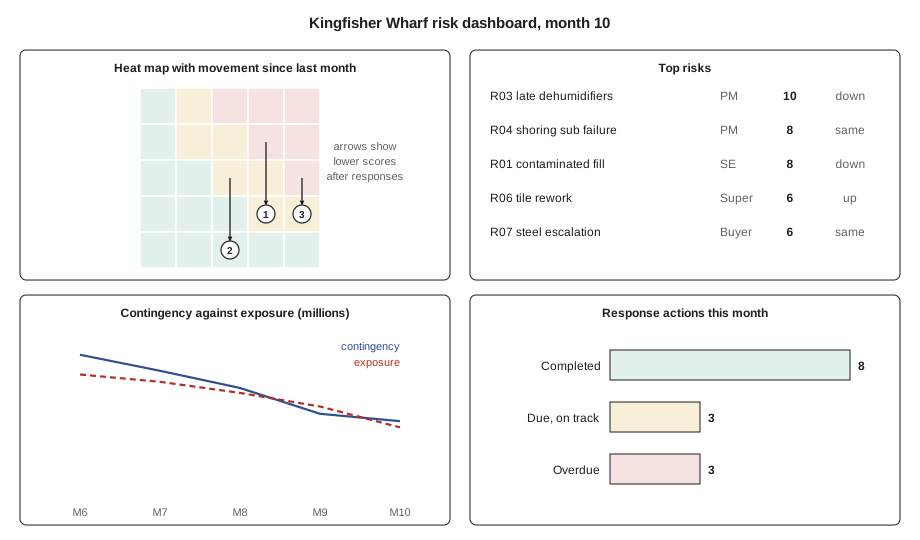
Monthly risk reporting should be short, visual and focused on decisions. A one-page dashboard typically shows the heat map, the top risks with their owners and trends, the contingency position, overdue actions and any decisions needed from senior management or the owner.
# Monthly risk indicators for Kingfisher Wharf (illustrative)
months = ["M6", "M7", "M8", "M9", "M10"]
contingency_left = [1_180_000, 1_050_000, 910_000, 700_000, 640_000]
exposure_left   = [1_020_000,   960_000, 870_000, 760_000, 590_000]   # open EMV plus allowance for unknowns
actions_due     = [14, 16, 12, 15, 11]
actions_overdue = [ 1,  2,  2,  5,  3]
for m, c, e, d, o in zip(months, contingency_left, exposure_left, actions_due, actions_overdue):
    cover = c / e
    flag = "OK" if cover >= 1.1 else "WATCH" if cover >= 0.95 else "ACT"
print(f"{m}: cover ratio {cover:4.2f} ({flag}) overdue actions {o / d:5.1%}")M6: cover ratio 1.16 (OK) overdue actions 7.1% M7: cover ratio 1.09 (WATCH) overdue actions 12.5% M8: cover ratio 1.05 (WATCH) overdue actions 16.7% M9: cover ratio 0.92 (ACT) overdue actions 33.3% M10: cover ratio 1.08 (WATCH) overdue actions 27.3%
A cover ratio, remaining contingency divided by remaining exposure, is a simple headline measure. Above about 1.1 the project has a cushion; near 1.0 it is tight; below 1.0 it is underfunded for the risks it knows about, before allowing for surprises. In the illustration, cover slipped to WATCH in months 7 and 8 and fell below 1.0 to ACT in month 9, with a third of due actions overdue at the same time, a combination that should prompt a focused review rather than waiting for the next monthly cycle.
Different audiences need different reports. Site teams need the actions and triggers. Project executives need the top risks, contingency and decisions. Owners need the risks they carry and any requests for time or money. Sureties and lenders need assurance that the contractor's projects are under control (CON-320 lesson 11). Insurers need loss prevention information, incident reports and prompt notice of potential claims. Tailoring the same underlying register to each audience avoids the common problem of reports that are too detailed for executives and too vague for site staff.
Enterprise risk for contractors
A contractor manages risk across its whole business as well as on each project. Enterprise risks include concentration of backlog in one client, sector or region; bonding capacity and working capital (CON-320); key people; safety performance, which affects insurance costs, prequalification and reputation (HSE-401); cyber and fraud (lesson 8); and claims exposure across all projects. A bid committee that reviews each major pursuit against the firm's risk appetite, and a quarterly enterprise risk review by senior management, connect project risk management to the health of the company.
| Enterprise risk | Indicator | Response |
|---|---|---|
| Backlog concentration | Share of backlog with one client or project type | Diversify pursuits; limit exposure per client |
| Working capital and bonding | Backlog ÷ working capital; surety limits used | Pace growth; retain earnings; talk to the surety early |
| Safety | Injury rates, experience rating, serious incidents | Safety management system, leadership (HSE-401) |
| Claims and disputes | Total value and age of open claims | Early resolution; claims reserve |
| Cyber and fraud | Phishing tests, payment change verification | Controls, training, cyber and crime cover |
| Key people | Depth of experienced project managers and superintendents | Succession planning; limit concurrent large projects |
Lessons learned
Every completed project is a source of data for the next one. A lessons-learned review compares the risks identified at the start with what actually happened: which risks occurred, what they cost, which responses worked, and which surprises were never in the register. Recording these results, especially the cost of occurred risks against their estimates, builds the reference data that improves future ranges and probabilities and counters optimism bias (lesson 1). Organizations that skip this step make the same mistakes on every project.
Capstone: a risk management plan for Kingfisher Wharf
The capstone brings the course together. Tallgrass Builders has just signed the $48 million stipulated price contract for the Kingfisher Wharf Community Centre. The schedule is 24 months, liquidated damages are $8,000 per day, and the city wants the building open for the summer festival. The base estimate before contingency is $46.2 million. You are preparing Tallgrass's risk management plan for the project. The sections below set out what the plan contains, using the analyses from earlier lessons.
| Plan section | Content for Kingfisher Wharf | Lesson |
|---|---|---|
| Context and appetite | Objectives, tolerance (no unmitigated risk above 2 % of contract value; budget at P80 for contractor risks) | 1 |
| Roles | Project manager owns the plan; named risk owners; monthly review; executive escalation for high risks | 2, 12 |
| Register | Initial register with cause-event-effect descriptions, owners and allocation | 2 |
| Analysis | Scoring scales, heat map, Monte Carlo cost and schedule models | 3 |
| Responses | Dewatering, early procurement, bonds or SDI, escalation clause, fallback plans | 4, 6, 10 |
| Contingency | P80 contingency of about $1.52 million, drawdown plan, release rules | 4 |
| Contract allocation | Clause review results and owner-carried risks to track for notice | 5, 6 |
| Insurance | Builder's risk, CGL tower, pollution, professional for delegated design, deductibles | 7, 8 |
| Surety | Performance and payment bonds on the prime contract; subcontract protection strategy | 9, 10 |
| Claims and disputes | A notice calendar, records and the claims reserve approach | 11 |
| Monitoring and reporting | Dashboard, triggers, audiences, lessons learned | 12 |
Capstone: key analyses
The plan draws on numbers developed through the course. Bringing them together shows how the pieces fit.
Worked problem
The Kingfisher Wharf risk budget
Summarize the main risk-related costs Tallgrass should carry in its budget: contractor contingency at P80 from lesson 3 ($1.52 million), dewatering installed as a mitigation in lesson 4 ($85,000), builder's risk premium at $0.128 per $100 on $48 million (lesson 7), bond premium at 0.65 % (lesson 9), and an allowance for subcontractor bond costs or SDI retention of $250,000 (lesson 10). What is the total, and what share of the contract price is it?
Show solution
- Contingency: $1,520,000.
- Dewatering: $85,000.
- Builder's risk: 480,000 × 0.128 = $61,440.
- Bonds: 0.0065 × 48,000,000 = $312,000.
- Subcontract default protection allowance: $250,000.
- Total: 1,520,000 + 85,000 + 61,440 + 312,000 + 250,000 = $2,228,440.
- Share of price: 2,228,440 ÷ 48,000,000 ≈ 4.6 %.
Answer: About $2.2 million, or 4.6 % of the contract price, is risk-related cost: retained risk in contingency plus the price of transferring risk to insurers and sureties. Liability insurance and wrap-up costs would sit in general requirements as well.
# Capstone: top risks after responses, with residual exposure (illustrative)
risks = [  # (risk, probability before, impact before, response cost, probability after, impact after)
    ("Excavation flooding",            0.35, 480_000, 85_000, 0.35,  25_000),
    ("Late dehumidifiers",             0.35, 520_000, 18_000, 0.15, 400_000),
    ("Shoring subcontractor failure",  0.10, 900_000, 22_000, 0.10, 350_000),
    ("Pool tile rework",               0.20, 250_000, 12_000, 0.12, 200_000),
    ("Steel escalation over band",     0.40, 180_000,      0, 0.40,  65_000),
]
before = after = spend = 0
for name, p0, c0, cost, p1, c1 in risks:
    before += p0 * c0; after += p1 * c1; spend += cost
    print(f"{name:<30} EMV {p0 * c0:>9,.0f} -> {p1 * c1:>9,.0f}   response {cost:>7,}")
print(f"Total EMV before {before:,.0f}, after {after:,.0f}; response spend {spend:,}; net benefit {before - after - spend:,.0f}")Excavation flooding EMV 168,000 -> 8,750 response 85,000 Late dehumidifiers EMV 182,000 -> 60,000 response 18,000 Shoring subcontractor failure EMV 90,000 -> 35,000 response 22,000 Pool tile rework EMV 50,000 -> 24,000 response 12,000 Steel escalation over band EMV 72,000 -> 26,000 response 0 Total EMV before 562,000, after 153,750; response spend 137,000; net benefit 271,250
The table shows the value of the response plan: about $562,000 of expected loss reduced to about $154,000 for $137,000 of response spending, a net expected benefit of about $271,000 before counting the reduced chance of a large single loss. The remaining exposure is carried in contingency and monitored through the dashboard. The figures are illustrative, but the method is the one used on real projects.
Capstone: risks the owner carries
Tallgrass's plan also lists the risks the City of Larkspur carries under the contract, because Tallgrass must give notice and keep records to recover their cost. At Kingfisher Wharf these include contaminated soil (paid at the unit rate), concealed conditions beyond the site report (lesson 6), owner changes, late owner decisions on library fit-out, and permits the city committed to obtain. For each, the plan names the notice requirement, the person responsible for spotting the event and the cost code for tracking it. Sharing this part of the register with the city at the start-up meeting, and agreeing how such events will be handled, is a practical step toward avoiding disputes later.
| Owner-carried risk | Contract mechanism | Tallgrass action |
|---|---|---|
| Contaminated soil | Unit rate by weight for disposal | Track quantities daily with the owner's inspector |
| Concealed conditions | CCDC 2 GC 6.4 | Notify before disturbing; photograph; separate cost code |
| Owner changes and late decisions | Change process and decision deadlines | RFI and decision log; time impact analysis |
| Permits the city obtains | Owner obligation in the contract | Track permit status in the schedule; notify early |
| Rowing club access arrangements | Owner coordination with stakeholders | Agree access plan; record disruptions |
Capstone: making the plan work
A plan earns its value through use. Tallgrass schedules a joint risk workshop with the city in the first month, reviews the top ten risks at every weekly site meeting, runs a full register review and dashboard monthly, updates the Monte Carlo model at enclosure and at the start of commissioning, and holds a lessons-learned review within two months of substantial completion. Each of these is a line in the schedule with an owner, not an aspiration. If the plan is followed, the project still will not be free of surprises, but the team will see most of them coming, will have money set aside for them, and will know who pays.
Common mistakes
MistakeReporting the same detailed register to every audience.
InsteadTailor reports: actions for site teams, decisions for executives, owner risks for the owner.
MistakeWaiting for the monthly cycle when a cover ratio drops.
InsteadUse triggers and thresholds to prompt immediate reviews.
MistakeIgnoring enterprise risks such as backlog concentration and bonding capacity.
InsteadReview enterprise risk quarterly and at bid committee.
MistakeSkipping lessons-learned reviews.
InsteadRecord what risks occurred and what they cost to improve future estimates.
MistakeWriting a risk plan that is never scheduled.
InsteadPut workshops, reviews and model updates in the schedule with owners.
Summary and key terms
- Monitoring tracks exposure, contingency, responses, register health, triggers and occurred risks.
- Triggers give early warning when assigned to people who will see them.
- A one-page dashboard shows the heat map, top risks, contingency cover and overdue actions.
- The cover ratio of remaining contingency to remaining exposure is a simple headline measure.
- Reports should be tailored to site teams, executives, owners, sureties, lenders and insurers.
- Contractors also manage enterprise risks: backlog, working capital and bonding, safety, claims, cyber and people.
- A risk management plan combines context, roles, register, analysis, responses, contingency, allocation, insurance, surety, claims and monitoring.
- Risk monitoring
- Tracking risks, responses and the risk process during the project.
- Risk dashboard
- A short visual report of risk status for decision makers.
- Cover ratio
- Remaining contingency divided by remaining risk exposure.
- Trigger
- An early warning sign that a risk is about to occur.
- Enterprise risk management
- Managing risk across an organization rather than one project.
- Backlog concentration
- The share of a contractor's future work with one client, sector or region.
- Bid committee
- A senior group that reviews major pursuits against the firm's risk appetite.
- Lessons learned
- A review comparing expected and actual risk outcomes to improve future work.
- Risk management plan
- A document setting out how risk will be managed on a project.
- Residual exposure
- Expected loss remaining after responses.
Practice problems
Work each problem on paper first, then reveal the answer to check.
Remaining contingency is $540,000 and remaining exposure $600,000. What is the cover ratio and what does it suggest?
Show answer
0.90; the project is underfunded for known risks and needs review.
Name two triggers for a subcontractor default risk.
Show answer
Slow payment of its suppliers, reduced crews, requests for advance payment.
What should a site team's risk report focus on?
Show answer
Actions and triggers.
What do sureties want to see from a contractor's risk reporting?
Show answer
Assurance that projects are under control and early warning of problems.
Give three enterprise risks for a contractor.
Show answer
Any three of: backlog concentration, working capital and bonding, safety, claims, cyber and fraud, key people.
Why are lessons-learned reviews valuable?
Show answer
They build reference data on actual risk outcomes and counter optimism bias.
In the capstone, what share of the contract price was risk-related cost?
Show answer
About 4.6 %.
Why does the contractor's plan list owner-carried risks?
Show answer
Giving notice and keeping records are needed to recover their cost.
Name four sections of a risk management plan.
Show answer
Any four of: context, roles, register, analysis, responses, contingency, allocation, insurance, surety, claims, monitoring.
When should the Monte Carlo model be updated on Kingfisher Wharf?
Show answer
At key milestones such as enclosure and the start of commissioning.
Lesson quiz · 5 questions
Score 60% or more to complete this lesson.
Create a free account to save your progress, take quizzes and earn a certificate.