
CON-350 · Lesson 5 of 12 · 26 min
Risk allocation in contracts I: principles and key clauses
Most risk transfer on a construction project happens through the contract. Before any insurer or surety becomes involved, the owner and contractor have already decided, clause by clause, who pays when the ground is worse than expected, when a worker is injured, when the design has an error or when the project finishes late. CON-220 explains the law of contracts and the standard forms in detail. This lesson and the next look at the same clauses through a risk lens: what each clause does to the allocation of risk, how it interacts with insurance, and what a contractor or owner should check before signing.
Principles of good allocation
Lesson 1 introduced the principle that a risk should go to the party best able to control it, or failing that, the party best able to bear it at the least cost. In practice several further tests are applied by experienced drafters and by owners' advisers.
| Test | Question | Example |
|---|---|---|
| Control | Who can influence whether the risk occurs or how big it is? | Contractor controls its methods; owner controls its own changes |
| Foreseeability | Can the party carrying it assess and price it? | A contractor cannot price contamination nobody has investigated |
| Capacity | Can the party pay if the worst happens? | A small subcontractor cannot absorb a $5 million delay claim |
| Insurability | Can the risk be insured economically? | Fire during construction can; design errors only partly |
| Cost of transfer | What premium will the receiving party charge? | Pushing ground risk to bidders adds contingency to every bid |
| Clarity | Is it clear from the contract who carries it? | Ambiguous clauses lead to disputes |
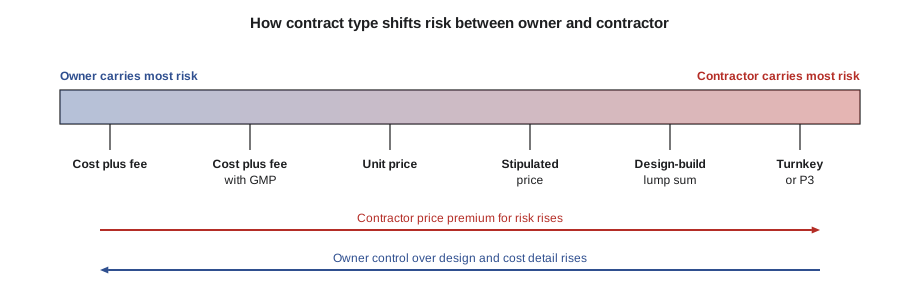
Owners sometimes believe that a contract transferring every risk to the contractor is the safest choice. It rarely is. Bidders price risks they cannot control at a premium, often a large one; the best contractors may decline to bid; and when a risk too large for the contractor occurs, the result is a dispute, an insolvency or a project that stops. Many public reviews of failed projects, including transit P3s in both countries discussed in CON-340 lesson 7, have concluded that risk was transferred to private parties who could not manage it, and that the public owner ended up paying anyway.
Indemnities
An indemnity is a promise by one party to protect another against specified losses, usually claims by third parties. In a construction contract the contractor typically indemnifies the owner against claims arising from the contractor's work, such as a passer-by injured by falling debris or a neighbour whose building is damaged by vibration. The owner may indemnify the contractor against claims arising from its own acts or from conditions it is responsible for.
| Form of indemnity | Scope | Risk effect |
|---|---|---|
| Limited (comparative fault) | Indemnifier pays only to the extent of its own negligence | Each party carries its own fault |
| Intermediate | Indemnifier pays for all of the loss unless the indemnified party was solely at fault | Shifts shared-fault losses to the indemnifier |
| Broad form | Indemnifier pays even if the loss was caused entirely by the indemnified party | Shifts the other party's own negligence; often unenforceable or uninsurable |
In Canada, CCDC contracts use mutual indemnities limited by reference to the insurance the contract requires and to each party's fault, and courts generally read an indemnity as covering the indemnified party's own negligence only if the clause says so clearly. Owners who rewrite the CCDC indemnity into a broad, unlimited form create a risk that the contractor's insurance will not cover, because liability policies respond to the insured's legal liability and to contracts the insurer has agreed to cover. A contractor asked to sign an unlimited broad-form indemnity should take it to its broker before signing.
Indemnities and insurance work together. The contractor's commercial general liability policy, discussed in lesson 8, usually covers liability the insured assumes under an insured contract, which typically includes many indemnities given in construction contracts, subject to the policy terms. That coverage is why owners require contractors to carry liability insurance and to name the owner as an additional insured. But an indemnity broader than the coverage leaves the contractor paying from its own pocket.
Limitation of liability
A limitation of liability clause caps the amount one party can recover from the other. Designers routinely seek caps tied to their fee or their professional liability insurance limit. Contractors seek caps on their total liability, often tied to the contract price, and especially on liquidated damages, which are frequently capped at a percentage of the contract price, such as 5 to 10 %. Owners resist caps because they leave the owner exposed above the cap, but a reasonable cap often lowers the price and widens the field of bidders.
Worked problem
Liquidated damages exposure with and without a cap
Kingfisher Wharf carries liquidated damages of $8,000 per calendar day. The contract price is $48 million. Tallgrass proposes a cap of 5 % of the contract price. If the project finishes 70 days late for reasons the contractor is responsible for, what does Tallgrass pay with and without the cap? How many days of delay would reach the cap?
Show solution
- Without a cap: 70 × 8,000 = $560,000.
- Cap: 0.05 × 48,000,000 = $2,400,000.
- With the cap: $560,000, because it is below the cap.
- Days to reach the cap: 2,400,000 ÷ 8,000 = 300 days.
Answer: At 70 days the cap makes no difference; it matters only for very long delays. A contractor should weigh the cap against how the owner will respond to the request, since a cap of this size gives protection only in a disaster.
Caps usually exclude certain liabilities, such as fraud, intentional misconduct, gross negligence, third-party bodily injury and amounts recovered from insurance. Courts in both countries generally enforce clear caps between sophisticated commercial parties, though they may refuse to enforce a cap in cases of serious misconduct or where enforcement would be unconscionable. CON-220 covers the legal tests.
Waiver of consequential damages
Consequential damages are indirect losses that flow from a breach, such as an owner's lost revenue or rent while a building is late, or a contractor's lost profit on other work because its resources were tied up. They can be enormous compared with the contract price, and they are hard for the other party to price. Many standard forms therefore include a mutual waiver: each party gives up its claim to consequential damages against the other.
CCDC 2-2020 does not contain a broad waiver in the American style, although it limits some claims through its waiver of claims and indemnity provisions; owners and contractors in Canada often negotiate a mutual waiver of consequential and indirect losses in supplementary conditions. Because the line between direct and consequential loss is not always clear, careful drafters list the specific losses waived, such as loss of use, lost revenue and lost profit, rather than relying on the word consequential alone.
The waiver and liquidated damages clause are closely linked. Liquidated damages usually represent the owner's agreed recovery for delay, replacing the uncertain consequential losses the owner might otherwise claim. An owner that strikes the waiver and keeps a low liquidated damages rate may argue it can claim actual losses above the rate; a contractor should make sure the contract says liquidated damages are the owner's sole remedy for delay.
Warranties and guarantees
A warranty allocates the risk of defects that appear after completion. Standard construction contracts give a one-year correction period, during which the contractor must return to fix defective work, and the owner keeps its legal rights for latent defects beyond that period, subject to limitation periods. Specific systems often carry longer manufacturer warranties, such as twenty years for a roofing membrane. Owners sometimes ask for extended contractor warranties or performance guarantees, for example a guarantee that the pool's dehumidification system will hold the hall at a stated humidity. These shift performance risk to the contractor and should be priced and, where possible, backed by the manufacturer.
| Risk | Usual allocation in a stipulated price contract | Common owner amendment | Contractor response |
|---|---|---|---|
| Third-party injury and damage | Contractor indemnity for its negligence; insured under CGL | Broad-form indemnity | Limit to fault; check with broker |
| Design errors | Owner (through its designer) | Contractor to verify and accept the design | Limit to reasonable review; exclude design responsibility |
| Delay caused by contractor | Contractor; liquidated damages or actual damages | High daily rate, no cap | Seek cap and sole-remedy wording |
| Owner lost revenue | Often waived or limited | Delete waiver of consequential damages | Restore mutual waiver or cap |
| Defects after completion | One-year correction period plus latent defect rights | Extended warranty or performance guarantee | Price it; seek manufacturer backing |
Reviewing a contract for risk
Contractors who review an owner's contract before bidding usually work from a checklist of high-risk clauses. A clause-by-clause review compares the owner's terms with the standard form it was based on, flags each change, and decides whether to price it, qualify the bid, ask for clarification during the tender, or decline to bid. CON-220 lesson 4 discusses supplementary conditions; from a risk point of view the point is to know what each change does to exposure.
# Scoring an owner contract against a risk checklist (illustrative)
clauses = {
    # clause: (owner amendment present?, severity 1-5 if present)
    "Broad-form indemnity":            (True, 4),
    "No cap on liquidated damages":    (True, 3),
    "Consequential damages waiver deleted": (True, 5),
    "Contractor accepts design":       (False, 5),
    "No differing site conditions clause": (False, 5),
    "Pay-if-paid to subcontractors":   (True, 2),
    "Extended 3-year warranty":        (False, 2),
}
flags = {k: s for k, (present, s) in clauses.items() if present}
score = sum(flags.values())
for k, s in sorted(flags.items(), key=lambda kv: -kv[1]):
    print(f"{s}  {k}")
print(f"Total risk score {score}; decision: {'qualify or price' if score < 12 else 'escalate to executive'}")5 Consequential damages waiver deleted 4 Broad-form indemnity 3 No cap on liquidated damages 2 Pay-if-paid to subcontractors Total risk score 14; decision: escalate to executive
Scoring of this kind is crude, but it forces a consistent review and makes it easy to escalate unusually risky contracts to senior management. The weights should reflect the firm's own experience of which clauses have cost it money.
Insurance requirements as allocation
The insurance article of a contract is itself a risk allocation tool. By requiring the contractor to buy builder's risk, general liability with stated limits, automobile, pollution or professional coverage, and by requiring the parties to be named as insureds and to waive subrogation, the contract decides which losses will be paid by insurers and which will fall back on the parties. A contract with a generous indemnity but low required insurance limits leaves a gap that the contractor carries itself. A contract that requires high limits for every trade may be safe on paper but drive up prices or exclude smaller subcontractors who cannot buy such limits. Reviewing the indemnity, limitation of liability and insurance clauses together, with the broker, is the only way to see the real allocation. Lessons 7 and 8 cover the insurance products themselves.
Common mistakes
MistakeAssuming the owner benefits from transferring every risk to the contractor.
InsteadAllocate each risk to the party best able to control or bear it; excessive transfer raises prices and causes disputes.
MistakeSigning a broad-form indemnity without checking insurance coverage.
InsteadAsk the broker whether the liability policy covers the indemnity as written.
MistakeAssuming any indemnity wording is enforceable everywhere.
InsteadCheck how courts read the clause and limit it to fault where possible.
MistakeDeleting the consequential damages waiver while keeping low liquidated damages.
InsteadState whether liquidated damages are the sole remedy for delay.
MistakeAccepting a performance guarantee without manufacturer backing.
InsteadPrice the guarantee and obtain back-to-back support from the supplier.
Summary and key terms
- Good allocation considers control, foreseeability, capacity, insurability, cost of transfer and clarity.
- Contract type moves risk along a spectrum from cost plus fee (owner) to fixed-price turnkey (contractor).
- Indemnities range from limited to broad form; broad-form indemnities may be unenforceable or uninsured.
- Limitation of liability clauses cap exposure, often tied to the contract price or fee, with standard exclusions.
- Mutual waivers of consequential damages remove large indirect losses; liquidated damages usually replace the owner's delay losses.
- Warranties and performance guarantees allocate post-completion risk and should be priced and backed.
- A systematic clause review decides whether to price, qualify, clarify or decline each risky term.
- Indemnity
- A promise to protect another party against specified losses or claims.
- Broad-form indemnity
- An indemnity covering losses caused even solely by the indemnified party.
- Anti-indemnity statute
- A law limiting or voiding certain indemnity clauses in construction contracts.
- Limitation of liability
- A clause capping the amount one party can recover from another.
- Consequential damages
- Indirect losses flowing from a breach, such as lost revenue or profit.
- Mutual waiver
- An agreement in which each party gives up certain claims against the other.
- Liquidated damages
- A pre-agreed amount payable for each day of late completion.
- Correction period
- The period after completion during which the contractor must fix defects, usually one year.
- Performance guarantee
- A promise that a completed system will meet stated performance levels.
- Additional insured
- A party added to another party's liability policy for specified claims.
Practice problems
Work each problem on paper first, then reveal the answer to check.
Name three tests applied when allocating a risk.
Show answer
Any three of: control, foreseeability, capacity, insurability, cost of transfer, clarity.
Why might transferring all risk to the contractor cost the owner more?
Show answer
Bidders price uncontrollable risks at a premium, good bidders may decline, and failures can return the risk to the owner.
What does a broad-form indemnity cover that a limited one does not?
Show answer
Losses caused by the indemnified party's own negligence.
Liquidated damages are $6,000 per day with a cap of 5 % of a $36 million price. How many days to reach the cap?
Show answer
Cap $1.8 million ÷ 6,000 = 300 days.
Give two examples of consequential damages for an owner.
Show answer
Lost revenue, loss of use, rental expenses, lost profit.
Why should a contract say liquidated damages are the sole remedy for delay?
Show answer
To stop the owner claiming actual delay losses above the agreed rate.
What liabilities are commonly excluded from a liability cap?
Show answer
Fraud, intentional misconduct, gross negligence, third-party bodily injury, insured amounts.
What is the usual correction period in standard contracts?
Show answer
One year after completion.
How does liability insurance relate to an indemnity?
Show answer
The CGL policy usually covers liability assumed under an insured contract, within its terms.
Name four ways to respond to a risky owner clause before bidding.
Show answer
Price it, qualify the bid, ask for clarification, or decline to bid.
Lesson quiz · 5 questions
Score 60% or more to complete this lesson.
Create a free account to save your progress, take quizzes and earn a certificate.