
CON-350 · Lesson 4 of 12 · 27 min
Risk response and contingency management
Analysis tells the team which risks matter; responses decide what happens to them. Lesson 1 listed the standard responses: avoid, reduce, transfer, share and accept for threats, and exploit or enhance for opportunities. This lesson shows how to choose among them on the basis of cost and benefit, how to plan responses so they actually get done, and how to fund the risks that remain through contingency. Insurance and bonds, the main ways of transferring risk to third parties, come in lessons 7 to 10; contract clauses that allocate risk between owner and contractor come in lessons 5 and 6.
Choosing a response
A response is worth carrying out if it reduces expected loss by more than it costs, after allowing for the organization's attitude to large losses. A mitigation that costs $60,000 and reduces a risk's EMV from $180,000 to $40,000 saves $140,000 of expected loss for $60,000, a clear benefit. A mitigation that costs $100,000 to reduce an EMV of $90,000 to $30,000 does not pay on expected value alone, but may still be worth doing if the risk could cause a loss the organization cannot afford, such as a missed opening date with heavy liquidated damages and reputational damage.
| Response | Kingfisher Wharf example | Typical cost |
|---|---|---|
| Avoid | Redesign the parking level with less depth below the water table | Design fee and possible loss of parking stalls |
| Reduce | Install wellpoint dewatering before excavation; order dehumidifiers early with an expediting clause | Dewatering system rental; deposit and expediting fee |
| Transfer | Require the shoring subcontractor to provide performance and payment bonds | Bond premium, usually 1 % or less of the subcontract |
| Share | Agree with the owner to share pool tile cost growth above an allowance | Negotiation; part of the upside lost |
| Accept | Carry the remaining weather risk in contingency | Contingency in the price |
| Enhance (opportunity) | Pre-fabricate the gym roof trusses to save two weeks | Engineering and fabrication premium |
Responses also create secondary risks. Dewatering can lower groundwater under a neighbour's building and cause settlement; early ordering of equipment commits money before the design is final; bonding a small subcontractor may push its price up or drive it out of the bid. A good response plan lists the secondary risks it creates and adds them to the register.
Decision trees
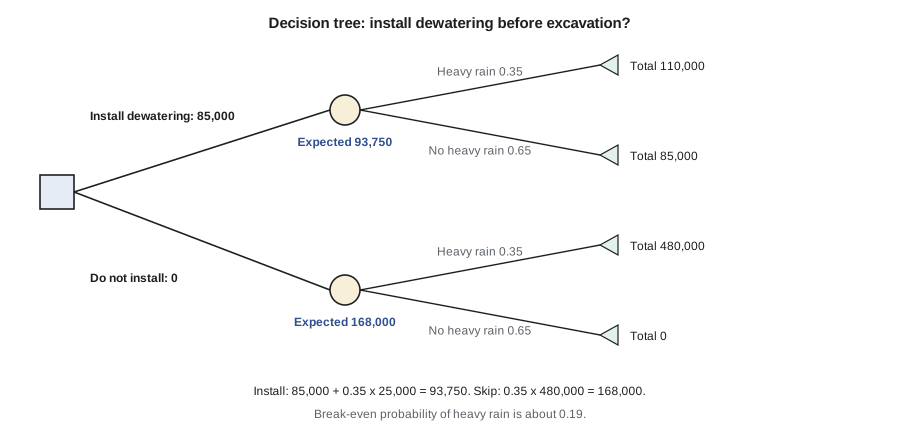
When a response involves a choice between options with uncertain outcomes, a decision tree helps. Squares mark decisions, circles mark chance events, and each branch carries a probability and a cost. The expected cost of each option is calculated by working back from the right-hand end.
Worked problem
Should Tallgrass install dewatering before excavation?
Option A: install wellpoint dewatering now for $85,000; if heavy spring rain occurs (probability 0.35) there is still $25,000 of pumping and clean-up. Option B: do not install; if heavy rain occurs the excavation floods, costing $480,000 in pumping, subgrade replacement and delay. Which option has the lower expected cost?
Show solution
- Option A expected cost: 85,000 + 0.35 × 25,000 = 85,000 + 8,750 = $93,750.
- Option B expected cost: 0.35 × 480,000 = $168,000.
- Difference: 168,000 − 93,750 = $74,250 in favour of option A.
Answer: Install dewatering. It costs more up front but lowers expected cost by about $74,000 and removes the chance of a large single loss.
The tree also shows what the probability would have to be for the decision to change. Here the options break even when 85,000 + 25,000p = 480,000p, so p = 85,000 ÷ 455,000, about 0.19. If the team believed heavy rain had less than about a 19 % chance, skipping dewatering would have the lower expected cost. Break-even analysis of this kind is useful when probabilities are hard to estimate: the team only needs to agree whether the probability is above or below the threshold.
Planning and tracking responses
A response that is only written in the register is not a response. Each one should be broken into actions with an owner, a due date and a cost, and the actions should appear in the schedule and budget where they belong. Dewatering needs a subcontract, a permit for discharge, a design and a start date before excavation. Early procurement of dehumidifiers needs approved shop drawings and a purchase order. The risk owner checks that actions are completed and updates the residual score once they are.
Contingency plans, sometimes called fallback plans, are different from mitigation. They are prepared in advance but carried out only if the risk occurs: a standby pump arrangement, a second shoring subcontractor prequalified in case the first fails, or an agreed procedure for handling contaminated soil if it is found. Their value lies in speed; a team that has already planned what to do loses days rather than weeks when the event happens.
Contingency: money for retained risk
After responses, some risk always remains. Contingency is the money set aside to pay for it. It is not a slush fund, a hidden profit or a reserve for scope the owner has not yet decided on. CON-300 lesson 9 shows how contractors build contingency into a bid, and CON-310 how it is tracked in the cost report. This lesson focuses on how much is needed, who holds it, and how it is released.
| Type | Who holds it | What it covers |
|---|---|---|
| Design contingency | Owner or design-builder | Growth in scope detail as the design develops from concept to construction documents |
| Estimating contingency | Estimator, in the estimate | Normal uncertainty in quantities and rates |
| Construction (contractor) contingency | Contractor, inside its price or GMP | Contractor-carried risks such as productivity, coordination, minor rework, buyout shortfalls |
| Owner construction contingency | Owner, outside the contract | Owner-carried risks such as unforeseen conditions, owner changes, permit delays |
| Escalation allowance | Either, depending on the contract | Price increases between estimate date and purchase |
| Management reserve | Owner or company executives | Unknown unknowns and risks above the project tolerance |
The distinction between contingency and management reserve is important on large projects. Contingency covers identified risks and is controlled by the project manager within agreed limits. Management reserve covers risks nobody has identified, and releasing it requires approval above the project, from a sponsor, board or executive committee. Keeping them separate stops the project from quietly spending the reserve on known problems and leaving nothing for genuine surprises.
Sizing contingency
Three methods are common, in rising order of rigour. A flat percentage, such as 5 % of construction cost, is quick but ignores the specific risks of the project. Summing the EMVs of identified risks ties the figure to the register but, as lesson 3 showed, is often exceeded. A probabilistic method reads contingency from the Monte Carlo S-curve at a chosen confidence level.
| Method | Kingfisher Wharf result | Comment |
|---|---|---|
| Flat 5 % of base estimate | 0.05 × 46.2 million = $2.31 million | Ignores project risk profile |
| Sum of EMVs (four risks, lesson 3) | $442,000 | Ignores estimating uncertainty; often exceeded |
| Monte Carlo P50 | About $0.86 million over base | Even chance of overrun |
| Monte Carlo P80 | About $1.52 million over base | Common choice for public owners |
| Monte Carlo P90 | About $1.91 million over base | Conservative; used where overruns are costly to fund |
The confidence level is a policy decision. Public owners that must return to a council or legislature for more money often budget at P80 or higher, because an overrun is politically expensive. Contractors bidding competitively cannot carry a P90 contingency and still win; they typically carry less and rely on their margin and company resources for the tail. This difference in appetite is one reason owners and contractors view the same risk differently. CON-300 lesson 11 shows how competitive pressure pushes contractor contingency down.
# Contingency at different confidence levels, and the cost of each extra point (illustrative)
base = 46_200_000
levels = {"P50": 47_063_630, "P80": 47_717_848, "P90": 48_105_209}   # from the lesson 3 simulation
prev = None
for name, value in levels.items():
    cont = value - base
    line = f"{name}: contingency {cont:>10,.0f}  ({cont / base:.1%} of base)"
    if prev:
        line += f"   extra over {prev[0]}: {cont - prev[1]:,.0f}"
    print(line)
    prev = (name, cont)
bid_margin = 0.05 * base
print(f"For comparison, a 5 % fee is {bid_margin:,.0f}")P50: contingency 863,630 (1.9% of base) P80: contingency 1,517,848 (3.3% of base) extra over P50: 654,218 P90: contingency 1,905,209 (4.1% of base) extra over P80: 387,361 For comparison, a 5 % fee is 2,310,000
Moving from P50 to P80 costs about $650,000 on this project; moving from P80 to P90 costs another $390,000 for just ten more points of confidence. The curve flattens at the top because the tail is long. Deciding where to stop is a matter of risk appetite, not arithmetic.
Drawing down and releasing contingency
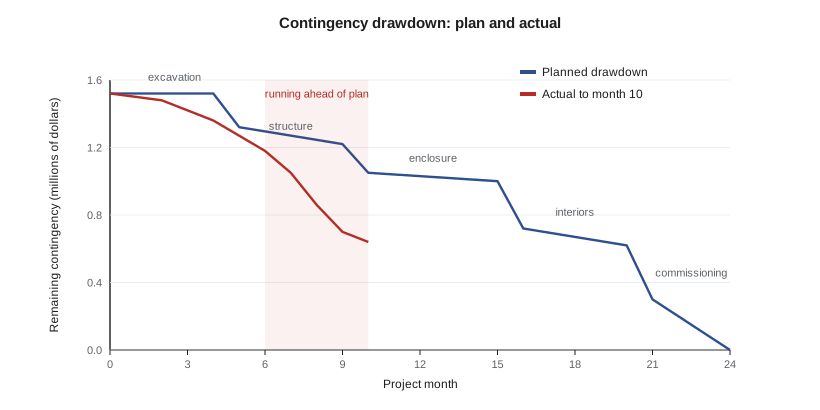
Contingency is spent as risks occur and released as risks expire. A dewatering allowance can be released once the parking level is backfilled; a contaminated soil allowance once excavation is finished. A well-run project plans how contingency should decline over time, based on when each risk's exposure ends, and compares actual drawdown with the plan each month. Drawdown that runs ahead of plan is an early warning that the project is consuming its cushion faster than the risks are expiring.
Worked problem
Is contingency burning too fast?
At month 9, Tallgrass has spent $820,000 of its $1.52 million contingency. The drawdown plan expected $560,000 to be used by month 9, and 55 % of the risk exposure in the register has now expired. Is the burn rate a concern?
Show solution
- Actual spent: 820,000 ÷ 1,520,000 = 54 % of contingency.
- Planned spent by month 9: 560,000 ÷ 1,520,000 = 37 %.
- Exposure expired: 55 %.
- Remaining contingency: 1,520,000 − 820,000 = $700,000 for the remaining 45 % of exposure.
Answer: Spending is $260,000 ahead of plan but roughly in line with exposure expired, so the position is tight rather than alarming. The team should review whether the remaining $700,000 covers the open risks and report the trend.
Release rules should be written down before the project starts. Under a guaranteed maximum price contract (CON-340 lesson 4) the contract often says how unspent contractor contingency is treated at the end: returned to the owner, shared, or partly kept by the contractor. Under a stipulated price contract unspent contingency is the contractor's, which is fair because overspent contingency is the contractor's too. On the owner side, releasing contingency to fund scope additions is a common temptation that leaves the project exposed later.
Risk-adjusted pricing
Contractors price risk in three places: in specific line items where a risk is concrete enough to estimate, in contingency for identified risks, and in the markup, which must cover general business risk as well as profit. CON-300 lesson 11 explains how competitive pressure and bid strategy affect markup. From a risk management point of view, the key discipline is to price known risks explicitly rather than burying them in markup, so that if the job is won the team knows exactly what money is available for which risk.
Common mistakes
MistakeChoosing responses by instinct rather than comparing cost with the reduction in expected loss.
InsteadCompare the response cost with the reduction in EMV, then consider whether the remaining loss is tolerable.
MistakeWriting responses in the register without actions, owners or dates.
InsteadBreak each response into scheduled, budgeted actions with an owner.
MistakeMixing management reserve with project contingency.
InsteadHold reserve separately with approval above the project.
MistakeUsing released contingency to fund new scope.
InsteadFund new scope through change orders or the owner's budget, not the risk cushion.
MistakeIgnoring the secondary risks created by a response.
InsteadList and register the risks each response creates.
Summary and key terms
- A response is worthwhile if it reduces expected loss by more than it costs, or prevents a loss the organization cannot tolerate.
- Decision trees compare options with uncertain outcomes; break-even probabilities help when probabilities are hard to estimate.
- Responses need actions, owners, dates and budgets, and they can create secondary risks.
- Contingency funds retained risk; management reserve covers unknowns and needs higher approval.
- Contingency can be sized by flat percentage, summed EMV or Monte Carlo percentiles; the confidence level is a policy choice.
- Planned drawdown, based on when risk exposures expire, is compared with actual spending each month.
- Contractors should price known risks explicitly rather than hiding them in markup.
- Risk response
- An action chosen to deal with a risk: avoid, reduce, transfer, share, accept, exploit or enhance.
- Secondary risk
- A new risk created by carrying out a response.
- Contingency plan
- An action prepared in advance and carried out only if a risk occurs.
- Decision tree
- A diagram of decisions and chance events used to compare expected outcomes.
- Break-even probability
- The probability at which two options have equal expected cost.
- Contingency
- Money set aside for identified risks that remain after responses.
- Management reserve
- Money held above the project for unidentified risks.
- Drawdown plan
- The expected decline in contingency as risks are spent or expire.
- Confidence level
- The percentile of the cost distribution at which a budget is set.
- Escalation allowance
- Money set aside for price increases between estimate and purchase.
Practice problems
Work each problem on paper first, then reveal the answer to check.
A mitigation costs $40,000 and reduces EMV from $150,000 to $50,000. Is it worthwhile on expected value?
Show answer
Yes: it saves $100,000 of expected loss for $40,000.
Option A costs $50,000 for certain; option B has a 20 % chance of costing $300,000. Which has lower expected cost?
Show answer
A: B's expected cost is $60,000.
At what probability are the two options in the previous question equal?
Show answer
50,000 ÷ 300,000 ≈ 17 %.
What is the difference between mitigation and a contingency plan?
Show answer
Mitigation is done in advance to lower probability or impact; a contingency plan is prepared in advance but used only if the risk occurs.
Who normally approves release of management reserve?
Show answer
A sponsor, board or executive above the project.
A 5 % flat contingency on a $30 million estimate is how much?
Show answer
$1.5 million.
Why do public owners often budget at P80 or higher?
Show answer
Because returning for more money is politically costly.
Why does moving from P80 to P90 cost so much for little extra confidence?
Show answer
The cost distribution has a long tail, so the S-curve flattens at the top.
At month 6, 45 % of contingency is spent but only 25 % of exposure has expired. What does this suggest?
Show answer
Contingency is being consumed faster than risks are expiring; the remaining cushion may be too small.
Give one secondary risk of dewatering.
Show answer
Settlement of neighbouring buildings, or discharge permit problems.
Lesson quiz · 5 questions
Score 60% or more to complete this lesson.
Create a free account to save your progress, take quizzes and earn a certificate.