
CON-350 · Lesson 6 of 12 · 27 min
Risk allocation in contracts II: site conditions, delay, force majeure and escalation
Four risks cause a large share of construction disputes: ground and site conditions that differ from what was expected, delays, events outside anyone's control, and price increases. CON-220 lessons 8, 9 and 10 explain the law that governs changes, delay claims, frustration and force majeure. This lesson looks at the same four risks from the allocation side: what choices an owner has when drafting, what each choice does to bid prices and disputes, and how contractors and owners can reduce the exposure that remains.
Site and ground conditions
The ground is the largest single source of uncertainty on most projects, and the owner is usually the party best placed to reduce it, because the owner chooses the site, controls the time available for investigation and pays for it. A borehole program costs a small fraction of what an unexpected rock ledge or contaminated layer can cost during construction. Yet owners often investigate too little, either to save money or because the project schedule leaves no time.
There are three broad ways to allocate ground risk.
| Approach | How it works | Effect on price and disputes |
|---|---|---|
| Contractor carries all ground risk | Contract disclaims site information; contractor must satisfy itself | Bidders add large contingencies or decline; disputes over misrepresentation |
| Differing site conditions clause | Owner pays for conditions that differ materially from those indicated or normally expected | Bidders price only what is indicated; owner pays when conditions differ |
| Geotechnical baseline report | Contract sets measurable baselines (for example, volume of rock, boulder frequency, groundwater inflow); conditions worse than the baseline are the owner's, better ones the contractor's | Clear line for payment; widely used for tunnels and heavy civil work |
CCDC 2-2020 GC 6.4, Concealed or unknown conditions, gives the contractor relief where subsurface or concealed conditions differ materially from those indicated in the contract documents, or are of an unusual nature that would not ordinarily be expected. The contractor must notify promptly, before disturbing the conditions, and the consultant investigates and decides whether a change is warranted. Owners who delete or weaken GC 6.4 in supplementary conditions shift ground risk to bidders, who then price it.
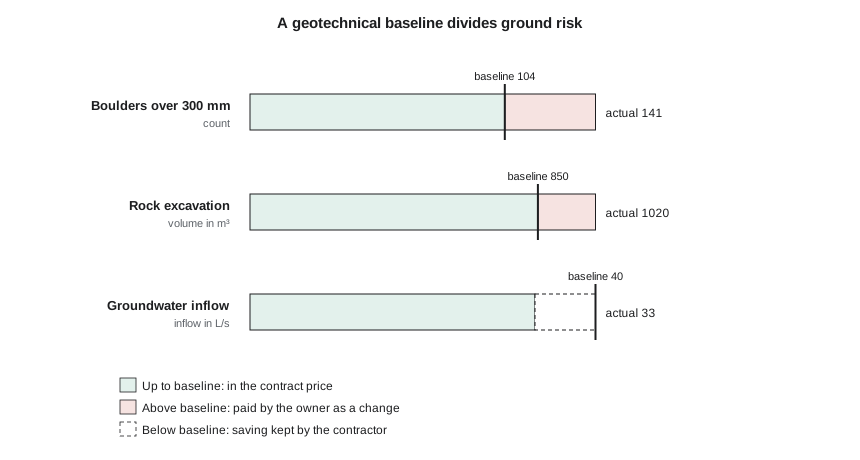
The geotechnical baseline report deserves attention because it turns an argument about what was indicated into a measurement. Instead of saying the soil is 'generally stiff clay with occasional boulders', the baseline says, for example, 'the contractor shall assume 120 boulders larger than 300 mm in the shaft excavation'. If 180 boulders are found, the owner pays for 60; if 90 are found, the contractor keeps the saving. Baselines can be set adversely or favourably, and setting them is itself a risk allocation decision: an adverse baseline raises the bid price but lowers the owner's chance of extra payments.
Worked problem
Paying for boulders against a baseline
A storm sewer contract at Kingfisher Wharf sets a baseline of 40 boulders larger than 300 mm per 100 metres of trench, with a unit rate of $1,850 per boulder above the baseline. The trench is 260 metres long, and 141 boulders are removed. What extra payment is due?
Show solution
- Baseline for the trench: 40 × 260 ÷ 100 = 104 boulders.
- Boulders above baseline: 141 − 104 = 37.
- Extra payment: 37 × 1,850 = $68,450.
Answer: The owner pays $68,450 for the 37 boulders above the baseline; the first 104 were in the contract price.
Contamination is a special case. Many contracts treat hazardous materials separately from ground conditions, with the owner responsible for pre-existing contamination and the contractor responsible for contamination it causes, such as a fuel spill. Environmental law in both countries can make the owner of contaminated land liable regardless of fault, so owners usually prefer to control and pay for contaminated soil handling directly. Kingfisher Wharf's contract includes a unit price, by weight, for contaminated soil disposal, which turns an open-ended risk into a priced quantity risk the owner carries.
Reliance on site information
A related question is whether the contractor can rely on the reports the owner provides. Owners sometimes include the geotechnical report 'for information only' and disclaim its accuracy, hoping to avoid liability if it is wrong. Courts in both countries have often held owners liable where the information was misleading and the contractor reasonably relied on it, especially where the owner knew more than it disclosed. Disclaimers also make bidders less willing to rely on the data, so they add contingency. Many owners now take the opposite approach and make the factual data, such as borehole logs, part of the contract, while keeping interpretations separate.
Delay risk
Delay is usually allocated through the contract's classification of causes. CON-220 lesson 9 covers the law in detail; the risk summary is that the contractor carries delays it causes, the owner carries delays it causes, and neutral events such as unusual weather or strikes are shared, with time granted but no money.
| Category | Typical causes | Time extension? | Money? |
|---|---|---|---|
| Non-excusable | Contractor productivity, subcontractor failures, contractor-supplied material delays | No | No; contractor may owe liquidated damages |
| Excusable, non-compensable | Abnormal weather, labour disputes, some force majeure events | Yes | No |
| Excusable, compensable | Owner changes, late owner information, differing site conditions, owner-caused suspension | Yes | Yes, for time-related costs |
Owners sometimes add a no-damages-for-delay clause, which gives the contractor time but no money even for owner-caused delay. Such clauses shift a large and uncontrollable risk to the contractor. Courts in the United States enforce them in many states but recognize exceptions, for example for delays not contemplated by the parties, delays amounting to abandonment, or delays caused by the owner's bad faith, and several states restrict them by statute on public work. In Canada they are less common in standard practice, and courts read them strictly. From a risk point of view, a contractor facing such a clause should price the owner-caused delay risk explicitly, which is exactly what the owner hoped to avoid.
Worked problem
Pricing owner-caused delay risk under a no-damages clause
Tallgrass estimates its time-related site costs at $42,000 per week. It believes there is a 40 % chance of owner-caused delay averaging six weeks during permitting and design clarifications. If the contract had a no-damages-for-delay clause, what amount should be priced for this risk?
Show solution
- Cost if delay occurs: 6 × 42,000 = $252,000.
- Expected value: 0.40 × 252,000 = $100,800.
Answer: About $100,000 should be priced, plus a premium for the tail. The owner pays for the risk either way, but through the bid price rather than through change orders.
Force majeure and pandemics
Force majeure clauses excuse performance when extraordinary events beyond the parties' control prevent it: war, terrorism, natural disasters, epidemics, government action. The clause decides whether the contractor gets time, money or neither, and whether either party can terminate if the event lasts long enough. The COVID-19 pandemic was a severe test. Contracts that mentioned epidemics or government orders gave contractors time; many did not address the extra costs of distancing, site shutdowns and supply disruptions, leading to negotiation and disputes. Many owners and standard forms have since added explicit pandemic and supply chain wording.
| Drafting choice | Owner-favourable | Balanced | Contractor-favourable |
|---|---|---|---|
| Events covered | Narrow closed list | List plus similar events beyond control | Broad, including supply chain failure |
| Relief | Time only | Time; costs shared or paid for specified events | Time and costs |
| Required notice | Short, strict condition precedent | Prompt notice with details | Give notice when practicable |
| Termination | Owner only | Either party after a prolonged event | Contractor may terminate early |
Insurance interacts with force majeure. Builder's risk insurance (lesson 7) covers physical damage from storms, floods and fire, but not the costs of a pandemic or a government shutdown without physical damage. Delay in start-up coverage can protect an owner's lost revenue after an insured physical loss. A complete picture of how an extraordinary event is handled requires reading the force majeure clause, the delay provisions and the insurance requirements together.
Escalation and price adjustment
Price escalation became a major risk after 2020, when materials such as steel, lumber and copper rose sharply, and again with tariffs on steel and aluminum between Canada and the United States in 2025 and 2026 (CON-330 lesson 8). Under a stipulated price contract the contractor carries escalation unless the contract says otherwise. Owners can share the risk through a price adjustment clause that ties payment for specified materials to a published index.
Here Q is the quantity of the material, P0 the base unit price, I0 the index at the bid date and I1 the index at purchase. Most clauses add a band, often a few per cent either way, within which there is no adjustment, and a cap on the total adjustment. The band keeps small movements with the contractor, and the cap limits the owner's exposure. Clauses work both ways: if the index falls, the owner receives a credit.
Canadian clauses often use Statistics Canada industrial product price indexes for the materials concerned, or published commodity prices for items such as reinforcing steel and diesel fuel.
# Steel price adjustment with a band and a cap (illustrative)
qty_t = 410            # metric tons of structural steel
p0 = 3_250             # $ per metric ton in the bid
i0, i1 = 100.0, 118.4  # index at bid and at purchase
band = 0.05            # no adjustment within +/- 5 %
cap = 250_000          # maximum adjustment either way

change = i1 / i0 - 1
if abs(change) <= band:
    adj = 0.0
else:
    excess = change - band if change > 0 else change + band
    adj = qty_t * p0 * excess
adj = max(-cap, min(cap, adj))
print(f"Index change {change:.1%}; adjustment after band and cap: {adj:,.0f}")
print(f"Contractor carries: {qty_t * p0 * change - adj:,.0f} of the {qty_t * p0 * change:,.0f} increase")Index change 18.4%; adjustment after band and cap: 178,555 Contractor carries: 66,625 of the 245,180 increase
In the example, steel rose 18.4 %. The band leaves the first 5 % with the contractor and the clause pays the rest, so the owner pays about $178,000 and the contractor absorbs about $67,000. Without a clause, the contractor would carry the whole increase of roughly $245,000 and would have priced that risk into the bid.
Change in law
A final allocation question is who carries changes in laws, codes, taxes and tariffs after the bid. Standard forms generally give the contractor relief for changes in law that affect the cost or time of the work, because neither party controls legislation. Owners sometimes exclude tax and tariff changes, or cap relief. With tariffs between Canada and the United States changing several times in 2025 and 2026, contractors increasingly ask for explicit tariff clauses that treat new or increased duties on specified imported materials as a change.
Common mistakes
MistakeDeleting the differing site conditions clause to save money.
InsteadKeep the clause and invest in site investigation; bidders otherwise price the risk.
MistakeProviding site reports 'for information only' with broad disclaimers.
InsteadMake factual data part of the contract and keep interpretations separate.
MistakeAccepting a no-damages-for-delay clause without pricing it.
InsteadPrice the owner-caused delay risk explicitly or seek deletion.
MistakeAssuming builder's risk insurance covers pandemic shutdowns.
InsteadRead force majeure, delay and insurance provisions together; property policies need physical damage.
MistakeWriting an escalation clause without a band or cap.
InsteadUse a band for small movements, a cap for owner exposure and a named index.
Summary and key terms
- Owners can carry ground risk through a differing site conditions clause, transfer it to bidders, or divide it with a geotechnical baseline report.
- Baselines turn disputes about what was indicated into measurements; their level is itself an allocation decision.
- Factual site data that bidders can rely on reduces contingencies and disputes.
- Delay causes are classified as non-excusable, excusable non-compensable and excusable compensable.
- No-damages-for-delay clauses shift owner-caused delay to contractors, who then price it; enforceability varies.
- Force majeure clauses decide time, money and termination for extraordinary events; COVID-19 exposed gaps in older wording.
- Index-based escalation clauses with a band and cap share price risk; change-in-law and tariff clauses address legislative risk.
- Differing site conditions
- Physical conditions that differ materially from those indicated or ordinarily expected.
- Geotechnical baseline report
- A contract document that sets measurable ground condition baselines for risk allocation.
- Baseline
- A stated quantity or condition above which the owner pays and below which the contractor benefits.
- Excusable delay
- A delay for which the contractor is entitled to more time.
- Compensable delay
- An excusable delay for which the contractor is also paid.
- No-damages-for-delay clause
- A clause granting time but no money for delay, even if caused by the owner.
- Force majeure
- Extraordinary events beyond the parties' control that excuse performance.
- Price adjustment clause
- A clause tying payment for specified materials to a published price index.
- Band
- The range of index movement within which no price adjustment is made.
- Change in law
- A change in legislation, codes, taxes or duties after the bid date.
Practice problems
Work each problem on paper first, then reveal the answer to check.
Why is the owner usually best placed to reduce ground risk?
Show answer
It chooses the site, controls the time for investigation and pays for it.
A baseline is 30 boulders per 100 m; a 300 m trench yields 115 boulders at $2,000 each above baseline. What is paid?
Show answer
Baseline 90; 25 extra × 2,000 = $50,000.
What is the difference between Type I and Type II differing site conditions?
Show answer
Type I differ from those indicated in the contract; Type II are unusual conditions differing from those ordinarily encountered.
Name the three categories of delay.
Show answer
Non-excusable, excusable non-compensable, excusable compensable.
Weekly time-related costs are $30,000 and there is a 25 % chance of an 8-week owner delay. What expected value should be priced under a no-damages clause?
Show answer
0.25 × 240,000 = $60,000.
Does builder's risk insurance usually cover a government-ordered shutdown with no physical damage?
Show answer
No; property policies require physical loss or damage.
Give two features of a balanced force majeure clause.
Show answer
Listed events plus similar events beyond control; time with costs shared for specified events; prompt notice; termination after a prolonged event.
An index rises from 100 to 112 with a 5 % band on $500,000 of material. What is the adjustment?
Show answer
Excess 7 % × 500,000 = $35,000.
Why does an escalation clause usually include a cap?
Show answer
To limit the owner's total exposure.
Why have tariff clauses become more common?
Show answer
Tariffs between Canada and the United States changed several times in 2025 and 2026.
Lesson quiz · 5 questions
Score 60% or more to complete this lesson.
Create a free account to save your progress, take quizzes and earn a certificate.