
CIV-331 · Lesson 8 of 12 · 18 min
Beam-columns and combined forces
Few members carry pure axial load or pure bending. A column in a moment frame bends as the frame resists wind; a wall column carries roof load and spans between floors to resist wind on the cladding; a truss top chord carries joist loads between panel points. These are beam-columns. Their design combines the column rules of lesson 4 and the beam rules of lessons 5 and 6 in interaction equations, and it must account for the extra moment that the axial load produces as the member deflects. This lesson develops the interaction checks and applies them to a wall column of the maintenance bay.
Second-order moments
Consider a pinned column with an axial load \(P\) and a uniform lateral load that bends it. The lateral load alone gives a first-order moment \(M_o\) and a deflection \(\delta_o\). With the axial load acting on the deflected shape, each section has an additional moment \(P\delta\), which increases the deflection, which increases the moment again. The process converges to an amplified moment:
This member effect, called \(P\)-\(\delta\), is significant only when \(P\) is a noticeable fraction of the Euler load of the member in the plane of bending. The factor \(C_m\) accounts for the shape of the first-order moment diagram. For a member bent in single curvature by end moments, or by a transverse load, the deflected shape adds to the existing moment where it is largest, and \(C_m\) is close to 1.0. For a member bent in reverse curvature by end moments, the maximum first-order moment is at an end, where the deflection is zero, and the amplification is smaller.
A second effect, \(P\)-\(\Delta\), arises when a whole storey sways: the gravity loads acting on the displaced frame add overturning moment to every column. It belongs to the frame, not to one member, and lesson 11 treats it. A column in a braced frame, such as the wall column in this lesson, has only the \(P\)-\(\delta\) effect.
Interaction of axial load and bending
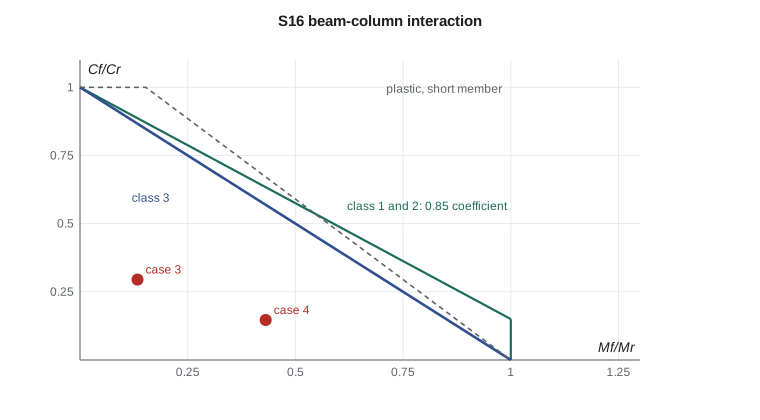
A short member that is fully yielded under axial load and moment together has an interaction curve between \(P/P_y = 1\) and \(M/M_p = 1\). For a W shape bent about its strong axis, that curve is nearly a straight line from \((0, 1)\) to about \((0.15, 1)\) and then down to \((1, 0)\): a small axial load barely reduces the plastic moment, because the web carries the axial force near the neutral axis. For longer members, buckling under axial load and lateral-torsional buckling under bending reduce both end points, and the second-order amplification bends the curve inward.
S16 replaces these curves with linear interaction equations that are checked three times, for three ways the member can fail. For class 1 and 2 I-shaped members:
The three checks use different resistances. (a) Cross-sectional strength uses the squash load \(C_r = \phi AF_y\) and the full moment resistance; it governs short members. (b) Overall member strength uses the compressive resistance for buckling in the plane of bending and the full moment resistance; it governs members that buckle in the plane of bending. (c) Lateral-torsional buckling strength uses the compressive resistance for the governing axis and the lateral-torsional moment resistance \(M_r\) from lesson 6, with \(U_{1x}\) not less than 1.0. For class 3 sections and other members not covered by the 0.85 coefficient, the coefficient on the moment term is 1.0. Each moment term must also satisfy \(M_f \le M_r\) on its own. The factor \(\beta = 0.6 + 0.4\lambda_y \le 0.85\) applies to weak-axis bending.
The amplification factor U1
The factor \(U_1\) amplifies the first-order moment for the \(P\)-\(\delta\) effect. \(C_e = \pi^2EI/L^2\) is the Euler load in the plane of bending. The factor \(\omega_1\) plays the role of \(C_m\): \(\omega_1 = 0.6 - 0.4\kappa \ge 0.4\) for members with end moments only, where \(\kappa\) is the ratio of the smaller to the larger end moment, positive for double curvature; \(\omega_1 = 1.0\) for members with distributed or concentrated transverse loads between supports. In a braced frame, the moments \(M_f\) from a first-order analysis are amplified by \(U_1\) inside the interaction equation.
The maintenance bay wall column
The end-wall columns of the maintenance bay are 6.0 m high, pinned at the base and at the roof, and the roof and wall bracing prevent sway. Each column supports the end reaction of a roof truss, \(D = 69.3\) kN and \(S = 177.3\) kN, and spans vertically between base and roof to resist wind on the wall cladding, delivered by horizontal girts. The columns are 7.5 m apart and the net specified wind pressure is 1.0 kPa, so the wind load is 7.5 kN/m and its moment is \(7.5(6.0)^2/8 = 33.8\) kN·m. The girts at mid-height brace the column about its weak axis, but under wind suction the inner flange is in compression and is unbraced over the full 6.0 m.
Two load cases compete. Case 3, with snow principal and wind companion, gives the largest axial load: \(C_f = 1.25(69.3) + 1.5(177.3) = 353\) kN with \(M_f = 0.4(33.8) = 13.5\) kN·m. Case 4, with wind principal and snow companion, gives the largest moment: \(C_f = 175\) kN with \(M_f = 1.4(33.8) = 47.2\) kN·m. Both are checked, together with 0.9D + 1.4W.
Worked problem
Wall column under snow and wind
Check a W200x46 (\(A = 5860\) mm², \(I_x = 45.5 \times 10^6\) mm⁴, \(S_x = 448 \times 10^3\) mm³, \(r_x = 88.1\) mm, \(r_y = 51.2\) mm, class 3 in bending from lesson 2) for case 4: \(C_f = 175\) kN, \(M_f = 47.2\) kN·m.
Show solution
- Compressive resistances: about x, \(KL/r = 6000/88.1 = 68.1\), \(C_{rx} = 1196\) kN; about y with the girts, \(3000/51.2 = 58.6\), \(C_{ry} = 1342\) kN; squash \(\phi AF_y = 1820\) kN.
- Moment resistances: class 3, so \(\phi M_y = 0.90(448 \times 10^3)(345) = 139\) kN·m. For LTB over 6.0 m with \(\omega_2 = 1.13\), \(M_u = 164\) kN·m and \(M_r = 118\) kN·m.
- Amplification with \(\omega_1 = 1.0\) for the wind load:
- \[C_e = \frac{\pi^2(200\,000)(45.5 \times 10^6)}{6000^2} = 2495\ \text{kN} \qquad U_{1x} = \frac{1.0}{1 - 175/2495} = 1.08\]
- (a) Cross-section: \(175/1820 + 1.08(47.2)/139 = 0.10 + 0.37 = 0.46\)
- (b) Overall member: \(175/1196 + 1.08(47.2)/139 = 0.15 + 0.37 = 0.51\)
- (c) Lateral-torsional buckling: \(175/1196 + 1.08(47.2)/118 = 0.15 + 0.43 = 0.58\)
Answer: Lateral-torsional buckling governs with an interaction value of 0.58 for case 4; case 3 gives 0.43. The W200x46 is adequate.
The program checks all three load combinations, so that no combination is missed when loads change. It also computes the wind deflection.
import math
# Wall column W200x46 (class 3 in bending): axial load from the truss plus wind, CSA S16 clause 13.8
E, G, Fy, phi, n = 200000.0, 77000.0, 345.0, 0.90, 1.34
A, Ix, Sx, Iy, rx, ry, J, Cw = 5860, 45.5e6, 448e3, 15.4e6, 88.1, 51.2, 223e3, 142e9
L, Ly, Lb = 6000.0, 3000.0, 6000.0     # height; weak axis braced by girts; inner flange unbraced

D, S, Wm = 7.7 * 9, 19.7 * 9, 7.5 * 6.0**2 / 8      # truss reactions (kN) and wind moment (kN.m)
cases = {"Case 3: 1.25D + 1.5S + 0.4W": (1.25 * D + 1.5 * S, 0.4 * Wm),
         "Case 4: 1.25D + 1.4W + 0.5S": (1.25 * D + 0.5 * S, 1.4 * Wm),
         "Case 4: 0.9D + 1.4W":         (0.9 * D, 1.4 * Wm)}

def Cr(KL, r):
    lam = KL / r * math.sqrt(Fy / (math.pi**2 * E))
    return phi * A * Fy * (1 + lam**(2 * n))**(-1 / n) / 1e3

My = Sx * Fy / 1e6
Mu = 1.13 * math.pi / Lb * math.sqrt(E * Iy * G * J + (math.pi * E / Lb)**2 * Iy * Cw) / 1e6
Mr_ltb = min(1.15 * phi * My * (1 - 0.28 * My / Mu), phi * My) if Mu > 0.67 * My else phi * Mu
Mr_cs = phi * My
Cr0, Crx, Cry = phi * A * Fy / 1e3, Cr(L, rx), Cr(Ly, ry)
Cr_c = min(Crx, Cry)
Cex = math.pi**2 * E * Ix / L**2 / 1e3
print(f"Cr: section {Cr0:.0f}, x-axis {Crx:.0f}, y-axis {Cry:.0f} kN; Mr: section {Mr_cs:.1f}, LTB {Mr_ltb:.1f} kN.m (Mu = {Mu:.0f}); Cex = {Cex:.0f} kN")

for name, (Cf, Mf) in cases.items():
    U1 = 1.0 / (1 - Cf / Cex)                      # omega1 = 1.0 for the distributed wind load
    a = Cf / Cr0 + U1 * Mf / Mr_cs
    b = Cf / Crx + U1 * Mf / Mr_cs
    c = Cf / Cr_c + max(U1, 1.0) * Mf / Mr_ltb
    print(f"{name}: Cf = {Cf:5.1f} kN, Mf = {Mf:4.1f} kN.m, U1 = {U1:.3f} -> "
          f"(a) {a:.2f}  (b) {b:.2f}  (c) {c:.2f}")

# Wind deflection with the specified wind load (7.5 kN/m)
d = 5 * 7.5 * L**4 / (384 * E * Ix)
print(f"Wind deflection = {d:.1f} mm = L/{L/d:.0f}")Cr: section 1820, x-axis 1196, y-axis 1342 kN; Mr: section 139.1, LTB 117.8 kN.m (Mu = 164); Cex = 2495 kN Case 3: 1.25D + 1.5S + 0.4W: Cf = 352.6 kN, Mf = 13.5 kN.m, U1 = 1.165 -> (a) 0.31 (b) 0.41 (c) 0.43 Case 4: 1.25D + 1.4W + 0.5S: Cf = 175.3 kN, Mf = 47.2 kN.m, U1 = 1.076 -> (a) 0.46 (b) 0.51 (c) 0.58 Case 4: 0.9D + 1.4W: Cf = 62.4 kN, Mf = 47.2 kN.m, U1 = 1.026 -> (a) 0.38 (b) 0.40 (c) 0.46 Wind deflection = 13.9 mm = L/431
The column is used at about 60 per cent of its capacity. A lighter W200 would satisfy strength, but the team kept the W200x46 because it matches the mezzanine columns, simplifies purchasing and keeps the wind deflection small, 14 mm or span/430 under the specified wind, which suits the metal cladding.
Other beam-column cases
- Truss chords with loads between panel points: purlins or joists that bear on the top chord between joints bend it locally. The chord is a beam-column, continuous over the panel points, with the local moment amplified by the chord's axial compression.
- Columns with eccentric beam reactions: a beam bearing on a column cap or a seat at some distance from the column axis applies a moment equal to the reaction times the eccentricity. In simple construction a nominal eccentricity, typically the distance to the face of the column plus 100 mm (4 in.), is taken and split between the column lengths above and below.
- Moment frame columns: the moments come from the frame analysis and include sway effects. Lesson 11 shows how the amplification changes.
- Biaxial bending: corner columns and columns with eccentric loads in both directions add a weak-axis term. The weak-axis moment resistance of a W shape is about 1.5 times \(S_y F_y\) and the weak-axis term often adds noticeably to the interaction.
Tension with bending
Members in tension and bending, such as a truss bottom chord carrying a hoist load between panel points, are checked with \(T_f/T_r + M_f/M_r \le 1.0\), and also for lateral-torsional buckling with the tension allowed to reduce the compression in the critical flange. Tension straightens the member, so no amplification is needed.
Common mistakes
MistakeChecking only the load case with the largest axial load.
InsteadCheck every combination; the largest moment case often governs a wall column.
MistakeUsing \(\omega_1 = 0.6 - 0.4\kappa\) for a member with transverse load.
Instead\(\omega_1 = 1.0\) for transversely loaded members.
MistakeUsing the 0.85 coefficient for a class 3 section.
InsteadThe 0.85 coefficient applies only to class 1 and 2 I-shaped members.
MistakeForgetting that the girts brace only one flange.
InsteadUnder suction the unbraced inner flange is in compression; use the full height for LTB.
Summary and key terms
- Beam-columns combine axial load and bending; the axial load amplifies moments through the \(P\)-\(\delta\) effect.
- S16: \(C_f/C_r + 0.85U_{1x}M_{fx}/M_{rx} + \beta U_{1y}M_{fy}/M_{ry} \le 1.0\) for class 1 and 2 I-shapes, checked for the cross-section, the overall member and LTB; the coefficient is 1.0 for class 3.
- \(U_1 = \omega_1/(1 - C_f/C_e)\), with \(\omega_1 = 1.0\) for transverse loads and \(0.6 - 0.4\kappa \ge 0.4\) for end moments.
- Check all load combinations; for wall columns the wind-principal case often governs.
- The W200x46 wall column has a governing interaction value of 0.58 (LTB, case 4).
- Beam-column
- A member that carries axial load and bending together.
- P-delta effect
- Additional moment from axial load acting on the deflection of a member between its ends (P-δ).
- P-Delta effect
- Additional moment from gravity loads acting on the sway of a storey (P-Δ).
- Amplification factor U1
- U1 = ω1/(1 − Cf/Ce), the factor that magnifies first-order moments in a braced member.
- Equivalent moment factor ω1
- The factor that accounts for the shape of the first-order moment diagram in amplification.
- Single curvature
- Bending of a member so that it is concave on one side along its full length.
- Interaction equation
- An expression that combines the ratios of load effects to resistances for several actions.
- Girt
- A horizontal member that supports wall cladding and spans between columns.
Practice problems
Work each problem on paper first, then reveal the answer to check.
A braced column has end moments of 60 and −30 kN·m bending it in double curvature. Find \(\omega_1\).
Show answer
\(\kappa = +0.5\) for double curvature, so \(\omega_1 = 0.6 - 0.4(0.5) = 0.4\).
For case 3 of the wall column, show that check (c) gives about 0.43.
Show answer
\(U_1 = 1/(1 - 353/2495) = 1.17\); \(353/1196 + 1.17(13.5)/118 = 0.30 + 0.13 = 0.43\).
Why does a small axial load barely reduce the plastic moment of a W shape?
Show answer
The axial force can be carried by a strip of web near the neutral axis, which contributes little to the moment.
Why is no amplification applied to a member in tension and bending?
Show answer
Tension reduces the deflection rather than increasing it.
Lesson quiz · 5 questions
Score 60% or more to complete this lesson.
Create a free account to save your progress, take quizzes and earn a certificate.