
CIV-331 · Lesson 2 of 12 · 21 min
Structural steel: materials, shapes and properties
Every steel calculation rests on a few material properties and a table of section properties. This lesson explains where those numbers come from: how steel is made and graded, what its stress-strain curve looks like, which grades are used for which products, how rolled shapes are named, and how the proportions of a cross-section decide whether it can reach its full plastic strength or will buckle locally first.
From scrap to shapes
Most structural shapes in North America are made in electric arc furnaces that melt steel scrap. The liquid steel is refined, its chemistry adjusted, and it is cast continuously into blooms or beam blanks that are close to the final shape. Hot rolling then squeezes the hot steel through a series of shaped rolls until it reaches the final profile. Plates are rolled flat, and hollow structural sections (HSS) are formed from flat strip and welded along a seam.
Chemistry controls properties. Carbon raises strength but reduces ductility and weldability, so structural steels keep carbon low, around 0.2 per cent or less. Manganese, and small amounts of vanadium, niobium and other elements, raise strength without much loss of ductility. The carbon equivalent, a weighted sum of these elements, tells a welding engineer whether preheat is needed to avoid cracking.
The stress-strain curve
A tension test on a coupon of structural steel gives the curve in the figure. Up to the yield stress the steel is linear elastic with modulus \(E = 200\,000\) MPa. At yield the strain increases at nearly constant stress across a yield plateau that extends to about 10 to 15 times the yield strain. Beyond the plateau the steel strain-hardens to the tensile strength \(F_u\), then necks and fractures at an elongation of 20 per cent or more.
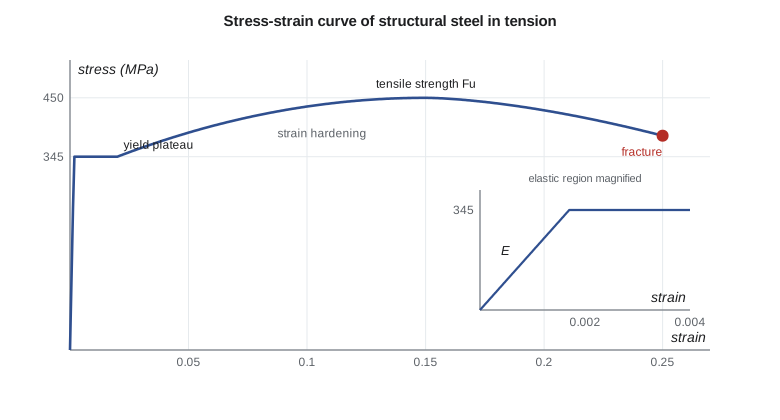
Three things on this curve matter for design. The yield stress \(F_y\) sets the strength of members that fail by yielding or by inelastic buckling. The tensile strength \(F_u\) sets the strength of net sections, bolts and welds that fail by fracture. And the long plateau and strain-hardening give ductility: a steel member can redistribute load and absorb energy long after it first yields. The plastic design of beams in lesson 5 relies on it.
Other properties are nearly the same for all structural steels: shear modulus \(G = 77\,000\) MPa, Poisson's ratio 0.3, coefficient of thermal expansion about \(11.7 \times 10^{-6}\) per °C, and density 7850 kg/m³, which gives a unit weight of 77 kN/m³.
Grades of steel
In Canada, structural steel is specified to CSA G40.21 or to ASTM standards. The grade name gives the minimum yield strength in MPa and a letter for the type: W is weldable, A is atmospheric corrosion-resistant (weathering), and a T suffix adds a notch toughness requirement with a test temperature category. Wide-flange shapes are usually supplied to a dual specification that satisfies both G40.21 345WM and ASTM A992, so this course uses \(F_y = 345\) MPa and \(F_u = 450\) MPa for W shapes and 350W (\(F_y = 350\), \(F_u = 450\) MPa) for angles, plates and HSS.
| Product | Common grade | Fy (MPa) | Fu (MPa) |
|---|---|---|---|
| W shapes | CSA G40.21 345WM / ASTM A992 | 345 | 450 |
| Angles, channels, plates | CSA G40.21 350W or 300W | 350 or 300 | 450 |
| HSS | CSA G40.21 350W class C or H, ASTM A1085 | 350 / 345 | 450 |
| Weathering steel | CSA G40.21 350A | 350 | 480 |
| High-strength bolts | ASTM F3125 grade A325 | — | 825 |
| Weld metal | E49XX electrodes | — | Xu = 490 |
HSS come in two classes in G40.21. Class C is cold-formed and has residual stresses from forming; class H is stress-relieved by heat treatment and has a higher compressive resistance in lesson 4.
Toughness and brittle fracture
A ductile steel can still fracture in a brittle way when three conditions meet: a sharp notch or crack, high tensile stress, and low temperature. Toughness, the ability to resist crack growth, is measured by the Charpy V-notch test, which records the energy absorbed in breaking a small notched bar at a given temperature. Steel becomes less tough as the temperature drops, with a transition from ductile tearing to brittle cleavage.
Most buildings are heated and their steel never sees very low temperatures, but members in unheated buildings, exterior canopies, bridges and members with thick welded plates may need steel with a specified Charpy energy at a low test temperature. In G40.21 these are the T grades, such as 350WT with a category that sets the test temperature. Good detailing matters as much as material: avoid sharp re-entrant corners, intersecting welds and notches in tension zones.
Residual stresses
Hot-rolled shapes cool unevenly. The flange tips and the middle of the web cool first and the flange-web junctions last, and the parts that cool last end up in tension while the parts that cooled first are left in compression. These residual stresses, often 30 per cent of the yield stress at the flange tips, are locked in before any load is applied. They do not change the plastic moment or the yield load of a short member, but they make parts of the section yield early under compression. That early yielding reduces the stiffness of a column and is the reason the column strength curves in lesson 4 fall below the elastic buckling curve at intermediate slenderness.
Rolled shapes and their names
The common shapes are wide-flange W shapes, HP bearing piles, standard S beams, channels C and MC, angles L, tees WT cut from W shapes, HSS (square, rectangular and round) and plate. A W shape is named by its nominal depth in millimetres and its mass in kilograms per metre: a W460x60 is about 460 mm deep and has a mass of 60 kg/m. Canadian W shapes are the same physical sections as the US shapes, so a W460x60 is a W18x40. An angle is named by its leg lengths and thickness: L102x102x9.5. An HSS is named by its outside dimensions and wall: HSS 152x152x9.5.
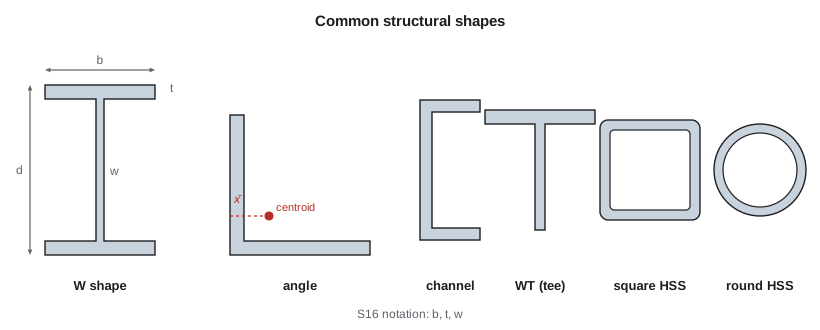
The CISC Handbook tabulates for each shape its dimensions and the properties used in design: area \(A\), moments of inertia \(I_x\) and \(I_y\), elastic and plastic section moduli \(S\) and \(Z\), radii of gyration \(r_x\) and \(r_y\), the St. Venant torsion constant \(J\) and the warping constant \(C_w\). S16 calls the flange width \(b\), flange thickness \(t\) and web thickness \(w\).
The tabulated values include the fillets where the flanges meet the web, so they are slightly larger than values computed from the flange and web plates alone. You can check a table entry, or find properties for a built-up section that is not in the tables, from the plate dimensions.
Elastic and plastic section moduli
When a beam is bent until the extreme fibre reaches the yield stress, the moment is the yield moment \(M_y = S F_y\), where \(S = I/c\) is the elastic section modulus. The beam has more strength in reserve. As the moment increases, yielding spreads inward from the extreme fibres until the whole section has yielded, half in tension and half in compression. That is the plastic moment:
For a doubly symmetric section the plastic neutral axis is at mid-depth. For a W shape bent about its strong axis,
The ratio \(Z/S\) is the shape factor. For W shapes bent about the strong axis it is about 1.10 to 1.18, because most of the material is already in the flanges; for a rectangle it is 1.5 and for bending of a W shape about its weak axis it is about 1.5 or more.
Local buckling and section classes
A wide thin flange or a deep thin web can buckle locally, rippling like a sheet of paper, before the section yields completely. Whether it does depends on the width-to-thickness ratio of each plate element and on whether the element is supported along one edge, like a flange outstand, or both edges, like a web.
S16 sorts cross-sections into four classes. Class 1 sections can reach \(M_p\) and keep rotating, as plastic analysis requires. Class 2 sections can reach \(M_p\) but have limited rotation capacity. Class 3 sections can reach the yield moment \(M_y\) but buckle locally before \(M_p\). Class 4 sections buckle locally before yielding and need special rules. The class of a section is the worst class of its elements, using the limits in the table for flexure. For a flange the element is the outstand, half the flange width, so with \(b\) the full flange width the ratio is \(b/2t\); the table writes it as \(b/t\) of the outstand.
| Element | Class 1 | Class 2 | Class 3 | Value for Fy = 345 MPa (1 / 2 / 3) |
|---|---|---|---|---|
| Flange of a W shape, b/t | 145/√Fy | 170/√Fy | 200/√Fy | 7.8 / 9.2 / 10.8 |
| Web in flexure, h/w | 1100/√Fy | 1700/√Fy | 1900/√Fy | 59 / 92 / 102 |
Nearly all rolled W shapes are class 1 or 2 in bending at 345 MPa. A few have wide, thin flanges and are class 3, and some built-up girders with thin webs are class 3 or 4. In axial compression, a single limit applies: elements at or below the class 3 limit (\(200/\sqrt{F_y}\) for a flange and \(670/\sqrt{F_y}\) for a web) can reach the yield load.
Worked problem
Checking table properties and section class
Owen wants to understand the table entry for the W460x60 he will use for the mezzanine beams (\(d = 455\), \(b = 153\), \(t = 13.3\), \(w = 8.0\) mm). Compute \(A\) and \(Z_x\) from the plates, compare them with the handbook values \(A = 7600\) mm² and \(Z_x = 1280 \times 10^3\) mm³, and classify the section for bending with \(F_y = 345\) MPa.
Show solution
- \[A = 2(153)(13.3) + (455 - 26.6)(8.0) = 4070 + 3427 = 7497\ \text{mm}^2\]
- \[Z_x = 153(13.3)(455 - 13.3) + \frac{8.0(428.4)^2}{4} = 898.8 \times 10^3 + 367.0 \times 10^3 = 1266 \times 10^3\ \text{mm}^3\]
- Both are about 1 per cent below the handbook values, the difference being the fillets.
- \[\frac{b}{2t} = \frac{153}{2(13.3)} = 5.8 < \frac{145}{\sqrt{345}} = 7.8 \qquad \frac{h}{w} = \frac{428.4}{8.0} = 53.5 < \frac{1100}{\sqrt{345}} = 59.2\]
Answer: The computed properties confirm the table, and the W460x60 is class 1, so it can reach \(M_p\). Use the handbook values in design.
Sofia's program repeats the calculation and classifies the four shapes used most in this course. One of them is a surprise.
import math
# Section properties of a W shape from its plate dimensions (fillets ignored)
def props(d, b, t, w):
    hw = d - 2 * t
    A = 2 * b * t + hw * w
    Ix = (b * d**3 - (b - w) * hw**3) / 12
    Zx = b * t * (d - t) + w * hw**2 / 4
    Iy = 2 * t * b**3 / 12 + hw * w**3 / 12
    J = (2 * b * t**3 + hw * w**3) / 3
    Cw = Iy * (d - t)**2 / 4
    return A, Ix, Ix / (d / 2), Zx, Iy, J, Cw

d, b, t, w = 455, 153, 13.3, 8.0          # W460x60
A, Ix, Sx, Zx, Iy, J, Cw = props(d, b, t, w)
print("W460x60 from plates:  A = %.0f mm2, Ix = %.1fe6, Sx = %.0fe3, Zx = %.0fe3 mm3" % (A, Ix/1e6, Sx/1e3, Zx/1e3))
print("            handbook: A = 7600 mm2, Ix = 255e6, Sx = 1120e3, Zx = 1280e3 mm3")
print("Shape factor Zx/Sx = %.2f" % (Zx / Sx))

# Section classes for bending (S16 Table 2), Fy = 345 MPa
Fy = 345
fl = [145 / math.sqrt(Fy), 170 / math.sqrt(Fy), 200 / math.sqrt(Fy)]
wb = [1100 / math.sqrt(Fy), 1700 / math.sqrt(Fy), 1900 / math.sqrt(Fy)]
print("Flange limits b/t: class 1 %.1f, class 2 %.1f, class 3 %.1f" % tuple(fl))
print("Web limits h/w:    class 1 %.1f, class 2 %.1f, class 3 %.1f" % tuple(wb))

def cls(ratio, limits):
    for i, lim in enumerate(limits):
        if ratio <= lim:
            return i + 1
    return 4

shapes = {"W460x60": (455, 153, 13.3, 8.0), "W530x74": (529, 166, 13.6, 9.7),
          "W200x46": (203, 203, 11.0, 7.2), "W310x60": (303, 203, 13.1, 7.5)}
for name, (d, b, t, w) in shapes.items():
    bt = (b / 2) / t
    hw = (d - 2 * t) / w
print(f"{name}: b/t = {bt:4.1f} (class {cls(bt, fl)}), h/w = {hw:4.1f} (class {cls(hw, wb)})")W460x60 from plates: A = 7497 mm2, Ix = 251.0e6, Sx = 1103e3, Zx = 1266e3 mm3
handbook: A = 7600 mm2, Ix = 255e6, Sx = 1120e3, Zx = 1280e3 mm3
Shape factor Zx/Sx = 1.15
Flange limits b/t: class 1 7.8, class 2 9.2, class 3 10.8
Web limits h/w: class 1 59.2, class 2 91.5, class 3 102.3
W460x60: b/t = 5.8 (class 1), h/w = 53.5 (class 1)
W530x74: b/t = 6.1 (class 1), h/w = 51.7 (class 1)
W200x46: b/t = 9.2 (class 3), h/w = 25.1 (class 1)
W310x60: b/t = 7.7 (class 1), h/w = 36.9 (class 1)The W200x46 has a flange ratio of 9.2, just above the class 2 limit, so it is class 3 in bending at 345 MPa and its moment resistance is based on \(S_x\), not \(Z_x\). Lesson 8 uses this shape as a wall column and has to account for it.
Choosing a shape
For beams, the deepest section that fits is usually the lightest for a given moment, because \(Z\) grows with depth. Narrow-flange W shapes such as the W460 and W530 series are efficient beams. For columns, the radius of gyration about the weak axis matters, so nearly square W shapes such as the W200, W250, W310 and W360 column series, and square HSS, are efficient. Angles and tees are used for truss members and bracing, channels for edge members and stair stringers, and HSS where torsion, appearance or closed shapes are wanted.
Availability matters too. Mills roll some sizes often and others rarely, and a fabricator can buy common sizes quickly from service centres. Designers keep to common sizes and repeat them, and they check with a fabricator before choosing an unusual shape.
Common mistakes
MistakeUsing \(F_y = 350\) MPa for W shapes in every calculation.
InsteadW shapes are usually 345WM/A992 with \(F_y = 345\) MPa; check what will be supplied.
MistakeUsing \(S\) where the section can develop \(Z\), or the reverse.
InsteadClass 1 and 2 sections use \(Z\); class 3 sections use \(S\).
MistakeTaking the full flange width as \(b\) in the flange slenderness ratio.
InsteadThe flange outstand is half the flange width.
MistakeIgnoring toughness for an unheated structure with thick welded plates.
InsteadSpecify notch-tough steel and detail to avoid notches where brittle fracture is possible.
Summary and key terms
- Structural steel has \(E = 200\,000\) MPa, a yield plateau and strain hardening to \(F_u\); W shapes are usually 345 MPa yield and 450 MPa tensile strength.
- Yielding limit states use \(F_y\); fracture limit states use \(F_u\).
- Residual stresses from cooling cause early yielding in compression and lower the strength of intermediate columns.
- The plastic moment is \(M_p = ZF_y\); the shape factor \(Z/S\) is about 1.1 to 1.2 for W shapes in strong-axis bending.
- Section class depends on the width-to-thickness ratios of flanges and webs; class 1 and 2 reach \(M_p\), class 3 reaches \(M_y\).
- The W460x60 is class 1; the W200x46 is class 3 because of its flange.
- Yield stress
- The stress at which steel begins to deform plastically, Fy.
- Tensile strength
- The maximum engineering stress reached in a tension test, Fu.
- Yield plateau
- The range of strain over which steel yields at nearly constant stress.
- Charpy V-notch test
- An impact test that measures the energy absorbed in fracturing a notched specimen.
- Residual stress
- Stress locked into a member by uneven cooling or welding before any load is applied.
- Plastic section modulus
- Z, the first moment of the areas above and below the plastic neutral axis.
- Shape factor
- The ratio Z/S of plastic to elastic section modulus.
- Section class
- The S16 category, 1 to 4, that describes how far a section can go before local buckling.
Practice problems
Work each problem on paper first, then reveal the answer to check.
Compute \(M_p\) and \(M_y\) for the W460x60 using the handbook values.
Show answer
\(M_p = 1280 \times 10^3(345) = 442\) kN·m; \(M_y = 1120 \times 10^3(345) = 386\) kN·m.
What is the shape factor of a solid rectangular section?
Show answer
\(Z/S = (bh^2/4)/(bh^2/6) = 1.5\).
A built-up flange is 400 mm wide and 16 mm thick, \(F_y = 350\) MPa. What is its class in bending?
Show answer
\(b/t = 200/16 = 12.5 > 200/\sqrt{350} = 10.7\), so class 4.
Why do residual stresses not change \(M_p\)?
Show answer
They are self-equilibrating; once the whole section has yielded, the stress is \(F_y\) everywhere regardless of the initial pattern.
Lesson quiz · 5 questions
Score 60% or more to complete this lesson.
Create a free account to save your progress, take quizzes and earn a certificate.