
CIV-224 · Lesson 9 of 12 · 22 min
Moving loads: crane wheels and design trucks
Influence lines tell you where to put one load or a uniform load. Real moving loads come in groups: the two wheels of a crane end truck, the axles of a design truck, the bogies of a train. The group moves as a unit, with fixed spacings, so the question becomes where to place the whole group to produce the largest moment or shear. This lesson develops the rules for that placement and applies them to the garage's crane runway beams and to the access road bridge, using the design vehicles specified by the bridge code.
A series of point loads and an influence line
For a quantity with a known influence line, the effect of a group of point loads \(P_i\) at positions where the ordinates are \(\eta_i\) is \(\sum P_i \eta_i\). To maximize it, move the group across the structure and evaluate the sum. Because influence lines for determinate structures are made of straight segments, the maximum always occurs with one of the loads at a peak or kink of the influence line. So you only need to try placing each load in turn at the peak, which turns an infinite search into a handful of trials.
For the moment at a fixed section C of a simple beam, this means placing each load at C in turn and computing \(\sum P_i \eta_i\). A useful test tells you which placement wins without computing them all: moving the group a small distance to the left changes the moment at C by an amount proportional to (load on the left part)/a minus (load on the right part)/b. The maximum occurs when moving a load across C changes the sign of this quantity, which happens when the average load per unit length on each side of C is about the same.
The absolute maximum moment in a simple span
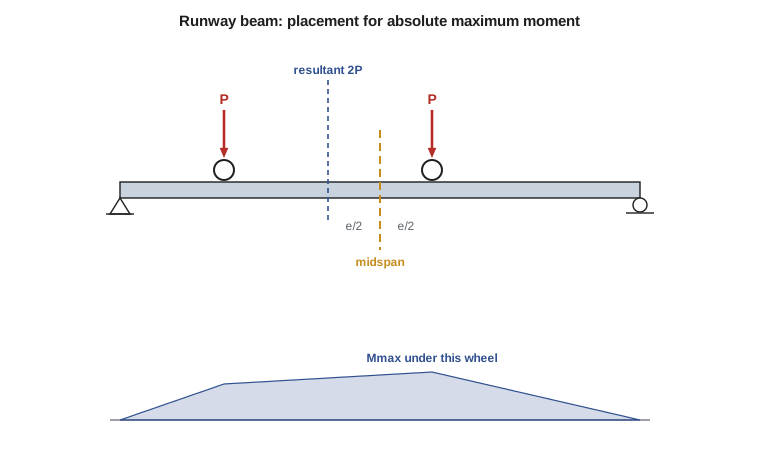
For a beam, the more important question is often the absolute maximum moment: the largest moment anywhere in the span for any position of the group. The moment under a particular load is greatest when that load and the resultant of all the loads on the span are placed equidistant from midspan. The absolute maximum usually occurs under the load nearest the resultant, typically one of the heavier loads, with that load and the resultant symmetric about the centre line.
The rule follows from a short derivation. Let the resultant R of the loads on the span lie a distance e to the right of the load being considered, and let that load be at x from A. The moment under it is \(M = R(L - x - e)x/L - M_{\text{left}}\), where \(M_{\text{left}}\) is the moment of the loads to its left about it, which does not depend on x as long as the same loads stay on the span. Setting \(dM/dx = 0\) gives \(x = (L - e)/2\): the load is \(e/2\) left of midspan and the resultant \(e/2\) right of it.
Crane runway beams
A bridge crane rides on two runway beams, one along each side of the building. Each end truck of the crane has two wheels at a fixed spacing, the wheelbase, and as the crane travels, the wheel pair rolls along the runway beam. The wheel loads depend on the crane's weight, the lifted load and where the trolley is; they are largest on one side when the trolley carrying the hook is pulled all the way over to that side. Codes also require an allowance for impact and for horizontal surge and braking forces.
Worked problem
Maximum moment in a runway beam
The garage's runway beams span 7.5 m between columns, simply supported. Each end truck has two wheels 3.0 m apart, each delivering a factored load of 40 kN including impact. Find the absolute maximum moment and compare it with the moment when the wheels are placed symmetrically about midspan.
Show solution
- The resultant of the two wheels is 80 kN at their midpoint, 1.5 m from each wheel, so \(e = 1.5\ \text{m}\).
- Place one wheel \(e/2 = 0.75\ \text{m}\) to the right of midspan, at 4.5 m from A, and the resultant 0.75 m to the left; the other wheel is then at 1.5 m from A.
- Reaction at B: \(R_B = 40(4.5 + 1.5)/7.5 = 32.0\ \text{kN}\).
- \[M_{\max} = R_B(7.5 - 4.5) = 32.0 \times 3.0 = 96.0\ \text{kN·m}\]
- Symmetric placement (wheels at 2.25 m and 5.25 m): \(R = 40\ \text{kN}\) and \(M = 40 \times 2.25 = 90.0\ \text{kN·m}\) under each wheel.
- One wheel alone at midspan: \(40 \times 7.5/4 = 75.0\ \text{kN·m}\).
Answer: The absolute maximum is 96.0 kN·m under the wheel 0.75 m right of midspan, about 7 per cent more than the symmetric placement. If the wheelbase were long compared with the span (more than about 0.586L), a single wheel at midspan would govern, because the second wheel would then be off the beam or near a support.
Maximum shear
The maximum end shear (the reaction) in a simple span occurs with the heaviest group of loads as close as possible to that support, usually with the leading heavy axle just at the support. Shear at an interior section follows the shear influence line: move the group onto the span from the far end, with a heavy load just to the right of the section, and check whether adding the next load beyond the section increases or decreases the shear. For crane runways, the maximum reaction also gives the vertical load on the column bracket, and the end shear governs the beam's bearing and web design.
Highway design vehicles
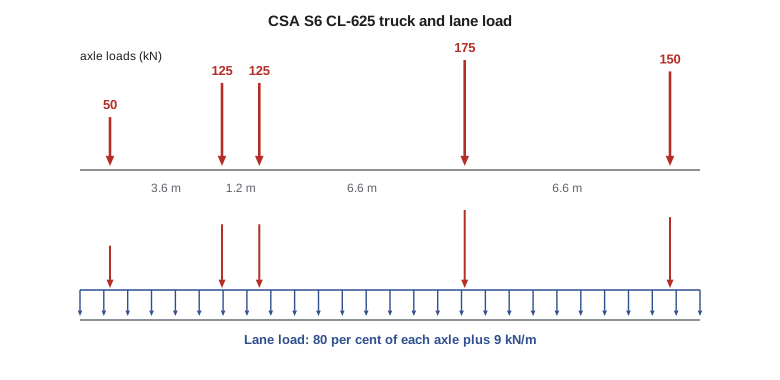
Bridges in Canada are designed to CSA S6, the Canadian Highway Bridge Design Code. Its standard live load is the CL-W truck, where W is the gross weight in kilonewtons; most provinces use W = 625 kN, the CL-625 truck. It has five axles with loads of 50, 125, 125, 175 and 150 kN (8, 20, 20, 28 and 24 per cent of W), spaced 3.6, 1.2, 6.6 and 6.6 m apart, for a total length of 18 m. Ontario specifies a modified version, the CL-625-ONT truck. The code also specifies a lane load consisting of the truck with each axle reduced to 80 per cent, superimposed on a uniform load of 9 kN/m, and the designer uses whichever of the truck or the lane load produces the larger effect.
Dynamic effects are covered by a dynamic load allowance applied to the truck axles but not to the uniform part of the lane load. In CSA S6 its value depends on how many axles are involved: larger when only one or two axles govern a short component, and 0.25 when three or more axles are on the span. Load factors, multiple lane presence and the distribution of load among girders are covered in bridge design courses.
Worked problem
The truck on the access road bridge
For the 20 m access road span, find the maximum moment due to one CL-625 truck, placing the 175 kN axle according to the absolute maximum rule.
Show solution
- The 18 m truck almost fills the 20 m span, so as it moves into a critical position one end axle tends to leave the span. Trials (and the program below) show that the governing case has four axles on the span, 50, 125, 125 and 175 kN, with the 150 kN axle just off, and that the critical axle is the second 125 kN axle.
- Four axles at offsets 0, 3.6, 4.8 and 11.4 m behind the 50 kN axle: \(R = 475\ \text{kN}\), acting \((125 \times 3.6 + 125 \times 4.8 + 175 \times 11.4)/475 = 6.41\ \text{m}\) behind it.
- The critical axle is at 4.8 m, so \(e = 6.41 - 4.8 = 1.61\ \text{m}\). Place it \(e/2 = 0.81\ \text{m}\) short of midspan, at 9.19 m from A, with the resultant at 10.81 m. The other axles are then at 4.39 m (50 kN), 7.99 m (125 kN) and 15.79 m (175 kN); the 150 kN axle would be at 22.39 m, off the span, as assumed.
- Reaction at A: \(R_A = 475(20 - 10.81)/20 = 218.4\ \text{kN}\).
- \[M_{\max} = 218.4(9.19) - 50(9.19 - 4.39) - 125(9.19 - 7.99) = 2007 - 240 - 150 = 1617\ \text{kN·m}\]
Answer: The truck alone produces about 1,620 kN·m; with a dynamic load allowance of 0.25 this becomes about 2,020 kN·m. The lane load gives \(0.8(1617) + 9(20^2)/8 = 1294 + 450 = 1744\ \text{kN·m}\), so the truck governs, before load factors and distribution to girders. Note that the heaviest axle did not govern: multi-axle trucks need careful bookkeeping, which is why the calculation is almost always automated.
Whatever the vehicle, the procedure is the same: identify the influence line, try each heavy axle at the critical point, check whether axles leave or enter the span, and keep the largest result. A spreadsheet or short program removes the bookkeeping errors that make hand calculations of multi-axle trucks error-prone.
Moving a load train by computer
Sofia's program moves the design vehicle across the span in 10 mm steps, in both directions, and records the largest moment under any axle and the largest end reaction. It then combines the truck with the lane load and applies the dynamic allowance.
# Move a train of axles across a simple span and record the worst moment and end shear
L = 20.0
axles = [50.0, 125.0, 125.0, 175.0, 150.0]                     # loads
gaps = [3.6, 1.2, 6.6, 6.6]                       # spacing between consecutive axles
pos = [0.0]
for g in gaps: pos.append(pos[-1] + g)
train = list(zip(pos, axles))     # offsets from the front axle

def effects(front):
    on = [(front - d, P) for d, P in train if 0.0 <= front - d <= L]
    RA = sum(P * (L - x) for x, P in on) / L
    best = 0.0
    for x, _ in on:               # moment peaks under an axle
        m = RA * x - sum(P * (x - xi) for xi, P in on if xi < x)
        best = max(best, m)
    return best, RA

step = 0.01
n = int((L + pos[-1]) / step) + 1
Mmax = max(effects(i * step)[0] for i in range(n))
Vmax = max(effects(i * step)[1] for i in range(n))
# also run the truck reversed, since it may travel either way
train = [(pos[-1] - d, P) for d, P in train]
Mmax = max(Mmax, max(effects(i * step)[0] for i in range(n)))
Vmax = max(Vmax, max(effects(i * step)[1] for i in range(n)))
lane = 9.0
M_lane = 0.8 * Mmax + lane * L ** 2 / 8
V_lane = 0.8 * Vmax + lane * L / 2
print(f"Truck alone: Mmax = {Mmax:.0f} kN*m, end shear = {Vmax:.0f} kN")
print(f"Lane load:   Mmax = {M_lane:.0f} kN*m, end shear = {V_lane:.0f} kN")
print(f"Truck with dynamic allowance {0.25:.2f}: Mmax = {(1 + 0.25) * Mmax:.0f} kN*m")Truck alone: Mmax = 1618 kN*m, end shear = 391 kN Lane load: Mmax = 1744 kN*m, end shear = 403 kN Truck with dynamic allowance 0.25: Mmax = 2022 kN*m
Note that in CSA S6 the lane load contains 80 per cent of the truck, not the full truck, so the program's lane line is the truck effect times 0.8 plus the uniform 9 kN/m. For this span the truck with its dynamic allowance governs over the lane load.
Common mistakes
MistakePlacing the heaviest axle at midspan and stopping.
InsteadPlace the critical axle and the resultant equidistant from midspan, and check the other heavy axles.
MistakeForgetting that axles move off the span as the vehicle shifts.
InsteadRecompute the resultant whenever an axle leaves or enters the span.
MistakeApplying the dynamic load allowance to the uniform lane load.
InsteadIt applies to the truck axles only.
MistakeRunning the truck in only one direction.
InsteadVehicles travel both ways; asymmetric trucks give different results reversed.
Summary and key terms
- For a group of moving loads, the maximum effect occurs with one load at a peak of the influence line; try each heavy load there.
- Absolute maximum moment in a simple span: the critical load and the resultant are equidistant from midspan.
- Maximum end shear: heaviest loads as close as possible to the support.
- Crane runway beams carry pairs of wheel loads with impact, surge and braking forces.
- CSA S6 uses the CL-625 truck (50, 125, 125, 175, 150 kN) and a lane load of 80 per cent of the truck plus 9 kN/m.
- The dynamic load allowance increases the truck axle loads but not the uniform lane load.
- Wheelbase
- The spacing between the wheels of a crane end truck or a vehicle.
- Absolute maximum moment
- The largest moment anywhere in a member for any position of a moving load group.
- Design truck
- A code-specified vehicle used to represent highway live load.
- Lane load
- A code-specified uniform load, sometimes with axles, representing a line of traffic.
- Dynamic load allowance
- An increase in vehicle loads to account for dynamic effects.
- Runway beam
- A beam carrying the wheels of a bridge crane along a building.
- Surge force
- A horizontal force on a crane runway from trolley acceleration and braking.
- Resultant
- The single force equivalent to a group of loads, located at their centroid.
Practice problems
Work each problem on paper first, then reveal the answer to check.
Two wheels of 50 kN each, 2 m apart, cross a 10 m simple span. Find the absolute maximum moment.
Show answer
Wheel at 5.5 m: \(R_B = 50(5.5 + 3.5)/10 = 45\); \(M = 45 \times 4.5 = 202.5\ \text{kN·m}\).
Where should a group of loads be placed for maximum end shear?
Show answer
With the heavy loads as close to that support as possible, usually the leading heavy axle at the support.
Why does the absolute maximum moment not occur at midspan for two equal wheels?
Show answer
The moment under a wheel is maximized when the wheel and the resultant are symmetric about midspan, which puts the wheel off centre.
What is the total weight of the CL-625 truck and its length?
Show answer
625 kN over 18 m.
Is the dynamic load allowance applied to the uniform lane load?
Show answer
No, only to the truck axles.
When might a single wheel at midspan govern over the two-wheel placement?
Show answer
When the wheelbase is long relative to the span, roughly over 0.586L.
Lesson quiz · 5 questions
Score 60% or more to complete this lesson.
Create a free account to save your progress, take quizzes and earn a certificate.