
CIV-224 · Lesson 7 of 12 · 25 min
Cables and arches
Beams carry load by bending, which is inefficient because most of the cross-section works at low stress. Cables and arches do better by changing shape. A cable hangs in whatever shape puts it in pure tension under its loads, and an arch built to the same shape turned upside down is in pure compression. These forms let suspension bridges span more than a kilometre and masonry arches stand for two thousand years. For the operations centre, Priya's team is comparing a cable-supported option and a steel arch option for the pedestrian bridge across the drainage channel, and the comparison needs the methods of this lesson.
Cables: assumptions
A cable is assumed perfectly flexible: it cannot resist bending, shear or compression, only tension along its length. It is also assumed inextensible for finding its shape, although its elastic stretch matters for deflections and for very long spans. Because it has no bending stiffness, a cable under point loads forms straight segments between the loads, and under a distributed load it forms a smooth curve. At every point, the tension acts along the tangent to the cable.
A consequence of these assumptions is that the horizontal component of cable tension, H, is the same everywhere along a cable carrying only vertical loads. Horizontal equilibrium of any piece of the cable requires it. The vertical component varies, and the tension is largest where the cable is steepest, normally at the higher support.
The general cable theorem
For a cable with supports at the same level carrying vertical loads, there is a neat link with beams. Imagine a simply supported beam of the same span carrying the same loads, and let \(M(x)\) be its bending moment. Take moments about a point on the cable at distance x from the left support, for the part of the cable to the left. The vertical reaction is the same as the beam's, and the horizontal tension H acts with a lever arm equal to the sag \(y(x)\) below the chord. Therefore
The cable's sag at every point is proportional to the moment in the equivalent beam. The cable takes the shape of the moment diagram, hung upside down. If you know the sag at one point, H follows at once, and then the sag everywhere else. This is the general cable theorem, and it also holds when the supports are at different levels if the sag is measured from the chord joining them.
Worked problem
A cable with two point loads
A cable spans 12 m between supports A and B at the same level and carries 20 kN at 4 m from A and 30 kN at 8 m from A. The sag at the 30 kN load is 2.0 m. Find H, the sag at the other load and the maximum tension.
Show solution
- Equivalent simple beam reactions: \(R_B = (20 \times 4 + 30 \times 8)/12 = 26.67\ \text{kN}\), \(R_A = 23.33\ \text{kN}\).
- Beam moments: \(M(4) = 23.33 \times 4 = 93.3\ \text{kN·m}\), \(M(8) = 26.67 \times 4 = 106.7\ \text{kN·m}\).
- \[H = \frac{M(8)}{y(8)} = \frac{106.7}{2.0} = 53.3\ \text{kN}\]
- Sag at the first load: \(y(4) = 93.3/53.3 = 1.75\ \text{m}\).
- The steepest segment is next to B, where the vertical component equals \(R_B = 26.67\ \text{kN}\): \(T_{\max} = \sqrt{53.3^2 + 26.67^2} = 59.6\ \text{kN}\).
Answer: H = 53.3 kN, sag 1.75 m at the 20 kN load, maximum tension 59.6 kN in the segment next to B.
Cables under uniform load
A suspension bridge cable carries a deck whose weight is roughly uniform per unit horizontal length. The equivalent beam's moment is the parabola \(M = wx(L - x)/2\), so the cable is a parabola too. With maximum sag h at midspan, the cable theorem gives
Here the maximum tension occurs at the supports, where the vertical component is half the total load. The equation for H shows the key design trade-off: halving the sag doubles the horizontal tension, and with it the force on the anchorages. Shallow cables are elegant but expensive to anchor, which is why suspension bridges typically use sag-to-span ratios of about 1:8 to 1:12.
A cable hanging under its own weight, which is uniform along its length rather than along the horizontal, takes the shape of a catenary. For sag ratios below about 1:10 the difference from a parabola is small, and the parabolic formulas are used for design. The cable's length for a shallow parabola is approximately \(L[1 + \tfrac{8}{3}(h/L)^2]\), which you need when ordering the cable and checking its stretch.
Worked problem
Cable option for the pedestrian bridge
The cable option for the pedestrian bridge hangs a deck from two main cables spanning 30 m with a sag of 3.0 m. Each cable carries a factored load of 6.0 kN/m along the span. Find H, the maximum tension and the cable length.
Show solution
- \[H = \frac{6.0 \times 30^2}{8 \times 3.0} = 225\ \text{kN}\]
- Vertical component at each support: \(6.0 \times 30/2 = 90\ \text{kN}\).
- \[T_{\max} = \sqrt{225^2 + 90^2} = 242\ \text{kN}\]
- Length: \(30[1 + \tfrac{8}{3}(0.1)^2] = 30(1.0267) = 30.8\ \text{m}\).
Answer: Each cable carries 242 kN at its supports, and each anchorage must resist a horizontal pull of 225 kN. Over a short channel crossing, those anchorages in soft ground are a major cost, which counts against the cable option.
Cables have one more weakness: they change shape when the load pattern changes. A cable shaped for uniform load will sag noticeably under a point load. Suspension bridges control this with stiffening girders or trusses at deck level, which share moving loads and distribute them to many hangers.
Arches
Turn the cable upside down and make it rigid, and you have an arch. An arch shaped to match the funicular (the inverted cable shape) for its load carries that load in pure compression, with no bending at all. A parabolic arch is funicular for a load uniform along the span; a catenary arch for its own weight; and a polygonal arch for point loads. Because the arch pushes outward at its supports, it needs abutments or a tie to resist the horizontal thrust. A tied arch, with a tension tie between its feet, delivers only vertical reactions to its supports, which is convenient on poor ground.
Arches are classified by their hinges. A three-hinged arch, with hinges at both supports and the crown, is statically determinate and insensitive to settlement and temperature. A two-hinged arch, with hinges only at the supports, is indeterminate to the first degree. A fixed arch is indeterminate to the third degree but stiffer. Most steel and concrete highway arches are two-hinged or fixed, while three-hinged forms appear in timber and steel buildings.
Three-hinged arches under non-funicular load
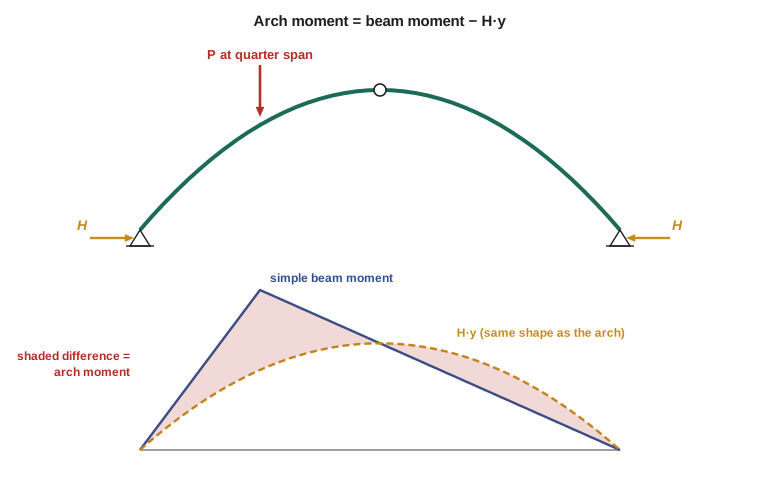
Real arches carry moving loads, so they are never funicular for every load case. Under a load that does not match their shape, arches carry bending as well as compression. For a three-hinged arch, find the reactions as for the three-hinged frame in lesson 3, then compute the moment at any section from the forces on one side. The moment at a point on the arch at height \(y\) above the springing line is the equivalent simple beam's moment minus the thrust times the height:
This is the cable theorem in another form. Where the arch follows the moment diagram, the two terms cancel and the arch is in pure compression. Where they differ, the difference is the bending the arch must carry.
Worked problem
A point load on the arch option
The arch option is a three-hinged parabolic steel arch with span 24 m and rise 6 m. Find the reactions, the thrust and the moment under a 100 kN point load at the quarter point (6 m from A), and compare with a simple beam.
Show solution
- Vertical reactions as for a simple beam: \(A_y = 100(18)/24 = 75\ \text{kN}\), \(B_y = 25\ \text{kN}\).
- Crown hinge, right half: \(25(12) - H(6) = 0\), so \(H = 50\ \text{kN}\).
- Arch height at the load: \(y(6) = 4(6)(6)(18)/24^2 = 4.5\ \text{m}\).
- \[M = M_{\text{beam}} - Hy = 75(6) - 50(4.5) = 450 - 225 = 225\ \text{kN·m}\]
Answer: The arch moment under the load is 225 kN·m, half the simple beam's 450 kN·m. Under a uniform load over the whole span it would be zero. The arch also carries axial compression of the order of the thrust, about 50 to 90 kN along its length.
The thrust line
Engineers since Robert Hooke in the seventeenth century have used the idea of a thrust line: the path of the resultant compressive force through an arch. For a masonry arch, which cannot carry tension, the arch is safe as long as some thrust line for the loads can be drawn within the masonry, ideally within its middle third so that no joint opens. For a steel or concrete arch, the distance between the thrust line and the arch axis is the eccentricity of the compression, and the moment is the thrust times that eccentricity, the same result as the formula above. Choosing an arch shape close to the thrust line for the dominant load keeps bending small and the arch slender.
Computing a cable's shape
Sofia's program uses the cable theorem to find the shape of a cable under any set of vertical point loads once one sag is specified, and the tension in every segment. Changing the input to a single heavy point load shows how much a cable changes shape under non-uniform loads.
import math
L = 12.0
loads = [(4.0, 20.0), (8.0, 30.0)]          # (x from A, load down) in m, kN
x_spec, y_spec = 8.0, 2.0                    # specified sag at one point

RB = sum(P * x for x, P in loads) / L; RA = sum(P for _, P in loads) - RB
def M(x):                                    # equivalent simple beam moment
    return RA * x - sum(P * (x - xp) for xp, P in loads if xp < x)
H = M(x_spec) / y_spec
pts = [0.0] + [x for x, _ in loads] + [L]
print(f"H = {H:.2f} kN")
V = RA
for a, b in zip(pts[:-1], pts[1:]):
    ya, yb = M(a) / H, M(b) / H
    T = math.hypot(H, V)
    print(f"segment {a:4.1f}-{b:4.1f} m: sag {ya:4.2f} to {yb:4.2f} m, tension {T:6.2f} kN")
V -= dict(loads).get(b, 0.0)H = 53.33 kN segment 0.0- 4.0 m: sag 0.00 to 1.75 m, tension 58.21 kN segment 4.0- 8.0 m: sag 1.75 to 2.00 m, tension 53.44 kN segment 8.0-12.0 m: sag 2.00 to 0.00 m, tension 59.63 kN
The output reproduces the hand calculation and shows the tension in each segment. The segment next to B is the steepest and carries the most tension, as predicted.
Choosing between the options
Owen summarizes the comparison for Priya. The cable option is light and slender, but it needs two heavy anchorages for the horizontal pull, and its deck needs stiffening so that a group of people walking to one side does not change the cable shape noticeably. Pedestrian bridges are also sensitive to vibration, and a light, flexible cable structure can respond to the rhythm of footsteps; that check belongs to a later dynamics course but it influences the choice now. The arch option needs abutments for its thrust, or a tie, but carries the deck from below, keeps the structure stiff under moving crowds, and fits the shallow channel banks. Both options carry their dominant load mainly by axial force, which is why either one is lighter than a plain girder of the same span. The team will carry both forward to cost estimates, and the decision will likely turn on the foundations rather than the superstructure, as it so often does.
Common mistakes
MistakeAssuming the cable tension is the same everywhere.
InsteadOnly the horizontal component H is constant; the tension is largest in the steepest segment.
MistakeForgetting that halving the sag doubles the horizontal tension.
Instead\(H = wL^2/(8h)\): shallow cables need large anchorage forces.
MistakeAssuming an arch carries no bending under any load.
InsteadAn arch is bending-free only under its funicular load; other loads produce moments equal to the beam moment minus H times y.
MistakeForgetting the horizontal thrust when designing arch supports.
InsteadProvide abutments or a tie for the thrust.
Summary and key terms
- Cables carry only tension; the horizontal component H is constant under vertical loads.
- General cable theorem: \(H\,y(x) = M(x)\) of the equivalent simple beam.
- Under uniform load a cable is a parabola with \(H = wL^2/(8h)\) and \(T_{\max}\) at the supports.
- An arch shaped to its funicular carries load in pure compression and needs supports for its thrust.
- Three-hinged arches are determinate; arch moment \(= M_{\text{beam}} - H\,y\).
- The thrust line must stay within a masonry arch, ideally in its middle third.
- Cable
- A flexible member that carries only tension along its length.
- Sag
- The vertical distance from a cable to the chord between its supports.
- Funicular shape
- The shape a cable takes under a given load; an arch of this shape has no bending.
- Catenary
- The curve of a uniform cable hanging under its own weight.
- Thrust
- The horizontal reaction at the supports of an arch.
- Tied arch
- An arch whose thrust is resisted by a tension tie between its supports.
- Thrust line
- The path of the resultant compressive force through an arch.
- Rise
- The height of an arch crown above its springing line.
Practice problems
Work each problem on paper first, then reveal the answer to check.
A cable spans 40 m with 4 m sag and carries 5 kN/m. Find H and \(T_{\max}\).
Show answer
\(H = 5(1600)/32 = 250\ \text{kN}\); \(T_{\max} = \sqrt{250^2 + 100^2} = 269\ \text{kN}\).
What happens to H if the sag of a uniformly loaded cable is halved?
Show answer
It doubles.
What shape of arch carries a uniform load per horizontal length without bending?
Show answer
A parabola.
Why is a three-hinged arch unaffected by small support settlements?
Show answer
It is statically determinate, so it can move as a rigid assembly without inducing internal forces.
A beam moment at a section is 300 kN·m, the arch thrust is 60 kN and the arch is 4 m high there. Find the arch moment.
Show answer
\(300 - 60 \times 4 = 60\ \text{kN·m}\).
Why does a tied arch suit sites with poor soil?
Show answer
The tie carries the thrust, so the supports receive only vertical reactions.
Lesson quiz · 5 questions
Score 60% or more to complete this lesson.
Create a free account to save your progress, take quizzes and earn a certificate.