
CISSP-115 · Lesson 7 of 12 · 32 min
Log reviews, monitoring and synthetic transactions
Logs are the memory of an information system. They record who signed in, what changed, which requests failed and when a service slowed down. Without them, an organization cannot investigate an incident, prove compliance or notice that a control has stopped working. With them, but without anyone reviewing them, it has an expensive archive that tells the story only after the damage is done. Sub-domain 6.2 of the outline names log reviews and synthetic transactions as testing activities, and 6.3 treats log data as part of the security process data that management collects.
This lesson covers log review as an assurance activity: what to log, how to protect and retain logs, how to organize reviews so they find problems rather than generate noise, and how synthetic transactions and real user monitoring test whether services and controls behave as users and attackers would experience them. It stays at the level of program design and evidence. Detection engineering and incident response are treated in the security operations material and in ITIL-140 for service monitoring.
Why log review is a control test
Reviewing logs tests controls in two ways. First, it tests whether preventive controls are working: if the access control system is supposed to block logins from disabled accounts, a review that finds successful logins by disabled accounts has found a control failure. Second, log review is itself a detective control that must be tested: auditors ask whether reviews happen as scheduled, whether the reviewer had the skills and independence to spot problems, and whether findings were followed up. A signed checklist saying that logs were reviewed, with no evidence of what was examined, is weak evidence.
| Log source | Example events | What a review can reveal |
|---|---|---|
| Identity provider and directory | Sign-ins, failures, MFA prompts, group changes | Account misuse, password spraying, unauthorized privilege grants |
| Operating systems | Process starts, service changes, local account creation | Unapproved software, persistence, policy changes |
| Network devices and firewalls | Allowed and denied connections, rule changes | Unexpected outbound traffic, rule changes outside change windows |
| Applications | Transactions, permission checks, errors | Business logic abuse, failed authorization checks |
| Cloud control planes | API calls, configuration changes, key use | Public exposure of storage, disabled logging, new access keys |
| Databases | Privileged queries, schema changes, bulk reads | Unusual data access, changes outside approved windows |
| Security tools | Endpoint alerts, scanner results, data loss events | Whether detections fire and are triaged |
Deciding what to log
Logging everything is neither affordable nor useful. A logging standard should start from the risks and controls that matter and define, for each class of system, which events must be recorded. Common baselines include authentication successes and failures, use of privileged accounts, changes to accounts, groups and permissions, changes to security configuration and to the logging itself, access to sensitive data, and errors that indicate attacks or failures. NIST SP 800-92, Guide to Computer Security Log Management, remains the foundational reference, and NIST has published draft and revised guidance on log management planning (SP 800-92 Revision 1 was released in draft in 2023; check its current status).
Each log record should answer the classic questions: what happened, when, where, by whom or by which process, from which source, and with what outcome. Time is critical. If servers disagree about the time by even a few minutes, reconstructing a sequence of events across systems becomes guesswork. Clock synchronization to a trusted time source, and recording time zones or using UTC consistently, are prerequisites for meaningful review.
Protecting log integrity
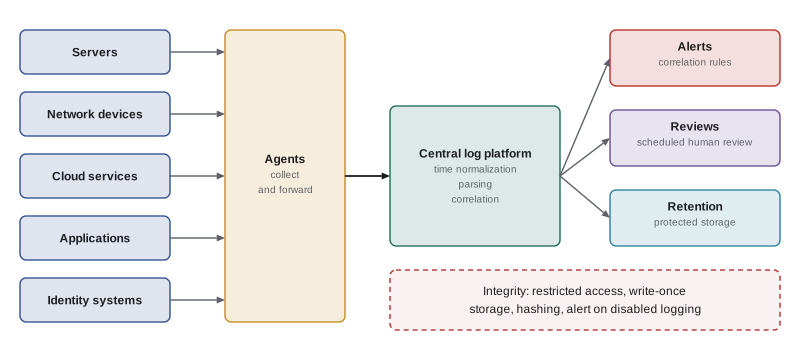
Logs are evidence, and evidence is worthless if it can be altered. An administrator who can delete the record of their own actions defeats the accountability that logging is meant to provide. Good practice separates duties so that system administrators cannot modify central logs, forwards logs promptly off the system that generated them, restricts access to the log platform, stores logs on write-once or immutable storage for the retention period, and monitors for logging being disabled. Hashing log files or using a platform that records integrity information allows tampering to be detected. A sudden gap in a system's logs is itself an event worth investigating.
In Canada, retention periods come from several sources. Federal departments follow Treasury Board policy and the Library and Archives of Canada Act for records; the Canadian Centre for Cyber Security recommends retaining security logs long enough to support investigations, commonly at least a year. Organizations subject to PIPEDA must keep a record of every breach of security safeguards involving personal information for 24 months after determining the breach occurred, which in practice depends on logs. In Quebec, Law 25 requires a confidentiality incident register. Sector regulators such as OSFI expect logging adequate to detect and investigate technology and cyber incidents under Guideline B-13.
Organizing log reviews
Effective reviews are scheduled, scoped and recorded. Scheduled means the frequency matches the risk: privileged activity on critical systems may be reviewed daily through automated alerts and weekly by a person, while lower-risk systems are reviewed monthly. Scoped means each review has a defined question, such as whether any administrator account was used outside approved change windows. Recorded means the reviewer documents what was examined, the time range, what was found and what action followed, so that an auditor can re-perform or at least understand the review.
Automation does the heavy lifting. A security information and event management (SIEM) platform collects and normalizes logs, applies correlation rules and produces alerts and reports. Rules encode the review questions: a disabled account with a successful login, a change to a firewall rule outside the approved window, more than a threshold of failed logins across many accounts from one source. Human reviewers then examine what the rules surface and periodically look at raw data for patterns the rules do not cover.
import re
from collections import Counter
# Synthetic authentication log lines (illustrative format)
log = '''2026-10-12T02:14:03Z INFO auth user=amira src=10.1.4.20 result=success mfa=yes
2026-10-12T02:15:11Z WARN auth user=svc_backup src=203.0.113.9 result=failure mfa=no
2026-10-12T02:15:12Z WARN auth user=svc_backup src=203.0.113.9 result=failure mfa=no
2026-10-12T02:15:14Z WARN auth user=svc_backup src=203.0.113.9 result=failure mfa=no
2026-10-12T02:15:15Z WARN auth user=svc_backup src=203.0.113.9 result=failure mfa=no
2026-10-12T02:15:17Z WARN auth user=svc_backup src=203.0.113.9 result=failure mfa=no
2026-10-12T02:15:19Z INFO auth user=svc_backup src=203.0.113.9 result=success mfa=no
2026-10-12T08:01:44Z INFO auth user=jlee src=10.1.6.31 result=success mfa=yes
2026-10-12T09:30:02Z ERROR auth user=former.contractor src=10.1.9.4 result=success mfa=yes'''
disabled = {'former.contractor'}
pat = re.compile(r'(\S+) (\w+) auth user=(\S+) src=(\S+) result=(\w+) mfa=(\w+)')
fails, findings = Counter(), []
for line in log.splitlines():
    ts, level, user, src, result, mfa = pat.match(line).groups()
    if result == 'failure':
        fails[(user, src)] += 1
    elif result == 'success':
        if fails[(user, src)] >= 5:
            findings.append(f'{ts} success for {user} from {src} after {fails[(user, src)]} failures')
        if user in disabled:
            findings.append(f'{ts} success for disabled account {user}')
        if mfa == 'no' and not src.startswith('10.'):
            findings.append(f'{ts} external sign-in without MFA for {user}')
for f in findings:
print('FINDING', f)FINDING 2026-10-12T02:15:19Z success for svc_backup from 203.0.113.9 after 5 failures FINDING 2026-10-12T02:15:19Z external sign-in without MFA for svc_backup FINDING 2026-10-12T09:30:02Z success for disabled account former.contractor
The three findings illustrate how log review tests other controls. A burst of failures followed by success suggests a password-guessing attempt that succeeded, which tests the lockout and password controls. An external sign-in without multifactor authentication tests the conditional access policy, and here shows a service account exempted from it. A successful sign-in by a disabled account tests the deprovisioning process. Each finding becomes an incident ticket, a control deficiency or both.
Clipping levels and noise
A clipping level is a threshold below which events are recorded but not alerted, because isolated occurrences are normal. Three failed logins in an hour is ordinary; fifty is not. Setting clipping levels is a balance: too low and reviewers drown in alerts and start ignoring them, too high and real attacks pass under the threshold. Clipping levels should be documented, justified by data, reviewed when systems or user behaviour change, and tested by occasionally checking what fell below them.
Worked problem
An unreviewed review
An organization's policy requires weekly review of privileged access logs. The auditor finds 52 signed checklists for the year, each reading "Reviewed, no issues". The SIEM shows that the review dashboard was opened on only 9 occasions. What should the auditor conclude?
Show solution
- The signed checklists are the reviewer's own assertion, which is weak evidence.
- The platform's access records are system-generated and show the dashboard was rarely opened.
- This suggests the reviews were not performed as described on most weeks; it is an operating deficiency.
- Ask for any alternative evidence, such as exported reports, and interview the reviewer about the process.
- Recommend review records that capture the time range examined, the queries run and any follow-up, with periodic supervisory checks.
Answer: The control did not operate as designed on most weeks; signed checklists without evidence of examination do not prove review.
Synthetic transactions and real user monitoring
Logs record what happened. Synthetic transactions test what would happen, on demand, by running scripted actions against a system as a user would: loading a login page, signing in with a test account, adding an item to a cart, checking a balance. Synthetic monitoring runs these scripts on a schedule from different locations and measures availability, response time and correctness. Because the script and its expected results are known, any deviation is meaningful: the page is down, slow, or returns the wrong content.
Synthetic transactions also test security controls. A scheduled script can confirm that a disabled test account is rejected, that an administrative interface is not reachable from the internet, that a page requires authentication, or that a security header is present. These are positive tests of controls that would otherwise be checked only during an annual assessment. Real user monitoring (RUM) complements synthetic monitoring by measuring the experience of actual users through instrumentation in the application, revealing problems that scripted paths miss, but it cannot test what users have not yet done.
| Approach | How it works | Strengths | Limits |
|---|---|---|---|
| Synthetic transactions | Scheduled scripts run known user journeys | Predictable, runs when no users are active, tests controls on demand | Only tests scripted paths; test accounts need protection |
| Real user monitoring | Instrumentation measures actual sessions | Reflects real experience and unexpected paths | No data until users act; privacy considerations |
| Log review | Analysis of recorded events | Evidence of what actually happened | Depends on logging coverage and integrity |
| Misuse case testing | Tests built from how a feature could be abused | Checks that controls stop unwanted behaviour | Requires careful scoping and authorization |
import random
random.seed(2026)
# Synthetic transaction: a login journey checked every 5 minutes for 30 days
checks_per_day = 24 * 12
results = []
for day in range(30):
    for k in range(checks_per_day):
        ok = random.random() > 0.0015          # rare random failures
        if day == 17 and 80 <= k < 104:      # a two-hour outage on day 18
            ok = False
        results.append(ok)
up = sum(results)
avail = up / len(results)
print(f'checks run: {len(results)}  failed: {len(results) - up}')
print(f'measured availability: {avail:.4%}')
for target in (0.999, 0.9995):
    allowed = (1 - target) * 30 * 24 * 60
print(f'target {target:.2%}: allowed downtime in 30 days = {allowed:.1f} min -> {"met" if avail >= target else "missed"}')checks run: 8640 failed: 38 measured availability: 99.5602% target 99.90%: allowed downtime in 30 days = 43.2 min -> missed target 99.95%: allowed downtime in 30 days = 21.6 min -> missed
The calculation shows how synthetic monitoring produces evidence for a service-level commitment. One two-hour outage was enough to miss a 99.9 % target, which allows about 43 minutes of downtime in 30 days. A manager reviewing these results would ask whether the outage was detected promptly, whether the cause was found and whether the commitment, the architecture or both need to change.
Reporting log review results
Log review results feed the reporting covered in lesson 11. Useful measures include the percentage of in-scope systems sending logs to the central platform, the age of the oldest unreviewed high-priority alert, the time from alert to triage, the number of findings by category and the percentage closed within target. Coverage matters as much as volume: a review program that works well for the systems it sees, but sees only 70 % of critical systems, has a 30 % blind spot that belongs in the risk register.
Worked problem
Synthetic tests as control evidence
An organization must show that its customer portal always requires authentication for account pages and that a retired administrative URL is no longer reachable. How can synthetic transactions provide ongoing evidence?
Show solution
- Create a scheduled check that requests account pages without a session and expects a redirect to the login page.
- Create a second check that requests the retired administrative URL from an external location and expects it to be unreachable or return an error.
- Store results centrally with timestamps, and alert if either check returns an unexpected result.
- Review the check definitions periodically and protect the test credentials and scripts as sensitive assets.
Answer: Scheduled negative and positive checks provide continuous, timestamped evidence that the access controls remain in place.
Worked problem
Logging coverage gap
A review of the log platform shows that 140 of 160 critical servers send logs. The 20 missing servers were built from an older template. How should this be reported?
Show solution
- Calculate coverage: 140 of 160 is 87.5 % of critical servers.
- Identify the cause: the older build template lacks the logging agent and configuration.
- Report the gap as a control deficiency with the risk that activity on those servers would go undetected and uninvestigable.
- Recommend deploying the agent, updating the template and adding a monitoring rule that alerts when a critical server stops sending logs.
Answer: Report 87.5 % coverage of critical servers as a deficiency with root cause, risk and a remediation that prevents recurrence.
Common mistakes
MistakeLogging everything and reviewing nothing.
InsteadLog what supports risks and controls, and review it on a risk-based schedule.
MistakeLetting administrators control the logs of their own activity.
InsteadSeparate duties, forward logs centrally and use immutable storage.
MistakeAccepting signed review checklists as proof of review.
InsteadRecord what was examined, the time range, findings and follow-up.
MistakeIgnoring clock synchronization.
InsteadSynchronize clocks to a trusted source and use consistent time zones or UTC.
MistakeSetting clipping levels once and never revisiting them.
InsteadJustify thresholds with data and review them as systems change.
MistakeRelying only on real user monitoring.
InsteadAdd synthetic transactions to test paths and controls even when no users are active.
Summary and key terms
- Log review tests preventive controls and is itself a detective control that must be tested.
- A logging standard defines events to record from the risks and controls that matter, with synchronized time.
- Log integrity depends on separation of duties, central forwarding, restricted access and immutable storage.
- Retention periods come from law, regulation, contracts and investigation needs.
- Effective reviews are scheduled, scoped and recorded; SIEM rules encode review questions.
- Clipping levels balance noise against missed events and need periodic review.
- Synthetic transactions test availability and controls on demand; real user monitoring reflects actual experience.
- Log review
- Examination of recorded events to detect problems and test controls.
- SIEM
- A security information and event management platform that collects, correlates and reports on logs.
- Clipping level
- A threshold below which events are recorded but not alerted.
- Log integrity
- Assurance that logs have not been altered or deleted.
- Immutable storage
- Storage that prevents modification or deletion for a set period.
- Synthetic transaction
- A scripted user action run against a system to test its behaviour.
- Synthetic monitoring
- Scheduled synthetic transactions measuring availability and correctness.
- Real user monitoring
- Measurement of actual users' sessions through application instrumentation.
- Logging coverage
- The proportion of in-scope systems sending required logs centrally.
- Time synchronization
- Aligning system clocks to a trusted source so events can be correlated.
Practice problems
Work each problem on paper first, then reveal the answer to check.
Give two ways log review acts as a control test.
Show answer
It reveals failures of preventive controls and is itself a detective control whose operation can be tested.
Why is clock synchronization important for log review?
Show answer
Events from different systems must be placed in the correct order.
Name three practices that protect log integrity.
Show answer
Separation of duties, central forwarding, restricted access, immutable storage, hashing, monitoring for disabled logging.
What makes a log review record useful to an auditor?
Show answer
It states what was examined, the time range, findings and follow-up.
What is a clipping level?
Show answer
A threshold below which events are recorded but not alerted.
How can a synthetic transaction test a security control?
Show answer
For example by confirming that a disabled test account is rejected or a page requires authentication.
What is a limitation of real user monitoring?
Show answer
It produces no data until real users act and cannot test unused paths.
How much downtime does a 99.9 % monthly availability target allow in 30 days?
Show answer
About 43 minutes.
Why is logging coverage a key metric?
Show answer
Systems that do not send logs are blind spots for detection and investigation.
Which NIST publication is the foundational guide to log management?
Show answer
SP 800-92.
Lesson quiz · 5 questions
Score 60% or more to complete this lesson.
Create a free account to save your progress, take quizzes and earn a certificate.