
CISSP-115 · Lesson 12 of 12 · 29 min
Capstone: building an assessment and testing program
The earlier lessons treated each kind of assessment on its own: strategies, scoping and authorization, vulnerability management, scoring, penetration testing, control testing, log review, software testing, audits, process data and reporting. In practice they must work together as a program, planned over a year, resourced, independent where it needs to be, and producing results that management uses. This capstone builds such a program for an invented organization, then closes with strategies for Domain 6 questions on the exam.
The organization, its numbers and its people are invented for teaching. The regulatory context differs between the two versions of the course, and the figures are illustrative.
The organization
Westbrook Credit Union is an invented credit union based in Manitoba with 240,000 members, 38 branches, 1,100 employees and a growing digital banking platform. It is regulated provincially, holds personal information subject to PIPEDA, processes payment cards through a third-party processor and runs a mix of on-premises systems and cloud services hosted in Canada. Its board's risk committee has asked for an assessment and testing program that gives it confidence in the credit union's security controls and satisfies its regulator, its card processor and its external auditor.
The chief information security officer (CISO) has a team of nine, an internal audit function of four that reports to the board's audit committee, and an operating budget for external assurance. The credit union has never had a structured program: it has commissioned an occasional penetration test, runs a vulnerability scanner with no defined service levels, and collects evidence for audits in a hurry each year.
Step 1: define objectives and requirements
A program starts from what it must achieve. The CISO gathers the requirements that drive assessment work: regulatory expectations, contractual obligations to the card processor (PCI DSS validation), the external auditor's reliance on IT general controls for the financial statement audit, the board's risk appetite statements, and the credit union's own top risks from its risk register, which name ransomware, account takeover of members, third-party failure and insider misuse.
| Driver | What it requires | Assessment activity |
|---|---|---|
| Board risk appetite | Confidence that top risks are controlled | Risk-based testing plan, quarterly reporting |
| Regulator | Evidence of an effective security program and independent testing | Internal audit coverage, annual independent assessment |
| Card processor (PCI DSS) | Annual validation, quarterly scans, annual penetration testing | ASV scans, segmentation and penetration tests, self-assessment or QSA review |
| External financial auditor | Reliable IT general controls over financial systems | Control testing of access, change and operations |
| Top risks | Ransomware, account takeover, third parties, insiders | Recovery exercises, identity testing, vendor assurance reviews, log review |
Step 2: assign roles and protect independence
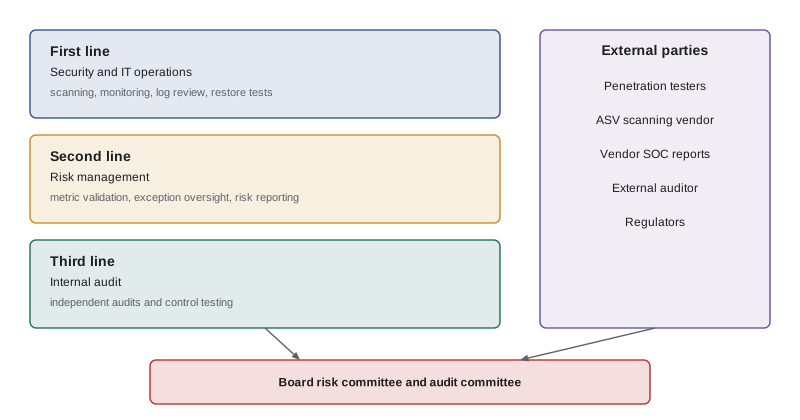
Different activities need different degrees of independence. Day-to-day vulnerability scanning and continuous control monitoring belong to the first line, the security and IT teams that run the controls. Oversight, metric validation and challenge belong to the second line, a risk management function. Independent assurance belongs to the third line, internal audit, and to external parties. The CISO must not commission audits of the CISO's own controls and present them to the board as independent; internal audit or an external firm engaged by the audit committee should perform those.
Step 3: build the annual plan
The annual plan schedules each activity, assigns an owner and links it to its driver. Frequencies follow risk and requirements: continuous for scanning and monitoring, quarterly for external scans and access reviews, annual for penetration tests and major audits, and after significant change for targeted testing. The plan also leaves capacity for unplanned work, such as a test after a major system change or an audit requested by the board after an incident elsewhere in the sector.
| Activity | Frequency | Owner | Independence |
|---|---|---|---|
| Internal vulnerability scanning with SLAs | Continuous, reported monthly | Security operations | First line |
| External ASV scans | Quarterly and after change | Security operations with ASV | External |
| Continuous control monitoring (leavers, MFA, public storage) | Daily | Identity and cloud teams | First line, validated by second line |
| Privileged access reviews | Quarterly | System owners | First line, tested by internal audit |
| Restore tests of critical systems | Quarterly rotation; each system yearly | IT operations | First line, results reviewed by second line |
| External and internal penetration test, including segmentation | Annually and after significant change | External firm engaged by CISO | External |
| Ransomware tabletop and recovery exercise | Annually | Business continuity lead | First line with second-line observation |
| Internal audit of identity and access management | Annually | Internal audit | Third line |
| IT general controls testing for financial systems | Annually | Internal audit and external auditor | Third line and external |
| Critical vendor assurance reviews (SOC reports, questionnaires) | Annually per vendor | Vendor risk team | Second line |
| Phishing simulation and awareness metrics | Quarterly | Security awareness lead | First line |
| Metric validation sample | Semi-annually | Risk management | Second line |
Step 4: budget the external work
External assurance costs money, and the plan must fit the budget. The CISO estimates costs for each external activity from market quotes, adds a contingency and compares the total with the budget. The figures below are illustrative; real prices vary widely by scope, region and provider.
# Illustrative annual budget for external assessment work (CAD or USD; same figures for both versions)
items = {
    'External and internal penetration test incl. segmentation': 85_000,
    'Targeted retest after remediation': 15_000,
    'ASV quarterly external scans (4)': 8_000,
    'Ransomware exercise facilitation': 22_000,
    'Independent assessment of security program': 60_000,
    'Specialist support for internal audit (co-source)': 45_000,
}
subtotal = sum(items.values())
contingency = round(subtotal * 0.15)
total = subtotal + contingency
budget = 260_000
for name, cost in items.items():
    print(f'{name:60s} {cost:>9,}')
print(f'{"Subtotal":60s} {subtotal:>9,}')
print(f'{"Contingency 15% for change-driven testing":60s} {contingency:>9,}')
print(f'{"Total":60s} {total:>9,}')
print(f'Budget {budget:,}: {"within budget" if total <= budget else f"over by {total - budget:,}"}')External and internal penetration test incl. segmentation 85,000 Targeted retest after remediation 15,000 ASV quarterly external scans (4) 8,000 Ransomware exercise facilitation 22,000 Independent assessment of security program 60,000 Specialist support for internal audit (co-source) 45,000 Subtotal 235,000 Contingency 15% for change-driven testing 35,250 Total 270,250 Budget 260,000: over by 10,250
The plan comes in over budget. The CISO's options are to ask the board for more funding with a clear explanation of the risk each item addresses, to rescope (for example, alternating the independent program assessment every second year with an internal audit in between), or to bring some work in-house where independence allows. The decision belongs to the risk committee, and the CISO's job is to present the trade-off clearly rather than quietly drop activities.
Step 5: define the metrics and reports
The program needs a small set of headline indicators for the board and a larger set for management. For Westbrook, the CISO proposes eight board metrics, each with a definition, data source, target and threshold, reported quarterly with four quarters of trend: critical and high vulnerabilities on internet-facing systems remediated within SLA; known exploited vulnerabilities open beyond 14 days; leavers disabled within one business day; privileged accounts with phishing-resistant MFA; critical systems with a successful restore test in the last 12 months; logging coverage of critical systems; open high-risk audit findings past due; and active security exceptions by residual risk.
# Quarterly board scorecard: current value, target and direction (illustrative)
metrics = [
    # name, current, previous, target, higher_is_better
    ('Internet-facing crit/high fixed within SLA (%)', 88, 81, 95, True),
    ('KEV items open beyond 14 days (count)',           3,  7,  0, False),
    ('Leavers disabled within 1 business day (%)',     91, 86, 98, True),
    ('Privileged accounts with phishing-resistant MFA (%)', 74, 52, 100, True),
    ('Critical systems restore-tested in 12 months (%)', 67, 58, 100, True),
    ('Critical systems sending logs centrally (%)',     94, 88, 100, True),
    ('High audit findings past due (count)',            2,  5,  0, False),
    ('Active high-risk exceptions (count)',             4,  4,  2, False),
]
for name, cur, prev, target, up in metrics:
    improving = (cur > prev) if up else (cur < prev)
    trend = 'improving' if improving else ('flat' if cur == prev else 'worsening')
    met = (cur >= target) if up else (cur <= target)
    status = 'on target' if met else 'below target'
print(f'{name:52s} {cur:>4} (prev {prev:>3}, target {target:>3}) {trend:9s} {status}')Internet-facing crit/high fixed within SLA (%) 88 (prev 81, target 95) improving below target KEV items open beyond 14 days (count) 3 (prev 7, target 0) improving below target Leavers disabled within 1 business day (%) 91 (prev 86, target 98) improving below target Privileged accounts with phishing-resistant MFA (%) 74 (prev 52, target 100) improving below target Critical systems restore-tested in 12 months (%) 67 (prev 58, target 100) improving below target Critical systems sending logs centrally (%) 94 (prev 88, target 100) improving below target High audit findings past due (count) 2 (prev 5, target 0) improving below target Active high-risk exceptions (count) 4 (prev 4, target 2) flat below target
The scorecard tells a clear story: every metric but one is improving, none has yet reached its target, and the number of high-risk exceptions has not moved. A board member reading it knows where progress is happening and which item to ask about. Detailed findings, remediation lists and exception registers sit beneath it for management.
Step 6: run, review and improve
Once running, the program needs its own governance. Results from each activity flow into the remediation tracker and the risk register. The second line validates a sample of metrics twice a year. Internal audit periodically audits the assessment program itself: are activities happening as planned, are findings tracked to closure, are exceptions controlled? At year end, the CISO reviews what each activity found and what it cost, and adjusts the next plan: activities that repeatedly find nothing may be reduced in frequency, while areas with recurring findings may need more testing or a different approach.
Worked problem
Adjusting the plan after an incident
Midway through the year, a peer institution suffers a breach through a compromised remote support tool used by a vendor. Westbrook uses the same vendor. How should the assessment program respond?
Show solution
- Treat it as a significant change in threat and use the plan's contingency for an unplanned assessment.
- Commission a targeted review of third-party remote access: which vendors have access, how it is authenticated, monitored and limited, and whether the specific tool is in use.
- Check the vendor's latest assurance report and request a statement about the incident and its controls.
- Report findings to the risk committee promptly, with any urgent actions such as disabling the tool or adding MFA and session recording.
- Add third-party remote access to next year's plan as a recurring test area.
Answer: Use contingency for a targeted third-party access review, act on urgent findings, report to the committee and build the area into future plans.
Worked problem
Choosing who tests what
The CISO proposes that the security team test the effectiveness of privileged access reviews and report the results to the audit committee as independent assurance. What should the audit committee say?
Show solution
- The security team designs and runs the privileged access process, so it is not independent of it.
- First-line self-assessment is useful for management but is not independent assurance.
- Ask internal audit, or an external firm engaged by the committee, to test the control.
- The security team can still monitor the control continuously and report its own metrics, labelled as first-line data.
Answer: Independent assurance must come from internal audit or an external party; the security team's testing is valuable but is first-line self-assessment.
Exam strategy for Domain 6
Domain 6 questions usually describe a situation and ask what to do first, what is best or what is most appropriate. They reward a manager's judgement over a technician's instinct. A few patterns recur.
| If the question is about | Look for answers that | Be wary of answers that |
|---|---|---|
| Starting any test | Obtain written authorization and agree scope and rules of engagement first | Start testing immediately, even with good intent |
| Choosing a test type | Match the method to the stated objective and risk | Pick the most technical or aggressive option by default |
| Evidence | Prefer system-generated evidence, re-performance and complete populations | Rely on inquiry or owner-prepared lists |
| Independence | Use internal audit or external parties for assurance | Have teams audit their own controls |
| Findings | Address root causes and track remediation to closure | Fix symptoms one by one or close items without verification |
| Exceptions | Require compensating controls, the right approver and expiry dates | Grant permanent waivers |
| Reporting | Fit the audience; give boards risk, trends and decisions | Give boards raw technical data |
| Vendor assurance | Check report type, period, scope, carve-outs and customer controls | Accept any certificate or report at face value |
When two answers both seem right, ask which one a manager responsible for risk, accountable to a board and bound by law and ethics would choose. Authorization comes before testing, design before operation, evidence before conclusions, independence for assurance, and risk-based priorities for everything. Read the question for words like first, best, most and least, and for clues about the role you are playing: an auditor, a CISO or a system owner may each have a different correct answer.
This course is independent study material aligned with the CISSP Domain 6 outline in force since 15 April 2024 (checked October 2026). Canadian learners preparing for the exam should also confirm current exam registration details and any accommodations with the testing provider, and may find chapter events of local ISC2 and ISACA communities useful for study groups.
Common mistakes
MistakeBuilding a test plan from tools the team already owns.
InsteadBuild it from requirements, risks and risk appetite, then choose methods.
MistakePresenting first-line self-assessment as independent assurance.
InsteadLabel sources by line and use internal audit or external parties for assurance.
MistakeQuietly dropping activities when the budget is short.
InsteadPresent the trade-offs to the risk committee for a decision.
MistakeLeaving no capacity for unplanned testing.
InsteadKeep contingency for change-driven and threat-driven assessments.
MistakeReporting dozens of metrics to the board.
InsteadReport a small set with targets, trends and decisions needed.
MistakeNever reviewing the program itself.
InsteadAudit the program and adjust frequencies based on results and cost.
Summary and key terms
- An assessment program starts from regulatory, contractual, audit and board requirements and the top risks.
- Responsibilities spread across three lines and external parties, with independence for assurance.
- The annual plan sets frequency, owner and independence for each activity and keeps contingency.
- External work is budgeted with a contingency, and trade-offs go to the risk committee.
- A small board scorecard shows each metric against target with its trend.
- The program is itself reviewed, audited and adjusted each year.
- Domain 6 questions reward authorization first, sound evidence, independence, root causes and audience-appropriate reporting.
- Assessment program
- A planned, resourced set of assessment, testing and audit activities over a period.
- Annual assessment plan
- The schedule of activities with frequencies, owners and drivers for a year.
- Three lines model
- A governance model separating operational management, oversight and independent assurance.
- First line
- The teams that own and operate controls, including self-assessment.
- Second line
- Functions that oversee and challenge risk management, such as risk management.
- Third line
- Independent assurance, usually internal audit.
- Scorecard
- A short set of headline metrics with targets and trends for leaders.
- Contingency
- Reserved budget and capacity for unplanned assessments.
- Change-driven testing
- Testing triggered by a significant change in systems or threats.
- Program review
- Periodic evaluation of whether the assessment program itself is effective.
Practice problems
Work each problem on paper first, then reveal the answer to check.
What should an assessment program be built from?
Show answer
Regulatory, contractual and audit requirements, board risk appetite and the top risks.
Which line provides independent assurance?
Show answer
The third line, usually internal audit, plus external parties.
Why keep contingency in the annual plan?
Show answer
For assessments triggered by significant changes or new threats.
What should the CISO do if the plan exceeds the budget?
Show answer
Present the trade-offs to the risk committee for a decision.
What should each board metric have?
Show answer
A definition, data source, target or threshold and trend.
Why audit the assessment program itself?
Show answer
To confirm activities happen as planned and findings and exceptions are controlled.
What is the first step before any test in an exam scenario?
Show answer
Obtain written authorization and agree scope and rules of engagement.
Which evidence do exam answers usually prefer?
Show answer
System-generated evidence, re-performance and complete populations.
How should a CISO respond when a peer suffers a breach through a shared vendor?
Show answer
Use contingency for a targeted review, act on urgent findings and report to the committee.
What words in exam questions signal judgement about priority?
Show answer
First, best, most and least.
Lesson quiz · 5 questions
Score 60% or more to complete this lesson.
Create a free account to save your progress, take quizzes and earn a certificate.