
CISSP-115 · Lesson 5 of 12 · 31 min
Penetration testing methodology and reporting
A vulnerability scan asks which known weaknesses are present. A penetration test asks a harder question: could a skilled, motivated adversary use the weaknesses in this environment, alone or chained together, to reach something that matters? Penetration testers combine tools with human judgement to explore paths that automated scanners cannot, such as abusing business logic, chaining a minor misconfiguration with a weak password, or moving from a compromised workstation to a database server. The value of a test lies not in the drama of getting in, but in the evidence it produces about which controls failed and which held.
This lesson explains penetration testing at the level a security manager needs: the phases of a test, the recognized methodologies, how to manage testers and risk during the engagement, and how to read and act on the report. It deliberately does not teach attack techniques; those belong in specialist training, under supervision, against systems you are authorized to test.
Vulnerability assessment versus penetration test
The two are often confused, and the exam expects you to distinguish them. A vulnerability assessment identifies, quantifies and ranks weaknesses, mostly through scanning and configuration review, and aims for breadth. A penetration test attempts to exploit weaknesses in a controlled way to demonstrate impact, and aims for depth along realistic attack paths. Assessments are cheaper and can run frequently; penetration tests are more expensive, more intrusive and usually periodic. Penetration tests also validate scanning: if testers find a path through weaknesses the scanner missed, the scanning program needs attention.
| Aspect | Vulnerability assessment | Penetration test |
|---|---|---|
| Goal | Find and rank known weaknesses | Demonstrate whether weaknesses can be exploited to reach objectives |
| Approach | Mostly automated, broad | Manual and tool-assisted, deep |
| Exploitation | No | Yes, controlled and authorized |
| Frequency | Continuous to monthly | Annually and after significant change, or per release |
| Risk to systems | Low to moderate | Moderate; needs safeguards |
| Typical output | List of findings with severity | Narrative of attack paths, evidence and business impact |
The phases of a penetration test
Methodologies differ in names and detail, but nearly all follow the same arc. NIST SP 800-115, Technical Guide to Information Security Testing and Assessment, describes four phases: planning, discovery, attack and reporting. The Penetration Testing Execution Standard (PTES) uses seven: pre-engagement interactions, intelligence gathering, threat modelling, vulnerability analysis, exploitation, post-exploitation and reporting. The Open Source Security Testing Methodology Manual (OSSTMM) emphasizes measurable operational security across channels, including human, physical, wireless and data networks. For web applications, the OWASP Web Security Testing Guide is the usual reference.
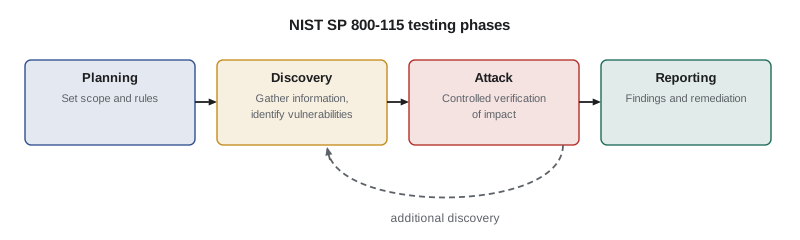
Planning, covered in lesson 2, sets objectives, scope, rules of engagement and authorization. Discovery has two parts: gathering information about the target, from public sources (open-source intelligence such as job postings, domain records and leaked credential lists) and from active probing within scope, then analysing that information for potential vulnerabilities. Attack is where testers attempt to verify vulnerabilities by exploiting them in a controlled way: gaining access, escalating privileges, moving to other systems and demonstrating access to agreed objectives such as a test record in a customer database. Each success typically reveals new information, which feeds further discovery; NIST draws this as a loop. Reporting documents what was found, how, what it means and how to fix it.
Professional testers stop short of real harm. They prove that data could be read rather than exfiltrating it, demonstrate that a change could be made by creating a harmless marker file rather than altering records, and avoid techniques that could disrupt availability unless explicitly authorized. At the end of the attack phase they clean up: remove accounts, files and tools they introduced and report anything they could not remove. A clean-up log is part of a professional deliverable.
Managing the engagement
The security manager's role during a test is oversight. Daily or regular check-ins keep both sides informed; testers report critical findings immediately under the rules of engagement; the operations team watches for unintended impact; and the manager decides quickly on scope questions that arise. If testers discover evidence that a real attacker is already present, testing pauses and the incident response plan takes over. Activity logs from the testers, with timestamps and source addresses, let defenders separate test activity from genuine attacks during and after the engagement.
Worked problem
A test that touches production
During an approved internal test, testers gain administrator access to a domain controller far earlier than expected and ask whether they may use it to reach the finance database, which is in scope. The finance team is in the middle of quarter-end close. What should the manager decide?
Show solution
- The access is a critical finding; it should be reported now, not saved for the report, so remediation can start.
- The finance database is in scope, but the rules of engagement and the business calendar matter: quarter-end is a period when disruption is unacceptable.
- Agree a safe demonstration, such as reading a single non-sensitive record count after hours, or defer that objective until after close with a written note.
- Ensure the testers record exactly what they did with the administrator access and clean up afterwards.
Answer: Treat the domain compromise as an immediate critical finding, and permit only a minimal, scheduled demonstration against finance that respects the business calendar.
Rating findings
Findings in a penetration test report are rated by risk, combining how likely exploitation is (given what the testers needed: skill, access, time) with the business impact if it occurred. Many reports use a likelihood-impact matrix, and also include CVSS scores for individual vulnerabilities. The most valuable findings are often attack paths rather than single flaws: a medium-rated weakness in password policy plus a medium-rated lack of segmentation may together produce a critical path to sensitive data. Good reports show these chains explicitly, often as diagrams.
# Rating findings with a 5x5 likelihood x impact matrix (illustrative scale)
LEVELS = {1: 'very low', 2: 'low', 3: 'medium', 4: 'high', 5: 'very high'}
def rating(likelihood, impact):
    s = likelihood * impact
    return 'Critical' if s >= 20 else 'High' if s >= 12 else 'Medium' if s >= 6 else 'Low'
findings = [
    ('Default password on building management console', 4, 4),
    ('Verbose error messages reveal software versions', 4, 1),
    ('Flat network: workstations reach database servers', 3, 5),
    ('Weak password policy allowed guessing of a service account', 4, 5),
    ('Missing security headers on marketing site', 2, 1),
]
for name, l, i in sorted(findings, key=lambda f: -f[1] * f[2]):
print(f'{rating(l, i):8s} L={l} I={i} score={l*i:2d} {name}')Critical L=4 I=5 score=20 Weak password policy allowed guessing of a service account High L=4 I=4 score=16 Default password on building management console High L=3 I=5 score=15 Flat network: workstations reach database servers Low L=4 I=1 score= 4 Verbose error messages reveal software versions Low L=2 I=1 score= 2 Missing security headers on marketing site
Look at how the two highest-rated findings in the output are not exotic. Weak passwords and a flat network are among the most common contributors to successful internal tests year after year. That is a key lesson for managers: penetration tests often confirm that basic controls, consistently applied, matter more than advanced ones.
Reading and acting on the report
A good penetration test report has two audiences. The executive summary, usually two pages or less, tells leaders in plain language what the testers set out to do, what they achieved, the overall risk, the most important themes and the strategic recommendations, without jargon. The technical section gives each finding a title, risk rating, affected assets, a description of the weakness, evidence (screenshots, request and response extracts with sensitive data redacted), the steps that demonstrate it at a level sufficient for remediation and retesting, and specific remediation advice with references. It also records scope, methodology, limitations, dates, tester names and the clean-up log.
| Report section | Purpose | Main reader |
|---|---|---|
| Executive summary | Overall risk, key themes, strategic actions | Executives, board, audit committee |
| Scope and methodology | What was tested, how, and what was not | Managers, auditors |
| Attack narrative | How objectives were reached, step by step | Security team |
| Detailed findings | Evidence, rating, remediation per issue | System owners, engineers |
| Limitations and clean-up | Constraints and artefacts removed or left | Security team, auditors |
| Appendices | Tool output, test accounts, references | Engineers |
After delivery, the organization owns the work. Each finding becomes a tracked remediation item with an owner and due date, prioritized as in lesson 4. Systemic themes, such as weak credential management, become improvement projects rather than one-off fixes. A retest, ideally by the same testers, verifies that fixes work and that no new path has opened. The report itself is sensitive: it is a map of how to break into the organization, so it should be classified, distributed on a need-to-know basis and stored securely. Sharing reports with customers or auditors usually happens through a summary letter of attestation rather than the full document.
Worked problem
Turning findings into themes
A test report lists 28 findings: 9 relate to missing patches on different servers, 7 to weak or reused passwords, 5 to excessive network access between segments and the rest are miscellaneous. How should the security manager present the results to the executive team?
Show solution
- Group findings into themes: patch management, credential management and network segmentation.
- Explain each theme as a control weakness with business impact, for example that reused passwords let testers move from one compromised laptop to the finance system.
- Propose program-level fixes with owners and budgets: an improved patch SLA and tooling, a password manager and multifactor rollout, and a segmentation project.
- Report progress against those themes in later quarters, with the retest as evidence.
Answer: Present three control themes with business impact and program-level remediation, not a list of 28 technical items.
Worked problem
Choosing a test type for an objective
A company wants to know whether a stolen employee laptop could give an attacker access to customer data. What kind of test should it commission?
Show solution
- The scenario starts with an authenticated insider position, so a grey-box internal test fits better than a black-box external test.
- Provide testers with a standard employee laptop build and a normal user account, as an attacker who stole it might have.
- Set the objective as demonstrating access to a test record in the customer database, with the rules of engagement limiting impact.
- Include detection objectives: did the security operations centre notice the activity?
Answer: A grey-box internal penetration test from a standard laptop and user account, with access and detection objectives.
Worked problem
Evaluating a cheap test
A vendor offers a "penetration test" for a tenth of other quotes. The sample report is 140 pages of scanner output with no attack narrative. What should the manager conclude?
Show solution
- The deliverable is a vulnerability scan, not a penetration test: there is no exploitation, chaining or narrative.
- It may still have value as a scan, but it will not answer the question of whether objectives can be reached.
- Ask for tester qualifications, methodology and a sample report with an executive summary and attack paths.
- Compare offers on scope, method and deliverable, not on price or page count.
Answer: The offer is a scan relabelled as a penetration test; evaluate vendors on methodology, skills and report quality.
Common mistakes
MistakeCalling an automated scan a penetration test.
InsteadReserve the term for authorized, manual exploitation that demonstrates attack paths and impact.
MistakeLetting testers exfiltrate real data to prove access.
InsteadProve access with minimal, agreed evidence and protect anything handled.
MistakeSaving critical findings for the final report.
InsteadReport critical findings immediately under the rules of engagement.
MistakeFixing findings one by one without looking for themes.
InsteadGroup findings into control weaknesses and address root causes.
MistakeDistributing the full report widely.
InsteadClassify the report, limit distribution and share attestation letters externally.
MistakeSkipping the retest.
InsteadRetest to verify fixes and confirm no new paths opened.
Summary and key terms
- Vulnerability assessments find weaknesses broadly; penetration tests exploit them to show impact.
- NIST SP 800-115 phases are planning, discovery, attack and reporting, with a discovery-attack loop.
- PTES, OSSTMM and the OWASP Web Security Testing Guide are other recognized methodologies.
- Testers prove impact minimally, avoid harm and clean up what they introduce.
- Findings are rated by likelihood and impact; attack chains often matter more than single flaws.
- Reports need an executive summary and detailed, evidenced findings with remediation.
- Track remediation, address themes, retest and protect the report as sensitive information.
- Penetration test
- An authorized, controlled attempt to exploit weaknesses to demonstrate attack paths and impact.
- Vulnerability assessment
- Identification and ranking of weaknesses without exploitation.
- Discovery phase
- Information gathering and vulnerability analysis in a penetration test.
- Attack phase
- Controlled exploitation to verify vulnerabilities and reach objectives.
- Open-source intelligence
- Information gathered from public sources about a target.
- Privilege escalation
- Gaining higher permissions than initially obtained.
- Lateral movement
- Moving from one compromised system to others in the environment.
- Attack path
- A chain of weaknesses that together allow an objective to be reached.
- Retest
- A follow-up test to verify that remediation worked.
- Letter of attestation
- A short summary confirming that a test was performed, shared instead of the full report.
Practice problems
Work each problem on paper first, then reveal the answer to check.
What are the four NIST SP 800-115 phases?
Show answer
Planning, discovery, attack and reporting.
Why does NIST draw a loop between discovery and attack?
Show answer
Access gained during attack reveals new information for further discovery.
Name three penetration testing methodologies.
Show answer
Any three of NIST SP 800-115, PTES, OSSTMM, OWASP Web Security Testing Guide.
How should a tester prove they could alter records?
Show answer
By creating a harmless, agreed marker rather than changing real data.
What belongs in an executive summary?
Show answer
Objectives, outcomes, overall risk, key themes and strategic actions in plain language.
Why are attack chains important in reports?
Show answer
Several moderate weaknesses together can create a critical path.
What should happen if testers find signs of a real attacker?
Show answer
Pause testing and invoke the incident response plan.
Why classify the penetration test report?
Show answer
It describes how to compromise the organization.
What does a clean-up log record?
Show answer
Accounts, files and tools introduced during testing and whether they were removed.
What verifies that remediation worked?
Show answer
A retest, ideally by the same testers.
Lesson quiz · 5 questions
Score 60% or more to complete this lesson.
Create a free account to save your progress, take quizzes and earn a certificate.