
CISSP-115 · Lesson 4 of 12 · 30 min
Vulnerability scoring and prioritization: CVSS, EPSS and KEV
A large organization's scans can report tens of thousands of open findings at any moment. No team can fix them all at once, and trying to fix them strictly in order of severity score wastes effort on flaws that are never exploited while real threats wait in the queue. Prioritization is the stage of vulnerability management where most of the risk reduction is won or lost. This lesson explains the main scoring systems, what each actually measures, and how to combine them with asset context into a defensible remediation order.
The three widely used public signals answer different questions. The Common Vulnerability Scoring System (CVSS) measures how severe a vulnerability is in technical terms. The Exploit Prediction Scoring System (EPSS) estimates how likely it is to be exploited soon. The Known Exploited Vulnerabilities (KEV) catalog records that it has been exploited in the wild. None of them knows how important the affected system is to your organization; that context has to come from you.
CVSS: severity, not risk
CVSS is maintained by FIRST, the Forum of Incident Response and Security Teams. Version 3.1, published in 2019, remains very widely used; version 4.0 was published in November 2023 and is being adopted by vulnerability databases and vendors, so you will see both. A CVSS base score from 0.0 to 10.0 describes the intrinsic characteristics of a vulnerability, and is mapped to qualitative ratings: none (0.0), low (0.1 to 3.9), medium (4.0 to 6.9), high (7.0 to 8.9) and critical (9.0 to 10.0).
The FIRST specification is explicit that the base score measures severity, not risk. A 9.8 on an isolated test server may matter less than a 6.5 on a payment system exposed to the internet. CVSS 3.1 provides temporal and environmental metric groups to adjust the base score for exploit maturity and for your own environment, but few organizations use them consistently.
| CVSS 3.1 base metric | Values (weight) | Meaning |
|---|---|---|
| Attack vector (AV) | Network 0.85, Adjacent 0.62, Local 0.55, Physical 0.20 | How remote the attacker can be |
| Attack complexity (AC) | Low 0.77, High 0.44 | Conditions beyond the attacker's control |
| Privileges required (PR) | None 0.85, Low 0.62 (0.68 if scope changed), High 0.27 (0.50) | Access needed before attacking |
| User interaction (UI) | None 0.85, Required 0.62 | Whether a victim must act |
| Scope (S) | Unchanged or Changed | Whether impact reaches other components |
| Confidentiality, integrity, availability (C, I, A) | High 0.56, Low 0.22, None 0 | Impact on the vulnerable component |
The base score is computed from these weights. First the impact sub-score combines the three impacts, then an exploitability sub-score multiplies the four exploitability weights, and finally they are added and rounded up to one decimal place. The formulas below are from the FIRST CVSS v3.1 specification.
If impact is zero or less the base score is 0. Otherwise, for unchanged scope the base score is the impact plus exploitability, capped at 10 and rounded up; for changed scope the sum is multiplied by 1.08 before capping and rounding. The specification defines a precise round-up function to avoid floating-point surprises, which the code below follows.
import math
W = {'AV': {'N': 0.85, 'A': 0.62, 'L': 0.55, 'P': 0.20}, 'AC': {'L': 0.77, 'H': 0.44},
     'UI': {'N': 0.85, 'R': 0.62}, 'CIA': {'H': 0.56, 'L': 0.22, 'N': 0.0}}
def pr(v, changed):
    return {'N': 0.85, 'L': 0.68 if changed else 0.62, 'H': 0.50 if changed else 0.27}[v]
def roundup(x):
    i = round(x * 100000)
    return i / 100000.0 if i % 10000 == 0 else (math.floor(i / 10000) + 1) / 10.0
def base(vector):
    m = dict(p.split(':') for p in vector.split('/')[1:])
    ch = m['S'] == 'C'
    iss = 1 - (1 - W['CIA'][m['C']]) * (1 - W['CIA'][m['I']]) * (1 - W['CIA'][m['A']])
    imp = 7.52 * (iss - 0.029) - 3.25 * (iss - 0.02) ** 15 if ch else 6.42 * iss
    exp = 8.22 * W['AV'][m['AV']] * W['AC'][m['AC']] * pr(m['PR'], ch) * W['UI'][m['UI']]
    if imp <= 0:
        return 0.0
    return roundup(min(1.08 * (imp + exp), 10)) if ch else roundup(min(imp + exp, 10))
def rating(s):
    return 'None' if s == 0 else 'Low' if s < 4 else 'Medium' if s < 7 else 'High' if s < 9 else 'Critical'
for v in ['CVSS:3.1/AV:N/AC:L/PR:N/UI:N/S:U/C:H/I:H/A:H',
          'CVSS:3.1/AV:N/AC:L/PR:N/UI:R/S:C/C:L/I:L/A:N',
          'CVSS:3.1/AV:L/AC:L/PR:L/UI:N/S:U/C:H/I:H/A:H',
          'CVSS:3.1/AV:N/AC:H/PR:N/UI:N/S:U/C:H/I:N/A:N',
          'CVSS:3.1/AV:P/AC:L/PR:N/UI:N/S:U/C:H/I:N/A:N']:
    s = base(v)
print(f'{v:46s} {s:4.1f} {rating(s)}')CVSS:3.1/AV:N/AC:L/PR:N/UI:N/S:U/C:H/I:H/A:H 9.8 Critical CVSS:3.1/AV:N/AC:L/PR:N/UI:R/S:C/C:L/I:L/A:N 6.1 Medium CVSS:3.1/AV:L/AC:L/PR:L/UI:N/S:U/C:H/I:H/A:H 7.8 High CVSS:3.1/AV:N/AC:H/PR:N/UI:N/S:U/C:H/I:N/A:N 5.9 Medium CVSS:3.1/AV:P/AC:L/PR:N/UI:N/S:U/C:H/I:N/A:N 4.6 Medium
The first vector, a network-reachable flaw needing no privileges or interaction with high impact on all three properties, scores 9.8, the familiar score of many remote code execution flaws. The second, a typical reflected cross-site scripting pattern with changed scope, scores 6.1. The physical-access example scores much lower even though its confidentiality impact is high. Reading the vector string, not just the number, tells you why a score is what it is.
CVSS 4.0 in brief
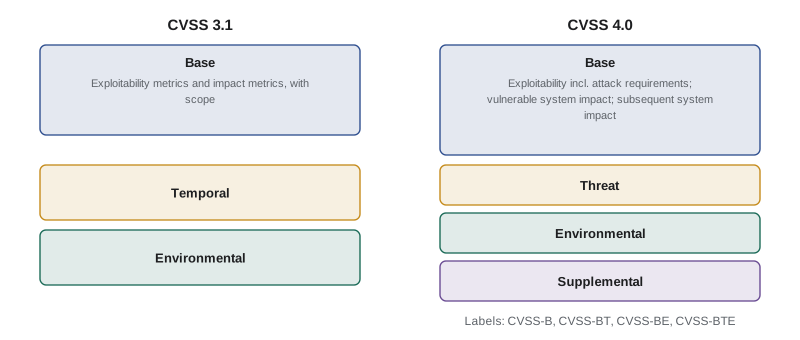
CVSS 4.0 keeps the 0 to 10 scale and qualitative bands but changes the metrics and the calculation. It adds an attack requirements metric (AT) alongside attack complexity, splits user interaction into none, passive and active, and replaces scope with separate impact metrics for the vulnerable system (VC, VI, VA) and subsequent systems (SC, SI, SA). Scores are produced from a lookup of 'macrovectors' derived from expert ranking rather than a closed formula, so use the official calculator. Version 4.0 also renames the metric groups, with the threat group (exploit maturity) replacing temporal, and requires labels showing which groups were used: CVSS-B for base only, CVSS-BT with threat, CVSS-BE with environmental and CVSS-BTE with all three. The labels are a useful reminder that a bare base score omits threat and environment.
EPSS: probability of exploitation
EPSS, also run by a FIRST special interest group, estimates the probability that a published CVE will be exploited in the wild in the next 30 days. It is a machine learning model trained on observed exploitation activity and features such as the vulnerability's description, references, availability of exploit code and vendor. Scores range from 0 to 1 and are published daily for every CVE along with a percentile. Version 4 of the model was released in March 2025. EPSS scores move as new evidence appears, so they should be refreshed regularly rather than recorded once.
The striking finding behind EPSS is how few vulnerabilities are ever exploited: most have a very low probability, and a small fraction account for nearly all observed exploitation. Prioritizing by CVSS alone therefore spends most effort on vulnerabilities that will never be used against anyone. EPSS is not a measure of severity or of your exposure; a high EPSS score on a system with no network path to attackers is still lower risk than the same flaw on an exposed server.
KEV: known exploitation
CISA's Known Exploited Vulnerabilities catalog, started in November 2021, lists CVEs with reliable evidence of exploitation in the wild, a clear remediation action and an assigned CVE identifier. It has grown to well over a thousand entries. For United States federal civilian agencies, Binding Operational Directive 22-01 makes listed vulnerabilities mandatory to remediate by stated due dates. Many private organizations in both Canada and the United States treat KEV listing as an automatic top-priority trigger, because it removes guesswork: the flaw is being used. Some vendors and national centres, including the Canadian Centre for Cyber Security through its alerts, publish similar exploitation signals.
| Signal | Question answered | Source | Limitation |
|---|---|---|---|
| CVSS base | How bad could exploitation be technically? | FIRST specification, scored by vendors and databases | Ignores likelihood and your context |
| EPSS | How likely is exploitation in the next 30 days? | FIRST EPSS model, daily | Probability, not impact; changes over time |
| KEV | Has it been exploited in the wild? | CISA catalog | Lagging; absence does not mean safe |
| Asset context | How important and exposed is this system? | Your inventory and risk register | Only as good as your data |
Building a risk-based priority
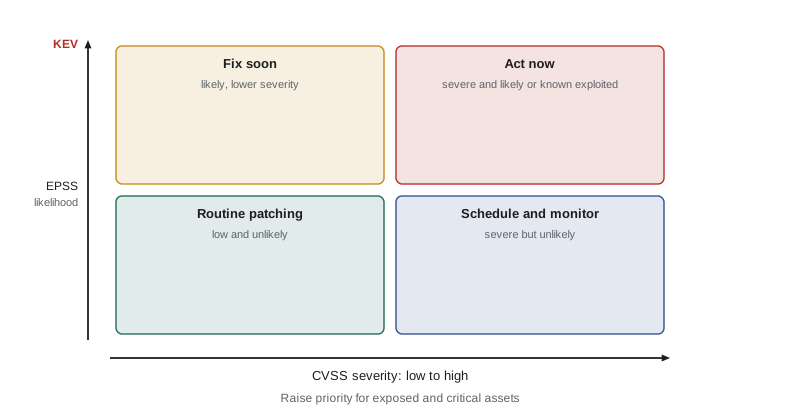
A practical prioritization scheme combines the signals with two pieces of internal context: exposure (is the system reachable from the internet or from untrusted networks?) and criticality (how important are the system and its data?). CISA's Stakeholder-Specific Vulnerability Categorization (SSVC) is one structured approach: a decision tree using exploitation status, technical impact, automatability and mission impact leads to one of four outcomes, track, track*, attend or act. Many organizations use simpler scoring matrices; what matters is that the rule is written down, applied consistently and agreed with system owners.
# Rank findings by a simple, written prioritization rule (illustrative data)
findings = [
    # id, cvss, epss, kev, internet_exposed, asset_criticality(1-3)
    ('F1', 9.8, 0.02, False, False, 1),
    ('F2', 7.5, 0.91, True,  True,  3),
    ('F3', 6.5, 0.45, False, True,  3),
    ('F4', 9.1, 0.01, False, True,  2),
    ('F5', 5.3, 0.88, True,  False, 2),
    ('F6', 8.8, 0.30, False, False, 3),
]
def priority(cvss, epss, kev, exposed, crit):
    likelihood = 1.0 if kev else epss
    score = (cvss / 10) * (0.5 + likelihood) * (1.5 if exposed else 1.0) * (0.75 + 0.25 * crit)
    return round(score, 3)
ranked = sorted(findings, key=lambda f: -priority(*f[1:]))
print('rank id  cvss  epss  kev   exposed crit  priority')
for r, f in enumerate(ranked, 1):
print(f'{r:>4} {f[0]:3s} {f[1]:4.1f} {f[2]:4.2f} {str(f[3]):5s} {str(f[4]):7s} {f[5]:>4} {priority(*f[1:]):.3f}')rank id cvss epss kev exposed crit priority 1 F2 7.5 0.91 True True 3 2.531 2 F3 6.5 0.45 False True 3 1.389 3 F6 8.8 0.30 False False 3 1.056 4 F5 5.3 0.88 True False 2 0.994 5 F4 9.1 0.01 False True 2 0.870 6 F1 9.8 0.02 False False 1 0.510
The ranking differs sharply from a CVSS-only order. F1, the 9.8, falls toward the bottom because it is unlikely to be exploited and sits on an internal, low-criticality system, while F2, a 7.5 that is known exploited and exposed on a critical system, rises to the top. The weights in this rule are invented for illustration; what makes a real rule defensible is that it is documented, consistently applied, reviewed against outcomes and approved by management.
Worked problem
Explaining the order to an auditor
An auditor notes that a CVSS 9.8 finding has been open for 60 days, past the 15-day critical SLA, while a CVSS 7.5 opened later was fixed in three days. How should the security manager respond?
Show solution
- Show the written prioritization policy that weighs known exploitation, EPSS, exposure and criticality as well as CVSS.
- Show that the 7.5 was on the KEV catalog and internet-facing, which the policy places in the act-now category.
- Show that the 9.8 is on an isolated internal system with a low EPSS score, and whether it was granted an approved exception with compensating controls.
- If no exception was approved, the SLA breach is real: the policy should either define risk-adjusted SLAs or the finding must be escalated.
Answer: Demonstrate a documented, risk-based policy and an approved exception; if neither exists, treat the breach as a genuine control failure.
Worked problem
Reading a vector string
A vendor rates a flaw CVSS:3.1/AV:A/AC:L/PR:N/UI:N/S:U/C:H/I:H/A:H. What does the vector tell a manager that the number alone does not?
Show solution
- AV:A means the attacker must be on an adjacent network, such as the same local segment or wireless network, not anywhere on the internet.
- No privileges or user interaction are needed, and impact is high on all three properties.
- The score is 8.8, high but below critical, because of the adjacent requirement.
- Network segmentation that keeps untrusted devices off the segment therefore reduces the real risk considerably.
Answer: The flaw needs adjacent network access; segmentation is an effective mitigation while patching is scheduled.
Worked problem
A KEV listing on a weekend
On Saturday, CISA adds a VPN appliance vulnerability to KEV. Your organization runs that appliance at its internet edge. What should the on-call security lead do?
Show solution
- Treat it as an incident-grade priority: the appliance is exposed and the flaw is known exploited.
- Apply the vendor fix or documented mitigation immediately under an emergency change.
- Hunt for signs of prior compromise, because exploitation may have begun before listing.
- Report to management with the actions taken and the residual risk.
Answer: Patch or mitigate immediately as an emergency change and check for prior compromise.
Common mistakes
MistakeTreating a CVSS base score as a measure of risk.
InsteadCombine severity with likelihood, known exploitation, exposure and criticality.
MistakeRecording an EPSS score once and never updating it.
InsteadRefresh EPSS regularly; it changes as evidence appears.
MistakeAssuming a flaw not on KEV is not being exploited.
InsteadTreat KEV as a strong positive signal, not a complete list.
MistakeQuoting a score without the vector or version.
InsteadRecord the vector string and CVSS version, or the CVSS 4.0 label.
MistakeInventing a new priority order for each finding.
InsteadWrite down and consistently apply a prioritization rule.
MistakeCalculating CVSS 4.0 scores with the 3.1 formula.
InsteadUse the official 4.0 calculator, which uses a lookup method.
Summary and key terms
- CVSS measures technical severity on a 0 to 10 scale; it is not a measure of risk.
- CVSS 3.1 uses published weights and formulas; 4.0 adds attack requirements and subsequent-system impacts and uses a lookup.
- CVSS 4.0 labels (CVSS-B, BT, BE, BTE) show which metric groups were used.
- EPSS estimates the probability of exploitation in the next 30 days; most CVEs score very low.
- The KEV catalog lists vulnerabilities exploited in the wild; BOD 22-01 binds US federal agencies.
- Effective prioritization adds exposure and asset criticality to the public signals.
- Document the rule so decisions are consistent and defensible to auditors.
- CVSS
- Common Vulnerability Scoring System, FIRST's standard for rating technical severity.
- Base score
- The CVSS score from intrinsic characteristics of a vulnerability.
- Vector string
- A compact text record of the CVSS metric values used to compute a score.
- Scope (CVSS 3.1)
- Whether impact extends beyond the vulnerable component's security authority.
- Attack requirements (CVSS 4.0)
- Deployment conditions needed for an attack to succeed.
- EPSS
- Exploit Prediction Scoring System, the probability of exploitation within 30 days.
- KEV catalog
- CISA's list of vulnerabilities known to be exploited in the wild.
- SSVC
- Stakeholder-Specific Vulnerability Categorization, a decision-tree approach to prioritization.
- Exposure
- Whether a vulnerable system can be reached by attackers, for example from the internet.
- Asset criticality
- The importance of a system and its data to the organization.
Practice problems
Work each problem on paper first, then reveal the answer to check.
What CVSS 3.1 base score does AV:N/AC:L/PR:N/UI:N/S:U/C:H/I:H/A:H produce?
Show answer
9.8, critical.
What qualitative rating does a CVSS score of 7.2 receive?
Show answer
High.
What does EPSS estimate?
Show answer
The probability that a CVE will be exploited in the wild in the next 30 days.
What three criteria must a CVE meet for KEV listing?
Show answer
An assigned CVE identifier, reliable evidence of active exploitation and a clear remediation action.
Why does the FIRST specification say the base score is not risk?
Show answer
It ignores likelihood, threat activity and the importance of the affected system.
What replaced scope in CVSS 4.0?
Show answer
Separate impact metrics for the vulnerable system and subsequent systems.
What does the label CVSS-BT mean?
Show answer
The score includes base and threat metrics.
Name the four SSVC outcomes.
Show answer
Track, track*, attend and act.
Why can a CVSS 6.5 outrank a 9.8?
Show answer
If it is known exploited, exposed and on a critical system while the 9.8 is unlikely and isolated.
Which US directive makes KEV remediation mandatory for federal civilian agencies?
Show answer
Binding Operational Directive 22-01.
Lesson quiz · 5 questions
Score 60% or more to complete this lesson.
Create a free account to save your progress, take quizzes and earn a certificate.