
CINE-340 · Lesson 9 of 12 · 27 min
Vehicles, camera cars, railways and traffic on location
Vehicles are everywhere on a production: picture cars driven in scenes, camera cars and tracking vehicles, process trailers, grip and electric trucks, generators, honeywagons, crew vans and the private cars that crew drive to and from set. Location shoots also put crews beside public roads and sometimes near railways. Vehicles bring hazards of collision, crushing, rollover, falls from moving vehicles, carbon monoxide and fatigue-related crashes on the drive home. Railways add the special danger of trains that cannot stop quickly. This lesson gives an awareness-level overview of vehicle safety for camera, grip and electric crews, building on the car cinematography in CINE-330 and focusing on the rules and practices that keep people alive. It includes the 2014 death of camera assistant Sarah Jones on a railway bridge, which changed industry practice.
Vehicles in production
Each kind of vehicle has its own hazards and rules.
- Picture cars appear on camera and may be driven by actors, stunt drivers or precision drivers, or carried on process trailers.
- Camera cars and tracking vehicles carry cameras, cranes and crew to film moving vehicles. They are specialized vehicles operated by trained drivers.
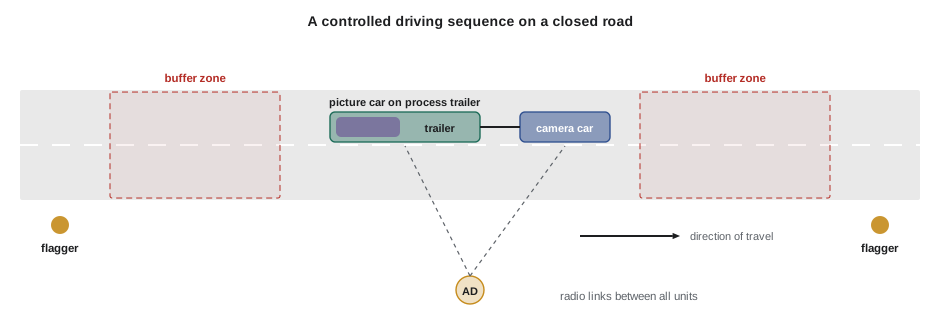
- Process trailers carry a picture car low to the ground, towed by a truck with the camera, lights and crew; the actor performs without driving.
- Production vehicles, such as grip and electric trucks, generators and trailers, move around base camp and locations, often in tight spaces with pedestrians.
- Crew vehicles transport people to and from set and between locations.
- Off-road vehicles, motorcycles, boats and aircraft have their own specialist requirements.
In Ontario, Guidelines 13 to 19 cover transportation, seat belts and restraints, motorcycles, railways and camera cars. In the United States, Bulletins 8, 8A, 8B and 8C cover camera cars, process trailers, camera boom vehicles and power line distances, Bulletin 20 covers motorcycles, Bulletin 37 covers vehicle restraint systems, Bulletin 40 covers non-camera utility vehicles and Bulletins 42 and 43 cover alternative driving systems and free driving.
Camera cars and process trailers
Camera cars and process trailers allow dramatic driving shots with professional control.
- Camera cars must be operated by qualified drivers, with all equipment mounted by trained grips using rated mounts and safety lines.
- Crew riding on camera cars must be seated or secured with approved restraints. No one should ride on running boards, bumpers or the outside of a moving vehicle unless the rig is designed for it and the person is secured.
- Process trailers keep the picture car's speed controlled by the tow vehicle; the actor in the picture car does not drive.
- Hold a safety meeting before every driving sequence, covering routes, speeds, signals, stop procedures and who has authority to stop.
- Use closed roads or controlled traffic, with police or traffic control as required by permits.
- Keep camera and lighting equipment within the vehicle's rated load and centre of gravity limits; tall loads raise rollover risk.
- Communicate by radio between the camera car, picture car, AD and traffic control.
- Avoid low clearances, power lines and overhanging branches; check the route in advance.
Stopping distances
Vehicles take longer to stop than most people think, especially at speed and when loaded with equipment.
Here \( d \) is the stopping distance, \( v \) the speed, \( t_r \) the reaction time and \( a \) the braking deceleration. Reaction distance rises with speed; braking distance rises with the square of speed.
Worked problem
How far does a camera car need to stop?
A camera car travels at 60 km/h. The driver's reaction time is 1.5 s and the loaded vehicle brakes at 6 m/s². What is the stopping distance? What if the speed is 80 km/h?
Show solution
- 60 km/h ≈ 16.7 m/s. Reaction distance: 16.7 × 1.5 ≈ 25 m. Braking distance: 16.7² ÷ (2 × 6) ≈ 23 m. Total ≈ 48 m.
- 80 km/h ≈ 22.2 m/s. Reaction distance ≈ 33 m. Braking distance: 22.2² ÷ 12 ≈ 41 m. Total ≈ 74 m.
Answer: About 48 m at 60 km/h and 74 m at 80 km/h. A 33 % increase in speed raises stopping distance by more than 50 %. Buffer zones, following distances and speed limits for driving sequences should be based on such numbers, with extra margin for wet roads.
Traffic control and working beside roads
Many location shoots happen on or beside public roads, where crews face passing traffic.
- Film permits from municipalities set conditions such as lane closures, intermittent traffic control, police presence and hours.
- Traffic control must follow the applicable traffic manual and be done by trained flaggers or police; crew members should not direct traffic without training and authority.
- Wear high-visibility clothing when working near traffic.
- Set up equipment, carts and cables away from the travelled lanes, behind barriers or cones where possible.
- Park production vehicles legally and safely, so they do not block sight lines or emergency access.
- Keep the public out of the work zone with barriers, signage and production assistants.
In Canada, provinces publish traffic control manuals, such as Ontario Traffic Manual Book 7 for temporary conditions, and municipalities issue film permits with traffic conditions. Traffic control persons need training under provincial rules.
Railways
Railways are uniquely dangerous. Trains are fast, quiet until close, and cannot stop or swerve. A freight train at speed can take more than a kilometre (about a mile) to stop. Railway property is private, and being on tracks or bridges without permission is trespassing as well as dangerous.
- Never shoot on or near railway tracks, bridges or rights-of-way without written permission from the railway and its safety requirements in place.
- Railways usually require a railway flagger or protection officer on site who communicates with dispatch and can stop trains.
- Assume any track is active at any time, in either direction, even if a schedule says otherwise.
- Plan escape routes away from the tracks, and never place crew or equipment where they cannot get clear quickly, such as on trestles and narrow bridges.
- Keep equipment and people outside the railway's fouling distance from the track.
On 20 February 2014, during the first day of shooting the film Midnight Rider in Georgia, the crew set up on a railway trestle over the Altamaha River after being denied permission by the railway. A freight train arrived at speed. Camera assistant Sarah Jones, 27, was struck and killed, and several others were injured. The director pleaded guilty to involuntary manslaughter and criminal trespass and served time in jail; an executive producer and the first assistant director also received criminal sentences of probation. The tragedy led to the "Slates for Sarah" movement, the Sarah Jones Film Foundation, renewed attention to railway safety bulletins and greater willingness of crews to question unsafe plans. US Safety Bulletin 28 and Ontario Guideline 16 cover railways and railway crossings.
Base camp and production vehicles
Base camps and truck parking areas are busy with large vehicles reversing and manoeuvring among people.
- Use spotters when reversing large trucks and trailers; many incidents involve vehicles backing into people.
- Separate pedestrian walkways from vehicle routes where possible, and light them at night.
- Chock wheels of parked trucks and trailers, and set brakes.
- Use lift gates, ramps and ladders correctly when loading; falls from truck beds and lift gates cause serious injuries.
- Keep generator exhaust and vehicle idling away from trailers and tents to avoid carbon monoxide build-up.
- Follow base camp guidance such as US Bulletins 9 and 9A.
Driving to and from set
The most dangerous part of a film worker's day may be the drive home. Long hours lead to drowsy driving, which impairs reaction time much like alcohol.
- Being awake for 17 to 19 hours can impair performance as much as a blood alcohol concentration of 0.05 %, and longer periods are comparable to 0.08 % or more.
- Productions should limit hours, respect turnaround and offer alternatives such as rides or hotel rooms after very long days (Lesson 11).
- Crew should speak up if they are too tired to drive, and colleagues should look out for each other.
- Carpooling, shuttles and nearby accommodation reduce driving after long shifts.
Worked problem
Reaction distance and drowsiness
A crew member driving home at 100 km/h (about 62 mph) normally reacts in 1.0 s. After a 16-hour day, their reaction time increases to 2.0 s. How much further do they travel before braking?
Show solution
- 100 km/h ≈ 27.8 m/s.
- Rested: 27.8 × 1.0 ≈ 28 m before braking.
- Tired: 27.8 × 2.0 ≈ 56 m before braking.
Answer: About 28 m more (roughly 90 ft) before even starting to brake, and microsleeps can cause no reaction at all. Fatigue management protects people after wrap as well as on set.
Vehicles in shots and actors driving
When actors drive on camera, the risk extends to the performer and anyone nearby.
- Use process trailers, tow rigs, low-loaders or LED volumes when the scene allows, eliminating the need for the actor to drive.
- When actors do drive, keep speeds low, use closed roads, rehearse and have the stunt coordinator involved.
- Stunt driving, chases and crashes are done only by qualified stunt drivers under a stunt coordinator (Lesson 10).
- Never place crew in front of or close to moving vehicles without barriers or a protected position; use remote heads, crash boxes or locked-off cameras for close shots.
| Hazard | Example | Controls |
|---|---|---|
| Collision | Camera car and picture car | Closed road, rehearsal, radio, speed limits |
| Struck by | Crew near a moving picture car | Protected positions, locked-off cameras |
| Reversing | Truck backing at base camp | Spotters, separate walkways |
| Rollover | Overloaded camera vehicle | Load limits, low centre of gravity |
| Train strike | Crew on tracks | Railway permission, flagger, no trestles |
| Drowsy driving | Crew driving home | Hour limits, rides, hotels |
| Carbon monoxide | Idling near trailers | Exhaust away from people |
Utility vehicles, carts and golf carts
Productions increasingly use utility vehicles, golf carts and electric carts to move people and gear around large locations and studio lots. They seem harmless but cause rollovers, collisions with pedestrians and falls from moving carts. Only authorized drivers should operate them, at walking speed in crowded areas, with passengers seated inside and loads secured and within the rated capacity. Drivers should avoid sharp turns on slopes, never carry people on the back or sides, and park with the brake set and key removed. US Safety Bulletin 40 covers non-camera utility vehicles, and studio lots have their own rules.
Loading and unloading trucks
Grip and electric trucks are loaded and unloaded many times a day, often at night and in tight spaces. Lift gates must be used within their capacity, with carts centred and wheels locked, and no one should ride a lift gate or stand beneath it. Ramps must be secured, and heavy carts need two people on slopes. Truck beds are a common fall hazard: use steps and handholds, keep three points of contact and never jump down from the bed. Good lighting at the back of the truck makes all of these tasks safer.
Common mistakes
MistakeRiding on the outside of a moving vehicle to get a shot.
InsteadRide only in seats or approved, secured positions on rigs designed for it.
MistakeDirecting traffic without training or permit authority.
InsteadUse trained flaggers or police as the permit requires.
MistakeShooting on railway tracks without written permission.
InsteadGet railway permission, a railway flagger and an escape plan, or do not shoot there.
MistakeReversing a truck at base camp without a spotter.
InsteadUse spotters and keep pedestrians separate from vehicle routes.
MistakeDriving home after a very long day without telling anyone you are exhausted.
InsteadSpeak up and use rides, carpools or hotels offered by production.
Summary and key terms
- Productions use picture cars, camera cars, process trailers and many support vehicles.
- Camera car work needs qualified drivers, secured crew, safety meetings and controlled roads.
- Stopping distance rises with reaction time and the square of speed.
- Traffic control follows provincial manuals or the MUTCD and needs trained flaggers.
- Railways need written permission, railway flaggers and escape routes; Midnight Rider showed the cost of ignoring them.
- Base camps need spotters, separated walkways and exhaust control.
- Drowsy driving after long days is a major risk; hours and rides matter.
- Picture car
- A vehicle that appears on camera.
- Camera car
- A vehicle specially equipped to carry cameras and crew for driving shots.
- Process trailer
- A low trailer that carries a picture car behind a tow vehicle.
- Spotter
- A person who guides a vehicle or watches for hazards.
- Flagger
- A trained person who controls traffic in a work zone.
- MUTCD
- The US Manual on Uniform Traffic Control Devices.
- Railway flagger
- A railway employee or contractor who protects work near tracks.
- Trestle
- A bridge-like structure carrying a railway over a gap.
- Reaction distance
- Distance travelled before braking begins.
- Drowsy driving
- Driving while impaired by fatigue.
Practice problems
Work each problem on paper first, then reveal the answer to check.
Stopping distance at 50 km/h, 1.5 s reaction, 6 m/s² braking?
Show answer
About 21 + 16 = 37 m.
What happens to braking distance if speed doubles?
Show answer
It quadruples.
Who should control traffic on a public road shoot?
Show answer
Trained flaggers or police as the permit requires.
What must a production have before shooting near railway tracks?
Show answer
Written railway permission and a railway flagger.
Why should crew not be placed on trestles?
Show answer
There is no escape route from an approaching train.
What US bulletin covers railway safety?
Show answer
Bulletin 28.
Extra distance at 27.8 m/s with 1 s more reaction time?
Show answer
About 28 m.
Why use spotters at base camp?
Show answer
To prevent reversing vehicles striking people.
Name a way to avoid having an actor drive.
Show answer
A process trailer, tow rig or LED volume.
What should crew riding a camera car use?
Show answer
Seats or approved restraints.
Lesson quiz · 5 questions
Score 60% or more to complete this lesson.
Create a free account to save your progress, take quizzes and earn a certificate.