
CINE-340 · Lesson 4 of 12 · 25 min
Cables, connectors, grounding and wet locations
Most electrical injuries and fires on set do not happen inside the generator or the distribution box. They happen in the cables and connectors that run across the location: a stinger crushed under a dolly wheel, a feeder connector left lying in a puddle, a missing ground pin, an extension cord daisy-chained beyond its rating, a cable run across a doorway where people trip in the dark. This lesson covers the cables and connectors used on set, how to inspect and route them, why grounding and bonding matter, how ground fault protection works and how to manage electricity in wet conditions, from rain towers and wet-downs to water tanks and swimming pools. It ends with a look at power lines, which kill more film workers than any distribution system.
Cable types on set
Film crews use several kinds of cable, each chosen for its current rating, flexibility and toughness.
- Single-conductor feeder cable, usually 2/0 or 4/0 copper with heavy rubber or thermoplastic jackets, carries power from generators to distribution. Each conductor is a separate cable, colour-coded by function.
- Multi-conductor portable cord, such as type SOOW or similar extra-hard-usage cord in Canada and the US, is used for distribution and extension cables. It is flexible, oil and weather resistant and rated for rough use.
- Stingers (extension cables) carry power from distribution to individual fixtures and come in standard lengths, often 25 or 50 ft.
- Multicore cable, such as Socapex, carries several dimmed circuits in one jacket.
- Data cables, such as DMX, Ethernet for lighting networks and video cables, carry control and signals rather than power but follow the same routing rules.
- Household-grade extension cords are not suitable for film lighting loads or rough use and should not be used for fixtures.
Every cable must be certified or listed for its use, rated for the current it will carry and the conditions, such as wet, oily or cold, and in good condition.
Connectors
Connectors join cables and connect cables to equipment. On set they are made and broken many times a day, so they wear and get dirty.
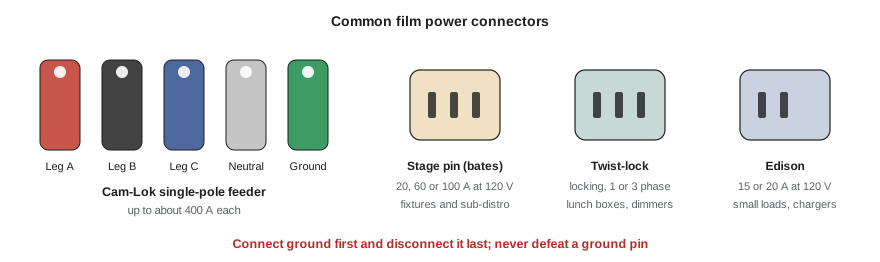
- Cam-Lok connectors join single-conductor feeder cables. They twist to lock. A standard sequence for connecting is ground first, then neutral, then the hot legs; disconnecting is the reverse: hots first, then neutral, then ground. This keeps a ground path present whenever hots are connected.
- Bates (stage pin) connectors in 20, 60 and 100 A sizes are common on 120 V film circuits.
- Twist-lock connectors lock against accidental disconnection and carry single-phase or three-phase circuits.
- Edison (NEMA 5-15 or 5-20) connectors are the common household-style plugs for small loads.
- Specialty connectors include Socapex for multicore, powerCON and similar locking connectors on LED fixtures, and pin-and-sleeve industrial connectors.
Connectors should never be forced, modified or adapted in ways that defeat polarity or grounding, such as cutting off a ground pin or using "cheater" adapters that drop the ground. Adapters between connector types must keep the correct current rating and overcurrent protection.
Inspecting cable and connectors
Cable takes a beating on set, so it must be inspected before use and whenever damage is suspected.
- Look along the jacket for cuts, crushing, abrasion, heat damage and exposed inner insulation or conductors.
- Check connectors for cracked housings, bent or loose pins, burned or discoloured contacts, missing screws and strain relief that has pulled away.
- Check that ground pins are present and secure.
- Warm spots in a cable or connector while running indicate overload or a poor connection. Electricians use infrared thermometers or touch checks with care.
- Tag damaged cable "do not use" and remove it from service until a qualified person repairs or replaces it.
- Test cables and adapters with appropriate testers for continuity, polarity and ground integrity, especially after repairs.
Routing cable safely
Cable routing protects both the cable and the people around it.
- Plan routes along walls and edges, away from walkways, doorways, stairs and camera dolly tracks.
- Where cable must cross a path, use cable ramps (cable crossovers) or fly it overhead with proper support.
- Do not run cable through doorways where doors can close on it, or under rugs where it cannot be seen.
- Protect cable from vehicles; use rated crossover ramps for vehicle crossings.
- Do not run power cable across water, through puddles or in wet areas unless it and its connectors are rated for wet locations and protected.
- Dress cable neatly with slack at fixtures so stands are not pulled over, and use sandbags to secure cables where they leave stands.
- Keep connectors off the ground where water can pool, using boxes, pallets or cable risers.
- Light the cable route at night and mark it where needed.
- Do not load-carry cable coiled; lay it out to dissipate heat (Lesson 3).
Grounding and bonding
Grounding and bonding are among the most important and least understood ideas in electrical safety.
- The equipment grounding conductor (often green or green-yellow) connects the metal parts of fixtures, stands, distribution boxes and generators back to the source. If a hot wire touches a metal housing, the ground provides a low-resistance path that lets a large current flow, tripping the breaker quickly.
- Without a ground, a faulted fixture housing can sit at full voltage, waiting for a person to complete the circuit.
- Bonding connects metal parts together so they stay at the same potential, preventing voltage differences between, for example, a lighting stand and a metal handrail.
- The neutral carries normal return current; the ground carries fault current only. In portable systems, the neutral and ground are connected at one point only, usually at the generator or source, as required by code and manufacturer instructions.
- Generators may need grounding to a ground rod or other means, depending on the system and code requirements. US Bulletin 23E addresses generator grounding on productions.
Removing a ground pin to make a plug fit, or using two-prong adapters on three-prong equipment, removes this protection and creates a shock hazard.
Worked problem
Why the ground trips the breaker
A fixture on a 20 A, 120 V circuit develops a fault where the hot wire touches the metal housing. The ground path from the housing back to the source has a total resistance of 0.4 Ω, including the hot conductor. What fault current flows, and what happens?
Show solution
- Fault current \( I = V \div R = 120 \div 0.4 = 300 \) A.
- 300 A is 15 times the 20 A breaker rating, so the breaker trips almost instantly.
- If the ground were missing, no large fault current would flow; the housing would stay live at up to 120 V until someone touched it.
Answer: About 300 A flows briefly and trips the breaker. The ground turns a hidden shock hazard into an obvious, harmless trip.
Ground fault protection
A breaker protects cables from overload, but a person can be killed by a current far below the trip level of any breaker. Ground fault protection fills that gap.
- A ground fault circuit interrupter (GFCI) compares the current flowing out on the hot conductor with the current returning on the neutral. If the difference exceeds about 5 mA, some current is leaking to ground, perhaps through a person, and the device cuts power within a fraction of a second.
- GFCI devices for personnel protection (Class A) trip at about 5 mA, well below the current that causes ventricular fibrillation.
- Ground fault protection of equipment (GFPE), which trips at higher currents such as 30 mA or more, protects equipment and reduces fire risk but is not designed to protect people from shock.
- Film-rated GFCI devices are built for large lighting loads and high inrush currents, with less nuisance tripping than household units.
- GFCI protection should be tested with its test button at the start of each day and whenever it is moved.
- A GFCI that trips is doing its job. Never bypass a tripping GFCI; find the fault.
In Canada, the Canadian Electrical Code requires ground fault circuit interrupter protection for many receptacles in wet and outdoor locations, and provincial OHS regulations and the Ontario film guidelines call for GFCI protection where equipment is used near water or in wet conditions. Class A GFCI devices certified to CSA standards trip at a nominal 5 mA.
Wet locations, rain and water work
Water and electricity are a deadly combination. Rain effects, wet-downs of streets, snow, fog, swimming pools, tanks and boats all bring water close to power.
- Plan electrical work for wet scenes in pre-production with the gaffer, special effects coordinator and safety officer.
- Use fixtures, cables and connectors rated for wet locations, and keep connections elevated, wrapped or covered according to manufacturer guidance.
- Use GFCI protection on all circuits in wet areas.
- Consider low-voltage or battery-powered fixtures near water, and keep line-voltage fixtures well back from the water's edge.
- Never use line-voltage equipment in or over a pool or tank where people are in the water unless it is specifically designed and approved for that use, and electrical isolation is designed by qualified people.
- Protect fixtures from rain falling on hot lenses, which can shatter glass. Rain hats and covers help.
- When rain towers or water trucks are running, keep distribution boxes out of the spray zone and on raised platforms.
- Turn off and lock out power before anyone moves fixtures in wet areas.
In Ontario, Guidelines 31 and 32 cover water hazards and water locations, and Guideline 12 covers electrical safety. In the United States, Bulletin 17 covers water hazards and the Bulletin 23 series covers electrical equipment.
Power lines
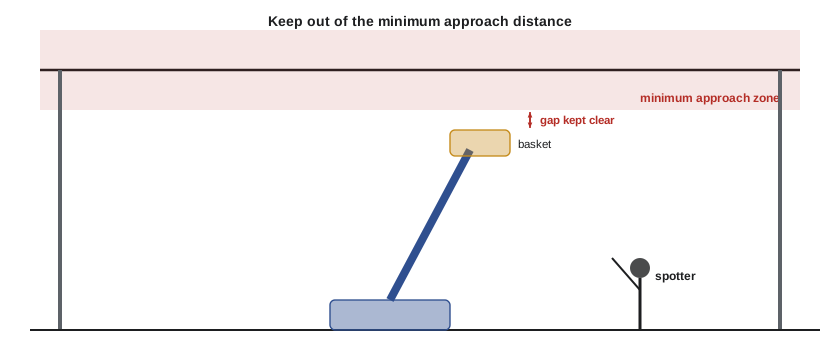
Overhead power lines are the most serious electrical hazard on many locations. Contact or arcing from a power line can kill instantly, and power lines can arc across gaps without being touched. Film crews meet power lines when using cranes, condors, boom lifts, lighting balloons, ladders, telescoping poles, drones and tall set pieces.
- Identify power lines on location scouts and mark them in the safety plan.
- Assume all overhead lines are energized and dangerous unless the utility confirms otherwise.
- Keep equipment and people at least the minimum approach distance, which increases with voltage.
- Use a dedicated spotter when moving cranes, lifts or tall equipment near lines.
- Contact the utility to de-energize, relocate or cover lines when work must happen closer.
- If a vehicle or crane contacts a line, people inside should stay inside unless there is fire, and everyone else must stay well away.
In Canada, provincial OHS regulations set minimum distances from energized overhead lines. In Ontario, for example, the construction regulation requires at least 3 m from lines between 750 V and 150 kV, with greater distances for higher voltages. Other provinces set similar tables, and many require the utility to be contacted. Ontario film guidelines on cranes, mobile elevating equipment and camera booms repeat this requirement.
| Check | What to look for | Action if found |
|---|---|---|
| Jacket | Cuts, crushing, abrasion, heat damage | Remove from service |
| Connector housing | Cracks, missing screws | Remove from service |
| Pins | Bent, loose, burned or missing ground | Remove from service |
| Strain relief | Pulled away, exposed conductors | Repair by qualified person |
| Running temperature | Warm or hot spots | Reduce load, check connection |
| GFCI | Fails the test button | Replace before use |
Common mistakes
MistakeRemoving a ground pin or using a cheater adapter to make a plug fit.
InsteadKeep grounding intact and use correct, rated adapters.
MistakeLeaving connectors lying in puddles or wet grass.
InsteadRaise connectors on boxes or risers and use wet-rated gear with GFCI protection.
MistakeResetting a tripping GFCI again and again or bypassing it.
InsteadTreat the trip as a fault, find and fix it.
MistakeRunning cable across a walkway without protection.
InsteadRoute along edges or use cable ramps and light the route.
MistakeRaising a pole, lift or ladder near overhead lines without checking.
InsteadIdentify lines, keep minimum distances and use a spotter.
Summary and key terms
- Film cables include feeder, portable cord, stingers and multicore, each rated for use and conditions.
- Cam-Lok connections are made ground first and broken ground last.
- Inspect cables and connectors before use and remove damaged gear from service.
- Route cable away from walkways and vehicles, use ramps and keep connectors out of water.
- Grounding gives fault current a path that trips the breaker; bonding keeps metal at the same potential.
- GFCIs trip at about 5 mA to protect people; GFPE protects equipment.
- Power lines need minimum approach distances, spotters and utility contact.
- GFCI
- A device that cuts power when current leaks to ground, protecting people at about 5 mA.
- GFPE
- Ground fault protection for equipment, tripping at higher currents.
- Equipment grounding conductor
- The green or green-yellow conductor that bonds metal parts to the source.
- Bonding
- Connecting metal parts to keep them at the same electrical potential.
- Stinger
- An extension cable used to power a fixture.
- Cable ramp
- A protective crossover that lets people or vehicles pass over cable.
- Wet location
- An area exposed to water, rain or saturation, needing rated equipment.
- Minimum approach distance
- The closest a person or equipment may come to an energized line.
- Socapex
- A multicore connector carrying several circuits in one cable.
- Cheater adapter
- An adapter that defeats the ground; unsafe and not permitted.
Practice problems
Work each problem on paper first, then reveal the answer to check.
In what order are Cam-Lok connections made?
Show answer
Ground, neutral, then hot legs; reverse to disconnect.
At about what leakage current does a Class A GFCI trip?
Show answer
About 5 mA.
What does a ground do during a fault?
Show answer
Provides a low-resistance path so a large current trips the breaker.
Fault current through 0.6 Ω at 120 V?
Show answer
200 A.
Why keep connectors off wet ground?
Show answer
Water can create leakage paths and shock hazards.
What should you do with a damaged cable?
Show answer
Tag it out and remove it from service.
Why test a GFCI each day?
Show answer
To confirm it will trip when needed.
Name two places cable should not be run.
Show answer
Doorways, walkways, under rugs, across water.
What should crew in a vehicle do if it contacts a power line?
Show answer
Stay inside unless there is fire, and keep others away.
Name a US bulletin on power line distances.
Show answer
8C, 22A, 23A or 25A.
Lesson quiz · 5 questions
Score 60% or more to complete this lesson.
Create a free account to save your progress, take quizzes and earn a certificate.