
CINE-340 · Lesson 7 of 12 · 27 min
Working at heights: ladders, scaffolds, lifts and fall protection
Film crews spend a surprising amount of time off the ground. Electricians climb ladders to set practicals and hang lights from pipe grids; grips build scaffolds for high camera positions and work on catwalks above sound stages; rigging crews work from boom lifts and scissor lifts to hang frames and fixtures; camera operators ride cranes. Falls from height are one of the leading causes of serious injury and death at work across all industries, and the film industry is no exception. A fall of only 2 or 3 m onto a hard floor can cause a fatal head injury. This lesson covers ladders, scaffolds and rolling towers, mobile elevating work platforms such as scissor lifts, boom lifts and condors, the hierarchy of fall protection, calculating fall clearance and the legal thresholds for fall protection in Canada and the United States. It is awareness-level only. Using fall protection or operating a lift requires specific certified training.
Why falls happen
Falls rarely happen to people doing something unusual; they happen during routine tasks done in a hurry.
- Overreaching from a ladder instead of moving it.
- Using the wrong equipment, such as standing on a chair, apple box stack or the top cap of a stepladder.
- Working near open edges of rooftops, catwalks, set platforms and loading docks without guardrails.
- Unstable bases: ladders on uneven or slippery ground, rolling towers with unlocked wheels.
- Climbing with tools or equipment in hand, without three points of contact.
- Fatigue, poor lighting and rushing at the end of a long day.
- Holes and openings in set floors, trap doors and stage pits left unguarded.
The hierarchy of fall protection
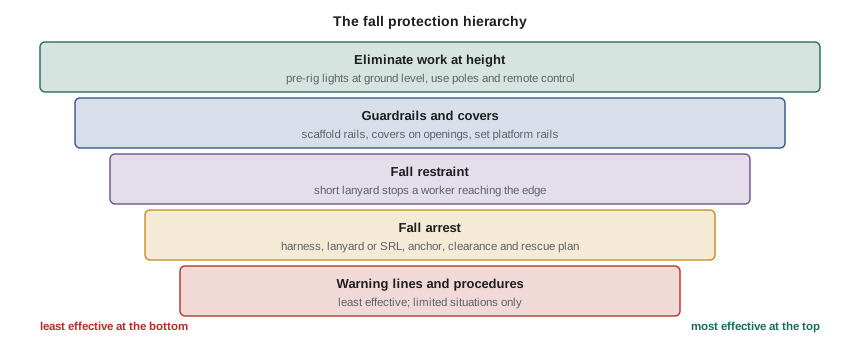
Like the general hierarchy of controls in Lesson 1, fall protection follows an order of preference.
- Eliminate the need to work at height: pre-rig fixtures at ground level and raise them on a lift or motor, use telescopic poles to adjust lights from the floor, use remote heads and wireless control.
- Passive fall prevention: guardrails, covers over openings, scaffolds and platforms with rails. These protect everyone without training or equipment use.
- Fall restraint: equipment that prevents a worker from reaching an edge, such as a short lanyard attached to an anchor.
- Fall arrest: a harness, lanyard or self-retracting lifeline and anchor that stop a fall after it begins. It requires training, clearance below and a rescue plan.
- Administrative controls: warning lines, safety monitors and procedures, which are least effective and allowed only in limited situations.
When fall protection is required
Laws set heights above which fall protection is required. The thresholds differ between jurisdictions, and between general work and construction, and some apply at any height where a fall could cause injury, such as falling onto machinery or into water.
In Canada, most provinces require fall protection where a worker could fall 3 m or more, and at lower heights where the fall could cause unusual injury, such as onto equipment or into hazardous substances. Ontario, British Columbia and Alberta all use 3 m as the general threshold, while federally regulated workplaces under the Canada Labour Code use 2.4 m. Ontario also requires workers on construction projects who use fall protection to complete approved Working at Heights training. Fall protection equipment is covered by the CSA Z259 series of standards, and the Ontario film guidelines include guidelines on working at heights, mobile elevating equipment and scaffolding.
Ladders
Ladders are simple tools that cause many injuries.
- Choose the right type and length: stepladders for free-standing work, extension ladders for access to upper levels, and platform ladders for longer tasks.
- Choose the right duty rating for the user plus tools and equipment. Ladder standards are CSA Z11 in Canada and ANSI A14 in the US.
- Inspect before use for damaged rails, rungs, feet and locks.
- Set extension ladders at a 4:1 angle: the base 1 unit out for every 4 units of height to the support point.
- Extend ladders at least 1 m (3 ft) above a landing used for access, and secure the top and bottom.
- Maintain three points of contact while climbing; carry tools in a belt or raise them with a line.
- Never stand on the top cap or top step of a stepladder, and never use a stepladder folded and leaning.
- Keep your belt buckle between the rails; move the ladder rather than overreach.
- Use non-conductive ladders (fibreglass) near electricity.
Worked problem
Setting up an extension ladder
An electrician needs to reach a balcony 4.8 m above the ground to set a practical. Using the 4:1 rule and extending 1 m above the balcony edge, how far should the ladder base be from the wall, and how long must the extended ladder be?
Show solution
- Base distance: 4.8 ÷ 4 = 1.2 m from the wall.
- Length to the balcony edge: \( \sqrt{4.8^2 + 1.2^2} = \sqrt{23.04 + 1.44} \approx 4.95 \) m. Add 1 m above the edge: about 5.95 m.
- Allow for the overlap of extension sections, which reduces usable length; check the ladder's marked maximum working length.
Answer: Set the base about 1.2 m out and use a ladder with at least about 6 m of usable extended length, secured at top and bottom.
Scaffolds and rolling towers
Scaffolds give stable working platforms for camera positions, lighting and set construction.
- Scaffolds must be erected, altered and dismantled by competent workers following the manufacturer's instructions and applicable regulations.
- Use full guardrails (top rail, mid rail and toe boards) on working platforms, and safe access by built-in ladders or stairs, not by climbing the frame.
- Set scaffolds on firm, level bases with base plates and mud sills, and use outriggers or ties as required for height.
- On rolling towers, lock casters before climbing, and never move a tower with people or loose equipment on it.
- Respect the height-to-base ratio set by the manufacturer and regulations; taller towers need outriggers or ties.
- Inspect scaffolds before each shift and after any alteration or severe weather.
Mobile elevating work platforms
Scissor lifts, boom lifts (including articulating and telescopic booms) and the large truck-mounted or self-propelled booms the industry calls condors carry crew and lights high above the set. They are invaluable and dangerous.
- Operators must be trained and familiarized on the specific type and model, as required by standards and regulations.
- Inspect the lift before each use, including controls, emergency lowering, tires, outriggers and platform gates.
- Check the ground: firm, level, no holes, soft ground, buried vaults or slopes beyond the manufacturer's limits.
- Respect the platform's rated capacity, including people, fixtures, cable and accessories. A fixture and a large frame can exceed capacity and create huge wind loads.
- In boom lifts, wear a full-body harness and short lanyard attached to the platform's designated anchor; this is fall restraint, keeping the worker in the basket. In scissor lifts, guardrails are normally the primary protection, though some employers and manufacturers require harnesses too.
- Never climb on guardrails or use ladders inside a platform.
- Keep clear of power lines (Lesson 4), overhead obstructions and traffic.
- Observe the manufacturer's maximum wind speed. Many outdoor-rated lifts are limited to 12.5 m/s (about 45 km/h or 28 mph), and some allow less. Lights and frames mounted on the basket add sail area that the rating may not include (Lesson 8).
- Have a rescue plan and ground crew who can use the emergency lowering controls.
In Canada, the CSA B354 series (B354.6, B354.7 and B354.8), adopted in 2017 and aligned with ISO 16368, covers the design, safe use and training for mobile elevating work platforms, and provincial regulations require trained operators and inspections.
Personal fall arrest and fall clearance
Personal fall arrest systems include an anchor, a connector, a full-body harness and a lanyard with an energy absorber or a self-retracting lifeline. They work only if there is enough clear space below the worker to stop the fall before hitting the ground or an obstruction.
- Anchors must be strong enough, typically about 22 kN (5,000 lb) per worker or designed by a qualified person.
- Harnesses must fit correctly and be inspected before each use.
- Lanyards with energy absorbers extend as they slow the fall; self-retracting lifelines lock quickly and usually need less clearance.
- Suspension after a fall can cause suspension trauma within minutes, so a prompt rescue plan is essential.
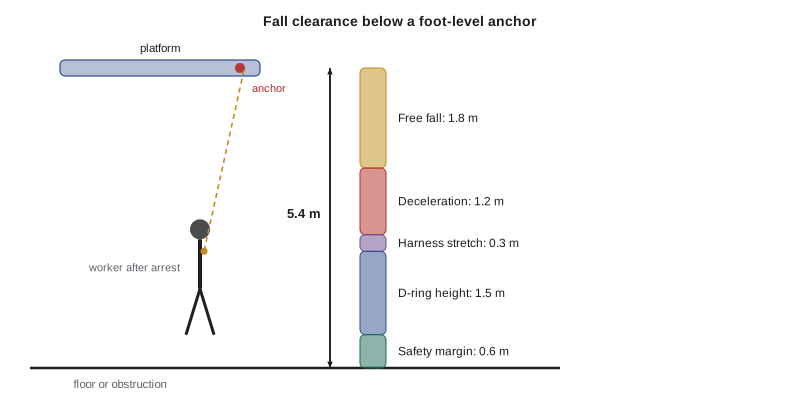
Fall clearance is the distance needed below the anchor or working surface to stop a fall safely. A common calculation adds the free fall distance, deceleration distance, harness stretch and D-ring shift, the height of the worker's D-ring above their feet and a safety margin.
Worked problem
Calculating fall clearance
A grip on a platform uses a 1.8 m lanyard with an energy absorber attached at foot level. The free fall is 1.8 m, the energy absorber may extend up to 1.2 m, harness stretch and D-ring shift add 0.3 m, the D-ring sits 1.5 m above the feet and a 0.6 m safety margin is used. How much clearance is needed below the platform?
Show solution
- Clearance = 1.8 + 1.2 + 0.3 + 1.5 + 0.6 = 5.4 m.
- Because the anchor is at foot level, the worker falls the full lanyard length plus the height of the D-ring above the feet before the lanyard begins to tighten.
Answer: About 5.4 m of clear space is needed below the platform. If the platform is only 4 m above the floor, this system would let the worker hit the floor; use an overhead anchor, a self-retracting lifeline or restraint instead.
Catwalks, grids and set platforms
Sound stages have catwalks and permanent grids high above the floor, and sets often include platforms, staircases and balconies.
- Stay on catwalks and walkways; never walk on grid pipes, ceilings or set walls not designed to be walked on.
- Keep catwalk gates closed and toe boards in place to prevent dropped objects.
- Tether tools and small items when working above others, and keep exclusion zones below.
- Guard open edges of set platforms with railings and mark them; cover or guard openings and trap doors.
- Light access routes and keep them clear of cable and equipment.
Rescue planning
Every plan to use fall arrest or lifts must include a rescue plan. Waiting for emergency services may take too long for a worker suspended in a harness.
- Identify how a fallen or stranded worker will be reached: from the ground with a lift, by using the lift's emergency lowering controls, or with a rescue kit used by trained people.
- Make sure rescuers are trained and equipment is on site.
- Practise the plan where possible and include it in the safety meeting.
| Jurisdiction | Typical threshold | Notes |
|---|---|---|
| Ontario, BC, Alberta | 3 m | Lower if fall onto hazards |
| Federal Canada | 2.4 m | Canada Labour Code workplaces |
| US general industry | 4 ft (1.2 m) | 29 CFR 1910.28 |
| US construction | 6 ft (1.8 m) | 29 CFR 1926.501 |
| US construction scaffolds | 10 ft (3 m) | 29 CFR 1926.451 |
Common mistakes
MistakeStanding on the top step of a stepladder to gain height.
InsteadUse a taller ladder, a platform ladder or a lift.
MistakeTying off to any convenient pipe without knowing its strength.
InsteadUse rated anchors or anchors designed by a qualified person.
MistakeUsing a fall arrest system without checking clearance.
InsteadCalculate clearance; use overhead anchors, SRLs or restraint when clearance is short.
MistakeMoving a rolling tower with a person on it.
InsteadLock casters and move towers only when empty.
MistakeFlying a large frame from a boom lift basket without checking wind and capacity limits.
InsteadCheck rated capacity and wind limits, including sail area.
Summary and key terms
- Falls happen during routine tasks, often from rushing, overreaching or using the wrong equipment.
- Eliminate work at height first, then use guardrails, then restraint or fall arrest.
- Canada generally requires fall protection at 3 m (2.4 m federally); OSHA uses 4 ft in general industry and 6 ft in construction.
- Ladders need the right type, 4:1 angle, three points of contact and extension above landings.
- Scaffolds and towers need competent erection, guardrails, firm bases and locked casters.
- Lifts need trained operators, inspections, ground checks, capacity and wind limits.
- Fall arrest needs strong anchors, correct clearance and a rescue plan.
- Fall restraint
- A system that prevents a worker from reaching a fall hazard.
- Fall arrest
- A system that stops a fall after it starts.
- Fall clearance
- The clear distance needed below a worker to stop a fall safely.
- Self-retracting lifeline
- A lifeline that extends and retracts and locks quickly in a fall.
- Energy absorber
- A device that extends to reduce the force of arresting a fall.
- MEWP
- Mobile elevating work platform, such as a scissor lift or boom lift.
- Condor
- Industry name for a large boom lift used for lighting.
- Four-to-one rule
- One unit out from the wall for every four units of ladder height.
- Suspension trauma
- A dangerous condition from hanging motionless in a harness.
- Toe board
- A low barrier at a platform edge that stops objects falling.
Practice problems
Work each problem on paper first, then reveal the answer to check.
General fall protection threshold in Ontario?
Show answer
3 m.
OSHA general industry threshold?
Show answer
4 ft.
Base distance for a ladder reaching 6 m?
Show answer
1.5 m.
How far should a ladder extend above a landing?
Show answer
About 1 m (3 ft).
Clearance with 1.8 + 1.2 + 0.3 + 1.5 + 0.6 m?
Show answer
5.4 m.
What protects workers in a boom lift basket?
Show answer
A harness and short lanyard on the designated anchor (restraint).
Common maximum wind for outdoor lifts?
Show answer
About 12.5 m/s (28 mph), or as the manufacturer states.
Why is a rescue plan needed for fall arrest?
Show answer
Suspension trauma can develop in minutes.
Which Canadian standard covers MEWPs?
Show answer
The CSA B354 series.
Which US standard series covers fall protection equipment?
Show answer
ANSI/ASSP Z359.
Lesson quiz · 5 questions
Score 60% or more to complete this lesson.
Create a free account to save your progress, take quizzes and earn a certificate.