
CINE-340 · Lesson 2 of 12 · 29 min
Electrical fundamentals for set lighting
Electricity is the lifeblood of a film set. Every light, monitor, camera charger, video village and catering urn depends on it, and the amounts involved are large. A modest commercial lighting package can draw more current than several houses, and a feature film's night exterior may run more power than a small neighbourhood. Electricity is also invisible, silent and unforgiving. It can kill through electric shock, injure through arc flash and burns, and start fires through overheated cables and connections. This lesson explains the basic quantities, voltage, current, resistance and power, and how they apply to set lighting. It covers single-phase and three-phase systems in Canada and the United States, how to calculate the load of a lighting package, how electricity harms the body and why only qualified people should work on electrical systems. Lessons 3 and 4 build on these ideas with distribution, generators, cables and grounding.
Voltage, current, resistance and power
Four quantities describe most of what happens in an electrical circuit.
- Voltage (V), measured in volts, is the electrical "pressure" that pushes charge around a circuit.
- Current (I), measured in amperes or amps (A), is the rate at which charge flows.
- Resistance (R), measured in ohms (Ω), opposes the flow of current. Conductors such as copper have low resistance; insulators such as rubber have very high resistance.
- Power (P), measured in watts (W) or kilowatts (kW), is the rate at which energy is used or delivered.
Ohm's law links voltage, current and resistance, and the power law links power, voltage and current.
For alternating current with resistive loads such as tungsten lamps, these formulas work directly. For loads such as LED drivers and HMI ballasts, the power factor and harmonics also matter, as explained below.
Electricians on set often use the "West Virginia" rule, \( W = V \times A \), to estimate current from the wattage written on a fixture. A 1,000 W tungsten fixture on 120 V draws about \( 1000 \div 120 \approx 8.3 \) A.
Worked problem
How much current does a fixture draw?
A gaffer plans to plug a 2 kW tungsten fixture and a 1 kW tungsten fixture into a single 20 A, 120 V circuit. Will the circuit be overloaded?
Show solution
- Current for the 2 kW fixture: \( 2000 \div 120 \approx 16.7 \) A.
- Current for the 1 kW fixture: \( 1000 \div 120 \approx 8.3 \) A.
- Total current: about 25 A.
- A 20 A circuit should normally carry no more than about 80 % of its rating, or 16 A, for loads that run for hours, as lights do.
Answer: The total of about 25 A exceeds the 20 A rating, so the breaker would trip or, worse, the circuit would overheat. Even the 2 kW fixture alone (16.7 A) is above the 16 A continuous guideline. The 2 kW needs its own larger circuit.
Alternating current and frequency
North American power is alternating current (AC). The voltage swings positive and negative 60 times a second, a frequency of 60 hertz (Hz). Light output from tungsten lamps barely changes over a cycle, because the filament stays hot. Discharge lamps and some LED drivers can flicker at twice the line frequency, 120 Hz, which interacts with camera frame rates and shutter angles. That is why HMI ballasts and LED drivers for film are designed to be flicker-free, and why camera crews pay attention to frame rates when shooting under ordinary practical lights (Lesson 5).
The voltages quoted for AC, such as 120 V, are root mean square (RMS) values, which give the same heating effect as the same DC voltage. The peak voltage of a 120 V supply is about 170 V.
Single-phase and three-phase systems
Power in North America is usually delivered as split-phase or three-phase systems.
- Split-phase 120/240 V is common in houses. Two "hot" legs are each 120 V to neutral and 240 V to each other. A house panel with a 200 A main can supply about 200 A on each leg.
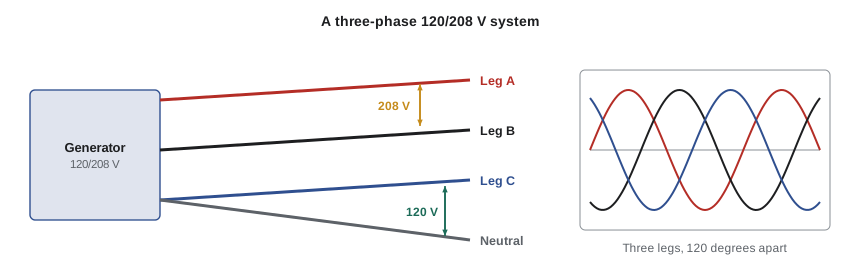
- Three-phase 120/208 V is common in commercial buildings, stages and film distribution. Three hot legs are each 120 V to neutral and 208 V to each other, 120° apart in phase.
- Higher-voltage systems power large buildings: 347/600 V in Canada and 277/480 V in the United States. Lighting distribution on set uses 120/208 V, so connecting to these systems requires transformers and specialists.
Three-phase systems deliver more power with less copper and allow large loads to be shared across three legs. Most film generators produce 120/208 V three-phase, with outlets for single-phase 120 V and 240 V or 208 V equipment.
Canadian commercial and industrial buildings commonly use 347/600 V services, with 347 V lighting circuits and transformers stepping down to 120/208 V for receptacles. A film tie-in to a 600 V service is high-voltage work that only licensed electricians can perform, with the right transformers and permits from the provincial electrical safety authority.
Power in three-phase systems
For a balanced three-phase load, the total power relates to the line-to-line voltage and the current in each leg:
Here \( V_{LL} \) is the line-to-line voltage (208 V), \( I \) the current per leg and PF the power factor, which is 1 for resistive loads such as tungsten.
Worked problem
Load of a lighting package on three-phase power
A night exterior uses a lighting package totalling 48 kW of resistive load, balanced across three legs of a 120/208 V generator. What current flows in each leg?
Show solution
- \( I = P \div (\sqrt{3} \times V_{LL}) = 48000 \div (1.732 \times 208) \).
- \( 1.732 \times 208 \approx 360 \).
- \( I \approx 48000 \div 360 \approx 133 \) A per leg.
Answer: About 133 A per leg. A generator and distribution rated for 200 A per leg would be needed, keeping the load below 80 % of the rating for continuous use (160 A).
Another way to estimate is to divide the total load by three and calculate each leg at 120 V: \( 16000 \div 120 \approx 133 \) A. Both methods agree for balanced loads.
Power factor, LED drivers and harmonics
Tungsten lamps are simple resistive loads: voltage and current rise and fall together. Modern film lighting is dominated by LED fixtures and HMI ballasts, which are electronic loads.
- Power factor (PF) is the ratio of real power, which does work, to apparent power, which the cables and generator must carry. A PF of 0.9 means the circuit carries about 11 % more current than the real power alone suggests.
- Good electronic ballasts and LED drivers have power-factor correction, raising PF close to 1. Older magnetic HMI ballasts and cheap drivers can have poor power factor.
- Electronic loads draw current in pulses, creating harmonics, currents at multiples of the 60 Hz line frequency. The third harmonic and its multiples add together in the neutral of a three-phase system instead of cancelling.
- Large LED and electronic-ballast loads can overheat neutrals sized only for balanced resistive loads. Many film distribution systems use "double neutral" feeders, with a neutral conductor twice the size of each hot leg, for this reason.
- Harmonics can also make some generators run unevenly, so generators for film use are chosen and sized with electronic loads in mind.
- Inrush current, a brief surge when equipment switches on, can trip breakers when many LED fixtures are switched at once. Staggering switch-on or using a dimmer or DMX console to bring lights up in groups helps.
How electricity harms people
Electric shock happens when current passes through the body. Current, not voltage, causes injury, but voltage drives current through the body's resistance, so higher voltages are more dangerous.
- Around 1 mA can be felt as a tingle.
- Around 10 to 20 mA can make muscles clamp, so a person cannot let go of a conductor.
- Around 50 to 100 mA through the chest can cause ventricular fibrillation, where the heart quivers instead of pumping, which is fatal without rapid CPR and defibrillation.
- Higher currents cause severe burns and tissue damage, often deep inside the body.
Body resistance varies hugely. Dry skin may have thousands of ohms; wet skin, sweat, cuts or standing in water may reduce resistance to a few hundred ohms. That is why wet locations, rain effects and water scenes are so dangerous for electricity (Lesson 4).
Worked problem
Why wet conditions matter
Estimate the current through a person touching a live 120 V conductor with a hand while standing on wet ground, if the total body and contact resistance is 1,000 Ω. Compare with dry conditions at 50,000 Ω.
Show solution
- Wet: \( I = V \div R = 120 \div 1000 = 0.12 \) A, or 120 mA.
- Dry: \( I = 120 \div 50000 = 0.0024 \) A, or 2.4 mA.
- 120 mA is in the range that can cause ventricular fibrillation; 2.4 mA is a perceptible shock.
Answer: Wet conditions can raise the current fifty-fold, from a tingle to a potentially fatal shock. This is why ground fault protection, which trips at about 5 mA, is required near water.
Other electrical injuries include arc flash, an explosive release of energy when current jumps through the air between conductors. Arc flash can cause severe burns, blindness, hearing damage and injuries from flying molten metal. It can happen when someone drops a tool across live busbars in a distribution box or connects equipment under load.
Electrical fires
Electricity causes fires when conductors or connections overheat.
- Overloaded cables heat up, softening insulation and eventually causing short circuits.
- Loose or dirty connections, such as a worn pin connector or a damaged Cam-Lok, create resistance and local heating.
- Coiled cable carrying heavy current cannot shed heat and can overheat, so feeder cable is laid out rather than left coiled when loaded.
- Damaged insulation, crushed by vehicles, cut by doors or stapled, can cause shorts and arcing.
- Hot fixtures placed near curtains, paper, set dressing or dry grass can ignite them (Lesson 5).
Overcurrent protection, fuses and circuit breakers, protects cables and equipment by cutting power when current exceeds safe levels. Breakers protect wiring, not people; it takes ground fault protection to protect people from shock.
Qualified people and electrical law
The law restricts electrical work to people with the right training and, for permanent installations and connections to building power, the right licences.
In Canada, the Canadian Electrical Code, Part I (CSA C22.1), adopted with amendments by each province, governs electrical installations. Section 44 covers theatre installations, including buildings used for motion picture and other shows, with rules for portable stage switchboards and equipment. Equipment must be certified by an accredited body such as CSA Group or another certification organization accredited by the Standards Council of Canada. Connecting to a building's electrical system is regulated electrical work that requires a licensed electrician and, in most provinces, a permit or notification to the electrical safety authority, such as the Electrical Safety Authority in Ontario or Technical Safety BC. Provincial OHS rules also require that only competent workers work on electrical equipment and that equipment be locked out before work on it. CSA Z462 sets out workplace electrical safety practices, including arc flash protection.
Set lighting technicians learn safe distribution practice through union training, apprenticeship and experience. Other crew members should never open distribution boxes, make connections or attempt repairs; their role is to recognize hazards and report them.
| Quantity | Unit | What it means on set |
|---|---|---|
| Voltage | V | 120 V for most fixtures; 208 V or 240 V for large heads |
| Current | A | Decides cable size, breaker size and generator capacity |
| Resistance | Ω | Low in copper cable; body resistance falls when wet |
| Power | W, kW | Fixture rating; total package load sizes the generator |
| Power factor | none | Below 1 means more current for the same real power |
| Frequency | Hz | 60 Hz in North America; flicker appears at 120 Hz |
Common mistakes
MistakeAdding up only wattage without checking circuit and continuous-load limits.
InsteadConvert to amps and keep continuous loads at or below 80 % of circuit rating.
MistakeAssuming LED loads are harmless to neutrals because they use less power.
InsteadElectronic loads create harmonics that add in the neutral; use double neutral feeders where needed.
MistakeThinking breakers protect people from shock.
InsteadBreakers protect cables; ground fault protection protects people.
MistakeTreating 120 V as low risk.
Instead120 V can push lethal current, especially in wet conditions.
MistakeLetting non-electrical crew open distro boxes or make connections.
InsteadOnly qualified electricians work on distribution.
Summary and key terms
- Voltage pushes current through resistance, and power equals voltage times current.
- North America uses 60 Hz AC, with 120/240 V split-phase and 120/208 V three-phase systems.
- Canada uses 347/600 V and the US 277/480 V for large buildings; tie-ins are specialist work.
- Three-phase power is \( \sqrt{3} \, V_{LL} \, I \, \text{PF} \); balanced loads share current across legs.
- LED and electronic loads have power factor and harmonic effects that affect neutrals and generators.
- Current through the body causes shock; wet conditions make 120 V deadly.
- Electrical work is regulated by the CE Code and provincial rules in Canada and the NEC and OSHA in the US.
- Voltage
- The electrical pressure that drives current, measured in volts.
- Current
- The rate of flow of electric charge, measured in amperes.
- Power factor
- The ratio of real power to apparent power in an AC circuit.
- Three-phase
- A system with three hot legs 120° apart, common for film distribution.
- Harmonics
- Currents at multiples of the line frequency created by electronic loads.
- Ventricular fibrillation
- A fatal heart rhythm that electric shock can cause.
- Arc flash
- An explosive release of energy from current arcing through the air.
- Overcurrent protection
- Fuses and breakers that cut power when current is too high.
- Double neutral
- A feeder neutral twice the size of each hot leg, used for harmonic loads.
- Qualified person
- Someone trained to recognize and avoid electrical hazards on the equipment involved.
Practice problems
Work each problem on paper first, then reveal the answer to check.
Current drawn by a 650 W fixture on 120 V?
Show answer
About 5.4 A.
Maximum continuous load on a 20 A circuit?
Show answer
About 16 A (80 %).
Voltage between two legs of a 120/208 V system?
Show answer
208 V.
Current per leg for 36 kW balanced on 120/208 V?
Show answer
About 100 A.
Why are neutrals oversized for LED loads?
Show answer
Triplen harmonics add in the neutral.
About what current can cause ventricular fibrillation?
Show answer
About 50 to 100 mA through the chest.
Current through 500 Ω at 120 V?
Show answer
240 mA.
What do breakers protect?
Show answer
Cables and equipment from overcurrent, not people from shock.
Which code governs electrical installations in Canada?
Show answer
The Canadian Electrical Code, Part I (CSA C22.1).
Which NEC article covers motion picture studios and remote locations?
Show answer
Article 530.
Lesson quiz · 5 questions
Score 60% or more to complete this lesson.
Create a free account to save your progress, take quizzes and earn a certificate.