
CINE-340 · Lesson 5 of 12 · 27 min
Lighting fixtures: LED, HMI, tungsten, heat, UV and fire
The lights themselves bring hazards of their own. A tungsten fresnel's lens can reach temperatures that burn skin in an instant and ignite fabric. An HMI lamp operates at high pressure and is ignited by a pulse of thousands of volts; when a lamp fails, it can shatter, and without its protective lens it emits ultraviolet radiation that burns eyes and skin. LED fixtures run cooler but can be very heavy, draw surge currents when switched on and produce bright light that can dazzle. Older or specialty sources, such as carbon arcs, xenon lamps, lasers and strobes, bring further hazards. This lesson covers the main fixture types, how each can harm crew or start fires, safe handling and mounting, flicker and the camera, and fire prevention around hot lights.
The main fixture families
Modern set lighting uses four main families of light source.
- Tungsten halogen (incandescent) fixtures, such as fresnels, open-face lights and PAR cans, heat a filament inside a quartz envelope. They are simple and give a continuous spectrum, but most of their power becomes heat, and they run very hot.
- HMI (hydrargyrum medium-arc iodide) fixtures produce daylight-balanced light from an arc in a gas-filled lamp, with much higher efficiency than tungsten. They need a ballast to ignite and run the lamp.
- LED fixtures, such as panels, fresnels, tubes and large soft sources, use light-emitting diodes and electronic drivers. They are efficient, cooler, dimmable and often colour-tunable, and they now dominate much of set lighting.
- Fluorescent fixtures, once common as soft sources, use gas-discharge tubes and ballasts. They have largely been replaced by LED.
Specialty sources include xenon searchlights, high-output plasma lights, strobes, lasers and practical lamps in set dressing.
| Family | Typical use | Main hazards |
|---|---|---|
| Tungsten halogen | Fresnels, open-face, PARs | Very hot surfaces, fire, burns, lamp breakage |
| HMI | Daylight keys, large exteriors | High ignition voltage, lamp explosion, UV, heat |
| LED | Panels, tubes, soft sources, fresnels | Weight, inrush current, glare, battery fires |
| Fluorescent | Older soft sources | Mercury in tubes, glass breakage |
| Xenon and plasma | Searchlights, effects | Very high pressure lamps, UV, heat |
| Strobes and lasers | Effects and atmosphere | Photosensitive seizures, eye damage |
Heat and burns
Tungsten fixtures turn most of their electrical power into heat. A 2 kW tungsten fresnel releases roughly 2 kW of heat into its housing, lens and surroundings. Even LED fixtures release most of their power as heat through heat sinks and fans, though at much lower temperatures.
- Lenses, barn doors, scrims and housings of hot lights can cause serious burns within seconds. Use heat-resistant gloves when adjusting barn doors, changing scrims or moving hot fixtures.
- Let fixtures cool before striking, packing or relamping. Relamp only with power disconnected.
- Never touch a quartz lamp's glass with bare fingers; skin oils cause hot spots that can make the lamp fail violently. Handle lamps with gloves or the protective sleeve.
- Keep scrims and gels in their correct holders; gels placed directly on lenses can melt or burn.
- Use lamps rated for the fixture and never exceed the fixture's rated wattage.
Worked problem
How much heat is in the room?
A small interior uses four 2 kW tungsten fresnels and two 1 kW open-face lights, all running for a two-hour scene. Roughly how much heat do the lights release, and what difference would LED fixtures of equal output make if they used about one-quarter of the power?
Show solution
- Tungsten power: 4 × 2 + 2 × 1 = 10 kW. Nearly all of it becomes heat in the room.
- Energy over two hours: 10 kW × 2 h = 20 kWh, roughly the heat of ten space heaters running for two hours.
- LED of equal light output at one-quarter power: about 2.5 kW, or about 5 kWh over two hours.
Answer: About 20 kWh of heat with tungsten against about 5 kWh with LED. Lower heat helps actors, makeup, food on set and air conditioning loads, and reduces fire risk, which is one reason productions have moved to LED.
HMI lamps and ballasts
HMI fixtures are workhorses for daylight and large night exteriors, but they need respect.
- Ignition voltage: an HMI ballast strikes the lamp with a pulse of several thousand volts and then runs it at lower voltage. Never open the fixture or touch the lamp, head cable connectors or ballast output while powered.
- Head cables and connectors must be in good condition; damaged head cables can expose crew to ignition voltages.
- Lamp failure: HMI lamps are under pressure when hot. At the end of life, or if damaged, they can shatter. The fixture's front glass contains fragments. Replace lamps at or before their rated life.
- Ultraviolet radiation: HMI arcs emit strong UV, including UV-C. The fixture's protective glass or lens filters it. Never run an HMI without its UV-protective lens, and replace cracked lenses. Many fixtures have safety interlocks that shut off the lamp if the lens door opens.
- Hot restrike: some fixtures cannot restart a hot lamp immediately. Forcing repeated strikes stresses the lamp.
- Ballasts: electronic ballasts are flicker-free at many frame rates and usually have power-factor correction, but they are electronic loads with harmonics and inrush (Lesson 2). Keep ballasts dry, ventilated and off wet ground.
- Weight: large HMIs, such as 18 kW fresnels, weigh tens of kilograms and are mounted on heavy-duty stands, condors or rigging by trained crew.
LED fixtures
LED fixtures have made sets cooler and more flexible, but they are not hazard-free.
- Weight and size: large LED soft sources and panels can be heavy and act as sails in wind (Lesson 8).
- Inrush current: switching many LED drivers on at once can trip breakers. Bring them up in groups or through a console.
- Batteries: many LEDs run on lithium-ion batteries, which can overheat, catch fire or explode if damaged, overcharged or short-circuited. Use approved chargers, inspect batteries, store them safely and follow transport rules. Contract Services publishes a fact sheet on lithium-ion battery safety.
- Glare and blue light: very bright LED sources can dazzle crew and performers. Avoid looking directly into fixtures, and warn talent before bright sources are switched on in their eyeline.
- Wireless control: LED fixtures controlled by wireless DMX or apps can change unexpectedly if networks conflict. Control systems should be secured.
Flicker and the camera
Flicker is a picture problem, but it can lead to safety problems when crews rush to fix it. Understanding it helps.
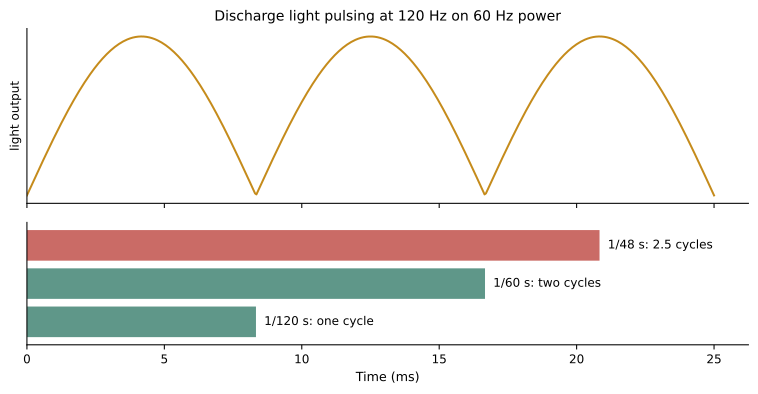
- AC-powered discharge and some LED sources vary in output at twice the line frequency, 120 Hz in North America.
- Shooting at frame rates and shutter angles that do not match the flicker frequency can produce pulsing exposure or colour.
- Safe combinations on 60 Hz power include 24, 30 or 60 fps with shutter speeds of 1/60 or 1/120 s, but high-speed work needs flicker-free sources.
- Flicker-free electronic ballasts and high-quality LED drivers eliminate most flicker.
Worked problem
Checking a flicker-safe shutter speed
A crew shooting at 24 fps under practical fluorescent lights on 60 Hz power uses a 180° shutter (1/48 s). Is that flicker-safe? What shutter speed would be safer?
Show solution
- Light output varies at 120 Hz, so one cycle lasts 1/120 s.
- A safe exposure contains a whole number of cycles: 1/120 s (one cycle) or 1/60 s (two cycles).
- 1/48 s contains 120 ÷ 48 = 2.5 cycles, not a whole number, so exposure varies frame to frame.
- Changing to a 144° shutter at 24 fps gives 1/60 s, a whole number of cycles.
Answer: 1/48 s is not flicker-safe under 60 Hz discharge lighting; 1/60 s (144° at 24 fps) is safer. CINE-330 covers flicker at high frame rates.
Mounting, stands and overhead fixtures
How lights are mounted is as important as the light itself.
- Use stands rated for the fixture's weight, extended no further than their rating allows, with the heaviest leg under the load.
- Sandbag stands, especially when extended high or outdoors; US guidance and many safety programs require sandbags on every stand.
- Secure fixtures with safety cables (safeties) whenever they are mounted overhead or on rigging, so that if a clamp or yoke fails the fixture cannot fall.
- Secure barn doors, scrims and accessories with their retaining clips or safety chains.
- Keep lights away from walkways and areas where actors move, and mark stand legs with tape or glow markers in dark sets.
- Never stand directly beneath a fixture being raised, lowered or adjusted overhead.
Lesson 6 covers rigging in detail.
Fire prevention around lights
Fires on sets are rare but can spread quickly through set dressing, curtains, paper, costumes and dry vegetation.
- Keep hot fixtures a safe distance from combustibles; follow manufacturer minimum distances.
- Use flame-retardant materials for diffusion, flags, set dressing and drapes where possible, and keep test certificates available.
- Never cover a fixture's vents or rest gels, diffusion or clothing on hot fixtures.
- Keep fire extinguishers of the right type near lights, generators and distribution, and know how to use them (HSE-105 covers extinguishers).
- Respect venue rules and fire department requirements, which may include fire watches when open flames or large hot lights are used.
- Turn off fixtures when not needed, especially in confined spaces.
- Treat practical lamps with care: practical bulbs inside lampshades can scorch shades if the wattage is too high.
In Canada, provincial and municipal fire codes, based on the National Fire Code, apply to film locations, and fire departments may issue permits and require fire safety officers for open flames, pyrotechnics or large crowds. The Ontario film guidelines also cover open flames, smoke and fog, and propane use.
Strobes, lasers and atmosphere
Some lighting effects affect health directly.
- Strobes and fast flashing lights can trigger seizures in people with photosensitive epilepsy, especially at flash rates of about 3 to 30 per second. Tell cast and crew in advance, limit flash rates and duration, and offer alternatives.
- Lasers used for effects must be classified, and higher-power lasers need a qualified operator, controlled beam paths and no direct exposure to eyes or camera sensors.
- Haze and fog effects require approved fluids, ventilation and attention to exposure limits; US Bulletin 10 and Ontario Guideline 9 address smoke and fog.
In Canada, laser products are regulated under the Radiation Emitting Devices Act by Health Canada, and high-power entertainment lasers may also need provincial approval or notification.
Relamping and lamp disposal
Changing lamps is routine but carries risk. Disconnect power and let the fixture cool before opening it, wear gloves and eye protection, and handle new lamps by their bases or in their sleeves. Inspect sockets for pitting or burning, which can cause poor contact and overheating, and replace damaged sockets rather than forcing a new lamp in. Spent HMI and fluorescent lamps contain mercury and metal halides and must not go in ordinary garbage; return them to the rental house or dispose of them through hazardous waste programs. Broken lamps should be cleaned up with gloves, the area ventilated and the pieces sealed in a container. Keep a log of lamp hours for HMIs so lamps are replaced before they reach the end of their rated life, when the risk of failure rises.
Common mistakes
MistakeAdjusting barn doors or scrims on a hot fixture with bare hands.
InsteadUse heat-resistant gloves and let fixtures cool.
MistakeRunning an HMI with a cracked or missing UV lens.
InsteadReplace the lens before use; interlocks exist for a reason.
MistakeCharging damaged lithium-ion batteries or storing them loose with metal objects.
InsteadInspect, use approved chargers and store batteries safely.
MistakeMounting a fixture overhead without a safety cable.
InsteadEvery overhead fixture and accessory needs a safety.
MistakeDraping diffusion or gels directly on hot lenses.
InsteadUse proper holders at safe distances and flame-retardant materials.
Summary and key terms
- Tungsten, HMI, LED and fluorescent fixtures each bring different hazards.
- Hot fixtures cause burns and fires; gloves, distance and cooling time reduce risk.
- HMI lamps need high ignition voltage, protective UV lenses and careful lamp handling.
- LED fixtures are cooler but bring weight, inrush current and lithium-ion battery risks.
- Flicker-safe shutter speeds on 60 Hz power contain whole numbers of 1/120 s cycles.
- Stands must be rated and sandbagged, and overhead fixtures need safety cables.
- Fire prevention, flame-retardant materials, extinguishers and fire department rules protect sets.
- HMI
- A daylight discharge lamp that needs a ballast and emits UV without its protective lens.
- Ballast
- The electronic unit that ignites and runs a discharge lamp.
- Tungsten halogen
- An incandescent lamp in a quartz envelope that runs very hot.
- Safety cable
- A steel cable that catches a fixture or accessory if its mount fails.
- Flicker-free
- A ballast or driver that eliminates light variation at line frequency.
- Inrush current
- A brief surge of current when electronic equipment switches on.
- Hot restrike
- Restarting a discharge lamp before it cools.
- Photosensitive epilepsy
- A condition in which flashing lights can trigger seizures.
- Flame retardant
- A treatment or material that resists ignition and slows fire spread.
- Barn doors
- Hinged metal flaps on a fixture used to shape the beam.
Practice problems
Work each problem on paper first, then reveal the answer to check.
Why not touch a quartz lamp with bare fingers?
Show answer
Skin oils create hot spots that can make the lamp fail.
What filters UV from an HMI lamp?
Show answer
The fixture's protective glass or lens.
Is 1/48 s flicker-safe on 60 Hz discharge light?
Show answer
No; it contains 2.5 cycles of 120 Hz.
Heat released by 6 kW of tungsten for 3 hours?
Show answer
About 18 kWh.
What causes LED breaker trips at switch-on?
Show answer
Inrush current from many drivers at once.
Name one lithium-ion battery hazard.
Show answer
Overheating, fire or explosion if damaged or overcharged.
What must every overhead fixture have?
Show answer
A safety cable.
Flash rates most likely to trigger seizures?
Show answer
About 3 to 30 flashes per second.
Which US bulletin covers open flame?
Show answer
Bulletin 19.
Who regulates laser products in Canada?
Show answer
Health Canada under the Radiation Emitting Devices Act.
Lesson quiz · 5 questions
Score 60% or more to complete this lesson.
Create a free account to save your progress, take quizzes and earn a certificate.