
CINE-340 · Lesson 1 of 12 · 29 min
Safety on a film set: hazards, roles and culture
A film set is a temporary workplace that is built in the morning and gone by night. In a single day a crew may run hundreds of amps of power through cables laid across a parking lot, hang lights from a ceiling grid, put an actor in a moving car, flood a street with rain towers and send a technician up a 25 m boom lift in the wind. The crew changes from show to show, the location changes from day to day and the schedule is always tight. Those features make film and television production one of the more hazardous creative industries, and they explain why safety on set depends so heavily on planning, communication and a culture in which anyone can stop work. This course gives camera, grip and electric crews an awareness-level understanding of the main hazards: electricity, lighting fixtures, rigging, heights, weather and water, vehicles, stunts and special effects, and fatigue. It ends with a safety plan for a location shoot.
This course is awareness-level education. Always follow the law where you work, your employer's safety program, manufacturers' instructions and the directions of qualified people on set.
Why film sets are hazardous
Most workplaces control hazards with permanent engineering: fixed wiring, guardrails, marked walkways and machine guards installed once and inspected regularly. A set rarely has that luxury. The crew builds a new temporary workplace at every location, often in places never designed for work, such as private homes, rooftops, forests, rivers and busy streets. Several factors combine.
- Temporary power and equipment are installed and removed daily, often by different crew members.
- Many trades work in a small space at the same time: grips rigging overhead while electricians run cable below and set dressers carry furniture through.
- Schedules are tight and expensive, so pressure to "get the shot" can push people to skip steps.
- Long hours and short turnarounds cause fatigue, which slows reactions and impairs judgment.
- Effects, stunts, vehicles, water and animals bring specialized hazards that need specialized people.
- Crews are freelance and move between productions, so each show must establish its own safety system quickly.
- Locations bring outside hazards: traffic, the public, uneven ground, wildlife, extreme weather and unfamiliar buildings.
Serious incidents in the industry have rarely had a single cause. Investigations usually find a chain of decisions: a missing permit, an unrehearsed shot, an untrained crew member in a dangerous role, a safety concern raised and ignored. Breaking that chain at any link prevents the harm, which is why every crew member matters.
The legal framework
Safety on set is not just good practice; it is the law. Producers are employers, and the law requires employers to take every reasonable precaution to protect workers.
In Canada, workplace health and safety is mainly provincial. Each province and territory has an occupational health and safety act and regulations, enforced by agencies such as WorkSafeBC, Ontario's Ministry of Labour, Immigration, Training and Skills Development, Alberta OHS and the CNESST in Quebec. Employers must assess hazards, train and supervise workers and provide safe equipment, and supervisors and workers have their own duties. Workers have three core rights: to know about hazards, to participate through health and safety committees or representatives, and to refuse unsafe work. Federally regulated work, such as some broadcasting, falls under the Canada Labour Code, Part II.
The industry adds guidance on top of the law. In Ontario, a committee of industry, labour and government under section 21 of the Occupational Health and Safety Act wrote the Safety Guidelines for the Film and Television Industry, with 43 guidelines covering topics such as electrical safety, working at heights, mobile elevating equipment, camera cars, firearms, explosives and pyrotechnics, and water hazards. In British Columbia, Actsafe, the health and safety association for the arts and entertainment industries, provides motion picture safety orientation, guidance and training. Unions and guilds, including IATSE Locals 667, 669, 873 and 891, NABET 700-M, the Directors Guild of Canada and ACTRA, also negotiate safety provisions and train their members.
Who does what: safety roles on a production
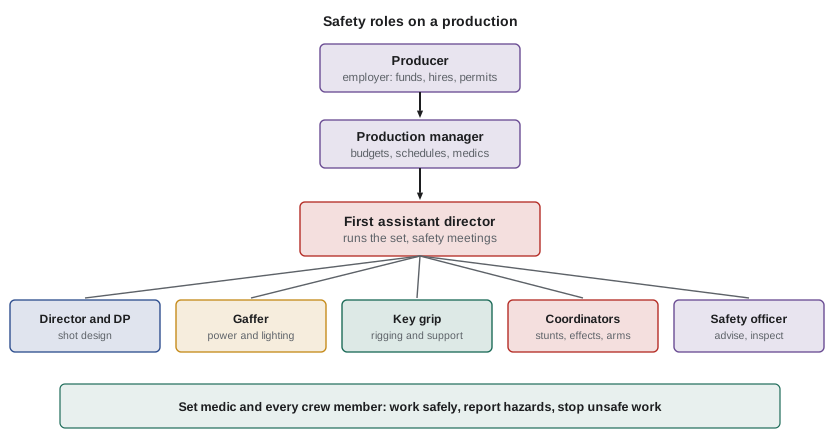
Safety is everyone's job, but specific people carry specific responsibilities. Knowing who to ask is part of working safely.
- The producer and production company are the employer. They must fund safety, hire qualified people, get permits and insurance, and make sure there is a safety program.
- The production manager and line producer turn the safety program into budgets, schedules and contracts, and often coordinate location safety, permits and medics.
- The first assistant director runs the set. The 1st AD leads safety meetings, controls who enters the set during hazardous shots, calls rehearsals and can stop work.
- The director and the director of photography design shots. Their creative choices create or remove hazards, so they must plan with safety in mind.
- The gaffer leads the electrical department and is responsible for safe power distribution and lighting. The best boy electric manages crew, equipment and paperwork.
- The key grip leads the grip department: rigging, camera support, dollies, cranes, flags and frames. The best boy grip manages crew and gear.
- Specialist coordinators, such as the stunt coordinator, special effects coordinator, armourer, marine coordinator, picture car coordinator and animal coordinator, are responsible for their specialties.
- A production safety officer or safety representative, required on many productions, advises, inspects and documents. Health and safety committees or worker representatives give crew a voice.
- Set medics or first aid attendants provide first aid and know how to call emergency services to the location.
- Every crew member must work safely, use protective equipment, report hazards and refuse unsafe work.
Hazard, risk and control
Safety professionals separate a hazard, which is anything that can cause harm, from risk, which combines how likely harm is with how severe it would be. A 4/0 feeder cable is a hazard; the risk depends on whether it is protected, inspected and routed where no one can trip on it. Productions assess risk before work begins and choose controls to reduce it.
The hierarchy of controls ranks controls from most to least effective.
- Elimination: remove the hazard. Shoot the car scene on a process trailer instead of having the actor drive. Use a battery-powered LED instead of running cable into a wet location.
- Substitution: replace with something less hazardous. Use LED fixtures that run cooler than tungsten. Use a non-firing replica instead of a real firearm.
- Engineering controls: isolate people from the hazard. Ground fault protection, guardrails, cable ramps, barricades and closed roads.
- Administrative controls: change how people work. Safety meetings, permits, training, schedules, signage and rehearsals.
- Personal protective equipment: the last line of defence. Gloves, safety footwear, hearing protection, eye protection, harnesses and high-visibility clothing.
Controls higher in the hierarchy protect people even when they make mistakes; lower controls depend on everyone doing the right thing every time. A good safety plan uses several layers.
| Level | Example on set | Depends on |
|---|---|---|
| Elimination | Use a process trailer so the actor does not drive | Planning in pre-production |
| Substitution | LED fixtures instead of hot tungsten near a curtain | Equipment choice |
| Engineering | Ground fault protection on all wet-area circuits | Correct installation |
| Administrative | Safety meeting and rehearsal before a stunt | People following the plan |
| PPE | Gloves for handling hot lamps and cable | People wearing it correctly |
Worked problem
Scoring risk with a simple matrix
A production uses a 5 × 5 risk matrix where likelihood and severity are each scored from 1 to 5 and risk = likelihood × severity. Scores of 15 or more need senior approval and extra controls. Feeder cable is laid across a busy catering path at night. Likelihood of a trip is judged 4 and severity 3 (a sprain or fracture). After controls are added (rerouting cable around the path, cable ramps where it must cross and lighting), likelihood drops to 1. What are the scores before and after?
Show solution
- Before controls: risk = 4 × 3 = 12.
- After controls: risk = 1 × 3 = 3.
- Severity did not change, because a trip could still cause a fracture; the controls reduced likelihood.
Answer: The risk falls from 12 to 3. Neither score needs senior approval, but the controls reduce risk by 75 % and cost almost nothing. A matrix is only a tool; its value is in making the crew think through each hazard.
Safety meetings and communication
Communication is the most powerful safety tool on a set. The crew may be new to each other and to the location, so clear, repeated information matters.
- The call sheet carries safety notes: hazards of the day (for example, "Scene 42: rain towers and electrical near water; Scene 45: stunt fall"), the location of the nearest hospital, the set medic, weather and special instructions.
- A general safety meeting is held at the start of each day or on arrival at a new location, covering the day's hazards, emergency exits and assembly points, first aid and how to report concerns.
- Specific safety meetings are held before any hazardous work, such as stunts, special effects, firearms, vehicles, water work or aerial lifts, with everyone involved present.
- Walk-throughs and rehearsals at reduced speed let everyone see the action before the real take.
- Radios and clear call protocols ("rolling", "cut", "hold the work") keep everyone informed; a single word such as "stop" or "cut" from anyone must halt hazardous action.
- Records of safety meetings, attendance and inspections show what was done and help investigations.
Many guidelines also call for advance notice of hazardous work, so that crew and performers can raise concerns or refuse. In Ontario, Guideline 3 deals with communication about potentially hazardous procedures. In the United States, Bulletin 5 calls for safety meetings and awareness on every production.
The right to refuse and stopping work
Every crew member has the right and the duty to stop or refuse work they reasonably believe is unsafe.
Canadian OHS laws give every worker the right to refuse work they have reason to believe is dangerous, following a set process: report to the supervisor, investigation with a worker representative, and if unresolved, involvement of a government inspector. Employers may not punish workers for using this right in good faith.
On set, the practical version is simple: if something looks wrong, say so, and if needed, call a hold. A good 1st AD and a good DP welcome this, because a short pause costs far less than an injury, a lawsuit or a lost life. A culture in which junior crew feel they cannot speak up is itself a serious hazard.
A safety culture on set
Safety culture means the shared attitudes and behaviours that decide what people actually do when no one is watching. Strong safety cultures share some features.
- Leaders model safe behaviour: the DP wears a harness on the crane, the gaffer checks the ground fault protection before the rain scene, the producer budgets for a safety officer.
- Concerns are welcomed and acted on, and the person who raised them is thanked.
- Near misses are reported and discussed, because they show where the next accident could happen.
- Schedules include time for setting up safely; "we're losing the light" is not a reason to skip steps.
- People are trained and qualified for their roles, and specialists are hired for specialized hazards.
- Fatigue is treated as a hazard, not a badge of honour.
The industry has learned these lessons through tragedy. The 2014 death of camera assistant Sarah Jones, struck by a train on a railway bridge during a shoot without permission to be on the tracks, and the 2021 death of cinematographer Halyna Hutchins, shot with a firearm on a set where live ammunition was present, both led to changes in training, guidance and attitudes. Both are discussed in later lessons. The common message is that no shot is worth a life.
Protective equipment basics for camera, grip and electric
PPE is the last line of defence, but it matters. Typical PPE for set lighting and grip crews includes:
- Safety footwear with toe protection and slip-resistant soles, often required on stages and construction-type locations.
- Work gloves for handling cable, rigging and hot equipment, and heat-resistant gloves for hot lamps.
- Eye protection when cutting, drilling, working overhead or near effects.
- Hearing protection near generators, effects and loud playback.
- Hard hats where there is a risk of falling objects, such as under rigging or on construction sites.
- High-visibility clothing when working near traffic or vehicles.
- Fall protection equipment when working at height, used only by trained workers (Lesson 7).
- Weather gear, sun protection and cold-weather clothing for exterior work (Lesson 8).
Worked problem
Applying the controls to a night exterior
A night exterior on a residential street needs a 12 kW HMI on a stand, a generator at the end of the block and cable along the sidewalk. List one control at each level of the hierarchy.
Show solution
- Elimination: place the generator so cable does not cross the road at all, or use a battery-powered LED for small fill lights.
- Substitution: replace the 12 kW HMI with a lower-power LED if it gives enough light.
- Engineering: use cable ramps at driveways, sandbags and a safety line on the stand, and ground fault protection.
- Administrative: safety meeting, permits, signage for residents, a crew member watching the cable path, and lighting along walkways.
- PPE: gloves, high-visibility vests for crew near the road and safety footwear.
Answer: A layered plan uses several controls. Planning choices made before the shoot day, such as generator placement and fixture choice, remove the most risk at the lowest cost.
Common mistakes
MistakeAssuming safety is someone else's job, such as the safety officer's.
InsteadEvery crew member must work safely, report hazards and stop unsafe work.
MistakeRelying on PPE alone to manage a hazard.
InsteadUse the hierarchy of controls, starting with elimination and engineering controls.
MistakeSkipping the safety meeting because the crew "has done this before".
InsteadHold meetings for every hazardous procedure and every new location.
MistakeTreating the call sheet safety notes as boilerplate.
InsteadRead them; they list the day's hazards, medic and hospital.
MistakeStaying silent about a concern to avoid slowing the shoot.
InsteadSpeak up or call a hold; a pause costs far less than an injury.
Summary and key terms
- Film sets are temporary workplaces with changing crews, locations and specialized hazards.
- Producers are employers with legal duties under provincial OHS law in Canada and OSHA in the US.
- Industry guidance such as Ontario's film guidelines, Actsafe and the US Safety Bulletins adds detail to the law.
- The first AD runs safety on set; gaffers, key grips and coordinators lead their departments' hazards.
- The hierarchy of controls favours elimination and engineering over PPE.
- Safety meetings, call sheet notes and rehearsals are the most important communication tools.
- Every worker has the right and duty to raise concerns and refuse unsafe work.
- Hazard
- Anything with the potential to cause harm.
- Risk
- The combination of the likelihood and severity of harm from a hazard.
- Hierarchy of controls
- The ranking of controls from elimination to PPE by effectiveness.
- Safety meeting
- A briefing on hazards and procedures before work or a hazardous shot.
- First assistant director
- The crew member who runs the set and leads safety meetings.
- Gaffer
- The head of the set lighting and electrical department.
- Key grip
- The head of the grip department, responsible for rigging and camera support.
- Near miss
- An event that could have caused harm but did not.
- Safety Bulletin
- A numbered US industry guideline from the Industry-Wide Labor-Management Safety Committee.
- Right to refuse
- A worker's legal right to refuse work believed to be dangerous.
Practice problems
Work each problem on paper first, then reveal the answer to check.
What is the difference between a hazard and a risk?
Show answer
A hazard can cause harm; risk combines likelihood and severity.
Who normally leads the safety meeting on set?
Show answer
The first assistant director.
Name the five levels of the hierarchy of controls.
Show answer
Elimination, substitution, engineering, administrative, PPE.
Likelihood 3, severity 5: what is the matrix score?
Show answer
15.
What safety information appears on a call sheet?
Show answer
Hazards of the day, nearest hospital, medic, weather and special notes.
Why are near misses worth reporting?
Show answer
They reveal where future injuries could happen.
Name two US Safety Bulletins and their topics.
Show answer
For example, Bulletin 1 firearms and Bulletin 23 portable power distribution.
Name two Canadian sources of film safety guidance.
Show answer
Ontario's film and television safety guidelines and Actsafe in BC.
Why is fatigue a hazard?
Show answer
It slows reactions and impairs judgment, on set and when driving home.
What should you do if you see an unsafe rig?
Show answer
Report it, and call a hold if there is immediate danger.
Lesson quiz · 5 questions
Score 60% or more to complete this lesson.
Create a free account to save your progress, take quizzes and earn a certificate.