
CINE-320 · Lesson 4 of 12 · 25 min
Operating handheld, shoulder rigs and gimbals
In documentary, the camera usually moves with the operator's body. Handheld and shoulder-mounted shooting give documentary its characteristic sense of presence: the viewer feels that someone was there, breathing and reacting. Done well, handheld camera work is fluid, purposeful and steady enough that the audience forgets about it. Done badly, it is shaky, restless and exhausting to watch. This lesson covers the physical craft of operating: stance, breathing and movement; handheld, shoulder, monopod, tripod and gimbal supports; when to use each; how to protect your body over long days; and how to plan battery power for a full day of operating. CINE-221 introduced camera movement and its grammar in drama; here the focus is on the endurance and responsiveness that documentary demands.
The body as a camera support
Good handheld operating starts with the body. The operator's skeleton, not their muscles, should carry the camera's weight as much as possible. Key principles include:
- Stance: feet roughly shoulder-width apart, knees slightly bent, weight balanced, so the legs act as shock absorbers.
- Elbows in: keep elbows close to the body to brace the camera against the torso.
- Three points of contact: the camera should touch the body in at least three places, such as two hands and the face or shoulder, to damp movement.
- Breathing: breathe slowly and steadily; for critical static shots, exhale and hold briefly.
- Walking: walk heel to toe with bent knees, rolling the feet to absorb shock, in a gliding movement sometimes called the ninja walk.
- Turning: turn from the hips and waist, not just the arms, so the camera pivots smoothly.
- Leaning: brace against walls, doorframes, furniture or vehicles whenever possible to steady static shots.
Wide lenses and image stabilization help enormously. Shake is magnified by focal length: the same tremor that is invisible at 24 mm becomes distracting at 100 mm. As a rule, handheld operators favour wide and normal focal lengths, move physically closer instead of zooming in, and use stabilization or a support when they must shoot long.
Handheld, shoulder and monopod
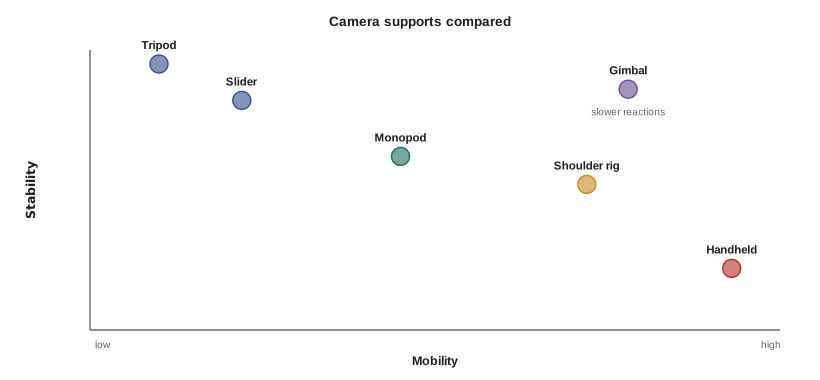
Small cameras can be held in front of the body with two hands and a monitor, at chest height or lower. This is discreet and flexible, allowing low angles and quick repositioning, but becomes tiring with heavier rigs and lacks a third point of contact. A top handle allows quick low and high shots, and a side grip or handle helps carry the camera ready to shoot.
Shoulder rigs place the camera's weight on the shoulder, with handles in front and often a counterweight or battery at the back for balance. A well-balanced shoulder rig can be operated for hours, with the eye at an electronic viewfinder providing a third point of contact. Shoulder height gives a natural eye-level perspective, although it can feel imposing in small rooms or with children, where kneeling or a lower handheld position may be better.
Monopods support the camera's weight on the ground while still allowing quick movement. They are excellent for long events, speeches, sports and interviews where the operator must reposition frequently. Some monopods have small feet that allow them to stand briefly, and fluid bases allow smooth pans.
Tripods and sliders
Tripods remain important in documentary for interviews, establishing shots, long lens work, time-lapse and observational scenes where a static frame is part of the visual approach. Many filmmakers, influenced by Frederick Wiseman or contemporary slow-cinema documentaries, deliberately use locked-off frames to observe without the restlessness of handheld. A lightweight tripod with a fluid head and quick-release plate lets the operator move between tripod and handheld in seconds. Sliders, small cranes and dollies add controlled movement to interviews and illustrative shots, but they slow production and are less common in purely observational work.
Gimbals
Motorized three-axis gimbals stabilize the camera electronically, keeping the horizon level and smoothing movement so that walking shots look almost as if they were on a dolly or Steadicam. Gimbals are popular for following subjects through spaces, travelling shots and sequences that need a floating, cinematic quality. They have drawbacks for documentary:
- Balance: the camera must be balanced on the gimbal, and changing lenses or accessories requires rebalancing.
- Weight and fatigue: holding a gimbal at arm's length is tiring, and payload limits restrict camera and lens choices.
- Reaction time: gimbals smooth out quick pans and tilts, making it harder to whip toward unexpected action.
- Look: gimbal footage can feel detached and impersonal compared with the human quality of handheld.
- Practicalities: gimbals need batteries, firmware updates and calibration, and they draw attention.
Many documentary operators use gimbals selectively, for specific sequences, and use handheld or shoulder rigs for the bulk of observational work. Supports such as vests and arms carry the gimbal's weight on the operator's body for longer takes.
| Support | Best for | Advantages | Limitations |
|---|---|---|---|
| Handheld | Fast, intimate observation | Discreet, flexible, quick | Fatigue, shake at long focal lengths |
| Shoulder rig | Long observational days | Balanced, eye-level, steady | Conspicuous, less flexible for low angles |
| Monopod | Events, speeches, sports | Supports weight, quick moves | Limited for walking shots |
| Tripod | Interviews, landscapes, time-lapse | Rock steady, precise | Slow to reposition |
| Gimbal | Following and travelling shots | Floating, smooth movement | Balance, weight, slower reactions |
| Slider | Interviews, illustrative shots | Controlled movement | Setup time |
Framing on the move
Handheld camera work in documentary is not only about steadiness. It is about responding intelligently to action. Experienced operators keep both eyes active, one at the viewfinder and the other watching the room, or glance up regularly to see what is happening outside the frame. They anticipate where people will move and position themselves early, often walking backward ahead of a subject with a colleague guiding them. They hold shots long enough to be usable, typically at least ten seconds for any significant framing, and move with motivation, following a look, a gesture or an entrance rather than wandering. When the camera must reframe during a shot, the movement should feel like a natural shift of attention.
Focus is an equal challenge. Modern autofocus with face and eye detection is reliable in many situations, and many documentary operators now use it most of the time, switching to manual focus when the camera is likely to hunt, such as through glass, with foreground objects or in low light. Shooting at moderate apertures (around f/4 to f/5.6 on Super 35) gives some depth of field to absorb small focus errors while still separating subjects from backgrounds.
Protecting your body
Documentary operators may hold cameras for ten or more hours a day, often for weeks. Repetitive strain injuries of the back, neck, shoulders and wrists are common. Good practice includes balancing rigs carefully, using support vests or harnesses for heavy configurations, switching between supports during the day, resting the camera whenever possible, stretching before and after shooting, staying hydrated, and building core and back strength. Safe lifting of camera cases and good ergonomics in vehicles matter too. A cinematographer who is injured cannot shoot, so long-term physical health is a professional responsibility.
Planning power for a shoot day
Long operating days require enough battery power for the camera, monitor, wireless audio and video, and any lights. The calculation is straightforward once the power draw of each item is known, usually from manufacturer specifications.
Here \( t \) is runtime in hours, \( E \) is battery capacity in watt-hours, \( \eta \) is the usable fraction (often 0.8 to 0.9, lower in cold weather) and \( P \) is total power draw in watts.
Worked problem
Batteries for a 10-hour observational day
A shoulder-mounted camera package draws 22 W (camera 16 W, viewfinder 3 W, wireless audio receiver 3 W). The camera is powered on for about 7 of the 10 hours. The crew uses 98 Wh V-mount batteries with 85 % usable capacity. A 98 Wh battery takes about 2.5 hours to charge, and a two-bay charger is available only at lunch for 1 hour. How many batteries should the crew carry?
Show solution
- Energy per battery: \( 98 \times 0.85 \approx 83 \) Wh usable.
- Runtime per battery: \( 83 \div 22 \approx 3.8 \) hours.
- Energy needed: \( 22 \times 7 = 154 \) Wh, which is \( 154 \div 83 \approx 1.9 \) batteries.
- Lunch charging adds at most about \( 2 \times \frac{1}{2.5} \approx 0.8 \) of a battery, and only if two drained batteries are on the charger.
- Allow for cold, unexpected long takes and lights: a margin of 50 to 100 % is prudent.
Answer: At least three, and preferably four, 98 Wh batteries for the day, with lunch charging as a bonus rather than a requirement.
In cold climates, which are common in Canadian winters and northern US states, keep batteries warm in inside pockets, use insulated covers and expect capacity to fall significantly. Condensation is a risk when moving cold equipment into warm interiors; seal cameras in bags before entering and let them warm slowly.
Practising the craft
The best way to improve handheld operating is practice and review. Shoot long takes following a friend through a busy space, review the footage critically on a large screen, and notice where shake, hesitation or wandering frames appear. Practise walking backward, moving through doorways, transitioning from a wide establishing frame to a close-up, and finding a steady static frame at the end of a movement. Over time, operators develop a personal style, a kind of signature in how the camera breathes, that becomes part of a film's visual identity.
Operating in crowds and tight spaces
Documentary operators often work in crowded rooms, vehicles, corridors and outdoor gatherings where there is little space and people move unpredictably. In tight spaces, a smaller handheld configuration with a wide lens lets you stay close without blocking others, and a top handle allows you to lift the camera above heads for a moment of overview. In crowds, keep your back protected when possible, know your exits, and work with a colleague who watches for obstacles and threats while you look through the viewfinder. Walking backward is especially risky: agree on a tap signal from your partner for steps, curbs and obstacles. In vehicles, wedge yourself securely, use the widest lens available and avoid holding the camera where an airbag could deploy. These habits protect both the operator and the people around them, and they let the operator concentrate on the shot rather than on staying upright.
Developing a camera style
Handheld camera work carries a personality. Some documentary cinematographers favour a calm, almost static handheld frame that drifts gently with the subject; others embrace a more energetic, searching camera that reflects the urgency of events. Neither is right in every case. The style should suit the film's subject and mode: a contemplative portrait of an elderly artist may call for stillness, while a film about emergency responders may justify a restless, reactive camera. What matters is that the style is deliberate and consistent, so that changes in camera behaviour carry meaning. A sudden shift from calm to agitated operating, for example, can signal to the audience that something has changed in the scene.
Common mistakes
MistakeZooming in from far away while handheld.
InsteadMove closer with a wide or normal lens and use support for long lenses.
MistakeMuscling the camera with arms extended.
InsteadKeep elbows in and use three points of contact and the skeleton.
MistakeUsing a gimbal for everything.
InsteadUse gimbals selectively; they slow reactions and change the feel.
MistakePlanning batteries without margin.
InsteadCalculate draw and runtime and add 50 to 100 % margin, more in cold.
MistakeIgnoring physical strain.
InsteadBalance rigs, alternate supports, rest, stretch and build strength.
Summary and key terms
- Handheld stability comes from stance, braced elbows, three points of contact and steady breathing.
- Shake increases with focal length, so handheld operators favour wide lenses and move closer.
- Shoulder rigs and monopods support long days; tripods give observational stillness.
- Gimbals add floating movement but cost balance time, reaction speed and intimacy.
- Good handheld framing anticipates action, holds shots and moves with motivation.
- Runtime equals usable energy divided by power draw; plan batteries with generous margin.
- Protecting the operator's body is part of professional practice.
- Three points of contact
- Bracing the camera with at least three body contacts to damp movement.
- Ninja walk
- A bent-knee, heel-to-toe gliding walk for smooth handheld movement.
- Shoulder rig
- A support that rests the camera on the operator's shoulder.
- Monopod
- A single-leg support that carries the camera's weight.
- Gimbal
- A motorized stabilizer that keeps the camera level and smooth.
- Payload
- The maximum weight a gimbal or support can carry.
- Locked-off shot
- A static frame from a fixed support.
- Image stabilization
- Optical, sensor or digital reduction of camera shake.
- Usable capacity
- The fraction of rated battery energy available in practice.
- Condensation
- Moisture forming on cold equipment brought into warm air.
Practice problems
Work each problem on paper first, then reveal the answer to check.
Name three principles of handheld stance.
Show answer
Feet apart, knees bent, elbows in, three points of contact.
Why favour wide lenses handheld?
Show answer
Shake is less visible at short focal lengths.
When is a monopod ideal?
Show answer
Long events, speeches and sports.
Give two drawbacks of gimbals in documentary.
Show answer
Balancing time, fatigue, slower reactions, impersonal look.
How long should a significant handheld framing be held?
Show answer
At least about ten seconds.
Runtime of 83 Wh usable at 20 W?
Show answer
About 4.2 hours.
Energy for 6 hours at 25 W?
Show answer
150 Wh.
How do you prevent condensation when moving indoors?
Show answer
Seal the camera in a bag and let it warm slowly.
Which supports suit a Wiseman-like static style?
Show answer
Tripods with locked-off frames.
Why alternate supports during the day?
Show answer
To reduce fatigue and strain.
Lesson quiz · 5 questions
Score 60% or more to complete this lesson.
Create a free account to save your progress, take quizzes and earn a certificate.