
CINE-320 · Lesson 1 of 12 · 26 min
Documentary cinematography: modes and traditions
Documentary cinematography is the craft of photographing real life. Instead of designing every shot in advance, building sets and lighting for actors who hit marks, the documentary cinematographer works with people who are living their own lives, in places that were not built for filming, under light that nobody controls. The camera has to be ready before the moment happens, and the moment will not be repeated. Yet the best documentary images are not accidents. They come from a clear idea of what the film is about, a deep understanding of the camera, and a set of habits that let the operator anticipate action, compose quickly and keep shooting usable material for hours. This course builds on the image-making foundations of CINE-202 (exposure, codecs and colour pipelines), CINE-221 (lighting and camera movement), CINE-301 and CINE-310 (look and grading). Here we focus on what is different when the subject is reality: the approaches, the crew, the kit, the operating techniques, interviews, observational coverage, sound, ethics, archival material, specialty capture and the workflow that carries footage from the field to a broadcaster or streamer.
This first lesson places documentary cinematography in its history and introduces the vocabulary that filmmakers use to describe different ways of filming reality. The way you hold the camera, where you stand, whether you speak to your subjects and whether you light them all follow from the approach the film takes.
What makes a documentary
The word documentary was popularized by the Scottish filmmaker John Grierson, who in a 1926 review described Robert Flaherty's film Moana as having documentary value. Grierson later defined documentary as the creative treatment of actuality, a phrase that still captures the central tension of the form. A documentary is about real people, events and places, and it makes a claim on the viewer's trust that what is shown happened. But it is also a work of authorship. Every documentary involves choices: who to film, when to turn the camera on, where to put it, which lens to use, what to leave out and how to arrange the material in the edit. The cinematographer is responsible for many of those choices, and documentary ethics (Lesson 9) begins with being honest about them.
Grierson's influence was especially strong in Canada. In 1939 he became the first Government Film Commissioner and led the creation of the National Film Board of Canada (NFB), which became one of the world's most important documentary institutions. The NFB trained generations of filmmakers, experimented with new technology and pioneered approaches that spread around the world.
Nichols' modes of documentary
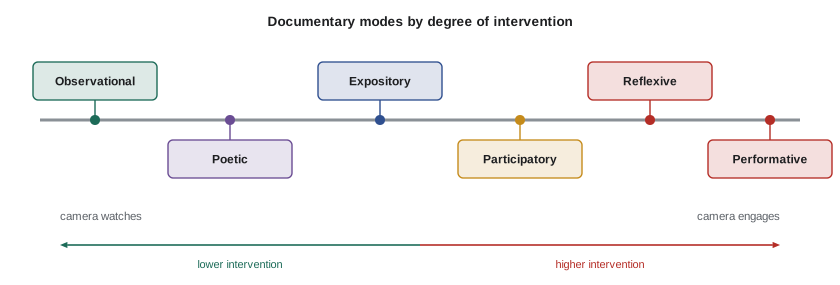
Film scholar Bill Nichols proposed a set of modes that describe the main ways documentaries address the viewer. The modes are not rigid categories; most films mix several. They are useful to the cinematographer because each mode implies a different relationship between camera and subject, and therefore a different shooting style.
- Poetic mode: emphasizes rhythm, image and mood over argument or information. Shots are composed for their visual and emotional qualities, often without dialogue. The cinematographer has freedom to explore texture, light and abstraction.
- Expository mode: addresses the viewer directly with an argument, often through narration and illustrative images. Shooting serves the argument: establishing shots, illustrative details and well-lit interviews with experts.
- Observational mode: the camera watches events unfold without intervening, with no narration, interviews or staged scenes. The operator must be unobtrusive, patient and always ready, following action in long takes.
- Participatory mode: the filmmaker interacts openly with subjects, through interviews, conversation or provocation, and the encounter itself becomes part of the film. The camera may be acknowledged by subjects and the filmmaker may appear on screen.
- Reflexive mode: draws attention to the process of filmmaking and the conventions of documentary itself, inviting viewers to question what they see.
- Performative mode: emphasizes the filmmaker's subjective, emotional experience of the subject, often blending personal narration with expressive images.
Direct cinema and cinéma vérité
Two movements of the late 1950s and 1960s shaped modern documentary camera work more than any others, and both depended on new technology. Lightweight 16 mm cameras that could be held on the shoulder, faster film stocks and portable synchronized sound recorders made it possible for a crew of two to follow people through their lives and record sync sound without a studio camera, tripod or cables.
In the United States, the movement known as direct cinema aimed for pure observation. Robert Drew and his associates, including Richard Leacock, D. A. Pennebaker and Albert and David Maysles, filmed Primary (1960), following John F. Kennedy and Hubert Humphrey through the Wisconsin primary. Films such as Don't Look Back (1967), Salesman (1969) and Grey Gardens (1975) followed, along with Frederick Wiseman's long institutional studies beginning with Titicut Follies (1967). Direct cinema filmmakers tried to make the camera a fly on the wall, avoiding interviews, narration and any staging.
In France, Jean Rouch and Edgar Morin's Chronicle of a Summer (1961) took the opposite approach, which they called cinéma vérité, after Dziga Vertov's Kino-Pravda. Rather than hiding, the filmmakers provoked and participated, asking people on the street whether they were happy and showing subjects the footage. The camera was a catalyst that revealed truths that would not otherwise surface. Today the term vérité is used loosely for any handheld, observational style, but the original distinction between observing and provoking remains useful.
Canadian filmmakers were central to this revolution. At the NFB's Unit B, the Candid Eye series (1958–1959) used lightweight equipment to observe everyday life, and films such as Lonely Boy (1962) about Paul Anka are landmarks of the observational style. In Quebec, Michel Brault, whose agile handheld camera work influenced Rouch, and Pierre Perrault developed cinéma direct, notably in Pour la suite du monde (1963). Allan King's Warrendale (1967) and A Married Couple (1969) pushed observational filmmaking into intimate institutional and domestic spaces. The NFB's Challenge for Change program (1967–1980) put cameras in the hands of communities, an early model of participatory and community-led filmmaking.
How approach shapes shooting style
Choosing a mode is not only an intellectual decision; it changes how the camera is used every day of the shoot. A strongly observational film usually needs a small crew, a camera that can run for long periods, natural light, wide and normal lenses that let the operator stay close, and very little direction of the subjects. An expository film may use carefully lit interviews, a slider or tripod for illustrative shots and a larger kit. A participatory film may put the filmmaker in frame, use two cameras to capture both sides of a conversation and accept that subjects look at the lens. A poetic film may favour long lenses, slow motion, macro and time-lapse.
| Mode | Camera relationship | Typical kit and technique | Key risk |
|---|---|---|---|
| Observational | Unobtrusive witness | Handheld or shoulder, natural light, long takes, zoom or normal primes | Missing key moments or coverage for the edit |
| Participatory | Acknowledged participant | Two cameras, filmmaker in frame, conversation, sync sound | Performance for the camera |
| Expository | Illustrator of an argument | Lit interviews, tripods, sliders, illustrative inserts | Images that merely decorate narration |
| Poetic | Expressive eye | Composed frames, slow motion, macro, time-lapse | Beauty without meaning |
| Reflexive | Self-aware maker | Crew and equipment visible, process shown | Distancing the audience |
| Performative | Subjective storyteller | Personal camera, voice-over, expressive imagery | Self-indulgence |
In practice, a film's visual approach is written down early, often in a look book or visual treatment that describes the mode, the camera style, the lighting philosophy, aspect ratio, lens choices and references. The cinematographer and director use it to make consistent decisions under pressure. When the unexpected happens, as it always does in documentary, the treatment helps the operator decide quickly whether to intervene, whether to light, and whether to move closer or stay back.
Contemporary documentary
Documentary has grown enormously with streaming services, which commission feature documentaries, multi-part series and true-crime, nature, music and sports programs. Production values have risen: many documentaries now use cinema cameras, anamorphic lenses, drones, gimbals and carefully designed interviews alongside observational footage. Hybrid films blend documentary with re-enactment, animation or staged sequences, and some invite subjects to perform versions of their own lives. Personal and essay films, often shot by the filmmaker alone, continue to thrive, and smartphones and mirrorless cameras put broadcast-quality images within reach of almost anyone. At the same time, audiences and critics debate the ethics of re-enactment, undisclosed staging and, increasingly, generative AI imagery presented as real, issues we return to in Lessons 9 and 10.
In Canada, documentary remains a central part of the screen industry. The NFB continues to produce and distribute documentaries; Hot Docs in Toronto is North America's largest documentary festival; and broadcasters and funders such as CBC, TVO, Knowledge Network, Télé-Québec, the Canada Media Fund, Telefilm Canada, the Rogers and Bell funds and provincial agencies support documentary production. The Documentary Organization of Canada (DOC) represents independent documentary makers. Canadian content certification by the Canadian Audio-Visual Certification Office (CAVCO) uses a points test that is adapted for documentaries, which often lack some of the key creative roles of drama; check the current CAVCO guidelines when planning a production.
Shooting ratio
The shooting ratio is the amount of footage recorded divided by the length of the finished film. In scripted drama, ratios of 10:1 to 30:1 are common. Documentaries usually shoot far more, because nobody knows in advance which moments will matter. Observational features commonly reach ratios of 50:1 to 100:1, and some exceed 200:1. Digital capture has made high ratios cheap to record but not cheap to manage: every hour must be offloaded, backed up, logged, transcribed and reviewed. Understanding the shooting ratio helps a cinematographer plan storage (Lesson 3) and helps the team plan post-production time.
Worked problem
Planning footage for an observational feature
A director plans a 90-minute observational feature and expects a shooting ratio of 100:1. An assistant editor can log and review footage at 1.5 times the running time (a 1-hour clip takes 1.5 hours). How much footage will be recorded, and how many 8-hour working days will logging take?
Show solution
- Recorded footage: \( 90 \times 100 = 9{,}000 \) minutes = 150 hours.
- Logging time: \( 150 \times 1.5 = 225 \) hours.
- Working days: \( 225 \div 8 \approx 28 \) days, more than five working weeks before editing proper begins.
Answer: About 150 hours of footage and roughly 28 working days of logging.
The example shows why experienced documentary cinematographers are disciplined about when to roll. Rolling on everything wastes post-production time and drains batteries and cards; rolling too little misses moments. The skill is to recognize when something is about to happen, roll early enough to capture the build-up and keep rolling through the aftermath, while cutting during obviously dead time. Many operators develop a habit of rolling whenever people start talking with energy, whenever someone enters or leaves, and whenever the light or situation changes.
Authorship and the cinematographer's eye
Even in purely observational films, the cinematographer is an author. Framing selects what the viewer sees; lens choice determines how close the audience feels; camera height expresses power relationships; holding a shot or panning away shapes meaning. A low angle on a politician, a wide shot that isolates a lonely figure or a tight close-up that lingers on a face after the words stop all carry interpretations. Documentary camera operators therefore need a visual vocabulary as rich as any drama cinematographer's, applied in fractions of a second. Studying the work of great documentary cinematographers, watching films with the sound off to see how shots are composed and sequenced, and reviewing your own rushes critically are the best ways to develop it.
Throughout this course, worked examples will use simple calculations for data, power, exposure, sound and budgets. These are not academic exercises: documentary crews are small, and the camera operator is often also the person who must know how many cards, batteries and hours of storage a day will need, whether the light will hold and whether the sound is usable.
Common mistakes
MistakeTreating documentary as unplanned shooting.
InsteadDefine the mode and visual approach early and use it to guide decisions in the field.
MistakeAssuming observational means passive.
InsteadAnticipate action, choose positions and roll early; observation is active work.
MistakeConfusing direct cinema with cinéma vérité.
InsteadDirect cinema observes; vérité, as Rouch used it, provokes and participates.
MistakeRolling on everything without thought.
InsteadBalance coverage against shooting ratio, storage and logging time.
MistakeBelieving the camera is neutral.
InsteadRecognize that framing, lens, height and timing are authorial choices.
Summary and key terms
- Grierson called documentary the creative treatment of actuality and helped found the NFB in 1939.
- Nichols' modes are poetic, expository, observational, participatory, reflexive and performative.
- Lightweight 16 mm cameras and portable sync sound enabled direct cinema and cinéma vérité around 1960.
- Canadian filmmakers at the NFB and in Quebec were central to observational and direct cinema.
- The mode of a film shapes crew size, kit, lighting and the relationship with subjects.
- Documentaries typically have high shooting ratios, which drive storage and logging time.
- Every camera choice in documentary is an act of authorship with ethical weight.
- Documentary
- A film that creatively treats actuality and asks the viewer to trust it.
- Observational mode
- Filming events as they unfold without intervening.
- Participatory mode
- Filming that includes the filmmaker's interaction with subjects.
- Expository mode
- Documentary that presents an argument, often with narration.
- Direct cinema
- American observational movement of the 1960s.
- Cinéma vérité
- Rouch and Morin's provocative, participatory approach.
- Cinéma direct
- Quebec observational movement led by Brault and Perrault.
- Shooting ratio
- Footage recorded divided by finished running time.
- Visual treatment
- Document describing a film's camera and lighting approach.
- Hybrid documentary
- Documentary that blends observation with staging, re-enactment or animation.
Practice problems
Work each problem on paper first, then reveal the answer to check.
Who coined the phrase creative treatment of actuality?
Show answer
John Grierson.
When was the NFB created?
Show answer
1939.
Name Nichols' six modes.
Show answer
Poetic, expository, observational, participatory, reflexive, performative.
What technology enabled direct cinema?
Show answer
Lightweight 16 mm cameras and portable sync sound.
How did Rouch's vérité differ from direct cinema?
Show answer
It provoked and participated rather than only observing.
Name a Quebec cinéma direct film.
Show answer
Pour la suite du monde (1963).
Footage for a 60-minute film at 80:1?
Show answer
4,800 minutes, or 80 hours.
Logging 80 hours at 1.5 times running time?
Show answer
120 hours.
What kit suits a strongly observational film?
Show answer
Small crew, handheld camera, natural light, long takes.
Why is camera height an authorial choice?
Show answer
It expresses power and relationships between viewer and subject.
Lesson quiz · 5 questions
Score 60% or more to complete this lesson.
Create a free account to save your progress, take quizzes and earn a certificate.