
CINE-320 · Lesson 2 of 12 · 25 min
The documentary camera operator and small crews
Documentary crews are small, and they are getting smaller. Where a drama unit might have dozens of people in the camera, grip and electric departments alone, a documentary shoot often has two or three people in total, and many are filmed by a single person who directs, operates the camera and records sound. Small crews are not only a matter of budget. They are less intrusive, they fit into cars, homes, hospital rooms and courtrooms, they can travel cheaply and quickly, and they allow relationships of trust to form between filmmakers and subjects. This lesson looks at who does what on a documentary crew, how the camera operator works with the director and sound recordist, how to plan a shoot day, and how to estimate what a small crew and its kit will cost.
The documentary cinematographer's job
On a documentary, the cinematographer (often called the director of photography, DP, or simply the shooter) is responsible for the images: choosing and preparing the camera package, deciding on the visual approach with the director, operating the camera, exposing and focusing, often lighting interviews, and frequently managing data on location. Unlike in drama, the documentary DP usually operates the camera personally and pulls their own focus. They must make instant creative decisions without rehearsal, follow unpredictable action, hold a shot steady for many minutes, and stay aware of sound, safety and the subjects' comfort all at once.
The documentary DP also needs journalistic instincts: an understanding of the story, a sense of when something important is about to happen, and the ability to read people and rooms. Many of the best documentary cinematographers describe their work as listening with the camera. They follow conversations, anticipate who will speak next and position themselves so that they can catch both the speaker and the reaction.
Common crew configurations
- Self-shooting director (preditor or VJ): one person directs, shoots and records sound, sometimes also editing. This is the most intimate and least expensive approach and is common in current affairs, personal films and long observational projects.
- Director and camera operator: the director handles subjects, logistics and sometimes sound, while the camera operator concentrates on images.
- Camera and sound pair: the classic documentary unit of the observational era, in which a camera operator and a sound recordist work as a tightly coordinated team, with the director or producer sometimes present.
- Small unit with assistant: a DP, sound recordist, camera assistant or data wrangler, and director or producer; common for interview-heavy series and higher-end streaming documentaries.
- Multi-camera unit: two or more camera operators, used for events, concerts, sports, legislative or court proceedings and reality-style series where action happens in several places at once.
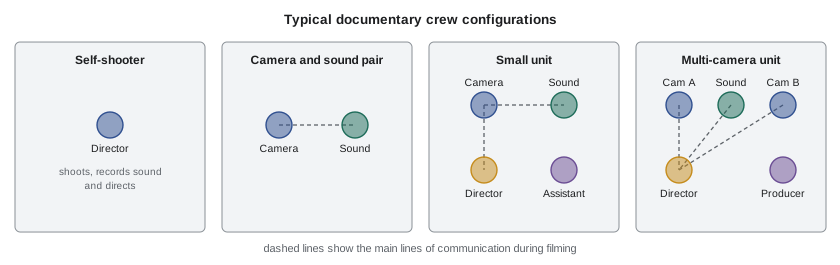
Working with the director
The director decides what the film is about and what each scene needs; the cinematographer decides how to capture it. In documentary, those roles overlap more than in drama, and the relationship depends on trust. Before the shoot, the director and DP agree on the visual treatment (Lesson 1), the access arrangements, the rules for interacting with subjects and the priorities for each day. During the shoot, they develop a quiet system of communication: a hand on the shoulder to signal "stay on her", a glance toward a door that means "someone is coming", or a whispered word during a pause. Many directors stand slightly behind the camera operator so that they can see what the camera sees without entering the frame.
Interruptions are costly. A director who shouts instructions while the camera is rolling may ruin the sound and break the mood. Good practice is to brief thoroughly before entering a situation, agree on what not to miss and then let the operator work, intervening only when necessary. After each sequence, a brief check-in confirms what was captured and what is still needed, and reviewing a few shots on the camera's monitor during breaks keeps both people aligned.
Working with the sound recordist
In the classic camera and sound pair, the two people move as one. The sound recordist positions the boom so that it stays out of frame, so the recordist needs to know the operator's framing; the operator needs to know where the boom is so that they do not compose it into shot or point the camera at a reflective surface that shows it. Many pairs agree on conventions: a wide shot is signalled by a tap so the boom rises, a change of lens is announced, and the recordist alerts the operator to off-camera sound that might be worth turning toward. Wireless audio sent to the camera (Lesson 8) keeps a guide track synchronized, and common timecode keeps separate recorders aligned.
The self-shooter
Self-shooting has become the norm in many genres. A self-shooter must manage everything a crew would, so preparation and simplicity matter. Typical habits include: rigging lavalier microphones on subjects at the start of the day and sending them wirelessly to the camera; using an on-camera shotgun microphone for ambience; choosing a lightweight, fast-to-operate camera with built-in ND and a long-range zoom; carrying a minimal lighting kit; and building generous time into the schedule for offloading data and charging batteries. The self-shooter's advantage is intimacy. Subjects often relax when there is only one person present, and a single filmmaker can return again and again over months or years.
Scheduling a documentary shoot day
Documentary schedules are flexible by necessity, but they are not unplanned. A typical shoot day plan, often called a call sheet even on tiny productions, lists the location, contacts, travel times, the scenes or events expected, interview times, sunrise and sunset, weather, nearest hospital, parking and any access restrictions. Planning around real events means arriving early to set up before things start, building in breaks for meals and data management, and leaving time to grab establishing shots, details and transitions when the light is good. Long days are common, but fatigue affects safety and judgement. Most crew agreements and labour laws limit hours or require overtime and rest periods, and responsible producers plan turnaround time between days.
In Canada, provincial employment standards set hours, overtime and rest rules for employees, and camera crew working on union productions may be covered by agreements negotiated by IATSE locals such as 667 (camera, eastern Canada) and 669 (camera, western Canada), NABET 700-M or the Directors Guild of Canada. Many documentary crew are freelancers working on negotiated day rates; the Canadian Society of Cinematographers is the national professional association for cinematographers.
| Time | Activity | Notes |
|---|---|---|
| 06:30 | Crew call and equipment check | Batteries charged, cards formatted, timecode jammed |
| 07:30 | Travel to location | Confirm access with the subject's contact |
| 08:30 | Rig microphones, establishing shots | Morning light for exteriors |
| 09:00 | Observational filming begins | Follow the subject's routine |
| 12:30 | Lunch and data offload | Two verified copies before formatting any card |
| 13:30 | Sit-down interview | Set up during lunch where possible |
| 15:30 | Observational filming continues | Details and cutaways |
| 17:30 | Golden hour exteriors and wrap | Release forms checked |
| 18:30 | Travel, final offload and charge | Log notes for the editor |
Crew and kit day budgets
Documentary budgets are tight, and the camera team is often asked how much a shoot day will cost. A simple day budget adds crew fees, equipment rental or kit fees, travel, meals, media and insurance, with a contingency for overtime and surprises. Rates vary widely by region, experience, union status and the type of production, so the figures in examples are illustrative only.
Worked problem
Estimating a two-person crew day
A producer books a DP at $850 per 10-hour day with their own camera kit at $450 per day, and a sound recordist at $700 per day with their own audio kit at $200 per day. Mileage is 180 km at $0.70 per km, meals are $40 per person, and media and hard drives are budgeted at $60 per day. The producer adds 10 % contingency. What is the daily cost?
Show solution
- Crew fees: \( 850 + 700 = 1{,}550 \) dollars.
- Kit fees: \( 450 + 200 = 650 \) dollars.
- Travel, meals and media: \( 180 \times 0.70 + 2 \times 40 + 60 = 126 + 80 + 60 = 266 \) dollars.
- Subtotal: \( 1{,}550 + 650 + 266 = 2{,}466 \) dollars; contingency 10 % = 246.60 dollars.
- Total: about 2,712.60 dollars per day before GST/HST, which registered suppliers add to their invoices.
Answer: About $2,713 per day before sales tax.
Overtime can change these numbers quickly. If the crew works 12 hours instead of 10 and overtime is paid at 1.5 times the hourly equivalent of the day rate, each person's fee for the extra two hours is \( \frac{\text{day rate}}{10} \times 1.5 \times 2 = 0.3 \times \) day rate. For the DP at $850, that is $255, and for the recordist at $700, $210, adding $465 before contingency. Producers who plan realistic days avoid these costs and keep crews safe.
Kit, insurance and responsibility
Many documentary DPs own their camera packages and rent them to productions as a kit fee, which keeps costs predictable and gives the DP equipment they know intimately. Owner-operators are responsible for maintaining and insuring their gear, and productions usually carry their own production insurance covering rented and owned equipment, liability, and errors and omissions (Lesson 9). Before a shoot, the camera team confirms what is covered: theft from vehicles, damage during travel, loss abroad and damage from weather or water are common exclusions. Carnets, equipment lists with serial numbers and receipts help crews cross borders with professional kit without paying duties.
Professional conduct with subjects
The camera operator is often the person subjects see most. Professional conduct matters: introducing yourself, explaining what the camera is doing, respecting requests to stop, dressing appropriately for the setting, keeping equipment tidy and quiet, and never sharing footage or private information outside the production. Small crews depend on the goodwill of subjects and locations, and a crew that behaves well is invited back. The ethical dimensions of this relationship are explored in Lesson 9.
Building a working partnership
Long documentary productions depend on partnerships that last months or years, and many celebrated films were shot by the same small team from start to finish. Partners learn each other's rhythms: when the director wants to stay wide, when the recordist needs a moment to reposition, when the operator is about to change cards. Before a production begins, it helps to talk through how decisions will be made in the field, who speaks to subjects about filming, how disagreements will be handled and what each person needs to do their best work. After each shoot day, a short debrief over the rushes, covering what worked, what was missed and what to try next, keeps the team learning together and builds the trust that subjects sense when a crew enters their lives.
Many experienced documentary cinematographers say that the most important piece of equipment on a small crew is the relationship between its members, because a crew that trusts itself can adapt to almost anything the day brings.
Common mistakes
MistakeShouting directions while the camera rolls.
InsteadBrief before the scene and use quiet signals during it.
MistakeIgnoring the boom operator's position.
InsteadAgree on framing signals so the boom stays out of shot.
MistakePlanning days with no time for data and charging.
InsteadSchedule offloads, breaks and turnaround time.
MistakeBudgeting crew without overtime or contingency.
InsteadAdd realistic hours, overtime rules and a contingency.
MistakeAssuming all gear is insured everywhere.
InsteadConfirm production insurance coverage and exclusions before travel.
Summary and key terms
- Documentary crews are small, from self-shooters to small multi-camera units.
- The documentary DP usually operates and focuses personally and needs journalistic instincts.
- Clear briefing and quiet signals let director and operator work without interrupting reality.
- Camera and sound must coordinate framing and boom position constantly.
- Shoot days are planned around real events, light, data offloads and rest.
- Day budgets add crew, kit, travel, meals, media and contingency; overtime adds up quickly.
- Insurance, carnets and professional conduct protect the crew, the kit and the relationship with subjects.
- Director of photography
- The person responsible for a film's images; on documentaries usually also the operator.
- Self-shooter
- A filmmaker who directs, shoots and records sound alone.
- Preditor
- A producer-editor who often also shoots.
- Call sheet
- A document listing the day's schedule, locations, contacts and logistics.
- Kit fee
- A daily charge for using an operator's own equipment.
- Day rate
- A fee for a standard working day, often 10 hours.
- Turnaround
- Rest time between the end of one working day and the start of the next.
- Contingency
- A budget allowance for unforeseen costs.
- Carnet
- An international customs document for temporary import of equipment.
- Guide track
- Audio recorded to camera for synchronization and reference.
Practice problems
Work each problem on paper first, then reveal the answer to check.
Name four documentary crew configurations.
Show answer
Self-shooter, director and operator, camera and sound pair, small unit, multi-camera unit.
Why are small crews preferred in documentary?
Show answer
They are less intrusive, mobile, cheaper and build trust.
How should a director communicate during a take?
Show answer
With quiet, pre-agreed signals rather than spoken instructions.
Why must the operator know where the boom is?
Show answer
To avoid framing it or reflecting it.
What does a self-shooter usually rig first?
Show answer
Wireless lavalier microphones on subjects.
Name three items on a documentary call sheet.
Show answer
Location, contacts, schedule, sunrise and sunset, hospital, access notes.
Overtime for 2 hours at 1.5 times on a $900 10-hour day?
Show answer
270 dollars.
What does a carnet do?
Show answer
Allows temporary import of equipment without duties.
Why build data offloads into the schedule?
Show answer
To secure footage and free cards safely.
What is a kit fee?
Show answer
A daily charge for using the operator's own equipment.
Lesson quiz · 5 questions
Score 60% or more to complete this lesson.
Create a free account to save your progress, take quizzes and earn a certificate.