
CINE-101 · Lesson 9 of 12 · 24 min
Pre-production: scripts, shot lists and schedules
Experienced filmmakers say that films are made in pre-production. The hours spent planning, writing, scouting, scheduling and securing permissions determine whether the shoot runs smoothly or descends into improvisation, missed shots and overtime. Even a one-day student shoot benefits from a script, a shot list, a schedule and the right permissions. This lesson walks through pre-production for a short project: the script and its format, breaking it down, shot lists, storyboards and floor plans, scheduling, location scouting, releases, permits and rights, the call sheet, and planning for safety.
The script
Narrative films start with a screenplay written in a standard format: scene headings (sluglines) such as "INT. CAFÉ – DAY" stating whether the scene is interior or exterior, the location and the time of day; action lines in the present tense describing what we see and hear; character names in capitals above their dialogue; and brief parentheticals for delivery where needed. The format is not decoration: in standard format, one page runs about one minute of screen time, which makes the script the basis for estimating length, schedules and budgets. Free and inexpensive screenwriting software formats scripts automatically.
Documentaries, interviews and corporate videos often use other documents: a treatment describing the story and approach, an interview question list, a shooting outline of sequences to capture, or a two-column script with visuals on one side and narration on the other. Whatever the form, the team needs a shared written plan before shooting.
Script breakdown
A breakdown lists, scene by scene, everything needed to film the script: cast, extras, locations, props, costume, makeup, vehicles, animals, special effects, stunts, special equipment and sound requirements. Breakdown sheets are traditionally colour-coded by category, and each scene's length is measured in eighths of a page, the unit used in scheduling. The breakdown reveals hidden costs and complications: a line such as "the crowd cheers as fireworks light the sky" implies extras, a night shoot, pyrotechnics, permits and safety personnel.
Shot lists, storyboards and floor plans
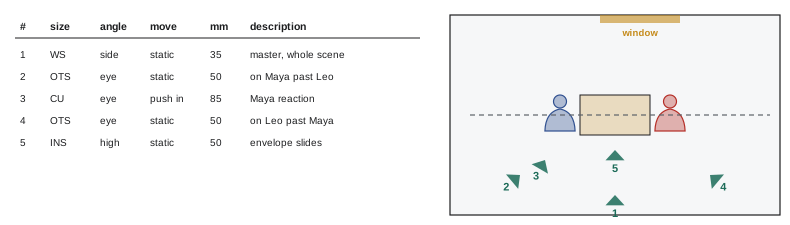
A shot list translates each scene into the shots needed to cover it (Lesson 5): shot number, size, angle, movement, lens, the action or dialogue covered, and notes such as special equipment. It is the camera department's plan and the basis for estimating how long each scene will take.
A storyboard draws key frames of each shot, like a comic strip, showing composition and movement. Storyboards are essential for complex action, visual effects and commercials, and helpful for any sequence where precise framing matters; simple stick figures are enough. A floor plan (overhead) shows the set from above with the positions and movements of actors and camera for each setup, which helps plan lighting and the order of setups and makes the 180-degree rule visible.
Scheduling
The schedule turns the breakdown into a day-by-day plan. Scenes are not shot in script order but grouped for efficiency: all scenes in the same location together, day exteriors when the light is right, actors' scenes grouped to minimize the days they must be paid or available. Professional schedules use a stripboard, in which each scene is a strip showing its location, cast, page length and day or night, rearranged until the plan works.
How much can be shot in a day depends on complexity and crew experience. Large productions often shoot two to four pages a day; low-budget productions sometimes attempt more, at the cost of coverage. A more reliable estimate counts setups: a small, efficient crew might complete 10 to 20 setups in a 10-hour day, fewer if each needs significant lighting or movement.
Worked problem
Scheduling a short film
A seven-page short film has three locations: an apartment (four pages, 22 setups), a café (two pages, 12 setups) and a street at night (one page, 8 setups). The crew expects about 14 setups per 10-hour day. How many shooting days should be scheduled, and in what order?
Show solution
- Total setups: 22 + 12 + 8 = 42; at 14 per day, about three days of shooting.
- Apartment: 22 setups, about a day and a half; café: 12 setups, nearly a full day; street at night: 8 setups, a short night.
- A practical plan: day 1 apartment (14 setups); day 2 apartment (8 setups) in the morning, then move to the café in the afternoon for the first few setups if the move is short; day 3 café completion, then a night shoot on the street with a later call time so the crew gets adequate rest between days.
Answer: About three shooting days, grouped by location, with the night exterior scheduled so that the turnaround (rest time between the end of one day and the start of the next) is respected. Adding a buffer of half a day for weather, overruns and pickups is wise on a first production.
Location scouting
Every location should be scouted before it is booked, ideally at the time of day you will shoot. A location checklist includes: how it looks and whether it suits the story; space for camera, lights and crew outside the frame; the direction and quality of natural light through the day; noise (traffic, aircraft, neighbours, machinery, air conditioning that cannot be switched off); power (outlets, circuits, a generator if needed); access, parking, loading and stairs; washrooms and a holding area for cast and crew; mobile reception; and the owner's conditions and fees. Take photographs and measurements, and note the sun's path. A location that looks perfect but sits under a flight path can cost a day of unusable sound.
Releases, permits and rights
Filming involves other people's images, property and creative work, and a project that will be shown publicly needs the right permissions:
- Talent releases: written consent from everyone identifiable on screen, especially actors and interview subjects, granting the right to use their image and voice. Minors require a parent or guardian's signature.
- Location releases: written permission from property owners, stating dates, times and conditions.
- Filming permits: many cities require permits for filming on public property such as streets, sidewalks and parks, especially when equipment, vehicles or crowds are involved. City film offices issue permits and may require insurance certificates and police or traffic control.
- Insurance: general liability and equipment insurance are usually required by locations, rental houses and permit offices.
- Music and other copyrighted material: using a song requires a synchronization licence from the publisher (for the composition) and a master use licence from the owner of the recording. Artwork, logos and film clips visible in shots may also need clearance. Royalty-free and specially commissioned music avoids these complications.
In Canada, copyright is governed by the Copyright Act; performing rights for music are administered by SOCAN, and recording rights by organizations such as Re:Sound, while synchronization licences are negotiated with publishers. Privacy and the right to control one's image are protected by provincial laws and, in Quebec, by the Civil Code, which makes consent especially important for identifiable people. Major cities such as Toronto, Vancouver and Montréal have film offices that issue permits.
Budget
Even a no-budget project has costs: equipment rental, transport, food for cast and crew, location fees, permits, insurance, props, costumes, hard drives and music. A simple budget lists each item with its estimate, separates above-the-line costs (story rights, writer, director, producers and principal cast) from below-the-line costs (crew, equipment, locations, post-production), and adds a contingency of around 10 %. Feeding the crew well is not a luxury; it is the cheapest way to keep a volunteer team working hard and safely.
The call sheet
The day before each shoot, the assistant director or producer issues a call sheet: the date and location with address and map, parking, the crew call time and each actor's call time, the scenes and setups to be shot in order, the weather forecast and sunrise or sunset times, contact numbers, the nearest hospital, and special notes (for example "night exterior, bring warm clothes" or "quiet on set: neighbours sleeping"). A clear call sheet means everyone arrives at the right place, at the right time, with the right equipment.
Planning for safety
Pre-production is also when risks are identified and controlled. A simple risk assessment lists the hazards of each location and scene (traffic, heights, water, weather, electrical equipment, stunts, vehicles, weapons props, fatigue from long days) and the measures to control them: spotters, permits with traffic control, qualified specialists for stunts and drones, rest periods, and an emergency plan with first aid and the nearest hospital. Realistic replica weapons need special care and often notification to police, because members of the public may call emergency services. No shot is worth an injury.
Pre-production for documentary
Documentary pre-production looks different but is just as important. Instead of a script, the team researches the subject, conducts pre-interviews (conversations before filming to learn the story and build trust), and writes a treatment and a list of sequences to film. Because real events cannot be repeated, planning focuses on access (permission to film in places and at moments that matter), on scheduling around participants' lives, and on ethics: participants must understand how they will be portrayed and give informed consent, vulnerable people need extra care, and the filmmaker must decide how to handle sensitive information. A shooting plan still lists likely sequences, interview locations and the cutaways needed, and the same releases, permits and safety planning apply.
Working with actors and contributors
Casting is one of the most important decisions in pre-production, because a strong performance can carry modest production values while a weak one undermines everything. Hold auditions or readings, ideally with a scene from the script, and record them so you can review them. Before the shoot, rehearse key scenes with the actors, even briefly, so that they arrive knowing their lines and the director knows what to ask for. Communicate clearly with everyone involved, whether professional actors, volunteers or documentary participants, about the schedule, what they need to bring, how long they will be needed and how the film will be used. Clear communication and respect in pre-production produce cooperation and goodwill on the day of the shoot.
Pre-production ends with a final meeting of the key crew, sometimes called a production meeting, at which everyone walks through the schedule scene by scene, confirms equipment and responsibilities, and raises any remaining concerns. On a small production, this can be a one-hour conversation over the shot list and call sheet, and it is time well spent.
Common mistakes
MistakeShooting scenes in script order.
InsteadGroup scenes by location, light and cast availability.
MistakeBooking a location without scouting it at shooting time.
InsteadScout for light, noise, power, access and space at the right time of day.
MistakeUsing popular music without licences.
InsteadObtain sync and master licences, or use cleared or original music.
MistakeFilming identifiable people without releases.
InsteadGet signed talent releases, with guardian signatures for minors.
MistakeScheduling with no buffer.
InsteadPlan realistic setups per day and add contingency time.
Summary and key terms
- Pre-production determines whether a shoot succeeds.
- Standard screenplay format runs about one page per minute and drives planning.
- Breakdowns list every element of every scene; scenes are measured in eighths of a page.
- Shot lists, storyboards and floor plans plan coverage and setups.
- Schedules group scenes by location, light and cast; count setups to estimate days.
- Scout locations, secure talent and location releases, permits, insurance and music rights.
- Budgets, call sheets and risk assessments complete the plan.
- Slugline
- A scene heading stating interior or exterior, location and time.
- Treatment
- A prose description of a film's story and approach.
- Breakdown
- A list of everything needed to film each scene.
- Shot list
- A list of the shots planned for each scene.
- Storyboard
- Drawings of key frames for each shot.
- Stripboard
- A scheduling tool showing scenes as movable strips.
- Talent release
- Written consent to use a person's image and voice.
- Synchronization licence
- Permission to use a musical composition with moving images.
- Call sheet
- The daily schedule and information for cast and crew.
- Turnaround
- The rest period between the end of one shooting day and the start of the next.
Practice problems
Work each problem on paper first, then reveal the answer to check.
What does "EXT. PARK – NIGHT" tell the crew?
Show answer
An exterior scene in a park at night.
About how long is a 12-page script on screen?
Show answer
About 12 minutes.
What does a script breakdown reveal?
Show answer
Everything each scene needs, including hidden costs and complications.
What is the difference between a shot list and a storyboard?
Show answer
A shot list describes shots in text; a storyboard draws key frames.
A film has 60 setups and the crew manages 15 a day. How many days?
Show answer
Four, plus a buffer.
Why are scenes shot out of order?
Show answer
To group locations, light conditions and cast availability efficiently.
Name four items on a location scouting checklist.
Show answer
Look, space, light, noise, power, access, washrooms, reception, owner conditions.
Which two licences are needed to use a commercial song?
Show answer
A synchronization licence from the publisher and a master use licence from the recording owner.
What must a release for a minor include?
Show answer
A parent or guardian's signature.
What emergency information belongs on a call sheet?
Show answer
The nearest hospital and contact numbers.
Lesson quiz · 5 questions
Score 60% or more to complete this lesson.
Create a free account to save your progress, take quizzes and earn a certificate.