
CINE-101 · Lesson 1 of 12 · 25 min
From still images to moving images
In Photography I (PHOT-101) you learned to control exposure, focus, lenses and light to make a single strong image. Moving images use all of those skills and add three new dimensions: time, sound and editing. A shot is no longer a moment but a duration in which things change; the picture is joined by sound that carries half of the experience; and the meaning of a shot depends on the shots before and after it. This course is a first hands-on course in making video: operating a camera for motion, covering a scene, lighting simply, recording usable sound, organizing a small production and editing the result. This first lesson describes what changes when images move, how productions are organized, who does what on a set, and how the course is arranged.
What changes when images move
A photograph asks the viewer to look; a moving image tells the viewer where to look and for how long. Several things follow from that:
- Time is a material. A shot can be held to build tension or cut short to create energy. Action unfolds within the frame, and the timing of a performance, a camera move or a cut becomes part of the expression.
- Motion has rules. Movement within the frame and movement of the camera must be readable, which affects shutter speed, focus, framing and how shots join together.
- Sound is half the experience. Audiences forgive imperfect pictures far more readily than poor sound. Dialogue that cannot be understood, or a hum under every line, ruins a film that looks beautiful.
- Meaning is built in editing. The Soviet filmmaker Lev Kuleshov showed in the 1920s that the same neutral face, cut against a bowl of soup, a child in a coffin or a woman on a couch, seemed to express hunger, grief or desire. Viewers read shots in relation to each other, so the camera operator must shoot pieces that will cut together.
- The work is collaborative. Even a small video involves several people, and a feature film hundreds. Communication, planning and shared vocabulary matter as much as individual skill.
Many of your photography skills transfer directly. Exposure is still a balance of aperture, shutter and ISO, but the shutter is now usually fixed by the frame rate (Lesson 2). Focal length still controls framing and perspective, and depth of field still separates subject from background, but focus must now follow moving subjects (Lesson 3). Composition still matters in every frame, but the frame now changes over time (Lesson 4).
A short history in four steps
Motion pictures rely on the persistence of the perception of motion: a sequence of still images shown quickly enough is seen as continuous movement. In the 1890s, the Lumière brothers in France and Thomas Edison's laboratory in the United States showed short films of everyday scenes. Early filmmakers soon discovered editing, close-ups and camera movement, and by the 1920s a sophisticated visual grammar existed. Synchronized sound arrived in the late 1920s, fixing the standard frame rate of 24 frames per second that cinema still uses. Television brought electronic images in the mid-twentieth century, with frame rates tied to each country's electrical supply. Since the 2000s, digital cameras have replaced film for almost all production, and today a phone records video that would have needed a professional camera twenty years ago. The grammar invented a century ago, however, still underlies almost everything we watch.
The production workflow
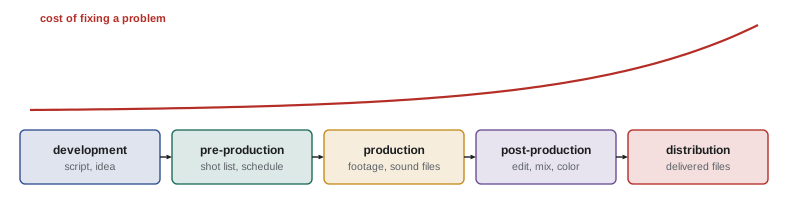
Whether it is a feature film or a two-minute promotional video, a production passes through the same phases:
- Development: the idea is shaped into a story, a script or an outline, and the project is approved and funded.
- Pre-production: planning everything needed to shoot: script breakdown, shot lists and storyboards, casting, locations, schedules, crew, equipment, permits and releases (Lesson 9).
- Production: the shoot itself, in which scenes are lit, rehearsed and recorded with camera and sound (Lesson 10).
- Post-production: organizing footage, editing, sound editing and mixing, colour correction, graphics and music, and delivery in the required formats (Lesson 11).
- Distribution: getting the work to its audience, whether in cinemas, on television, on streaming services or on social platforms.
Time and money are cheapest to spend early. A problem solved in pre-production costs a conversation; the same problem discovered on set costs hours of a whole crew's time; discovered in the edit, it may be unfixable without reshooting.
Who does what
On a professional set, work is divided among departments with clear responsibilities. Knowing the roles helps even on a two-person shoot, because someone still has to do each job.
- Producer: organizes and finances the project, hires the team and keeps it on schedule and budget.
- Director: responsible for the creative vision, the performances and the choice of shots.
- Director of photography (DP) or cinematographer: designs the look of the film, its lighting, framing and camera movement, and leads the camera, grip and electric departments.
- Camera operator and camera assistants: the operator frames and moves the camera; the first assistant (focus puller) keeps the image sharp; the second assistant handles the slate, camera reports and media.
- Gaffer and electricians: set up and power the lights, under the DP's direction. Grips: build camera supports and shape light with flags and stands.
- Production sound mixer and boom operator: record dialogue and sound on set.
- Production designer, art department, costume, hair and makeup: create the world in front of the camera.
- Script supervisor: tracks continuity and records what was shot, for the editor.
- Assistant director (AD): runs the set and the schedule, so the director can concentrate on the work.
- Editor, sound designer, colour grader and composer: shape the film in post-production.
On a student or small production, one person may be director, camera operator and editor, and a friend may hold the boom. The tasks remain; only the number of people changes.
Genres and forms
The skills in this course apply to many forms: narrative fiction (scripted stories with actors), documentary (real people and events), interviews, music videos, commercials and branded content, event coverage, educational and training videos, and short-form social content. Each has its conventions. Documentary and interviews rely heavily on sound and on shooting what happens rather than what is planned; commercials depend on precise planning and polished images; social content is shaped by vertical frames and the need to hold attention in the first seconds. The core craft, a well-exposed, well-framed, steady, sharp image with clean sound that cuts together, is the same in all of them.
Equipment for this course
You can complete this course with modest equipment: any camera that records video with manual control of exposure (a mirrorless or DSLR camera, a camcorder, or a phone with a manual video app), a tripod with a fluid head if possible, an external microphone (a shotgun microphone on a boom or a wired or wireless lavalier), headphones, a few lights or reflectors, and editing software. Free and inexpensive editing software is fully capable for the projects in this course. Learning to get good results from simple tools builds the habits you will need on larger productions.
Worked problem
Planning a first exercise
You are asked to film a one-minute sequence of a friend making a cup of tea, with no dialogue, to be edited into a clear, watchable piece. How should you approach it?
Show solution
- Break the action into steps: entering the kitchen, filling the kettle, waiting, pouring, adding milk, the first sip.
- For each step, plan two or three shots: a wide shot showing where we are, medium shots of the action, close-ups of hands, kettle and cup, and a reaction on the face.
- Ask your friend to repeat the action for each camera position, keeping it the same each time, so the shots can be cut together.
- Record clean sound of the kettle, pouring and cups as you shoot; it will carry the sequence.
Answer: Even a simple action becomes engaging when it is broken into varied shots that cut on movement, with real sound. This is the basic method of coverage, developed in Lessons 4 and 5, and it is the foundation of most filmmaking.
Thinking in sequences
The most important mental shift from photography to filmmaking is to think in sequences rather than single images. A photographer looks for the one frame that says everything; a filmmaker looks for the series of shots that, together, carry the viewer through an experience. A sequence usually begins by establishing where we are, moves closer to show what matters, and returns wider when the situation changes. It alternates between action and reaction, between what a character does and how others respond. It varies shot size and angle so that each cut gives the viewer something new, while keeping geography and direction clear so the viewer never loses track of where things are.
Thinking in sequences also changes how you shoot. Instead of waiting for the perfect moment, you gather material: the wide shot, the medium shot, the close-up, the detail, the reaction, and a few seconds of the location without action, which editors call cutaways and which save many edits. You also leave a little time before and after each action, called handles, so the editor has room to choose the exact cut point. Beginners often stop recording the instant the action ends, leaving the editor with no room to cut on movement or to hold on a face.
Working safely and respectfully
Filming involves people, places and equipment, and each brings responsibilities. Light stands fall over, cables trip people, batteries overheat, and camera operators walking backwards with their eye to a viewfinder walk into traffic. Every shoot, however small, needs someone watching for hazards, sandbags on stands, cables taped or covered where people walk, and a spotter for any moving shot. Respect for people is just as important: get permission before filming people who will be identifiable, explain what the video is for, and respect a refusal. Locations belong to someone, and many require permission or a permit to film (Lesson 9). The habits of safety and respect you build on small shoots will be expected on every professional set.
How this course is organized
The section at the end of the lesson shows how the twelve lessons fit together.
- Lesson 1 (this lesson): from still images to moving images.
- Lesson 2: the camera for video: frame rates, shutter and exposure.
- Lesson 3: lenses, focus and focus pulling.
- Lesson 4: shots, framing and composition in motion.
- Lesson 5: coverage and continuity.
- Lesson 6: camera support and movement.
- Lesson 7: simple lighting setups for video.
- Lesson 8: recording usable sound.
- Lesson 9: pre-production: scripts, shot lists and schedules.
- Lesson 10: on set: workflow, data and safety.
- Lesson 11: editing and finishing.
- Lesson 12: a short production and critique.
Each lesson ends with practice exercises. Shoot them; reading about coverage is no substitute for discovering in the edit that a shot you skipped was the one you needed.
Common mistakes
MistakeTreating video as photography that happens to move.
InsteadPlan for time, motion, sound and editing from the start.
MistakeNeglecting sound because the image looks good.
InsteadTreat sound as half of the experience and record it carefully.
MistakeShooting one long take of everything.
InsteadCover action in varied shots that can be cut together.
MistakeSkipping planning on small projects.
InsteadSolve problems in pre-production, where they are cheapest.
MistakeWaiting for better equipment.
InsteadLearn the craft with simple tools; habits matter more than gear.
Summary and key terms
- Moving images add time, sound and editing to photographic skills.
- Meaning is built from shots in relation to each other, as the Kuleshov experiment showed.
- Productions pass through development, pre-production, production, post-production and distribution.
- Problems are cheapest to solve early.
- Departments include direction, camera, lighting and grip, sound, art, continuity and post-production.
- Different forms have conventions, but the core craft is shared.
- Modest equipment is enough to learn the craft.
- Shot
- A continuous recording from one camera between cuts.
- Kuleshov effect
- The change in meaning of a shot caused by the shots around it.
- Pre-production
- Planning before the shoot.
- Post-production
- Editing, sound, colour and finishing after the shoot.
- Director of photography
- The person responsible for the film's images.
- First assistant camera
- The camera assistant who keeps focus, also called the focus puller.
- Gaffer
- The head of the electrical and lighting crew.
- Grip
- A crew member who builds camera supports and shapes light.
- Script supervisor
- The person who tracks continuity and records what was shot.
- Coverage
- The set of shots recorded to allow a scene to be edited.
Practice problems
Work each problem on paper first, then reveal the answer to check.
Name three things moving images add to photography.
Show answer
Time, sound and editing (also camera and subject motion).
What did the Kuleshov experiment show?
Show answer
Viewers read a shot's meaning from the shots around it.
List the five phases of production.
Show answer
Development, pre-production, production, post-production, distribution.
Why is it cheaper to solve problems in pre-production?
Show answer
On set they cost the whole crew's time; in the edit they may need reshoots.
What does a first assistant camera do?
Show answer
Keeps the image in focus and manages the camera.
Who leads the camera, grip and electric departments?
Show answer
The director of photography.
Why do audiences forgive poor pictures more than poor sound?
Show answer
Unclear dialogue or noise breaks understanding and immersion.
Name two forms with different conventions.
Show answer
For example: documentary, narrative, commercials, music videos, social content.
In the tea exercise, why repeat the action for each camera position?
Show answer
So shots from different positions match and cut together.
What minimum equipment does the course need?
Show answer
A camera with manual exposure, tripod, external microphone, headphones, simple lights or reflectors, editing software.
Lesson quiz · 5 questions
Score 60% or more to complete this lesson.
Create a free account to save your progress, take quizzes and earn a certificate.