
CINE-101 · Lesson 6 of 12 · 25 min
Camera support and movement
Whether a camera is locked off on a tripod, gliding on a dolly or held in the hands, the way it is supported shapes the feel of every shot. A steady frame feels observed and composed; a gentle push-in draws the viewer into a moment; handheld movement feels urgent and intimate; a soaring crane shot feels grand. Movement is one of the most expressive tools a filmmaker has, and also one of the easiest to overuse. This lesson covers the tripod and fluid head, smooth pans and tilts, handheld technique, sliders, dollies, gimbals, jibs and drones, and the principle that ties them together: camera movement should be motivated.
The tripod and fluid head
The tripod is the most important camera support, and for most of a beginner's shooting the most appropriate one. A video tripod differs from a photographic one in its head. A fluid head uses viscous damping to make pans (horizontal rotation) and tilts (vertical rotation) smooth and controllable, where a photographic ball head or pan-tilt head jerks. Key features are:
- Counterbalance: springs that hold the camera at any tilt angle without drifting forward or back, set to match the camera's weight and centre of gravity.
- Drag: adjustable resistance to panning and tilting; more drag gives smoother slow moves, less allows faster ones.
- A levelling bowl or built-in bubble level, so the horizon stays level as the camera pans. A pan with an unlevel head makes the horizon tilt progressively across the shot.
- A sliding plate to balance the camera front to back.
Set up by levelling the head first, balancing the camera on the plate so it stays at any angle with the tilt lock released, then setting counterbalance and drag. Extend the thicker leg sections before the thinner ones, spread the legs on uneven ground and, outdoors or on busy sets, add a sandbag or spreader for stability.
Pans and tilts
Pans and tilts follow action, reveal space and connect subjects within a shot. A good pan starts with a held frame, moves smoothly with an ease-in and ease-out rather than abrupt starts and stops, and ends on a composed frame held long enough to cut. Two problems affect pans in particular:
- Judder (strobing): at 24 fps, a fast pan across detailed backgrounds can stutter, because each frame jumps a large distance. A common guideline is that an object should take at least about five to seven seconds to cross the frame width in a pan at 24 fps; following a moving subject, which stays in the same place in the frame, hides the effect.
- Rolling shutter: many video sensors read out line by line, so fast pans make vertical lines lean (a skew) and quick vibrations make the image wobble. Slower moves, faster sensor readouts and global shutter sensors reduce the effect.
Practise pans by rehearsing the move before recording, positioning your body so that the end of the move is comfortable (start twisted, finish relaxed), and using the pan handle with a light grip.
Handheld
Handheld shooting gives freedom and energy: the camera can follow action through tight spaces and respond instantly. Done badly, it looks shaky and amateurish; done well, it feels alive and intentional. Techniques that help:
- Use a wide lens, which minimizes visible shake, and stand close rather than zooming in.
- Support the camera against your body: elbows tucked in, a shoulder rig or a viewfinder against the eye providing a third point of contact.
- Move from the legs, with bent knees and a heel-to-toe walk, letting the body absorb motion.
- Breathe steadily and keep the horizon level unless tilting deliberately.
- Use stabilization in the lens or camera (Lesson 3).
Handheld should match the story: a calm conversation filmed with nervous handheld feels wrong unless the scene's tension justifies it.
Sliders and dollies
A slider is a short track, typically 60 cm to 1.2 m, on which the camera glides for small, smooth moves: a slow push toward a subject, a lateral move past a foreground object, or a gentle parallax movement that adds depth to a static scene. A dolly is a wheeled platform that carries the camera (and often the operator) along a track or a smooth floor. Professional dollies have hydraulic arms that raise and lower the camera during the move; simple doorway dollies, wheelchairs and skateboard dollies are common on small productions.
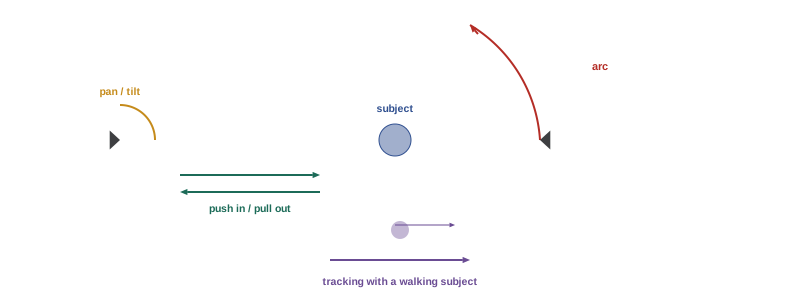
The main dolly moves are:
- Push in (dolly in): moving toward the subject, increasing intensity or emphasis.
- Pull out (dolly out): moving away, revealing context or leaving a character isolated.
- Tracking (trucking): moving alongside a moving subject, keeping them in frame.
- Arc: circling around a subject, adding energy and showing the space around them.
Unlike a zoom, which only magnifies the image, a dolly move changes perspective: foreground and background shift relative to each other, giving a sense of moving through space. Combining a dolly out with a zoom in keeps the subject the same size while the background appears to stretch, the unsettling "dolly zoom" made famous by Hitchcock's Vertigo.
Worked problem
Timing a push-in
A slow push-in on a seated actor must travel 1.2 m during a six-second line of dialogue, starting as the line begins. How fast must the dolly move, and how should the move be shaped?
Show solution
- Average speed: 1.2 m / 6 s = 0.2 m/s.
- The move should ease in and out, so the peak speed in the middle is a little higher than the average, and the first and last half-second are slower.
- Rehearse with the actor and the focus puller, because focus must change continuously as the distance shrinks, and mark the start and end positions on the track.
Answer: A move of about 0.2 m/s, eased at both ends and rehearsed with focus, lands on the final frame as the line ends. The dolly grip, the camera operator and the focus puller work as a team; a beautiful move with soft focus or a bumpy stop is unusable.
Gimbals and stabilizers
Motorized three-axis gimbals hold a camera level and steady while the operator walks, runs or moves through spaces, giving smooth floating moves once possible only with expensive Steadicam systems. Using a gimbal well requires careful balancing of the camera on each axis before powering on (an unbalanced camera makes the motors work harder and vibrate), choosing the right mode (for example pan follow, lock or full follow), and walking smoothly with bent knees, since the gimbal removes rotation but not vertical bounce. Gimbal shots can feel weightless and generic if overused; they are most effective when the movement follows a character or reveals a space in a way that serves the story. A spotter should guide the operator, who often walks backward watching a screen.
Jibs, cranes and drones
Jibs and cranes lift the camera on an arm, allowing rising, descending and sweeping moves: a jib up from a character to reveal a crowd, or down from rooftops to a street. Small jibs are used on modest productions; large cranes and telescopic arms need trained crews. Drones put the camera in the air for aerial establishing shots and sweeping movement at a fraction of the cost of helicopters, but they are aircraft and are regulated as such.
In Canada, drones between 250 g and 25 kg must be registered with Transport Canada and flown by a pilot holding a drone pilot certificate under Part IX of the Canadian Aviation Regulations: a basic certificate for operations in uncontrolled airspace away from bystanders, or an advanced certificate for controlled airspace and flights near or over people. Pilots must keep the drone in visual line of sight, stay below 122 m above ground, and respect restrictions near airports, emergency sites and national parks.
Motivated movement
The guiding principle for all camera movement is motivation: the camera moves because something in the story calls for it. Common motivations are following a moving character, revealing information the audience should discover (a slow pan to a figure standing in the doorway), changing emphasis (a push-in as a character realizes something), and expressing a character's state (unsteady handheld in panic). Movement without motivation draws attention to the camera and away from the story. Equally, a locked-off frame is a strong choice: it lets performances and composition carry the scene, and it gives later movement more impact. Many great scenes are filmed almost entirely from a tripod.
Safety with camera support
Camera supports carry heavy, expensive equipment near people. Keep tripods inside the set's traffic patterns or protected with sandbags; never leave a camera on a tripod unattended on a slope or in wind; check that sliders and dolly track are level and secured; walk backward only with a spotter; and keep jib and crane arms clear of people, lights and overhead power lines. Drones are flown only by qualified pilots, with the area secured and the crew briefed on take-off and landing zones.
Choosing the right support
Each support suits different situations, and the choice should follow the story and the practical constraints. A static tripod suits interviews, dialogue scenes where performances should carry the scene, and anything requiring precise composition. A slider adds subtle life to interviews and product shots with little setup. A dolly suits deliberate, repeatable movement on a prepared surface. A gimbal suits following a character through spaces where track cannot be laid. Handheld suits documentary, intimate drama and chaotic action. When time is short, choose the support that gets the most important shots reliably; an ambitious move that takes an hour to rig and fails three times may cost the coverage the scene needs.
Movement also changes the work of every department. A moving camera sees more of the location, so more of the set must be dressed and lit; the boom operator has fewer places to hide; and the focus puller must follow changing distances. Plan moves with the whole crew, mark start and end points, rehearse until the timing is reliable, and expect to shoot more takes than for a static shot.
Practising movement
Like focus, smooth movement is a physical skill. Practise pans by following a person walking along a path at different distances; practise handheld by walking with the camera through a doorway and around a corner while keeping a subject framed; practise gimbal walking with a cup of water on the camera to see how much vertical bounce remains. Review every exercise on a large screen, where small wobbles become obvious.
Above all, remember that the audience should feel the movement, not notice it. When a move is well motivated and well executed, viewers rarely think about the camera at all; they simply feel closer to the character or more aware of the space.
Common mistakes
MistakePanning with an unlevelled head.
InsteadLevel the head before every setup so the horizon stays level.
MistakeFast pans across detailed backgrounds at 24 fps.
InsteadSlow down or follow a subject to avoid judder.
MistakeHandheld on a long lens.
InsteadUse a wide lens and get closer for handheld.
MistakeMoving the camera because it looks cinematic.
InsteadMove only when the story motivates it.
MistakeFlying a drone without the required certificate and checks.
InsteadFollow the aviation rules, register and plan the flight.
Summary and key terms
- Fluid heads with counterbalance and drag make smooth pans and tilts; level the head first.
- Pans should ease in and out; avoid judder and rolling shutter skew with slower moves.
- Good handheld uses wide lenses, body support and leg movement.
- Sliders and dollies push, pull, track and arc, changing perspective unlike a zoom.
- Gimbals give floating moves but need balance, modes and careful walking.
- Jibs, cranes and drones add height; drones are regulated aircraft.
- Camera movement should be motivated by the story.
- Fluid head
- A tripod head with damped, smooth pan and tilt.
- Counterbalance
- Springs that hold the camera at any tilt angle.
- Pan
- Horizontal rotation of the camera.
- Tilt
- Vertical rotation of the camera.
- Judder
- Stuttering motion in fast pans at low frame rates.
- Rolling shutter
- Line-by-line sensor readout causing skew in fast motion.
- Dolly
- A wheeled camera platform.
- Tracking shot
- A shot moving alongside a moving subject.
- Gimbal
- A motorized stabilizer holding the camera level.
- Dolly zoom
- Combining a dolly move with an opposite zoom to distort perspective.
Practice problems
Work each problem on paper first, then reveal the answer to check.
What does counterbalance do on a fluid head?
Show answer
It holds the camera at any tilt angle without drifting.
Why level the tripod head before panning?
Show answer
Otherwise the horizon tilts during the pan.
What causes judder in pans?
Show answer
Large movement between frames at low frame rates across detailed backgrounds.
What is rolling shutter skew?
Show answer
Vertical lines leaning in fast pans because the sensor reads out line by line.
Why use a wide lens for handheld?
Show answer
It minimizes visible shake.
How does a dolly push-in differ from a zoom?
Show answer
It changes perspective as the camera moves through space; a zoom only magnifies.
A slider move of 0.9 m lasts 6 s. What is the average speed?
Show answer
0.15 m/s.
Why balance a camera on a gimbal before powering on?
Show answer
So the motors do not strain or vibrate.
What altitude limit applies to drone flights in your country?
Show answer
122 m above ground level.
Give two motivations for camera movement.
Show answer
Following a character, revealing information, changing emphasis, expressing a character's state.
Lesson quiz · 5 questions
Score 60% or more to complete this lesson.
Create a free account to save your progress, take quizzes and earn a certificate.