
CHEM-241 · Lesson 8 of 12 · 22 min
Acid–base models: Brønsted, Lewis and hard–soft acids and bases
Why does aluminium chloride dissolve in water to give an acidic solution? Why does mercury occur in nature as the sulfide, cinnabar, while aluminium occurs as oxide and silicate minerals? Why do boron trifluoride and ammonia combine instantly into a white solid, and why is cyanide so poisonous? Each question is about acid–base chemistry, but in a broader sense than the proton transfers of CHEM-102. This lesson extends the Brønsted–Lowry picture to the acidity of metal ions and oxoacids, introduces the Lewis definition that covers every reaction in which an electron pair is shared, and develops the hard–soft principle that explains which acids prefer which bases, from mineral deposits to the binding of metals in enzymes.
Brønsted acidity of aqua ions
Johannes Brønsted and Thomas Lowry independently proposed in 1923 that an acid is a proton donor and a base a proton acceptor. Many inorganic Brønsted acids are not obvious ones. A metal ion in water is surrounded by water molecules bound through oxygen, forming an aqua ion such as [Al(H₂O)₆]³⁺. The positive charge of the metal pulls electron density from the bound water molecules and weakens their O–H bonds, so they can lose a proton:
The acidity of aqua ions rises with the charge and falls with the size of the metal ion; the charge-to-radius ratio, z²/r or z/r, is a good predictor. Na⁺(aq) is essentially neutral (pKa about 14.8), Mg²⁺(aq) is very weakly acidic (11.4), Al³⁺(aq) is as acidic as acetic acid (5.0) and Fe³⁺(aq) is stronger still (2.2). This is why solutions of iron(III) chloride are yellow-brown and acidic, and why aluminium sulfate is used in water treatment: in near-neutral water it loses protons and precipitates as gelatinous Al(OH)₃, which sweeps fine particles out of suspension. Metals with very high charge, such as Ti⁴⁺ or Cr⁶⁺, are too acidic to exist as aqua ions at all; they lose protons completely to form oxo ions such as TiO²⁺ or oxoanions such as CrO₄²⁻.
Oxoacids and Pauling's rules
Oxoacids such as H₂SO₄, H₃PO₄ and HClO₄ have one or more OH groups attached to a central atom, which may also carry oxygen atoms without hydrogen (oxo groups). Linus Pauling noticed two simple regularities. If an oxoacid is written as OₚE(OH)_q, where p is the number of oxo groups:
1. The first pKa is approximately 8 − 5p.
2. Successive pKa values of a polyprotic acid increase by about 5 units each.
The oxo groups withdraw electron density and delocalize the negative charge of the conjugate base, so each one strengthens the acid by about five pKa units. The second rule reflects the extra energy needed to remove a proton from an ion that is already negatively charged. The rules work well for most main-group oxoacids:
| Acid | Formula as OₚE(OH)_q | p | Predicted pKa₁ | Measured pKa₁ |
|---|---|---|---|---|
| Hypochlorous | Cl(OH) | 0 | 8 | 7.5 |
| Boric (see text) | B(OH)₃ | 0 | 8 | 9.2 |
| Chlorous | OCl(OH) | 1 | 3 | 2.0 |
| Phosphoric | OP(OH)₃ | 1 | 3 | 2.1 |
| Nitrous | ON(OH) | 1 | 3 | 3.3 |
| Sulfuric | O₂S(OH)₂ | 2 | −2 | about −3 |
| Nitric | O₂N(OH) | 2 | −2 | −1.4 |
| Perchloric | O₃Cl(OH) | 3 | −7 | about −10 |
Exceptions are informative. Phosphorous acid, H₃PO₃, has pKa₁ = 1.3, not 8, which shows that its formula is OPH(OH)₂, with one hydrogen bonded directly to phosphorus (and not acidic), so p = 1. Hypophosphorous acid H₃PO₂ is OPH₂(OH), with one acidic proton. Boric acid, B(OH)₃, is not a Brønsted acid at all in the usual sense: it acts as a Lewis acid, accepting OH⁻ from water to form B(OH)₄⁻ and releasing a proton from the water. Carbonic acid appears weaker than predicted (measured 6.35) because most dissolved CO₂ is not hydrated to H₂CO₃; the true pKa of H₂CO₃ itself is about 3.5, close to Pauling's value of 3.
Lewis acids and bases
Gilbert N. Lewis proposed, also in 1923, a much broader definition: an acid is an electron-pair acceptor and a base an electron-pair donor. The product of their reaction is a complex, or adduct, held by a coordinate bond. A proton is one Lewis acid among many; every Brønsted acid–base reaction is a Lewis reaction in which the proton is the acceptor. But Lewis acids also include metal ions, molecules with an incomplete octet such as BF₃ and AlCl₃, molecules that can expand their valence shell such as SiF₄ and SbF₅, and molecules with low-lying π* orbitals such as SO₂ and CO₂.
In molecular orbital language, a Lewis base donates electrons from its HOMO into the LUMO of the acid. The stronger the interaction between these frontier orbitals, the closer they are in energy and the better they overlap, the stronger the adduct. This idea connects acid–base chemistry with the MO theory of lesson 7 and explains, for example, why CO binds metals through carbon.
Lewis acidity of the boron trihalides is a famous puzzle. Electronegativity alone suggests that BF₃, with the most electron-withdrawing substituents, should be the strongest Lewis acid. The experimental order toward strong bases such as NH₃ is the reverse: BF₃ < BCl₃ < BBr₃. The usual explanation is π bonding: the filled p orbitals of the halogens donate into the empty boron 2p orbital, and this donation is strongest for fluorine, whose 2p orbitals match boron's in size and energy. Forming an adduct pyramidalizes boron and destroys this π interaction, so the cost is greatest for BF₃. Calculations suggest that differences in the energy needed to distort the planar molecule, and the higher energy of the BF₃ LUMO, also contribute.
Lewis acids are workhorses of industrial chemistry. Aluminium chloride catalyses Friedel–Crafts reactions; zeolites, aluminosilicate frameworks with Lewis and Brønsted acid sites, crack crude oil into gasoline; and Lewis acids such as TiCl₄ and organoaluminium compounds catalyse the polymerization of ethylene and propylene into plastics. At the other extreme, mixing the strong Lewis acid SbF₅ with the strong Brønsted acid HSO₃F gives 'magic acid', a superacid more than a billion times as acidic as concentrated sulfuric acid, strong enough to protonate alkanes. George Olah's studies of carbocations in such media earned the Nobel Prize in Chemistry in 1994.
A modern twist on Lewis chemistry is the frustrated Lewis pair: a bulky Lewis acid and a bulky Lewis base that cannot form an adduct because their substituents get in the way. The unquenched pair is reactive enough to split H₂ heterolytically into H⁺ and H⁻, something previously thought to require transition metals. The concept was introduced by Douglas Stephan and coworkers in Canada in 2006 and has since been used for metal-free hydrogenation catalysis.
Hard and soft acids and bases
Lewis acid–base strength cannot be put on a single scale. Ag⁺ binds iodide much more strongly than fluoride, while Al³⁺ binds fluoride much more strongly than iodide. In 1963 Ralph Pearson organized such observations into the principle of hard and soft acids and bases (HSAB): hard acids prefer to bind hard bases, and soft acids prefer soft bases.
Hard acids are small, highly charged and not easily polarized: H⁺, Li⁺, Na⁺, Mg²⁺, Ca²⁺, Al³⁺, Cr³⁺, Fe³⁺, Ti⁴⁺ and BF₃. Hard bases have small, highly electronegative donor atoms, usually O, N or F: F⁻, OH⁻, H₂O, NH₃, CO₃²⁻, SO₄²⁻ and PO₄³⁻. Soft acids are large, of low charge and polarizable, often late transition metals with filled or nearly filled d shells: Cu⁺, Ag⁺, Au⁺, Hg²⁺, Cd²⁺, Pd²⁺ and Pt²⁺. Soft bases have large, polarizable donor atoms: I⁻, S²⁻, RS⁻, SCN⁻ (through S), CN⁻, CO, H⁻ and phosphines R₃P. Borderline species include Fe²⁺, Co²⁺, Ni²⁺, Cu²⁺, Zn²⁺, Pb²⁺, Br⁻, N₃⁻, NO₂⁻ and pyridine.
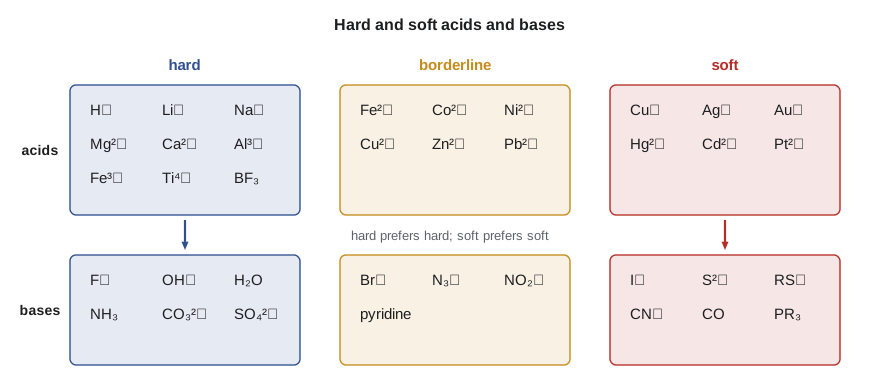
Hard–hard interactions are largely ionic (electrostatic), and soft–soft interactions largely covalent. In MO terms, hard acids have high-energy LUMOs and hard bases low-energy HOMOs, so the frontier orbitals are far apart and the bonding is mostly electrostatic. Soft acids and bases have frontier orbitals close in energy and polarizable electron clouds, so covalent bonding dominates. Robert Parr and Pearson gave the idea a quantitative form in 1983 by defining the absolute hardness η as half the gap between the ionization energy I and the electron affinity A:
For a cation, I is its ionization energy to the next higher charge and A the ionization energy of the next lower charge state; for an anion, η is usually taken from the corresponding neutral atom. The code below computes η for several acids and bases and uses the HSAB classes to predict the favoured partner in some exchange reactions.
# Absolute hardness eta = (I - A)/2 in eV, after Parr and Pearson.
# For a cation M(z+): I = ionization energy of M(z+) -> M((z+1)+), A = I of M((z-1)+) -> M(z+).
data = {
 'Al3+': (119.99, 28.45), 'Mg2+': (80.14, 15.04), 'Li+': (75.64, 5.39), 'Na+': (47.29, 5.14),
 'Ca2+': (50.91, 11.87), 'Hg2+': (34.2, 18.76), 'Ag+': (21.49, 7.58), 'Cu+': (20.29, 7.73),
 'F': (17.42, 3.40), 'Cl': (12.97, 3.61), 'Br': (11.81, 3.36), 'I': (10.45, 3.06),
}
print('species   I (eV)   A (eV)   hardness   Mulliken chi')
for k, (I, A) in sorted(data.items(), key=lambda kv: -(kv[1][0] - kv[1][1])):
    print(f'{k:7} {I:8.2f} {A:8.2f} {(I - A) / 2:9.2f} {(I + A) / 2:12.2f}')

HSAB = {'H+': 'hard', 'Li+': 'hard', 'Na+': 'hard', 'Mg2+': 'hard', 'Ca2+': 'hard', 'Al3+': 'hard',
        'Fe3+': 'hard', 'Ag+': 'soft', 'Hg2+': 'soft', 'Cd2+': 'soft', 'Cu+': 'soft', 'Pb2+': 'borderline',
        'Zn2+': 'borderline', 'F-': 'hard', 'OH-': 'hard', 'O2-': 'hard', 'I-': 'soft', 'S2-': 'soft',
        'CN-': 'soft', 'Cl-': 'hard', 'Br-': 'borderline'}
score = {'hard': 0, 'borderline': 1, 'soft': 2}

def favoured(a1, b1, a2, b2):
    """For a1b1 + a2b2 -> a1b2 + a2b1, the side with better hard/soft matching is favoured."""
    left = abs(score[HSAB[a1]] - score[HSAB[b1]]) + abs(score[HSAB[a2]] - score[HSAB[b2]])
    right = abs(score[HSAB[a1]] - score[HSAB[b2]]) + abs(score[HSAB[a2]] - score[HSAB[b1]])
    return 'products' if right < left else ('reactants' if left < right else 'no clear preference')

print()
for r in [('Ag+', 'F-', 'Li+', 'I-'), ('Hg2+', 'O2-', 'Ca2+', 'S2-'), ('Cu+', 'F-', 'Na+', 'I-'), ('Cd2+', 'OH-', 'Mg2+', 'S2-')]:
    a1, b1, a2, b2 = r
print(f'{a1}{b1} + {a2}{b2} -> {a1}{b2} + {a2}{b1}: favoured side = {favoured(*r)}')species I (eV) A (eV) hardness Mulliken chi Al3+ 119.99 28.45 45.77 74.22 Li+ 75.64 5.39 35.12 40.52 Mg2+ 80.14 15.04 32.55 47.59 Na+ 47.29 5.14 21.07 26.21 Ca2+ 50.91 11.87 19.52 31.39 Hg2+ 34.20 18.76 7.72 26.48 F 17.42 3.40 7.01 10.41 Ag+ 21.49 7.58 6.95 14.54 Cu+ 20.29 7.73 6.28 14.01 Cl 12.97 3.61 4.68 8.29 Br 11.81 3.36 4.23 7.58 I 10.45 3.06 3.69 6.75 Ag+F- + Li+I- -> Ag+I- + Li+F-: favoured side = products Hg2+O2- + Ca2+S2- -> Hg2+S2- + Ca2+O2-: favoured side = products Cu+F- + Na+I- -> Cu+I- + Na+F-: favoured side = products Cd2+OH- + Mg2+S2- -> Cd2+S2- + Mg2+OH-: favoured side = products
The hardness values rank the cations in the expected order: Al³⁺ and Mg²⁺ are very hard (45.8 and 32.6 eV), the alkali metal ions somewhat less so, and Ag⁺, Cu⁺ and Hg²⁺ are soft (around 6 to 8 eV). Among the halogens hardness falls from F (7.0) to I (3.7). The exchange predictions match experiment: LiF and AgI form from AgF and LiI, CuI and NaF from CuF and NaI, and the hard–hard pair CaO and soft–soft HgS are favoured over HgO and CaS. A crude matching score like this one cannot rank two hard acids against each other, however; for that, charge density and lattice energy (lesson 3) must be considered.
HSAB in geochemistry, biology and toxicology
The HSAB principle explains Victor Goldschmidt's classification of the elements by where they are found in the Earth. Lithophile elements, which concentrate in the silicate rocks of the crust and mantle, are hard acids that combine with the hard base oxide: Li, Na, K, Mg, Ca, Al, Ti. Chalcophile elements, which form sulfide ores, are soft or borderline acids that combine with the soft base sulfide: Cu, Ag, Zn, Cd, Hg, Pb (galena, PbS), together with As and Sb. This is why aluminium is mined as bauxite, an oxide, and mercury as cinnabar, HgS.
In biology, hard metal ions such as Mg²⁺ and Ca²⁺ bind to the hard oxygen donors of phosphate and carboxylate groups: Mg²⁺ is the partner of ATP in almost every phosphate-transfer enzyme, and Ca²⁺ binds the carboxylates of proteins in muscle and in blood clotting. Softer ions such as Cu⁺ and Zn²⁺ often bind the sulfur of cysteine. The toxicity of mercury, cadmium and lead comes partly from their strong binding to sulfur groups in enzymes, displacing essential metals. Treatments for poisoning use soft sulfur-containing chelators such as dimercaprol, developed as an antidote to arsenic in the 1940s, which bind the toxic metal more strongly than the enzyme does. Cyanide is a soft, strong base that binds the iron of cytochrome c oxidase in mitochondria and stops cellular respiration.
HSAB is a qualitative principle and has limits. It does not by itself give the strength of an acid or base; a strong hard acid can bind a soft base more strongly than a weak soft acid does. Russell Drago's E and C equation (1965) expresses the enthalpy of adduct formation as −ΔH = E_A E_B + C_A C_B, separating electrostatic (E) and covalent (C) contributions for each acid and base, and gives quantitative predictions for adducts in non-coordinating solvents.
Solvent systems and the Lux–Flood definition
Other definitions are useful in particular settings. In the solvent-system definition, an acid increases the concentration of the cation characteristic of the solvent and a base increases that of the anion. In liquid ammonia, which autoionizes to NH₄⁺ and NH₂⁻, ammonium chloride is an acid and sodium amide a base. In molten-oxide chemistry and metallurgy, the Lux–Flood definition treats an acid as an oxide-ion acceptor and a base as an oxide-ion donor. In the reaction CaO + SiO₂ → CaSiO₃, which removes silica impurities as slag in a blast furnace, CaO is the base (O²⁻ donor) and SiO₂ the acid. Each definition is a special case of the Lewis concept, chosen because it makes the chemistry of a particular system easy to follow.
Common mistakes
MistakeMetal ions in water are neutral spectators.
InsteadAqua ions of small, highly charged cations such as Al³⁺ and Fe³⁺ are Brønsted acids.
MistakeH₃PO₃ is a triprotic acid like H₃PO₄.
InsteadIt is OPH(OH)₂; only two protons are acidic.
MistakeBF₃ is the strongest boron trihalide Lewis acid because F is most electronegative.
InsteadToward NH₃ the order is BF₃ < BCl₃ < BBr₃, largely because B–F π bonding is lost on adduct formation.
MistakeHard means strong and soft means weak.
InsteadHardness describes bonding character and preference, not overall strength.
MistakeBoric acid donates its own protons.
InsteadIt is a Lewis acid that accepts OH⁻ to give B(OH)₄⁻.
MistakeHSAB gives exact equilibrium constants.
InsteadIt is qualitative; Drago's E and C equation is one quantitative extension.
Summary and key terms
- Aqua ions of small, highly charged metal ions are Brønsted acids whose strength follows charge density.
- Pauling's rules estimate oxoacid strength: pKa₁ ≈ 8 − 5p, with successive pKa values about 5 apart.
- Lewis acids accept and Lewis bases donate electron pairs; the interaction is a HOMO–LUMO combination.
- Hard acids prefer hard bases (mostly ionic bonding) and soft acids prefer soft bases (mostly covalent bonding).
- Absolute hardness η = (I − A)/2 quantifies the HSAB scale.
- HSAB explains ore minerals, metal binding in enzymes, toxicity of heavy metals and antidotes.
- Aqua ion
- A metal ion surrounded by and bonded to water molecules in solution.
- Oxoacid
- An acid containing OH groups and often oxo groups bonded to a central atom.
- Lewis acid
- An electron-pair acceptor.
- Adduct
- The product of a Lewis acid–base reaction, joined by a coordinate bond.
- Superacid
- An acid stronger than 100 % sulfuric acid.
- Frustrated Lewis pair
- A bulky Lewis acid and base that cannot form an adduct and remain reactive together.
- Absolute hardness
- Half the difference between ionization energy and electron affinity, η = (I − A)/2.
Practice problems
Work each problem on paper first, then reveal the answer to check.
Use Pauling's rules to estimate pKa₁ and pKa₂ of H₂SO₃, written as OS(OH)₂.
Show answer
p = 1: pKa₁ ≈ 3 and pKa₂ ≈ 8 (measured about 1.9 and 7.2).
Arrange [Na(H₂O)₆]⁺, [Mg(H₂O)₆]²⁺ and [Al(H₂O)₆]³⁺ in order of increasing acidity.
Show answer
Na⁺ < Mg²⁺ < Al³⁺, following charge density.
Identify the Lewis acid and base in SO₂ + Cl⁻ → SO₂Cl⁻ and in SiF₄ + 2F⁻ → SiF₆²⁻.
Show answer
SO₂ and SiF₄ are the acids; Cl⁻ and F⁻ are the bases.
Predict whether Hg²⁺ or Ca²⁺ binds more strongly to the thiolate RS⁻.
Show answer
Hg²⁺, a soft acid, prefers the soft sulfur donor.
Calculate η for Cl from I = 12.97 eV and A = 3.61 eV.
Show answer
η = (12.97 − 3.61)/2 = 4.68 eV.
In CaO + SiO₂ → CaSiO₃, which is the Lux–Flood acid?
Show answer
SiO₂, the oxide-ion acceptor.
Lesson quiz · 5 questions
Score 60% or more to complete this lesson.
Create a free account to save your progress, take quizzes and earn a certificate.