
CHEM-241 · Lesson 4 of 12 · 23 min
Covalent bonding I: Lewis structures, VSEPR and valence bond theory
Most inorganic molecules and ions, from the sulfate in gypsum to the xenon tetrafluoride that astonished chemists in 1962, are held together by covalent bonds. Before we reach the full power of symmetry and molecular orbital theory, we need the simpler models that inorganic chemists use every day to draw a structure, predict a shape and rationalize a bond angle. This lesson revisits Lewis structures with the main-group compounds that test them hardest, develops the valence-shell electron-pair repulsion (VSEPR) model in detail, and introduces valence bond theory and hybridization, with an honest account of what each model gets right and where it fails.
Lewis structures and the octet
Gilbert N. Lewis proposed in 1916 that a covalent bond is a shared pair of electrons and that atoms tend to surround themselves with eight valence electrons, the configuration of a noble gas. The rules you learned in CHEM-101 remain the starting point: count valence electrons, connect the atoms with single bonds (usually with the least electronegative atom in the centre, except hydrogen), complete octets on the outer atoms, place the remaining electrons on the central atom and form multiple bonds if the central atom is short of an octet. Formal charge, FC = (valence electrons) − (nonbonding electrons) − ½(bonding electrons), helps choose among possible structures: the best usually has formal charges close to zero and places any negative charge on the more electronegative atom.
Main-group chemistry offers three kinds of exception to the octet. Some molecules have an odd number of electrons and must have one atom with an unpaired electron: NO (11 valence electrons), NO₂ (17) and ClO₂ (19) are stable radicals. Some central atoms have fewer than eight electrons: BF₃ and BCl₃ have only six around boron, which is why they are strong Lewis acids (lesson 8). And many compounds of the third and later periods appear to have more than eight electrons around the central atom: PCl₅ (10), SF₆ (12), IF₇ (14) and XeF₄ (12). These are called hypervalent molecules.
Hypervalence: expanded octets or not?
For decades textbooks explained hypervalent molecules by saying that elements of period 3 and below can use empty d orbitals to hold extra electrons, forming sp³d or sp³d² hybrids. Quantum chemical calculations since the 1980s have shown that this is wrong: the 3d orbitals of sulfur and phosphorus are too high in energy and too diffuse to take a significant part in bonding. Their small contribution acts as polarization of the s and p orbitals rather than as true valence orbitals.
A better description uses three-centre, four-electron (3c–4e) bonds, an idea proposed by George Pimentel and Robert Rundle around 1951. In the linear F–Xe–F unit of XeF₂, a single p orbital on xenon combines with one orbital on each fluorine to give three molecular orbitals: bonding, nonbonding and antibonding. Four electrons fill the bonding and nonbonding orbitals. The nonbonding orbital is located on the fluorines, so the two Xe–F bonds share one pair of bonding electrons between them, giving each a bond order of ½ and placing negative charge on the electronegative fluorines. This explains why hypervalent molecules form almost only with very electronegative outer atoms (F, O, Cl) and why their bonds to those atoms are long and polar. In SF₆, the same picture gives four ordinary bonding pairs plus charge transferred to the fluorines; the sulfur carries a large positive partial charge.
Lewis structures drawn with expanded octets remain useful for counting electron domains and predicting shape, and we use them below. Just remember that the extra 'bonds' are really a way of describing highly polar, partly ionic bonding. The same caution applies to structures of oxoanions drawn with many double bonds, such as sulfate with two S=O bonds: the formal charges are zero, but calculations show that the S–O bonds are better described as single bonds strengthened by strong electrostatic attraction between S(+) and O(−), with the formal-charge-minimizing structure exaggerating the π bonding.
VSEPR: the model
The valence-shell electron-pair repulsion model was developed by Ronald Gillespie and Ronald Nyholm in 1957, building on a 1940 suggestion by Nevil Sidgwick and Herbert Powell. Gillespie spent most of his career at McMaster University in Hamilton, Ontario, where he refined the model for more than fifty years. Its central idea is simple: the electron pairs in the valence shell of a central atom, both bonding pairs and lone pairs, arrange themselves to be as far apart as possible. Multiple bonds count as a single electron domain.
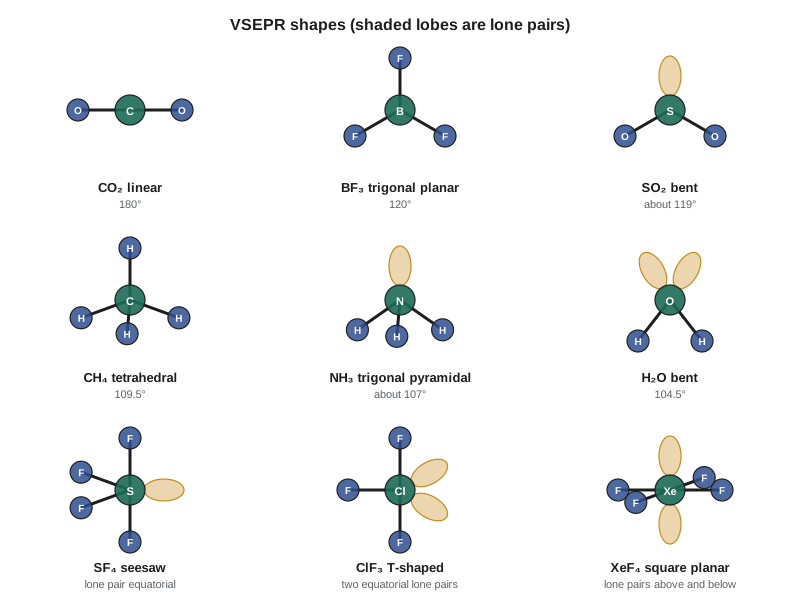
The number of domains sets the electron-pair geometry: two domains are linear, three trigonal planar, four tetrahedral, five trigonal bipyramidal and six octahedral. The molecular shape is then described by the positions of the atoms only, ignoring lone pairs. Using the AXₘEₙ notation, where m is the number of attached atoms and n the number of lone pairs on the central atom A:
| Domains | AXₘEₙ | Electron geometry | Molecular shape | Example |
|---|---|---|---|---|
| 2 | AX₂ | Linear | Linear | BeCl₂ (gas), CO₂ |
| 3 | AX₃ | Trigonal planar | Trigonal planar | BF₃, SO₃ |
| 3 | AX₂E | Trigonal planar | Bent | SO₂, O₃ |
| 4 | AX₄ | Tetrahedral | Tetrahedral | CH₄, SO₄²⁻ |
| 4 | AX₃E | Tetrahedral | Trigonal pyramidal | NH₃, PCl₃ |
| 4 | AX₂E₂ | Tetrahedral | Bent | H₂O, SCl₂ |
| 5 | AX₅ | Trigonal bipyramidal | Trigonal bipyramidal | PF₅, PCl₅ |
| 5 | AX₄E | Trigonal bipyramidal | Seesaw | SF₄ |
| 5 | AX₃E₂ | Trigonal bipyramidal | T-shaped | ClF₃ |
| 5 | AX₂E₃ | Trigonal bipyramidal | Linear | XeF₂, I₃⁻ |
| 6 | AX₆ | Octahedral | Octahedral | SF₆ |
| 6 | AX₅E | Octahedral | Square pyramidal | BrF₅ |
| 6 | AX₄E₂ | Octahedral | Square planar | XeF₄, ICl₄⁻ |
| 7 | AX₇ | Pentagonal bipyramidal | Pentagonal bipyramidal | IF₇ |
Refinements: lone pairs, multiple bonds and electronegativity
VSEPR also predicts how real bond angles depart from the ideal values. Gillespie ranked the repulsions: lone pair–lone pair > lone pair–bonding pair > bonding pair–bonding pair. A lone pair is held by only one nucleus and spreads over a wider angle than a bonding pair, so it pushes bonding pairs together. The angles in CH₄ (109.5°), NH₃ (107°) and H₂O (104.5°) decrease as lone pairs replace bonds. A multiple bond takes more room than a single bond: in OSF₄ and in Cl₂C=O the angles opposite the double bond are compressed. Electronegative outer atoms pull bonding pairs away from the central atom and make them take less room: NF₃ has a F–N–F angle of 102°, smaller than the H–N–H angle of 107° in NH₃.
In trigonal bipyramidal molecules the five positions are not equivalent. The three equatorial positions have two neighbours at 90° and two at 120°; the two axial positions have three neighbours at 90°. Because repulsion at 90° is much stronger than at 120°, lone pairs and multiple bonds go to the equatorial positions, where they have fewer close neighbours. This puts the lone pair of SF₄ in the equatorial plane (seesaw shape), the two lone pairs of ClF₃ equatorial (T shape) and the three lone pairs of XeF₂ all equatorial, leaving a linear F–Xe–F unit. The more electronegative substituents prefer the axial positions, a preference called apicophilicity: in PCl₂F₃ the fluorines are axial and one equatorial.
Where VSEPR fails
VSEPR is very successful for main-group molecules, but it has known failures. The hydrides of the heavier group 15 and 16 elements have bond angles close to 90°: PH₃ 93.5°, AsH₃ 92°, H₂S 92° and H₂Se 91°, instead of the roughly 107° and 104.5° the model suggests. The explanation is that heavier atoms have a larger energy gap between s and p orbitals, so the lone pair stays in a mostly s orbital and the bonds use mostly p orbitals, which are at 90° to one another. Some molecules with a lone pair on the central atom are perfectly symmetric because the lone pair is stereochemically inactive: SeCl₆²⁻ and TeBr₆²⁻ are regular octahedra even though they have seven electron domains. And VSEPR says little about transition-metal complexes, whose shapes depend on d-electron configurations (CHEM-341). Gillespie's later ligand close-packing model, which treats the outer atoms as touching spheres, explains several of these exceptions.
Valence bond theory and hybridization
Valence bond theory, developed by Walter Heitler and Fritz London in 1927 for H₂ and extended by Linus Pauling and John Slater from 1931, describes a covalent bond as the overlap of two atomic orbitals, each holding one electron, with the pair of spins opposed. The bond is strongest when the overlap is greatest. Pauling's 1939 book The Nature of the Chemical Bond made the theory, with its ideas of hybridization and resonance, the working language of chemistry for a generation.
To explain the tetrahedral shape of methane, in which four equivalent C–H bonds point to the corners of a tetrahedron, Pauling proposed that the carbon 2s and three 2p orbitals mix into four equivalent sp³ hybrid orbitals. Each hybrid has 25 % s and 75 % p character and points along a tetrahedral direction. Mixing one s with two p orbitals gives three sp² hybrids at 120° (as in BF₃) and mixing s with one p gives two sp hybrids at 180° (as in BeCl₂ gas). The angle between two equivalent hybrids is related to their s character by cos θ = −s/(1 − s), where s is the fraction of s character, so sp³ (s = 0.25) gives θ = 109.5°, sp² (s = 0.33) gives 120° and sp (s = 0.5) gives 180°.
Worked problem
Hybridization from a bond angle
The H–O–H angle in water is 104.5°. If the O–H bonds use equivalent hybrids, what is their s character, and what does that imply for the lone pairs?
Show solution
- cos 104.5° = −0.250 = −s/(1 − s), so s = 0.250/1.250 = 0.20.
- Each bonding hybrid has 20 % s and 80 % p character; the two bonds together use 0.40 of the oxygen 2s orbital.
- The remaining 0.60 of the s orbital goes to the lone pairs, which therefore have 30 % s character each on average.
Answer: The bonds are slightly richer in p character than sp³ (s = 0.20 rather than 0.25), and the lone pairs are richer in s character. This is an example of Bent's rule.
Henry Bent stated a useful generalization in 1961: atomic s character concentrates in orbitals directed toward electropositive substituents. Lone pairs, which have no substituent at all, are the most electropositive 'substituent' and get the most s character. Electronegative substituents get orbitals with more p character, which explains why F–A–F angles are smaller than H–A–H angles (NF₃ versus NH₃) and why axial positions in trigonal bipyramids, which use more p character, are taken by the more electronegative groups.
Resonance
When a single Lewis structure cannot describe a molecule, valence bond theory uses resonance: the real structure is a weighted average of several Lewis structures, none of which exists on its own. The nitrate ion is described by three equivalent structures, each with one N=O and two N–O bonds, giving three identical bonds of order 1⅓ (measured length 124 pm, between the N–O single bond of about 140 pm and the N=O double bond of about 120 pm). Ozone has two equivalent structures and a bond order of 1½ (128 pm). Resonance structures differ only in the placement of electrons, never of atoms.
A program for VSEPR
The VSEPR rules are mechanical enough to automate. Given the group number of the central atom, the number of attached atoms, their bonds and the overall charge, a program can count the lone pairs on the central atom, find the steric number and look up the shape. The code below does this for a list of main-group species and reports the ideal angles.
# VSEPR from electron counting for a central main-group atom.
SHAPES = {
 (2, 0): ('linear', '180'), (3, 0): ('trigonal planar', '120'), (3, 1): ('bent', '<120'),
 (4, 0): ('tetrahedral', '109.5'), (4, 1): ('trigonal pyramidal', '<109.5'), (4, 2): ('bent', '<<109.5'),
 (5, 0): ('trigonal bipyramidal', '90, 120'), (5, 1): ('seesaw', '<90, <120'), (5, 2): ('T-shaped', '<90'),
 (5, 3): ('linear', '180'), (6, 0): ('octahedral', '90'), (6, 1): ('square pyramidal', '<90'),
 (6, 2): ('square planar', '90'), (7, 0): ('pentagonal bipyramidal', '72, 90'),
}

def vsepr(name, valence, ligands, charge=0):
    """ligands: list of electrons each ligand takes from the central atom
    (1 for a single bond to H or a halogen, 2 for a double bond to O, etc.)."""
    electrons = valence - charge - sum(ligands)
    lone_pairs = electrons // 2
    steric = len(ligands) + lone_pairs
    shape, angle = SHAPES[(steric, lone_pairs)]
    print(f'{name:7} steric number {steric}, lone pairs {lone_pairs}: {shape:22} angles {angle}')

vsepr('BF3', 3, [1, 1, 1])
vsepr('SO2', 6, [2, 2])
vsepr('NH3', 5, [1, 1, 1])
vsepr('H2O', 6, [1, 1])
vsepr('SF4', 6, [1, 1, 1, 1])
vsepr('ClF3', 7, [1, 1, 1])
vsepr('XeF2', 8, [1, 1])
vsepr('I3-', 7, [1, 1], charge=-1)
vsepr('BrF5', 7, [1] * 5)
vsepr('XeF4', 8, [1] * 4)
vsepr('IF7', 7, [1] * 7)
vsepr('SO4 2-', 6, [2, 2, 1, 1])   # the 2- charge sits on the two singly bonded O
vsepr('ICl4-', 7, [1] * 4, charge=-1)

# bond angle between equivalent hybrids from s character, and the reverse
import math
for s in (0.5, 1 / 3, 0.25, 0.20):
print(f's character {s:.2f}: angle {math.degrees(math.acos(-s / (1 - s))):.1f} degrees')BF3 steric number 3, lone pairs 0: trigonal planar angles 120 SO2 steric number 3, lone pairs 1: bent angles <120 NH3 steric number 4, lone pairs 1: trigonal pyramidal angles <109.5 H2O steric number 4, lone pairs 2: bent angles <<109.5 SF4 steric number 5, lone pairs 1: seesaw angles <90, <120 ClF3 steric number 5, lone pairs 2: T-shaped angles <90 XeF2 steric number 5, lone pairs 3: linear angles 180 I3- steric number 5, lone pairs 3: linear angles 180 BrF5 steric number 6, lone pairs 1: square pyramidal angles <90 XeF4 steric number 6, lone pairs 2: square planar angles 90 IF7 steric number 7, lone pairs 0: pentagonal bipyramidal angles 72, 90 SO4 2- steric number 4, lone pairs 0: tetrahedral angles 109.5 ICl4- steric number 6, lone pairs 2: square planar angles 90 s character 0.50: angle 180.0 degrees s character 0.33: angle 120.0 degrees s character 0.25: angle 109.5 degrees s character 0.20: angle 104.5 degrees
The sulfate entry shows how the program counts: two oxygens are treated as double-bonded (taking two electrons each) and two as single-bonded with a negative charge, which together use all six sulfur electrons and leave no lone pair. Any choice of Lewis structure that keeps the octet or expands it gives the same steric number of four, and so the same tetrahedral shape. VSEPR depends only on the number of electron domains, which is why it is so robust.
Choosing among models
Each model in this lesson answers a different question. Lewis structures tell you how electrons are distributed in bonds and lone pairs and give formal charges. VSEPR predicts shapes and the direction of angle distortions with almost no effort. Valence bond theory and hybridization connect bond angles to orbital composition and explain trends such as Bent's rule. None of them, however, explains why O₂ is paramagnetic, why the ionization energies of CH₄ show two distinct bands in a photoelectron spectrum rather than one, or why some molecules absorb visible light. For those we need molecular orbital theory, which we build in lesson 7 after developing the symmetry tools of lessons 5 and 6.
Common mistakes
MistakeHypervalent molecules use d orbitals to expand the octet.
InsteadCalculations show d participation is negligible; 3c–4e bonding and charge transfer to electronegative ligands explain them.
MistakeLone pairs do not affect molecular shape.
InsteadThey occupy positions in the electron geometry and compress the bond angles.
MistakeIn SF₄ the lone pair is axial.
InsteadIt is equatorial, where it has only two 90° neighbours.
MistakeVSEPR predicts about 107° for PH₃.
InsteadThe heavier hydrides have angles near 90° because their bonds use mostly p orbitals.
MistakeResonance structures interconvert rapidly.
InsteadThey are not real species; the molecule is a single hybrid structure.
MistakeHybridization causes molecular shape.
InsteadShape is observed; hybridization is a description chosen to fit it.
Summary and key terms
- Lewis structures with formal charges remain the starting point; radicals, electron-deficient and hypervalent molecules break the octet rule.
- Hypervalent bonding is best described by 3c–4e bonds and polar charge transfer, not d-orbital participation.
- VSEPR predicts shapes from the number of electron domains; lone pairs and multiple bonds take more space and prefer equatorial sites.
- Electronegative substituents compress bond angles; heavy hydrides have angles near 90°.
- Valence bond theory describes bonds as overlapping half-filled orbitals; hybrid s character sets bond angles through cos θ = −s/(1 − s).
- Bent's rule places s character toward electropositive groups and lone pairs.
- Formal charge
- Valence electrons minus nonbonding electrons minus half the bonding electrons on an atom.
- Hypervalent molecule
- A molecule in which a central main-group atom appears to have more than eight valence electrons.
- Three-centre four-electron bond
- A bond in which four electrons in three molecular orbitals bind three atoms in a line.
- Steric number
- The number of atoms plus lone pairs around a central atom.
- Apicophilicity
- The preference of electronegative groups for axial positions in a trigonal bipyramid.
- Hybrid orbital
- A mixture of atomic orbitals on one atom pointing in a particular direction.
- Bent's rule
- Atomic s character concentrates in orbitals directed toward electropositive substituents.
Practice problems
Work each problem on paper first, then reveal the answer to check.
Predict the shape of ClO₃⁻ and estimate the O–Cl–O angle.
Show answer
Cl has 7 + 1 = 8 electrons; with three O (formal single bonds) there is one lone pair: AX₃E, trigonal pyramidal, angle a little under 109.5° (measured about 107°).
Predict the shapes of IF₅ and TeF₅⁻.
Show answer
Both are AX₅E: square pyramidal, with F–central–F angles slightly under 90°.
Why does PCl₃F₂ have both fluorines axial?
Show answer
Electronegative F prefers the axial positions, which use more p character (apicophilicity).
Calculate the angle between two equivalent hybrids with 30 % s character.
Show answer
cos θ = −0.30/0.70 = −0.429, θ = 115.4°.
Explain why the H–S–H angle (92°) is much smaller than the H–O–H angle (104.5°).
Show answer
Sulfur's larger 3s–3p gap keeps the lone pair in a mostly s orbital and the S–H bonds use nearly pure p orbitals.
Draw the resonance structures of CO₃²⁻ and give the C–O bond order.
Show answer
Three equivalent structures each with one C=O; bond order 4/3.
Lesson quiz · 5 questions
Score 60% or more to complete this lesson.
Create a free account to save your progress, take quizzes and earn a certificate.