
CHEM-241 · Lesson 3 of 12 · 27 min
Ionic bonding and lattice energy: the Born–Haber cycle
Why is table salt NaCl and not NaCl₂ or Na₂Cl? Why is magnesium oxide, a compound of a doubly charged cation and a doubly charged anion, one of the most stable substances known, melting at 2852 °C, even though making O²⁻ from oxygen atoms costs energy? Why do fluorides of metals in high oxidation states exist when the corresponding iodides do not? The answers come from the energetics of ionic solids, and the central quantity is the lattice energy. CHEM-101 introduced the Born–Haber cycle as an accounting exercise. In this lesson we derive the lattice energy from electrostatics, compare the result with the experimental cycle, and use both to make predictions about which compounds can exist.
The ionic model
The ionic model treats a solid such as NaCl as an array of spherical ions, Na⁺ and Cl⁻, held together by electrostatic attraction between opposite charges and kept apart by short-range repulsion when their electron clouds overlap. It is an idealization. No bond is purely ionic, and the model works best for compounds of very electropositive metals with very electronegative nonmetals: alkali and alkaline-earth halides and oxides. As the electronegativity difference shrinks, or as the cation becomes small and highly charged, covalent character grows and the model's predictions drift, which is itself informative.
The lattice energy is the energy released when gaseous ions come together to form one mole of the solid:
Many tables quote the reverse process, the energy needed to break the solid into gaseous ions, as a positive lattice enthalpy (787 kJ/mol for NaCl). Both conventions are common; what matters is to be consistent within a calculation. Here we use the lattice enthalpy as the positive energy of separation, written ΔH_L, and the lattice energy U as the negative energy of formation from the ions. The two differ by a small term, about 2RT for a 1:1 salt, that we ignore.
The Born–Haber cycle
The lattice enthalpy cannot be measured directly, because gaseous ions cannot be collected and condensed. Max Born and Fritz Haber showed in 1919 that it can be found from Hess's law. Formation of NaCl(s) from its elements in their standard states can be carried out in one step or in a series of steps through the gaseous ions, and the enthalpy changes must add to the same total.
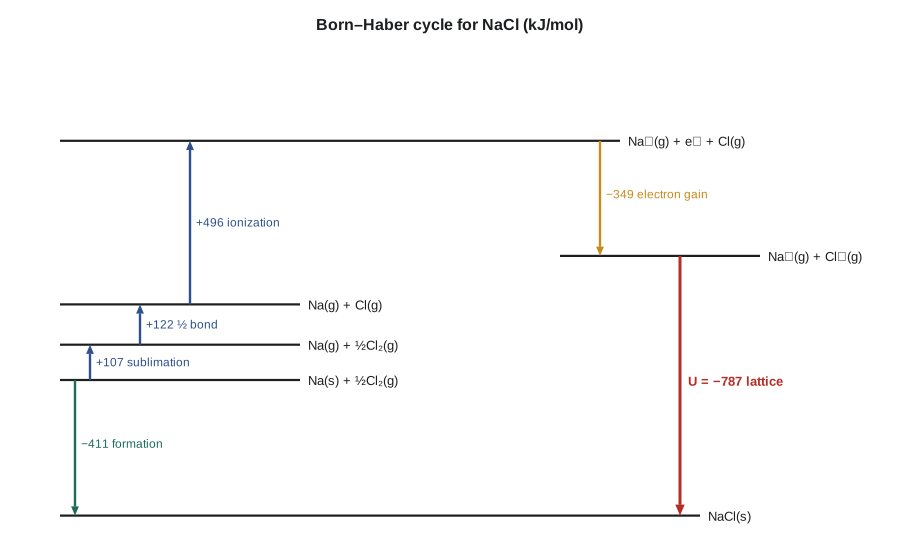
| Step | Process | ΔH (kJ/mol) |
|---|---|---|
| 1 | Na(s) → Na(g), sublimation | +107 |
| 2 | ½Cl₂(g) → Cl(g), half the bond enthalpy | +122 |
| 3 | Na(g) → Na⁺(g) + e⁻, first ionization | +496 |
| 4 | Cl(g) + e⁻ → Cl⁻(g), electron gain | −349 |
| 5 | Na⁺(g) + Cl⁻(g) → NaCl(s), lattice formation | U |
| Overall | Na(s) + ½Cl₂(g) → NaCl(s), formation | −411 |
Hess's law gives −411 = 107 + 122 + 496 − 349 + U, so U = −787 kJ/mol. Look at the balance: forming the gaseous ions from the elements costs a net +376 kJ/mol, because the ionization energy of sodium is larger than the electron affinity of chlorine. The compound is stable only because the lattice energy more than repays that cost. This is the general rule for ionic compounds: making ions in the gas phase is always endothermic overall, and lattice energy is what makes ionic solids possible.
Lattice energy from electrostatics: the Born–Landé equation
Can we calculate U from the structure of the crystal? Consider first a single ion pair. Two ions of charges z₊e and z₋e at distance r have a Coulomb energy z₊z₋e²/(4πε₀r), negative for opposite charges. In a crystal each ion interacts with every other ion: in NaCl a sodium ion has 6 chloride neighbours at r₀, 12 sodium ions at √2 r₀, 8 chlorides at √3 r₀, 6 sodium ions at 2r₀ and so on. Summing all these interactions gives a geometric factor, the Madelung constant A, that depends only on the structure type:
The series converges slowly and only conditionally; the order in which terms are summed matters, and lesson 12 shows how the Evjen method, which sums over neutral cubes, gets a reliable value. The Coulomb energy per mole of the crystal is then −N_A A |z₊z₋| e²/(4πε₀r). Without repulsion the crystal would collapse. Born and Alfred Landé represented the repulsion by a term B/rⁿ, where n, the Born exponent, is large (5 to 12) and can be estimated from the compressibility of the solid or from the electron configurations of the ions: 5 for a helium core, 7 for neon, 9 for argon, 10 for krypton and 12 for xenon, averaged for the two ions. Minimizing the total energy with respect to r at the equilibrium distance r₀ eliminates B and gives the Born–Landé equation:
The derivation is short. Write the energy per mole as U(r) = −C/r + NB/rⁿ with C = N_A A|z₊z₋|e²/(4πε₀). At equilibrium dU/dr = 0, so C/r₀² = nNB/r₀ⁿ⁺¹, giving NB = Cr₀ⁿ⁻¹/n. Substituting back, U(r₀) = −C/r₀ + C/(nr₀) = −(C/r₀)(1 − 1/n). The repulsion therefore reduces the Coulomb energy by only a fraction 1/n, about 12 % for NaCl, which is why the simple electrostatic picture works so well.
Worked problem
Lattice energy of NaCl from the Born–Landé equation
Calculate U for NaCl using A = 1.74756, r₀ = 282 pm and n = 8 (the average of 7 for Na⁺ and 9 for Cl⁻).
Show solution
- The constant N_A e²/(4πε₀) equals 1.389 × 10⁵ kJ pm mol⁻¹.
- Coulomb term: 1.389 × 10⁵ × 1.74756 × 1 / 282 = 861 kJ/mol.
- Repulsion correction: (1 − 1/8) = 0.875, so U = −861 × 0.875 = −753 kJ/mol.
Answer: U ≈ −753 kJ/mol, within about 4 % of the Born–Haber value of −787 kJ/mol. A better repulsion term (Born–Mayer, with an exponential e^(−r/ρ)) and the small van der Waals attraction close most of the gap.
The Kapustinskii equation
The Born–Landé equation needs the crystal structure. Anatoli Kapustinskii noticed in 1956 that the Madelung constant divided by the number of ions in the formula unit, ν, is nearly the same for most structures, about 0.87. He replaced A with this average and r₀ with the sum of the ionic radii, giving an equation that needs only charges and radii:
The Kapustinskii equation is less accurate than a full calculation, but it is invaluable for compounds whose structures are unknown or hypothetical. Turned around, it can assign thermochemical radii to complex ions such as SO₄²⁻, NO₃⁻ or BF₄⁻ from measured lattice energies, and those radii can then predict the lattice energies of other salts of the same ions.
The equations make the main dependence clear: lattice energy is proportional to the product of the ion charges and inversely proportional to the distance between them. Doubling both charges, from Na⁺Cl⁻ to Mg²⁺O²⁻, multiplies |z₊z₋| by four; and because Mg²⁺ and O²⁻ are also smaller than Na⁺ and Cl⁻, U for MgO is nearly five times that of NaCl. This is why MgO melts at 2852 °C and NaCl at 801 °C, and why MgO is used to line furnaces.
import math
K = 1.389e5          # N_A e^2 / (4 pi eps0) in kJ pm / mol

def born_haber(dHf, atomize_M, ionize_M, atomize_X, egain_X):
    """Lattice energy U (formation from gaseous ions), kJ/mol, by Hess's law."""
    return dHf - (atomize_M + ionize_M + atomize_X + egain_X)

def born_lande(A, zz, r0, n):
    return -K * A * zz / r0 * (1 - 1 / n)

def kapustinskii(nu, zz, rp, rm):
    d = rp + rm
    return -1.2025e5 * nu * zz / d * (1 - 34.5 / d)

# NaCl: sublimation 107, IE1 496, half of D(Cl2) 122, electron gain -349, dHf -411
U_bh = born_haber(-411, 107, 496, 122, -349)
print(f'NaCl  Born-Haber   U = {U_bh:7.0f} kJ/mol')
print(f'NaCl  Born-Lande   U = {born_lande(1.74756, 1, 282, 8):7.0f} kJ/mol')
print(f'NaCl  Kapustinskii U = {kapustinskii(2, 1, 102, 181):7.0f} kJ/mol')

# MgO: sublimation 148, IE1 + IE2 = 738 + 1451, half of D(O2) 249,
# O(g) -> O2-(g): -141 + 798 = +657, dHf -602
U_mgo = born_haber(-602, 148, 738 + 1451, 249, -141 + 798)
print(f'MgO   Born-Haber   U = {U_mgo:7.0f} kJ/mol')
print(f'MgO   Born-Lande   U = {born_lande(1.74756, 4, 211, 7):7.0f} kJ/mol')
print(f'MgO   Kapustinskii U = {kapustinskii(2, 4, 72, 140):7.0f} kJ/mol')

# CaF2 (fluorite, A = 2.51939): Kapustinskii vs Born-Lande
print(f'CaF2  Born-Lande   U = {born_lande(2.51939, 2, 236, 8):7.0f} kJ/mol')
print(f'CaF2  Kapustinskii U = {kapustinskii(3, 2, 100, 133):7.0f} kJ/mol')

# Would NaCl2 be stable? Assume a Na2+ radius like Mg2+ (72 pm) and a fluorite-like lattice.
U_nacl2 = kapustinskii(3, 2, 72, 181)
dHf_nacl2 = 107 + (496 + 4562) + 2 * 122 + 2 * (-349) + U_nacl2
print(f'NaCl2 estimate: U = {U_nacl2:.0f}, dHf = {dHf_nacl2:+.0f} kJ/mol')NaCl Born-Haber U = -787 kJ/mol NaCl Born-Lande U = -753 kJ/mol NaCl Kapustinskii U = -746 kJ/mol MgO Born-Haber U = -3845 kJ/mol MgO Born-Lande U = -3944 kJ/mol MgO Kapustinskii U = -3799 kJ/mol CaF2 Born-Lande U = -2595 kJ/mol CaF2 Kapustinskii U = -2638 kJ/mol NaCl2 estimate: U = -2463, dHf = +2248 kJ/mol
The Born–Haber values for NaCl and MgO are reproduced by the electrostatic models to within a few per hundred, a remarkable success for so simple a picture. The calculation for NaCl₂ shows why it does not exist: even with a much larger lattice energy, the second ionization energy of sodium (4562 kJ/mol, an electron from the neon core) makes the enthalpy of formation strongly positive, more than +2000 kJ/mol. The same kind of calculation shows that MgCl (with Mg⁺) would be stable with respect to the elements but would disproportionate to Mg and MgCl₂, releasing a large amount of energy. Compound formulas follow from a balance between ionization energies, which favour low charges, and lattice energies, which favour high ones.
When the ionic model fails
For compounds with significant covalent character, the Born–Haber lattice energy is larger than the electrostatic one, because the extra covalent bonding is included in the experimental value but not in the model. Silver halides are the classic example. For AgF the two agree closely, but for AgCl, AgBr and AgI the experimental value exceeds the calculated one by 6, 10 and 13 per hundred. The large, soft halide ions are polarized by the Ag⁺ cation, and the bond acquires covalent character. The same covalent contribution explains why AgCl, AgBr and AgI are so insoluble in water while AgF is very soluble.
Kazimierz Fajans summarized the factors that favour covalent character in 1923. A cation polarizes an anion more strongly if it is small and highly charged (high charge density) or if it has a non-noble-gas configuration, such as Ag⁺, Cu⁺, Hg²⁺ or Pb²⁺, whose d electrons shield the nucleus poorly. An anion is more polarizable if it is large and highly charged: I⁻ more than F⁻, and S²⁻ more than O²⁻. Fajans' rules explain why AlCl₃ is a volatile, partly covalent solid that sublimes at 180 °C while NaCl melts at 801 °C, why BeCl₂ forms chains in the solid rather than an ionic lattice, and why LiI is more covalent than LiF.
Using lattice energies: stability, solubility and thermal decomposition
Lattice energies explain many trends in descriptive chemistry. Consider the thermal decomposition of the group 2 carbonates, MCO₃(s) → MO(s) + CO₂(g). The reaction converts a lattice with the large carbonate anion into one with the small oxide anion. For a small cation, the gain in lattice energy on going to the oxide is large, because the oxide lattice energy depends strongly on the cation radius when the anion is small. For a large cation, the gain is smaller. So MgCO₃ decomposes at about 350 °C, CaCO₃ at about 900 °C (the industrial process for making lime), SrCO₃ near 1290 °C and BaCO₃ above 1360 °C. The same argument explains why lithium is the only alkali metal whose carbonate decomposes easily, and why the peroxides and superoxides of the large alkali metals (Na₂O₂, KO₂, CsO₂) are stable while lithium forms only Li₂O on burning: large anions are stabilized by large cations.
Solubility is a competition between lattice energy and hydration energy. When a salt dissolves, the lattice is broken (costing ΔH_L) and the ions are hydrated (releasing ΔH_hyd, which also scales with charge and inversely with size). Both terms are large and of opposite sign, so the enthalpy of solution is a small difference of large numbers and hard to predict. A useful rule of thumb follows from the different ways the two terms depend on size. Lattice energy depends on the sum r₊ + r₋, while hydration energy is a sum of separate terms for each ion. Salts with ions of very different size tend to be soluble, because one ion is strongly hydrated while the lattice is only moderately stable; salts with ions of similar size tend to be less soluble. This explains why LiF and CsI are less soluble than CsF and LiI, and why barium sulfate (large cation, large anion) is famously insoluble, which is why it can be swallowed safely as a contrast agent for X-ray imaging.
Worked problem
Why the group 2 sulfates become less soluble down the group
Magnesium sulfate is very soluble, while barium sulfate dissolves to only about 2.4 mg per litre. Explain the trend with lattice and hydration energies.
Show solution
- The sulfate ion is large (thermochemical radius about 230 pm), so r₊ + r₋ changes only modestly from Mg²⁺ (72 pm) to Ba²⁺ (135 pm): the lattice energy falls by about 15 per hundred.
- The hydration energy of the cation alone falls much more, from about −1920 kJ/mol for Mg²⁺ to −1300 kJ/mol for Ba²⁺, because hydration depends on the cation radius by itself.
- Down the group the loss in hydration energy outweighs the loss in lattice energy, so dissolution becomes less favourable.
Answer: Sulfate solubility falls down group 2 because hydration energy drops faster than lattice energy when the anion is large. With the small hydroxide anion the opposite holds, and Ba(OH)₂ is far more soluble than Mg(OH)₂.
Stabilizing high and low oxidation states
Lattice energy also explains why some oxidation states are found only with certain partners. Fluoride is small and has a high lattice energy with any cation, and fluorine is a powerful oxidizing agent; together these make fluorides the best compounds for stabilizing high oxidation states, such as AgF₂ (Ag²⁺), CoF₃ and the noble-gas fluorides. Iodide is large and easily oxidized; Cu²⁺ oxidizes it, 2Cu²⁺ + 4I⁻ → 2CuI + I₂, so copper(II) iodide does not exist, and no compound such as FeI₃ or PbI₄ is stable either. Conversely, large anions such as PF₆⁻ or tetraphenylborate stabilize large cations, which is why such counterions are used to crystallize unusual cations, and why the cation O₂⁺ was first isolated by Neil Bartlett as O₂⁺[PtF₆]⁻, an experiment that led him to make the first noble-gas compound in 1962 (lesson 11).
Common mistakes
MistakeLattice energy can be measured directly.
InsteadIt is obtained indirectly from a Born–Haber cycle or calculated from a model.
MistakeForming gaseous Na⁺ and Cl⁻ from the elements releases energy.
InsteadIt costs about +376 kJ/mol; the lattice energy pays for it.
MistakeThe repulsion term is a large correction.
InsteadIt reduces the Coulomb energy by only 1/n, about 10 to 15 per hundred.
MistakeLattice energy depends mainly on ion size.
InsteadIt depends first on the charge product |z₊z₋|, then on r₊ + r₋.
MistakeA large Born–Haber lattice energy proves a compound is ionic.
InsteadIf it exceeds the electrostatic value, covalent bonding contributes, as in AgI.
MistakeSolubility is set by lattice energy alone.
InsteadIt is a small difference between lattice and hydration energies; ion size match matters.
Summary and key terms
- Lattice energy is the energy of forming a solid from its gaseous ions; it makes ionic compounds possible.
- The Born–Haber cycle obtains it from formation, sublimation, bond, ionization and electron-gain enthalpies by Hess's law.
- The Born–Landé equation, U = −N_A A|z₊z₋|e²/(4πε₀r₀)(1 − 1/n), reproduces Born–Haber values for ionic solids within a few per hundred.
- The Kapustinskii equation needs only charges and radii and gives thermochemical radii for complex ions.
- Covalent character, favoured by Fajans' rules, makes experimental lattice energies exceed model values.
- Lattice energies explain compound formulas, carbonate decomposition temperatures, solubility trends and the stabilization of unusual oxidation states.
- Lattice energy
- The energy released when gaseous ions combine to form one mole of an ionic solid.
- Born–Haber cycle
- A Hess's law cycle linking the enthalpy of formation of an ionic solid to its lattice energy.
- Madelung constant
- The geometric factor that sums all electrostatic interactions in a lattice type.
- Born exponent
- The power n in the repulsive term B/rⁿ of the Born–Landé equation.
- Thermochemical radius
- An effective radius of a complex ion assigned from lattice energies.
- Fajans' rules
- Guidelines predicting covalent character from cation charge density and anion polarizability.
- Polarizability
- The ease with which an electron cloud is distorted by an electric field.
Practice problems
Work each problem on paper first, then reveal the answer to check.
Use a Born–Haber cycle to find U for KBr: ΔfH = −394, sublimation of K = +89, I₁ = +419, ½ΔH for Br₂(l) → Br(g) = +112, electron gain of Br = −325 kJ/mol.
Show answer
U = −394 − (89 + 419 + 112 − 325) = −394 − 295 = −689 kJ/mol.
Estimate U for KCl with the Kapustinskii equation (r(K⁺) = 138, r(Cl⁻) = 181 pm).
Show answer
d = 319; U = −1.2025 × 10⁵ × 2/319 × (1 − 34.5/319) = −754 × 0.892 = −673 kJ/mol (experimental about −701).
Without calculation, rank NaF, NaCl, MgO and CaO by lattice energy.
Show answer
MgO > CaO (charges 2,2; Mg²⁺ smaller) > NaF > NaCl (charges 1,1; F⁻ smaller than Cl⁻).
Why is AlCl₃ volatile while AlF₃ melts above 1290 °C?
Show answer
Al³⁺ has a high charge density; it polarizes the large Cl⁻ strongly (covalent, molecular Al₂Cl₆), but the small F⁻ much less (ionic lattice).
Predict which decomposes at the lower temperature, Li₂CO₃ or Na₂CO₃, and explain.
Show answer
Li₂CO₃: the small Li⁺ gains more lattice energy on forming Li₂O from the carbonate.
Suggest an anion to stabilize the large cation [N(CH₃)₄]⁺ in a crystal and explain your choice.
Show answer
A large anion such as BF₄⁻ or PF₆⁻ matches its size, giving a stable lattice; small anions gain little.
Lesson quiz · 5 questions
Score 60% or more to complete this lesson.
Create a free account to save your progress, take quizzes and earn a certificate.