
CHEM-241 · Lesson 5 of 12 · 24 min
Molecular symmetry and point groups
Look at a molecule of water and you see that its left and right halves are mirror images. Look at ammonia from above and it looks the same after a turn of 120°. Look at methane and you find four equivalent C–H bonds pointing to the corners of a tetrahedron. Symmetry like this is more than a matter of appearance. It decides whether a molecule has a dipole moment, whether it can be chiral, which of its vibrations show up in an infrared spectrum, which atomic orbitals can combine into molecular orbitals and which electronic transitions are allowed. Group theory, the mathematics of symmetry, turns these questions into calculations. This lesson introduces symmetry elements and operations, shows how to classify any molecule into a point group, and sets up the group theory that lesson 6 puts to work.
Symmetry operations and symmetry elements
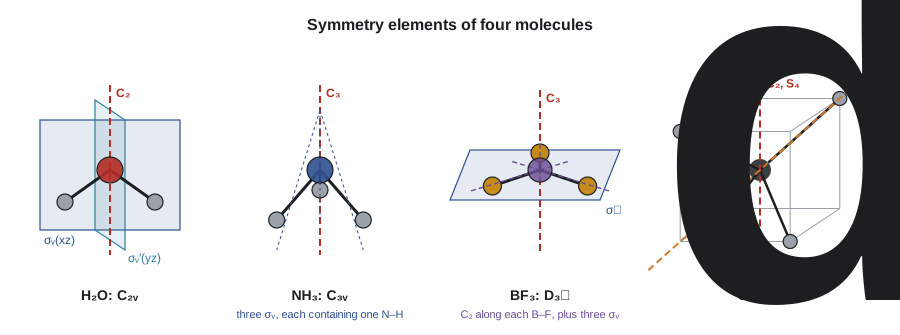
A symmetry operation is a movement of a molecule that leaves it looking exactly the same: every atom ends up at a position occupied by an identical atom. The geometric feature about which the operation is carried out, a point, line or plane, is the symmetry element. Molecules have five kinds.
1. The identity, E. Doing nothing. Every molecule has it, and it is needed to make the mathematics work.
2. A proper rotation, Cₙ, by 360°/n about an axis. Water has a C₂ axis through the oxygen, bisecting the H–O–H angle; ammonia has a C₃ axis; benzene has a C₆ axis. Repeated rotations are written as powers: C₃² is two successive rotations by 120°. The axis with the highest n is the principal axis, and by convention it defines the z direction.
3. A reflection, σ, through a mirror plane. Planes containing the principal axis are vertical, σᵥ; a plane perpendicular to the principal axis is horizontal, σₕ; and vertical planes that bisect the angle between two C₂ axes perpendicular to the principal axis are called dihedral, σ_d.
4. An inversion, i, through a centre of symmetry. Every point at position (x, y, z) is moved to (−x, −y, −z). Octahedral SF₆, square planar XeF₄, CO₂ and benzene have an inversion centre; tetrahedral CH₄ and water do not.
5. An improper rotation, Sₙ: a rotation by 360°/n followed by a reflection through a plane perpendicular to the rotation axis. Neither step alone need be a symmetry operation. Methane has three S₄ axes along the directions that bisect pairs of H–C–H angles: rotate by 90° about one of them, and the hydrogens are in the wrong places, but reflect through the perpendicular plane and they are back where they started. Note that S₁ is the same as a reflection and S₂ the same as an inversion.
Point groups
The complete set of symmetry operations of a molecule forms a group in the mathematical sense, called its point group because every operation leaves at least one point (the centre of mass) unmoved. A set of operations is a group if it satisfies four conditions:
1. Closure: performing any two operations in succession gives another operation in the set.
2. Identity: the set contains E, which leaves every operation unchanged when combined with it.
3. Inverses: every operation has an inverse in the set that undoes it. The inverse of C₃ is C₃², and every reflection is its own inverse.
4. Associativity: (AB)C = A(BC) for any three operations, which is automatically true for geometric operations.
The number of operations in the group is its order, h. Water's group, C₂ᵥ, has order 4: E, C₂, σᵥ(xz) and σᵥ′(yz). Ammonia's group, C₃ᵥ, has order 6: E, C₃, C₃², and three σᵥ. The multiplication table of a group lists the result of every product. For C₂ᵥ, every operation is its own inverse and the products commute (the group is abelian); for C₃ᵥ they do not, so the order in which operations are done matters, a fact the code at the end of this lesson verifies with matrices.
| C₂ᵥ | E | C₂ | σᵥ(xz) | σᵥ′(yz) |
|---|---|---|---|---|
| E | E | C₂ | σᵥ(xz) | σᵥ′(yz) |
| C₂ | C₂ | E | σᵥ′(yz) | σᵥ(xz) |
| σᵥ(xz) | σᵥ(xz) | σᵥ′(yz) | E | C₂ |
| σᵥ′(yz) | σᵥ′(yz) | σᵥ(xz) | C₂ | E |
Assigning a point group
Every molecule belongs to exactly one point group, and a systematic flowchart finds it. The questions are asked in order, and each answer narrows the possibilities.
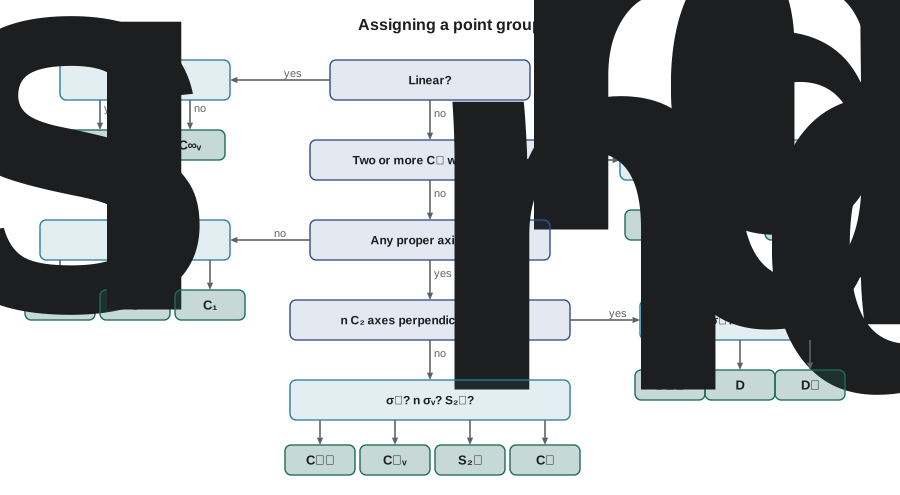
1. Is the molecule linear? If so it belongs to D∞ₕ if it has an inversion centre (CO₂, N₂, HC≡CH) or C∞ᵥ if it does not (HCl, OCS, HCN).
2. Does it have several high-order axes (n > 2)? Molecules with the shapes of the Platonic solids belong to the cubic groups: T_d for a regular tetrahedron (CH₄, P₄, SiF₄), O_h for a regular octahedron or cube (SF₆, cubane) and I_h for an icosahedron or dodecahedron (B₁₂H₁₂²⁻, C₆₀).
3. Otherwise find the principal axis Cₙ. If the molecule has no rotation axis at all, it is C_s if it has a mirror plane (HOCl, SOCl₂), C_i if it has only an inversion centre, and C₁ if it has no symmetry beyond E (CHFClBr).
4. Are there n C₂ axes perpendicular to the principal axis? If yes, the molecule belongs to a D group: Dₙₕ if there is also a horizontal plane (BF₃ is D₃ₕ, XeF₄ is D₄ₕ, benzene D₆ₕ), Dₙ_d if there are n dihedral planes but no σₕ (staggered ethane D₃_d, allene D₂_d), and Dₙ otherwise (a three-bladed propeller, or the twisted complex [Co(en)₃]³⁺, D₃).
5. If there are no perpendicular C₂ axes, it belongs to a C group: Cₙₕ with a horizontal plane (planar trans-N₂F₂ is C₂ₕ), Cₙᵥ with n vertical planes (H₂O C₂ᵥ, NH₃ C₃ᵥ, SF₄ C₂ᵥ, BrF₅ C₄ᵥ), S₂ₙ if only an improper axis is present, and Cₙ otherwise (H₂O₂ in its twisted gas-phase structure is C₂).
Worked problem
Point groups of common inorganic molecules
Assign point groups to (a) PCl₅, (b) SF₄, (c) SOCl₂ and (d) staggered ethane.
Show solution
- (a) PCl₅ is trigonal bipyramidal, not linear, with one C₃ axis (through the axial atoms) and no higher axes. Three C₂ axes lie along the equatorial P–Cl bonds, perpendicular to C₃, so it is a D group. The equatorial plane is σₕ: D₃ₕ.
- (b) SF₄ (seesaw) has one C₂ axis bisecting the equatorial F–S–F angle, through the lone-pair direction, and no perpendicular C₂ axes. It has two vertical mirror planes, one containing the axial F atoms and one containing the equatorial F atoms: C₂ᵥ.
- (c) SOCl₂ is a trigonal pyramid with S at the apex. It has no rotation axis, but the plane containing S and O and bisecting the two Cl atoms is a mirror plane: C_s.
- (d) Staggered ethane has a C₃ axis along C–C, three C₂ axes perpendicular to it (each passing through the C–C midpoint between staggered H atoms), no σₕ, and three dihedral planes: D₃_d. It also has an inversion centre and an S₆ axis.
Answer: PCl₅ D₃ₕ, SF₄ C₂ᵥ, SOCl₂ C_s and staggered ethane D₃_d. Eclipsed ethane, by contrast, has σₕ and belongs to D₃ₕ.
Consequences of symmetry: polarity and chirality
Two properties follow directly from the point group, before any calculation. A molecule can have a permanent dipole moment only if the dipole vector is unchanged by every symmetry operation. A dipole cannot be perpendicular to a rotation axis (rotation would turn it), cannot lie on both sides of a mirror plane at once and cannot survive an inversion. So only molecules in the groups C₁, C_s, Cₙ and Cₙᵥ can be polar, and in Cₙ and Cₙᵥ the dipole must lie along the principal axis. Water (C₂ᵥ), ammonia (C₃ᵥ), SF₄ (C₂ᵥ) and BrF₅ (C₄ᵥ) are polar. BF₃ (D₃ₕ), CH₄ (T_d), SF₆ (O_h), XeF₄ (D₄ₕ), CO₂ (D∞ₕ) and PCl₅ (D₃ₕ) are not, even though each of their bonds is polar: the bond dipoles cancel by symmetry.
A molecule is chiral, that is, not superimposable on its mirror image, if and only if it has no improper rotation axis Sₙ of any order. Because S₁ = σ and S₂ = i, a molecule with a mirror plane or an inversion centre is never chiral. Chiral molecules therefore belong only to the groups C₁, Cₙ and Dₙ (and the rare T, O and I). The criterion is not simply the absence of a mirror plane: a molecule can lack every mirror plane and still be achiral if it has an S₄ axis, as some tetrasubstituted spiro compounds do. In inorganic chemistry, chirality appears in tetrahedral centres with four different groups and, very importantly, in octahedral complexes with three chelating ligands such as [Co(en)₃]³⁺ (D₃), which exist as non-superimposable left- and right-handed propellers; Alfred Werner resolved such complexes in 1911, proving his octahedral model of coordination (CHEM-341).
Representing operations with matrices
To compute with symmetry we represent each operation as a matrix that acts on coordinates. A point (x, y, z) is a column vector, and an operation is a 3 × 3 matrix that moves it. The identity is the unit matrix. A reflection in the xz plane changes y to −y. A rotation by θ about z is
and the inversion is minus the unit matrix. Products of operations are matrix products, applied right to left: the matrix for 'first A, then B' is BA. Because the matrices obey the same multiplication table as the operations themselves, they form a representation of the group. The sum of the diagonal elements of a matrix, its trace or character χ, does not depend on the choice of axes, and characters turn out to carry all the information needed for most chemical applications. For a rotation by θ the character is 1 + 2cos θ; for a reflection it is +1; for the inversion it is −3; for an improper rotation by θ it is −1 + 2cos θ. Lesson 6 builds the character tables of point groups from these ideas.
Classes
In C₃ᵥ, the operations C₃ and C₃² are related: if you relabel the axes by one of the mirror planes, C₃ turns into C₃². Operations related in this way, A and XAX⁻¹ for some operation X in the group, are said to be conjugate and form a class. They always have the same character, which is why character tables group them together: C₃ᵥ has three classes, E, 2C₃ and 3σᵥ. In an abelian group such as C₂ᵥ every operation is in a class by itself. The code below builds the matrices of C₃ᵥ, verifies the group axioms, prints the multiplication table, shows that the group is not abelian and finds its classes.
import math
from itertools import product

def rot(deg):
    c, s = math.cos(math.radians(deg)), math.sin(math.radians(deg))
    return ((c, -s, 0.0), (s, c, 0.0), (0.0, 0.0, 1.0))

def mirror(deg):
    """Vertical mirror plane containing z and the direction at angle deg in the xy plane."""
    c, s = math.cos(math.radians(2 * deg)), math.sin(math.radians(2 * deg))
    return ((c, s, 0.0), (s, -c, 0.0), (0.0, 0.0, 1.0))

def mul(A, B):   # A @ B
    return tuple(tuple(sum(A[i][k] * B[k][j] for k in range(3)) for j in range(3)) for i in range(3))

def same(A, B):
    return all(abs(A[i][j] - B[i][j]) < 1e-9 for i in range(3) for j in range(3))

ops = {'E': rot(0), 'C3': rot(120), 'C3^2': rot(240),
       'sv1': mirror(90), 'sv2': mirror(210), 'sv3': mirror(330)}

def name_of(M):
    return next(n for n, X in ops.items() if same(M, X))

names = list(ops)
print('C3v multiplication table (row operation done after column operation):')
print('       ' + ''.join(f'{n:>6}' for n in names))
for b in names:
    print(f'{b:>6} ' + ''.join(f'{name_of(mul(ops[b], ops[a])):>6}' for a in names))

closure = all(any(same(mul(ops[a], ops[b]), X) for X in ops.values()) for a, b in product(names, names))
inverses = all(any(same(mul(ops[a], ops[b]), ops['E']) for b in names) for a in names)
abelian = all(same(mul(ops[a], ops[b]), mul(ops[b], ops[a])) for a, b in product(names, names))
print('closure:', closure, ' every operation has an inverse:', inverses, ' abelian:', abelian)

classes, seen = [], set()
for a in names:
    if a in seen: continue
    cls = set()
    for x in names:
        xinv = next(b for b in names if same(mul(ops[x], ops[b]), ops['E']))
        cls.add(name_of(mul(mul(ops[x], ops[a]), ops[xinv])))
    seen |= cls
    classes.append(sorted(cls))
print('classes:', classes)
print('characters (traces):', {n: round(sum(ops[n][i][i] for i in range(3)), 3) + 0.0 for n in names})C3v multiplication table (row operation done after column operation):
E C3 C3^2 sv1 sv2 sv3
E E C3 C3^2 sv1 sv2 sv3
C3 C3 C3^2 E sv3 sv1 sv2
C3^2 C3^2 E C3 sv2 sv3 sv1
sv1 sv1 sv2 sv3 E C3 C3^2
sv2 sv2 sv3 sv1 C3^2 E C3
sv3 sv3 sv1 sv2 C3 C3^2 E
closure: True every operation has an inverse: True abelian: False
classes: [['E'], ['C3', 'C3^2'], ['sv1', 'sv2', 'sv3']]
characters (traces): {'E': 3.0, 'C3': 0.0, 'C3^2': 0.0, 'sv1': 1.0, 'sv2': 1.0, 'sv3': 1.0}The output confirms that the six matrices are closed under multiplication, that each has an inverse, and that the group is not abelian: doing σᵥ1 and then C₃ is not the same as doing C₃ and then σᵥ1. The classes come out as {E}, {C₃, C₃²} and the three reflections, and the characters of the three-dimensional matrices are 3 for E, 0 for both rotations and 1 for every reflection, the same within each class. These characters are exactly what we need in lesson 6.
Common mistakes
MistakeA symmetry element and a symmetry operation are the same thing.
InsteadThe element is the point, axis or plane; the operation is the movement carried out with respect to it.
MistakeA molecule without a mirror plane is chiral.
InsteadA molecule is chiral only if it lacks every Sₙ axis, including S₂ = i and higher Sₙ.
MistakeMolecules with polar bonds are polar.
InsteadBond dipoles cancel in high-symmetry groups such as D₃ₕ, T_d and O_h.
MistakeThe order of operations never matters.
InsteadIn non-abelian groups such as C₃ᵥ, AB and BA can differ.
MistakeSF₄ belongs to T_d.
InsteadIts seesaw shape has only one C₂ axis and two mirror planes: C₂ᵥ.
MistakeStaggered and eclipsed ethane share a point group.
InsteadStaggered is D₃_d (inversion centre); eclipsed is D₃ₕ (horizontal plane).
Summary and key terms
- Symmetry operations (E, Cₙ, σ, i, Sₙ) leave a molecule indistinguishable; elements are the geometric features they use.
- The operations of a molecule form a point group that satisfies closure, identity, inverses and associativity.
- A flowchart assigns any molecule to one point group from linearity, high-order axes, perpendicular C₂ axes and mirror planes.
- Only molecules in C₁, C_s, Cₙ and Cₙᵥ can have a dipole moment.
- A molecule is chiral if and only if it has no improper axis Sₙ.
- Operations can be represented by matrices whose traces (characters) are the same within a class.
- Symmetry operation
- A movement that leaves a molecule in an arrangement indistinguishable from the original.
- Principal axis
- The rotation axis of highest order, taken as the z direction.
- Improper rotation
- A rotation followed by reflection through the plane perpendicular to the axis.
- Point group
- The group of all symmetry operations of a molecule.
- Order
- The number of operations in a group.
- Class
- A set of mutually conjugate operations in a group, which share the same character.
- Character
- The trace of the matrix representing an operation.
Practice problems
Work each problem on paper first, then reveal the answer to check.
List the symmetry elements of NH₃ and give its point group and order.
Show answer
E, C₃ (giving C₃ and C₃²), three σᵥ; C₃ᵥ, order 6.
Assign point groups to BF₃, XeF₄, CO₂ and HCN.
Show answer
D₃ₕ, D₄ₕ, D∞ₕ and C∞ᵥ.
Which of CH₂Cl₂, CCl₄, PF₅ and ClF₃ are polar?
Show answer
CH₂Cl₂ (C₂ᵥ) and ClF₃ (C₂ᵥ) are polar; CCl₄ (T_d) and PF₅ (D₃ₕ) are not.
Show that C₂ followed by σᵥ(xz) gives σᵥ′(yz) in C₂ᵥ, using coordinates.
Show answer
C₂: (x, y, z) → (−x, −y, z); then σᵥ(xz): → (−x, y, z), which is reflection in the yz plane.
What is the character of a C₄ rotation matrix, and of S₄?
Show answer
χ(C₄) = 1 + 2cos 90° = 1; χ(S₄) = −1 + 2cos 90° = −1.
Why is [Co(en)₃]³⁺ chiral although it has a C₃ axis and three C₂ axes?
Show answer
Its point group D₃ contains no mirror plane, inversion centre or Sₙ axis.
Lesson quiz · 5 questions
Score 60% or more to complete this lesson.
Create a free account to save your progress, take quizzes and earn a certificate.