
CHEM-241 · Lesson 11 of 12 · 22 min
Main-group chemistry II: nitrogen, oxygen, halogen and noble gas groups
The right-hand side of the p-block contains the elements that dominate the air, the oceans and the chemical industry: nitrogen, phosphorus, oxygen, sulfur and the halogens. It also contains the noble gases, long thought to be completely unreactive until a single experiment in 1962 overturned that belief. This lesson continues the tour begun in lesson 10, from group 15 to group 18, emphasizing the patterns that the principles of the course explain: why nitrogen is so unreactive and phosphorus so reactive, why oxygen is a diradical, why sulfur forms rings, why fluorine is the most reactive element and why xenon, but not neon, forms compounds.
Group 15: nitrogen
Nitrogen makes up 78 % of the atmosphere as N₂, held together by one of the strongest bonds in chemistry, a triple bond of 945 kJ/mol (lesson 7). The molecule is nonpolar, has a large HOMO–LUMO gap and is very hard to reduce or oxidize, which is why it is used as an inert atmosphere and why living things cannot use it directly. Converting N₂ into ammonia, nitrates or proteins, a process called nitrogen fixation, needs either special enzymes or extreme conditions.
Biological fixation is carried out by bacteria using the enzyme nitrogenase, whose active site is an iron–molybdenum–sulfur cluster (FeMo cofactor) that reduces N₂ to NH₃ at room temperature, consuming ATP and electrons. Industrial fixation uses the Haber–Bosch process. Fritz Haber showed in 1909 that N₂ and H₂ combine over an iron catalyst at about 400 to 500 °C and high pressure, and Carl Bosch scaled the process up for BASF, opening the first plant in 1913. Haber received the Nobel Prize in Chemistry in 1918 and Bosch shared it in 1931. The reaction N₂ + 3H₂ ⇌ 2NH₃ is exothermic (ΔH° = −92 kJ) but slow, so the conditions are a compromise between rate (which favours high temperature) and yield (which favours low temperature and high pressure). The process now consumes about 1 to 2 % of the world's energy, and the ammonia it produces is the basis of nitrogen fertilizers that feed billions of people.
Ammonia is converted to nitric acid by the Ostwald process: catalytic oxidation on platinum–rhodium gauze to NO, further oxidation to NO₂ and absorption in water. Nitrogen shows every oxidation state from −3 (NH₃) to +5 (NO₃⁻), and its oxides include N₂O (+1, a potent greenhouse gas and the anesthetic laughing gas), NO (+2, a radical that is also a messenger molecule in the body, as recognized by the Nobel Prize in Physiology or Medicine in 1998), N₂O₃, NO₂ and its dimer N₂O₄, and N₂O₅. The Frost diagram summarizes their relationships.
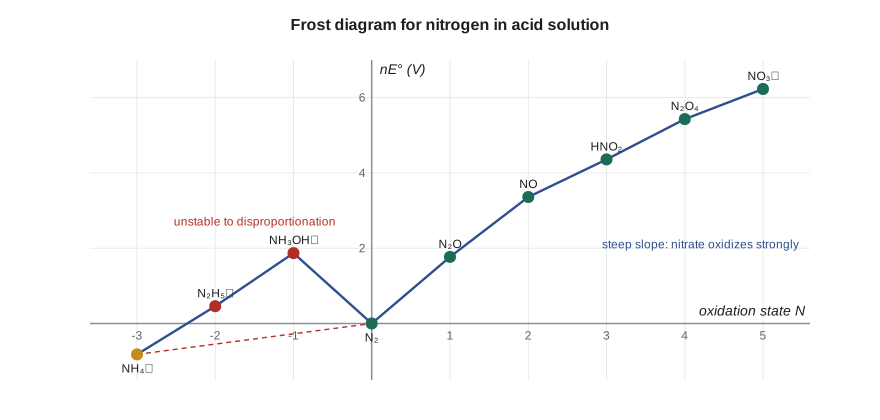
The diagram shows that ammonium is the most stable nitrogen species in acid, that nitrate is a strong oxidizing agent (the slope from N₂ up to NO₃⁻ is steep), and that hydroxylamine lies above the line joining its neighbours, while hydrazine lies well above the line from NH₄⁺ to N₂; both are thermodynamically unstable with respect to disproportionation. So are several of the oxides: NO, for example, slowly disproportionates at high pressure into N₂O and NO₂, and N₂O₄ in water gives HNO₂ and HNO₃. Molecular nitrogen lies only a little above the line from NH₄⁺ to the oxides, but it is kinetically protected by its strong triple bond. Without that kinetic barrier, the oxygen and nitrogen of the air would slowly combine to nitrate in the oceans.
Phosphorus, arsenic, antimony and bismuth
Phosphorus does not form a stable P≡P triple bond as nitrogen does, because its larger 3p orbitals overlap poorly in π bonds; instead it forms single bonds to three neighbours. White phosphorus consists of P₄ tetrahedra with very strained 60° angles. It is so reactive that it ignites in air and glows in the dark as it slowly oxidizes, and it is stored under water. Heating it gives polymeric red phosphorus, which is much less reactive and is used in matchbox strikers, and high pressure gives black phosphorus, a layered semiconductor whose single layers (phosphorene) are studied as two-dimensional materials. Phosphorus burns to P₄O₁₀, which reacts with water to give phosphoric acid; most phosphoric acid, however, is made by treating phosphate rock with sulfuric acid and is used to make fertilizers. Phosphate groups link the sugars of DNA and RNA and carry energy in ATP.
Down the group, metallic character increases: arsenic and antimony are metalloids and bismuth is a metal. The inert-pair effect makes Bi(III) the common state and Bi(V) strongly oxidizing; sodium bismuthate is one of the few reagents strong enough to oxidize Mn²⁺ to permanganate. Arsenic compounds are toxic; arsenic in groundwater, released from minerals under reducing conditions, is a serious health problem in parts of South Asia and elsewhere, and drinking-water guidelines in many countries set its limit at 10 µg/L.
Group 16: oxygen
Oxygen is the most abundant element in the Earth's crust and makes up 21 % of the atmosphere. Its ground state is a triplet diradical with two unpaired electrons in the π* orbitals (lesson 7). Because most organic molecules have all their electrons paired, a direct reaction with triplet O₂ is spin forbidden, which is why organic matter does not burst into flame in air at room temperature despite the large free energy available. Singlet oxygen, an excited state in which the two π* electrons are paired, lies 94 kJ/mol above the ground state and is much more reactive; it is generated in photodynamic therapy to destroy cancer cells.
Ozone, O₃, is a bent molecule (117°) with a bond order of 1½, formed in the stratosphere when ultraviolet light splits O₂ into atoms that then add to O₂. It absorbs ultraviolet radiation between about 200 and 310 nm, shielding the Earth's surface. Chlorine atoms released from chlorofluorocarbons destroy it catalytically (Cl + O₃ → ClO + O₂; ClO + O → Cl + O₂), as Paul Crutzen, Mario Molina and Sherwood Rowland showed, work recognized by the Nobel Prize in Chemistry in 1995. The Montreal Protocol of 1987 phased out these compounds, and the ozone layer is slowly recovering. Near the ground, ozone is a pollutant formed in smog.
Oxygen forms oxides with almost every element, with the full range of bonding from ionic (Na₂O) to network covalent (SiO₂) to molecular (CO₂, SO₂). The reduced forms O₂⁻ (superoxide) and O₂²⁻ (peroxide) appear in KO₂ and Na₂O₂, and hydrogen peroxide, H₂O₂, is a widely used, environmentally benign oxidizing agent that decomposes to water and oxygen.
Sulfur, selenium and tellurium
Sulfur, like phosphorus, prefers single bonds to multiple bonds. Its most stable form at room temperature is orthorhombic sulfur, made of crown-shaped S₈ rings. When sulfur is heated above about 160 °C the rings open and join into long chains, and the liquid becomes dramatically more viscous. Sulfur is recovered in huge amounts from natural gas and petroleum, where it occurs as H₂S, by the Claus process (2H₂S + SO₂ → 3S + 2H₂O). Most of it is converted to sulfuric acid, the chemical made in the largest quantity in the world, by the contact process: sulfur is burned to SO₂, which is oxidized to SO₃ over a vanadium(V) oxide catalyst at about 450 °C, and the SO₃ is absorbed in concentrated sulfuric acid.
Hydrogen sulfide is a toxic gas with the smell of rotten eggs that is as poisonous as hydrogen cyanide; it binds to the iron of cytochrome c oxidase, as cyanide does. Selenium is an essential trace element (in the enzyme glutathione peroxidase) but toxic in excess, and it is used in photocopier drums because its electrical conductivity increases in light. Tellurium is a component of cadmium telluride solar cells.
Group 17: the halogens
The halogens, fluorine, chlorine, bromine and iodine, exist as diatomic molecules X₂ whose colour deepens down the group, from pale yellow F₂ through yellow-green Cl₂ and red-brown Br₂ to violet-black I₂, as the HOMO–LUMO (π* to σ*) gap narrows. Fluorine is the most electronegative and most reactive element. Its reactivity comes from two factors: the F–F bond is unusually weak (159 kJ/mol, compared with 242 for Cl–Cl), because lone pairs on the small atoms repel each other, and the bonds fluorine forms with other elements are very strong. Henri Moissan first isolated fluorine in 1886 by electrolysis of a solution of KF in liquid HF, a feat that earned him the Nobel Prize in Chemistry in 1906. Fluorine is used to make UF₆ for uranium enrichment for nuclear power, SF₆ for electrical switchgear and fluoropolymers such as PTFE.
Chlorine is produced with sodium hydroxide by electrolysis of brine in the chlor-alkali process; modern plants use membrane cells, which have replaced the mercury and asbestos-diaphragm cells of the past. It is used to make PVC and to disinfect drinking water, where it forms hypochlorous acid. Bromine is recovered from brines and the Dead Sea and used in flame retardants; iodine is essential to the thyroid hormones, which is why table salt is iodized in many countries to prevent thyroid disease.
Hydrogen fluoride is a weak acid in water (pKa 3.2), unlike HCl, HBr and HI, which are strong. The H–F bond is very strong and the F⁻ ion very strongly hydrated, but the net effect is a small Ka. HF attacks glass (SiO₂ + 4HF → SiF₄ + 2H₂O) and is extremely dangerous to skin because it penetrates and binds calcium. The halogens form interhalogen compounds such as ClF, ClF₃, BrF₅ and IF₇, whose shapes are predicted by VSEPR (lesson 4), and polyhalide ions such as I₃⁻, which forms when iodine dissolves in potassium iodide solution and gives the blue colour of the starch test.
Group 18: the noble gases
Helium, neon, argon, krypton, xenon and radon have filled valence shells, the highest ionization energies of their periods and almost no tendency to form compounds. Helium, the second most abundant element in the universe, is obtained from natural gas wells, where it accumulates from the radioactive decay of uranium and thorium, and is used to cool the superconducting magnets of MRI scanners. Argon, about 0.93 % of the air, is a cheap inert gas for welding and incandescent bulbs.
In 1962 Neil Bartlett, then at the University of British Columbia in Vancouver, noticed that platinum hexafluoride is a strong enough oxidizing agent to remove an electron from O₂, forming O₂⁺[PtF₆]⁻. Because the first ionization energy of xenon (1170 kJ/mol) is almost the same as that of O₂ (1165 kJ/mol), he mixed xenon with PtF₆ and obtained an orange-yellow solid, the first compound of a noble gas, formulated at first as Xe⁺[PtF₆]⁻ and now known to be more complex. Within months, other groups had made the binary fluorides XeF₂, XeF₄ and XeF₆ by heating xenon with fluorine, and noble-gas chemistry became a new field. The shapes of the xenon fluorides are exactly those predicted by VSEPR: linear XeF₂ (AX₂E₃), square planar XeF₄ (AX₄E₂) and a distorted octahedral XeF₆ (AX₆E), whose lone pair makes it fluxional.
Krypton forms KrF₂, a powerful fluorinating agent. Argon forms no stable compounds at room temperature, but HArF was made in a solid argon matrix at very low temperature by Markku Räsänen's group in Helsinki in 2000. The trend follows ionization energy: only the larger noble gases, whose outer electrons are held less tightly, can be oxidized by fluorine or oxygen.
Light and bonds
Many reactions in this lesson are started by light that breaks a bond: ultraviolet light splitting O₂ and O₃ in the stratosphere, visible light splitting Cl₂ in photochemical chlorination. The longest wavelength that can break a bond follows from E = hc/λ, using the bond enthalpy per molecule. The code below computes these thresholds, checks the nitrogen Frost diagram for disproportionation and confirms the VSEPR shapes of the xenon fluorides.
h, c, NA = 6.62607e-34, 2.99792458e8, 6.02214e23
bonds = {'N2 (N-N triple)': 945, 'O2': 498, 'Cl2': 242, 'Br2': 193, 'F2': 159, 'I2': 151, 'O3 (O2-O)': 106}
print('bond            kJ/mol   threshold wavelength (nm)')
for k, D in bonds.items():
    lam = h * c * NA / (D * 1000) * 1e9
    print(f'{k:16} {D:5}   {lam:7.0f}')

# Nitrogen in acid: Frost points from the Latimer diagram (potentials in V)
lat = [('NO3-', 5, 0.80), ('N2O4', 4, 1.07), ('HNO2', 3, 1.00), ('NO', 2, 1.59), ('N2O', 1, 1.77), ('N2', 0, None)]
pts = {'N2': (0, 0.0)}
nE = 0.0
for i in range(len(lat) - 2, -1, -1):
    name, N, E = lat[i]
    nE += (N - lat[i + 1][1]) * E
    pts[name] = (N, nE)
nE = 0.0
for name, N, E in [('NH3OH+', -1, -1.87), ('N2H5+', -2, 1.41), ('NH4+', -3, 1.28)]:
    nE -= E                    # one electron per step down, per N atom
    pts[name] = (N, nE)
order = sorted(pts.items(), key=lambda kv: kv[1][0])
for name, (N, v) in order:
    print(f'   {name:7} N = {N:+d}  nE = {v:+.2f} V')
for (a, (Na, Ea)), (b, (Nb, Eb)), (cc, (Nc, Ec)) in zip(order, order[1:], order[2:]):
    if Eb > Ea + (Ec - Ea) * (Nb - Na) / (Nc - Na):
        print(f'   {b} lies above the line from {a} to {cc}: unstable to disproportionation')
print('   E(NO3-/NH4+) =', round((pts['NO3-'][1] - pts['NH4+'][1]) / 8, 3), 'V')

# Xenon fluorides: steric number = bonds + lone pairs on Xe (8 valence electrons)
for n in (2, 4, 6):
    lp = (8 - n) // 2
print(f'XeF{n}: {n} bonds, {lp} lone pair' + ('s' if lp != 1 else '') + f', steric number {n + lp}')bond kJ/mol threshold wavelength (nm) N2 (N-N triple) 945 127 O2 498 240 Cl2 242 494 Br2 193 620 F2 159 752 I2 151 792 O3 (O2-O) 106 1129 NH4+ N = -3 nE = -0.82 V N2H5+ N = -2 nE = +0.46 V NH3OH+ N = -1 nE = +1.87 V N2 N = +0 nE = +0.00 V N2O N = +1 nE = +1.77 V NO N = +2 nE = +3.36 V HNO2 N = +3 nE = +4.36 V N2O4 N = +4 nE = +5.43 V NO3- N = +5 nE = +6.23 V NH3OH+ lies above the line from N2H5+ to N2: unstable to disproportionation N2O lies above the line from N2 to NO: unstable to disproportionation NO lies above the line from N2O to HNO2: unstable to disproportionation N2O4 lies above the line from HNO2 to NO3-: unstable to disproportionation E(NO3-/NH4+) = 0.881 V XeF2: 2 bonds, 3 lone pairs, steric number 5 XeF4: 4 bonds, 2 lone pairs, steric number 6 XeF6: 6 bonds, 1 lone pair, steric number 7
The thresholds explain several observations. Breaking O₂ needs light shorter than about 240 nm, which is why oxygen atoms and ozone form only high in the atmosphere, where such light is not yet absorbed. Ozone's weak O₂–O bond could in principle be broken by infrared light, but ozone absorbs strongly only in the ultraviolet, where the photon excites it to a dissociative state. Chlorine and bromine can be dissociated by visible light, and fluorine's weak bond is broken at long wavelengths. The Frost calculation flags hydroxylamine and the intermediate oxides N₂O, NO and N₂O₄ as unstable to disproportionation (hydrazine's instability shows only against the more distant NH₄⁺ and N₂), and it gives E°(NO₃⁻/NH₄⁺) = 0.88 V.
Common mistakes
MistakeN₂ is unreactive because nitrogen is not very electronegative.
InsteadIts strong triple bond and large HOMO–LUMO gap make it kinetically inert.
MistakeWhite and red phosphorus are both P₄ molecules.
InsteadRed phosphorus is polymeric, which makes it far less reactive.
MistakeGround-state O₂ reacts directly with organic molecules.
InsteadThe reaction of triplet O₂ with singlet molecules is spin forbidden, so it is slow.
MistakeFluorine is reactive only because it is the most electronegative element.
InsteadIts weak F–F bond and the strength of the bonds it forms both contribute.
MistakeHF is a strong acid like HCl.
InsteadHF is weak in water (pKa 3.2).
MistakeNoble gases cannot form compounds.
InsteadXenon and krypton form fluorides and oxides; Bartlett made the first in 1962.
Summary and key terms
- N₂ is kinetically inert; it is fixed industrially by the Haber–Bosch process and biologically by nitrogenase.
- Nitrogen shows every oxidation state from −3 to +5; NH₄⁺ is most stable in acid and nitrate is a strong oxidizing agent.
- Phosphorus and sulfur prefer single bonds (P₄, S₈) because heavier atoms form weak π bonds.
- Triplet O₂ is a diradical whose reactions are spin restricted; ozone shields the Earth from ultraviolet light.
- Halogen reactivity peaks at fluorine, with its weak F–F bond; HF is a weak acid.
- Xenon forms fluorides whose shapes match VSEPR; Bartlett's 1962 experiment began noble-gas chemistry.
- Nitrogen fixation
- Conversion of atmospheric N₂ into ammonia or other nitrogen compounds.
- Haber–Bosch process
- The industrial synthesis of ammonia from N₂ and H₂ over an iron catalyst at high pressure.
- Contact process
- The industrial oxidation of SO₂ to SO₃ over vanadium(V) oxide to make sulfuric acid.
- Singlet oxygen
- An excited state of O₂ with paired electrons, much more reactive than the triplet ground state.
- Interhalogen
- A compound formed between two different halogens, such as ClF₃.
- Polyhalide ion
- An anion containing three or more halogen atoms, such as I₃⁻.
- Chlor-alkali process
- Electrolysis of brine to make chlorine, sodium hydroxide and hydrogen.
Practice problems
Work each problem on paper first, then reveal the answer to check.
Use Le Châtelier's principle to explain why the Haber–Bosch process uses high pressure.
Show answer
Four moles of gas form two; high pressure shifts the equilibrium toward NH₃.
Give the oxidation state of nitrogen in N₂O₄, HNO₂ and NH₃OH⁺.
Show answer
+4, +3 and −1.
Why does white phosphorus glow in the dark?
Show answer
It slowly oxidizes in air and part of the energy is emitted as light (chemiluminescence).
Explain why the colour of the halogens darkens from F₂ to I₂.
Show answer
The π*–σ* gap narrows, so absorption moves from violet to longer wavelengths.
Predict the shapes of IF₅ and XeOF₄.
Show answer
Both AX₅E: square pyramidal (in XeOF₄ the O is opposite the lone pair).
Calculate the threshold wavelength to break the Br–Br bond (193 kJ/mol).
Show answer
λ = hcN_A/D = 0.1196 J m mol⁻¹ / 193 000 J mol⁻¹ = 620 nm.
Lesson quiz · 5 questions
Score 60% or more to complete this lesson.
Create a free account to save your progress, take quizzes and earn a certificate.