
CHEM-241 · Lesson 2 of 12 · 25 min
Atomic structure: orbitals, shielding and periodic trends
Every property an inorganic chemist cares about, from the size of an ion to the strength of an acid or the colour of a salt, goes back to the energies and shapes of atomic orbitals. In PHYS-271 and CHEM-101 you met the hydrogen atom: one electron, energy levels Eₙ = −13.6 eV/n², and orbitals labelled by quantum numbers n, l and mₗ. This lesson takes the next step. It asks how orbitals change when an atom has many electrons, explains shielding and penetration quantitatively with radial distribution functions and Slater's rules, and uses the results to explain the periodic trends in radius, ionization energy, electron affinity and electronegativity, including the irregularities that a simple picture misses.
Hydrogen-like orbitals
For a one-electron atom or ion of nuclear charge Z (H, He⁺, Li²⁺ and so on) the Schrödinger equation can be solved exactly. Each orbital is the product of a radial function Rₙₗ(r) and an angular function Yₗₘ(θ, φ). The angular part gives the familiar shapes: a sphere for s orbitals (l = 0), two lobes for p (l = 1) and the four-leaf shapes of d (l = 2). The radial part depends on n and l and contains n − l − 1 radial nodes, spheres on which the electron density is zero. A 1s orbital has none, 2s has one, 3s has two, 2p and 3d have none, and 3p has one.
The probability of finding the electron at a distance between r and r + dr from the nucleus, in any direction, is given by the radial distribution function
The factor r² measures the volume of a thin shell of radius r. Although the 1s wave function is largest at the nucleus, the shell there has no volume, so P(r) for 1s is zero at r = 0, rises to a maximum at r = a₀/Z (where a₀ = 52.9 pm is the Bohr radius) and then decays. For hydrogen the 1s maximum is at exactly the Bohr radius, a satisfying link between the old Bohr model and quantum mechanics.
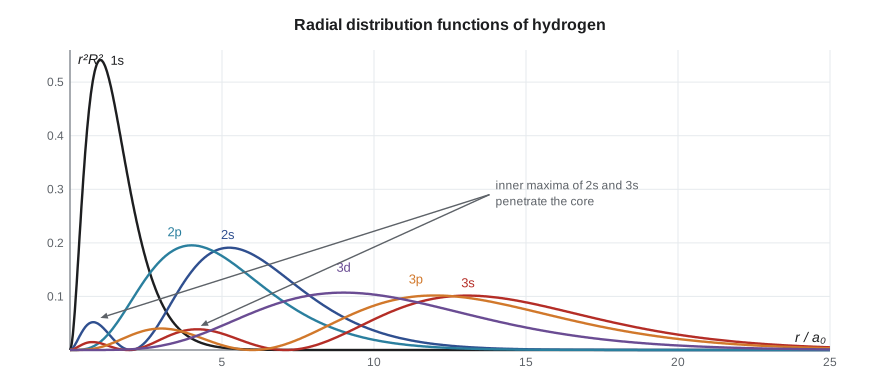
The figure contains the key to the whole periodic table. Look at 2s and 2p. Their main maxima are at similar distances (about 5.2a₀ and 4a₀), but 2s has a small inner maximum close to the nucleus. The same is true for 3s, 3p and 3d: 3s has two inner maxima, 3p one and 3d none. An electron in an orbital with inner maxima spends some of its time very close to the nucleus, inside the region occupied by the core electrons. This is called penetration, and it decreases in the order s > p > d > f for a given n.
Shielding and penetration in many-electron atoms
In a hydrogen atom the 2s and 2p orbitals have the same energy. In a many-electron atom they do not, and the reason is shielding. An outer electron feels the attraction of the nucleus, charge +Z, but it is repelled by all the other electrons. Electrons closer to the nucleus than the outer electron cancel much of the nuclear charge; electrons at the same distance cancel some of it. The net effect can be summarized by an effective nuclear charge,
where σ is the shielding (or screening) constant. Because a penetrating 2s electron spends part of its time inside the 1s core, it is less well shielded than a 2p electron and feels a larger Z_eff. Its energy is therefore lower. Penetration explains why orbitals fill in the order ns < np < nd and why 4s fills before 3d in potassium and calcium: the 4s orbital, despite its larger principal quantum number, penetrates the argon core so well that its energy lies below 3d at the start of period 4.
Slater's rules
In 1930 John Slater proposed simple rules for estimating σ that remain a useful teaching tool. Write the configuration in groups: (1s)(2s, 2p)(3s, 3p)(3d)(4s, 4p)(4d)(4f)(5s, 5p) and so on. For an electron in an s or p group:
1. Electrons in groups to the right contribute nothing.
2. Each other electron in the same group contributes 0.35 (0.30 for 1s).
3. Each electron in the shell n − 1 contributes 0.85.
4. Each electron in shells n − 2 and lower contributes 1.00.
For an electron in a d or f group, rules 1 and 2 apply, but every electron in groups to the left contributes 1.00. The rules are crude, but they capture the main idea: electrons in the same shell shield one another poorly, and inner electrons shield well.
Worked problem
Why potassium loses a 4s electron, not a 3d electron
Use Slater's rules to compare Z_eff for a 4s electron in K ([Ar]4s¹) with that for a hypothetical 3d electron in excited K ([Ar]3d¹).
Show solution
- 4s electron: the 3s and 3p electrons (8 in shell n − 1 = 3) each contribute 0.85, giving 6.80; the 10 electrons in shells 1 and 2 contribute 1.00 each, giving 10.00. σ = 16.80, Z_eff = 19 − 16.80 = 2.20.
- 3d electron: all 18 electrons in the argon core lie in groups to its left and each contributes 1.00. σ = 18.00, Z_eff = 1.00.
- A larger Z_eff means a lower energy, so the 4s orbital is lower than 3d in potassium.
Answer: Z_eff(4s) = 2.20 is greater than Z_eff(3d) = 1.00, so the valence electron of potassium occupies 4s, as observed.
Slater's rules can also estimate orbital sizes. Slater suggested an effective principal quantum number n* (1, 2, 3, 3.7, 4.0 and 4.2 for n = 1 to 6) and an orbital radius proportional to n*²/Z_eff. More accurate shielding constants were later computed by Enrico Clementi and Daniele Raimondi in 1963 from self-consistent field wave functions, and modern calculations give Z_eff for any orbital directly. The code below computes Slater Z_eff values and hydrogenic radial maxima, and compares Slater's estimate of the trend in Z_eff with that of the Clementi–Raimondi values.
import math
# 1. Radial distribution maxima for hydrogen (Z = 1), found numerically.
def R(n, l, r):
    # hydrogen radial functions in units of the Bohr radius
    if (n, l) == (1, 0): return 2 * math.exp(-r)
    if (n, l) == (2, 0): return (1 / math.sqrt(8)) * (2 - r) * math.exp(-r / 2)
    if (n, l) == (2, 1): return (1 / math.sqrt(24)) * r * math.exp(-r / 2)
    if (n, l) == (3, 0): return (2 / math.sqrt(27)) * (1 - 2 * r / 3 + 2 * r * r / 27) * math.exp(-r / 3)
    if (n, l) == (3, 1): return (8 / (27 * math.sqrt(6))) * (1 - r / 6) * r * math.exp(-r / 3)
    if (n, l) == (3, 2): return (4 / (81 * math.sqrt(30))) * r * r * math.exp(-r / 3)

def maxima(n, l):
    rs = [i * 0.001 for i in range(1, 30001)]
    P = [r * r * R(n, l, r) ** 2 for r in rs]
    return [round(rs[i], 2) for i in range(1, len(P) - 1) if P[i] > P[i - 1] and P[i] > P[i + 1]]

for n, l, name in [(1, 0, '1s'), (2, 0, '2s'), (2, 1, '2p'), (3, 0, '3s'), (3, 1, '3p'), (3, 2, '3d')]:
    print(f'{name}: maxima of r^2 R^2 at r/a0 =', maxima(n, l))

# 2. Slater's rules for the outermost s/p electron of a main-group atom.
def slater_sp(groups, target):
    """groups: list of (n, kind, count) in Slater order; kind 'sp', 'd' or 'f'.
    target: index of the group containing the electron."""
    n_t = groups[target][0]
    sigma = 0.0
    for i, (n, kind, c) in enumerate(groups):
        if i > target: continue
        if i == target:
            sigma += (c - 1) * (0.30 if n == 1 else 0.35)
        elif n == n_t - 1:
            sigma += 0.85 * c
        else:
            sigma += 1.00 * c
    return sigma

atoms = {
 'Li': (3, [(1, 'sp', 2), (2, 'sp', 1)]),   'C': (6, [(1, 'sp', 2), (2, 'sp', 4)]),
 'F': (9, [(1, 'sp', 2), (2, 'sp', 7)]),    'Na': (11, [(1, 'sp', 2), (2, 'sp', 8), (3, 'sp', 1)]),
 'Cl': (17, [(1, 'sp', 2), (2, 'sp', 8), (3, 'sp', 7)]),
 'K': (19, [(1, 'sp', 2), (2, 'sp', 8), (3, 'sp', 8), (4, 'sp', 1)]),
 'Ga': (31, [(1, 'sp', 2), (2, 'sp', 8), (3, 'sp', 8), (3, 'd', 10), (4, 'sp', 3)]),
}
clementi = {'Li': 1.28, 'C': 3.14, 'F': 5.10, 'Na': 2.51, 'Cl': 6.12, 'K': 3.50, 'Ga': 6.22}
print()
print('atom  Z  Slater Zeff  Clementi-Raimondi Zeff (valence)')
for sym, (Z, g) in atoms.items():
    zeff = Z - slater_sp(g, len(g) - 1)
print(f'{sym:3} {Z:3} {zeff:8.2f} {clementi[sym]:8.2f}')1s: maxima of r^2 R^2 at r/a0 = [1.0] 2s: maxima of r^2 R^2 at r/a0 = [0.76, 5.24] 2p: maxima of r^2 R^2 at r/a0 = [4.0] 3s: maxima of r^2 R^2 at r/a0 = [0.74, 4.19, 13.07] 3p: maxima of r^2 R^2 at r/a0 = [3.0, 12.0] 3d: maxima of r^2 R^2 at r/a0 = [9.0] atom Z Slater Zeff Clementi-Raimondi Zeff (valence) Li 3 1.30 1.28 C 6 3.25 3.14 F 9 5.20 5.10 Na 11 2.20 2.51 Cl 17 6.10 6.12 K 19 2.20 3.50 Ga 31 5.00 6.22
The numerical maxima reproduce the figure: 1s at 1.00a₀, 2p at 4.00a₀, 3d at 9.00a₀ (generally n²a₀ for the orbital with l = n − 1), and inner maxima for 2s and 3s. Slater's rules capture the main trends: Z_eff rises steeply across a period (Li 1.30 to F 5.20) and drops sharply at the start of a new period (Na 2.20). They underestimate the rise after the transition series: the ten 3d electrons of gallium shield the 4p electron less than Slater's 0.85 per electron implies, so the more accurate Clementi–Raimondi value (6.22) is well above Slater's (5.00). Note in particular the jump from K (3.50 in the accurate set) to Ga (6.22): ten d electrons have been added but shield poorly.
Atomic and ionic radii
An atom has no sharp edge, so radii are defined operationally: the covalent radius is half the distance between two identical atoms joined by a single bond (77 pm for carbon in diamond), the metallic radius is half the distance between neighbouring atoms in a metal, and ionic radii are assigned by dividing the distances between ions in crystals, using a reference value such as 140 pm for O²⁻. The tabulation of Robert Shannon (1976) gives ionic radii for each coordination number and remains the standard.
Radii decrease across a period, because Z_eff increases while the valence electrons stay in the same shell, and increase down a group, because each new period adds a shell. Two irregularities matter in inorganic chemistry. First, gallium (126 pm covalent radius) is almost the same size as aluminium (125 pm) rather than larger, because the ten 3d electrons added between them shield poorly; this is the d-block contraction. Second, the fourteen 4f electrons added across the lanthanides shield very poorly, so the 5d metals after them are almost the same size as the 4d metals above them: hafnium (159 pm metallic) is essentially the same size as zirconium (160 pm), and the two are so similar that they are among the hardest pair of elements to separate. This is the lanthanide contraction.
Cations are smaller than their parent atoms, because removing electrons lowers repulsion and often removes a whole shell: Na is 186 pm (metallic) but Na⁺ is 102 pm. Anions are larger: Cl is 99 pm (covalent) but Cl⁻ is 181 pm. In an isoelectronic series, such as O²⁻, F⁻, Na⁺, Mg²⁺ and Al³⁺ (all with ten electrons), the radius falls steadily as the nuclear charge rises: 140, 133, 102, 72 and 54 pm for six-coordinate ions.
Ionization energy
The first ionization energy, I₁, is the energy needed to remove the most loosely held electron from a gaseous atom. It rises across a period and falls down a group, the reverse of the radius trend. The figure shows I₁ for the first 36 elements. The large peaks are the noble gases and the deep troughs the alkali metals.
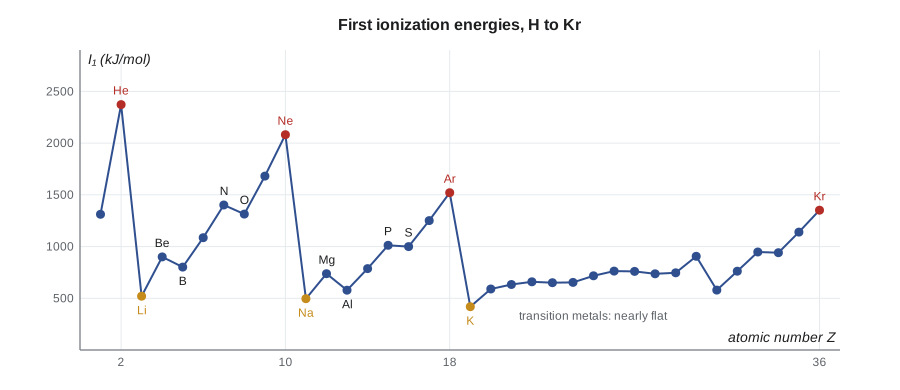
Two small dips in each period reveal the subshell structure. Boron (801 kJ/mol) has a lower I₁ than beryllium (900 kJ/mol), because its electron is removed from a 2p orbital, which penetrates less than 2s and is higher in energy. Oxygen (1314 kJ/mol) has a lower I₁ than nitrogen (1402 kJ/mol), because oxygen's fourth 2p electron must pair with another in the same orbital, and the extra repulsion makes it easier to remove. The same pattern repeats in period 3 (Mg to Al, P to S). Across the transition metals I₁ changes little, because the electron removed is always 4s while the added d electrons shield it fairly well.
Successive ionization energies show the shell structure even more clearly. For magnesium, I₁ = 738, I₂ = 1451 and I₃ = 7733 kJ/mol. The huge jump to I₃ comes from removing an electron from the neon core, which is why magnesium is always +2 in its compounds and never +3. Lattice and hydration energies can pay for I₁ + I₂ of magnesium, as we show in lesson 3, but nothing in ordinary chemistry can pay for I₃.
Electron affinity
The electron affinity is the energy released when a gaseous atom gains an electron. Sign conventions differ between books; here we quote the enthalpy change for X(g) + e⁻ → X⁻(g), which is negative when energy is released. Halogens release the most energy (Cl −349, F −328, Br −325, I −295 kJ/mol), because the added electron completes a p subshell. Fluorine's value is smaller than chlorine's, because the electron enters the small, crowded 2p shell where repulsion is high; oxygen and nitrogen show the same anomaly relative to sulfur and phosphorus. The noble gases, the group 2 metals and nitrogen have electron affinities near zero or positive. Adding a second electron to an anion is always endothermic: O⁻(g) + e⁻ → O²⁻(g) has ΔH ≈ +780 kJ/mol. Oxide ions exist in solids only because the lattice energy repays this cost.
Electronegativity
Electronegativity measures the power of an atom in a molecule to attract electrons to itself. It is not a directly measurable property, and several scales exist. Linus Pauling's scale (1932) is based on bond energies: the extra strength of an A–B bond compared with the average of A–A and B–B is attributed to ionic character and set proportional to (χ_A − χ_B)². Robert Mulliken (1934) defined electronegativity as the average of ionization energy and electron affinity, ½(I + A), the tendency of an atom both to keep its own electrons and to attract others. Allred and Rochow (1958) based their scale on the electrostatic force Z_eff e²/r² at the covalent radius, and Leland Allen (1989) on the average valence-electron energy measured spectroscopically. The scales agree closely when scaled to the same range: fluorine is highest (3.98 on Pauling's scale), followed by oxygen (3.44), chlorine (3.16) and nitrogen (3.04), and cesium and francium are lowest (about 0.8).
| Element | Pauling χ | I₁ (kJ/mol) | EA (kJ/mol) | Mulliken ½(I + A) (eV) |
|---|---|---|---|---|
| F | 3.98 | 1681 | −328 | 10.4 |
| Cl | 3.16 | 1251 | −349 | 8.3 |
| O | 3.44 | 1314 | −141 | 7.5 |
| N | 3.04 | 1402 | ≈ 0 | 7.3 |
| C | 2.55 | 1086 | −122 | 6.3 |
| H | 2.20 | 1312 | −73 | 7.2 |
| Na | 0.93 | 496 | −53 | 2.8 |
Electronegativity differences predict bond polarity and help classify bonds. A large difference, as in NaCl (2.2), suggests a mainly ionic bond; a small difference, as in C–H (0.35), a mainly covalent one. The van Arkel–Ketelaar triangle, which plots the difference against the average electronegativity, separates compounds into ionic, covalent and metallic regions and is a useful map for solid-state chemistry. Electronegativity also depends on hybridization and oxidation state: an sp carbon is more electronegative than an sp³ carbon, and Mn(VII) in MnO₄⁻ behaves as far more electronegative than Mn(II).
Relativistic effects in the heaviest elements
For very heavy atoms such as gold, mercury and lead, the inner electrons move at a substantial fraction of the speed of light (about Z/137 of it for a 1s electron). Their effective mass increases, and the s orbitals (and to a lesser extent p) contract and become more stable, while d and f orbitals expand and are destabilized. These relativistic effects explain several otherwise puzzling facts. The 6s orbital of gold is contracted, so the gap between the 5d and 6s levels is small enough for gold to absorb blue light, which makes it yellow, while silver, with a larger gap, absorbs only in the ultraviolet and looks white. The stabilized 6s² pair of mercury is held so tightly that mercury atoms bond weakly to one another and the metal is a liquid at room temperature. The same effect contributes to the inert-pair effect of thallium, lead and bismuth that we meet in lesson 10.
Common mistakes
MistakeThe 2s and 2p orbitals have the same energy in all atoms.
InsteadThey are degenerate only in one-electron atoms; in many-electron atoms 2s penetrates more and lies lower.
MistakeThe 1s electron is most likely to be found at the nucleus.
InsteadThe wave function peaks there, but the radial distribution r²R² is zero at r = 0 and peaks at a₀/Z.
MistakeSlater's rules give accurate Z_eff values.
InsteadThey are rough estimates; they underestimate Z_eff after the d-block, where d electrons shield poorly.
MistakeIonization energy rises smoothly across a period.
InsteadDips occur where a new subshell starts (B, Al) and where electrons first pair in p orbitals (O, S).
MistakeFluorine has the most negative electron affinity.
InsteadChlorine does; fluorine's small 2p shell adds repulsion.
MistakeGallium should be much larger than aluminium.
InsteadThe d-block contraction makes them almost the same size.
Summary and key terms
- Radial distribution functions r²R² show that s orbitals penetrate the core more than p, d and f orbitals of the same n.
- Penetration and shielding make Z_eff = Z − σ different for each subshell and set the filling order.
- Slater's rules estimate σ; more accurate values come from self-consistent field calculations.
- Radii shrink across a period and grow down a group, with d-block and lanthanide contractions.
- Ionization energies rise across a period with characteristic dips; large jumps between successive values mark shell boundaries.
- Electronegativity scales (Pauling, Mulliken, Allred–Rochow, Allen) agree on trends; fluorine is highest.
- Relativistic effects contract s orbitals in heavy atoms, explaining the colour of gold and liquid mercury.
- Radial distribution function
- The probability r²R² of finding an electron in a thin shell at distance r from the nucleus.
- Penetration
- The ability of an orbital to place electron density close to the nucleus, inside the core.
- Effective nuclear charge
- The net positive charge felt by an electron after shielding by the other electrons.
- Lanthanide contraction
- The unexpectedly small size of the 5d elements caused by poor shielding by 4f electrons.
- Isoelectronic series
- Atoms or ions with the same number of electrons, such as O²⁻, F⁻, Na⁺ and Mg²⁺.
- Electron affinity
- The energy change when a gaseous atom gains an electron.
- Electronegativity
- The power of an atom in a molecule to attract electrons to itself.
Practice problems
Work each problem on paper first, then reveal the answer to check.
How many radial nodes does a 4p orbital have, and how many angular nodes?
Show answer
Radial nodes n − l − 1 = 2; angular nodes l = 1.
Use Slater's rules to find Z_eff for the 2p electron of nitrogen (1s² 2s² 2p³).
Show answer
σ = 4 × 0.35 + 2 × 0.85 = 3.10; Z_eff = 7 − 3.10 = 3.90.
Use Slater's rules to find Z_eff for a 3d electron in Zn (3d¹⁰ 4s²).
Show answer
Same group: 9 × 0.35 = 3.15; all 18 inner electrons count 1.00; σ = 21.15, Z_eff = 30 − 21.15 = 8.85.
Arrange S²⁻, Cl⁻, K⁺, Ca²⁺ in order of decreasing radius.
Show answer
All have 18 electrons; radius falls as Z rises: S²⁻ > Cl⁻ > K⁺ > Ca²⁺.
Sodium has I₁ = 496 and I₂ = 4562 kJ/mol. Explain the size of the jump.
Show answer
The second electron comes from the 2p subshell of the neon core, far closer to the nucleus with a much higher Z_eff.
Calculate the Mulliken electronegativity of bromine (I = 11.81 eV, energy released on electron gain 3.36 eV).
Show answer
½(11.81 + 3.36) = 7.59 eV, between chlorine and iodine.
Lesson quiz · 5 questions
Score 60% or more to complete this lesson.
Create a free account to save your progress, take quizzes and earn a certificate.